
Bhagavad Gita — Vishwarupa Darshana Yoga, Shloka 31
Vishwarupa Darshana Yoga
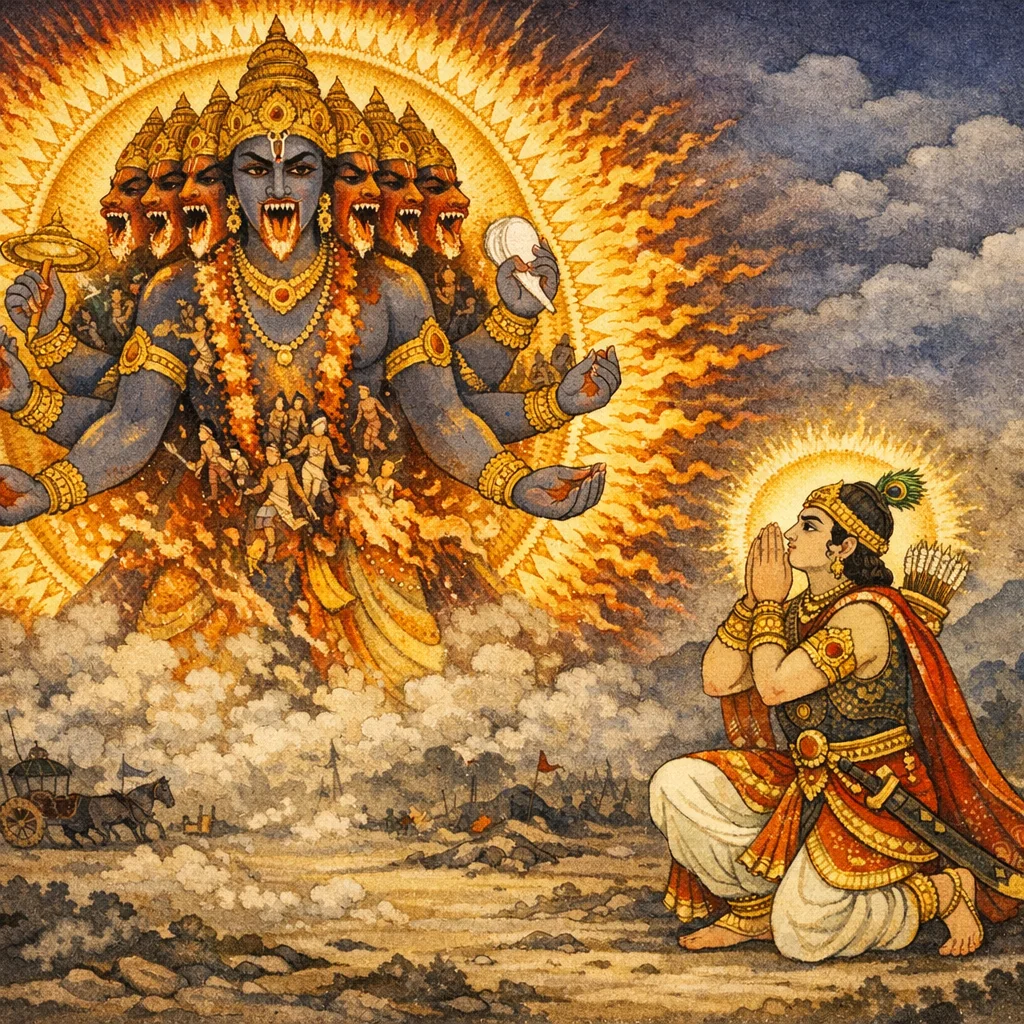
आख्याहि मे को भवानुग्ररूपो नमोऽस्तु ते देववर प्रसीद । विज्ञातुमिच्छामि भवन्तमाद्यं न हि प्रजानामि तव प्रवृत्तिम् ॥
ākhyāhi me ko bhavān ugrarūpo namo ’stu te devavara prasīda | vijñātum icchāmi bhavantam ādyaṁ na hi prajānāmi tava pravṛttim ||

Sage mir: Wer bist Du in dieser furchtbaren Gestalt? Verehrung sei Dir; o Bester der Götter, sei mir gnädig. Ich wünsche Dich, den Uranfänglichen, zu erkennen, denn ich kenne Dein Walten nicht.
मुझे बताइए कि आप उग्ररूप कौन हैं; आपको नमस्कार है, हे देवश्रेष्ठ, प्रसन्न हों। मैं आपको आदि रूप से जानना चाहता हूँ, क्योंकि आपकी प्रवृत्ति (अभिप्राय) मैं नहीं जानता।
Tell me: who are you in this formidable form? Homage to you, O best of gods; be gracious. I wish to know you, the primordial one, for I do not understand your intention/activity.
Pravṛtti can mean 'activity', 'course of action', or 'intention'; devotional translations often stress 'purpose', while literal renderings keep the semantic range open.
FAQs
After an overwhelming perception, Arjuna seeks cognitive framing: asking 'who are you?' is a stabilizing move from raw emotion to understanding.
The verse distinguishes appearance (ugra form) from essence (the 'primordial' reality), prompting reflection on how the absolute can be encountered in multiple modes.
It transitions from description of the vision to dialogue about its meaning, setting up Krishna’s identification with time and cosmic dissolution.
It models a balanced response to intense experiences: reverence and openness paired with critical inquiry about meaning and direction.