
Shloka 47
Sankhya Yoga — Sankhya Yoga
कर्मण्येवाधिकारस्ते मा फलेषु कदाचन । मा कर्मफलहेतुर्भूर्मा ते सङ्गोऽस्त्वकर्मणि ॥ २.४७ ॥
karmaṇy evādhikāras te mā phaleṣu kadācana | mā karma-phala-hetur bhūr mā te saṅgo 'stv akarmaṇi || 2.47 ||

Dein Anspruch gilt allein dem Handeln, niemals seinen Früchten. Sei nicht der Urheber aus Verlangen nach den Früchten der Tat; und hänge nicht am Nicht-Handeln.
Your right is to action alone, never to its fruits. Do not be motivated by the fruits of action, nor let your attachment be to inaction.
Your entitlement is only with respect to action, never at any time with respect to its results. Do not become a cause (agent) for the fruit of action; and do not let there be attachment in you toward non-action.
Most traditions read this as the core formulation of niṣkāma-karma: act without possessiveness toward outcomes. The phrase “mā karma-phala-hetuḥ bhūḥ” is variously glossed as ‘do not act for the sake of results’ or ‘do not identify yourself as the producer/owner of results,’ aligning with broader Indian debates on agency and causality.
FAQs
It promotes focusing on controllable inputs (effort, intention, skill) while reducing rumination over outcomes, which can support resilience and reduce performance anxiety.
It can be read alongside doctrines that limit individual ownership of results: outcomes arise from multiple causes (including nature, time, and other agents), so clinging to sole authorship is philosophically and practically unstable.
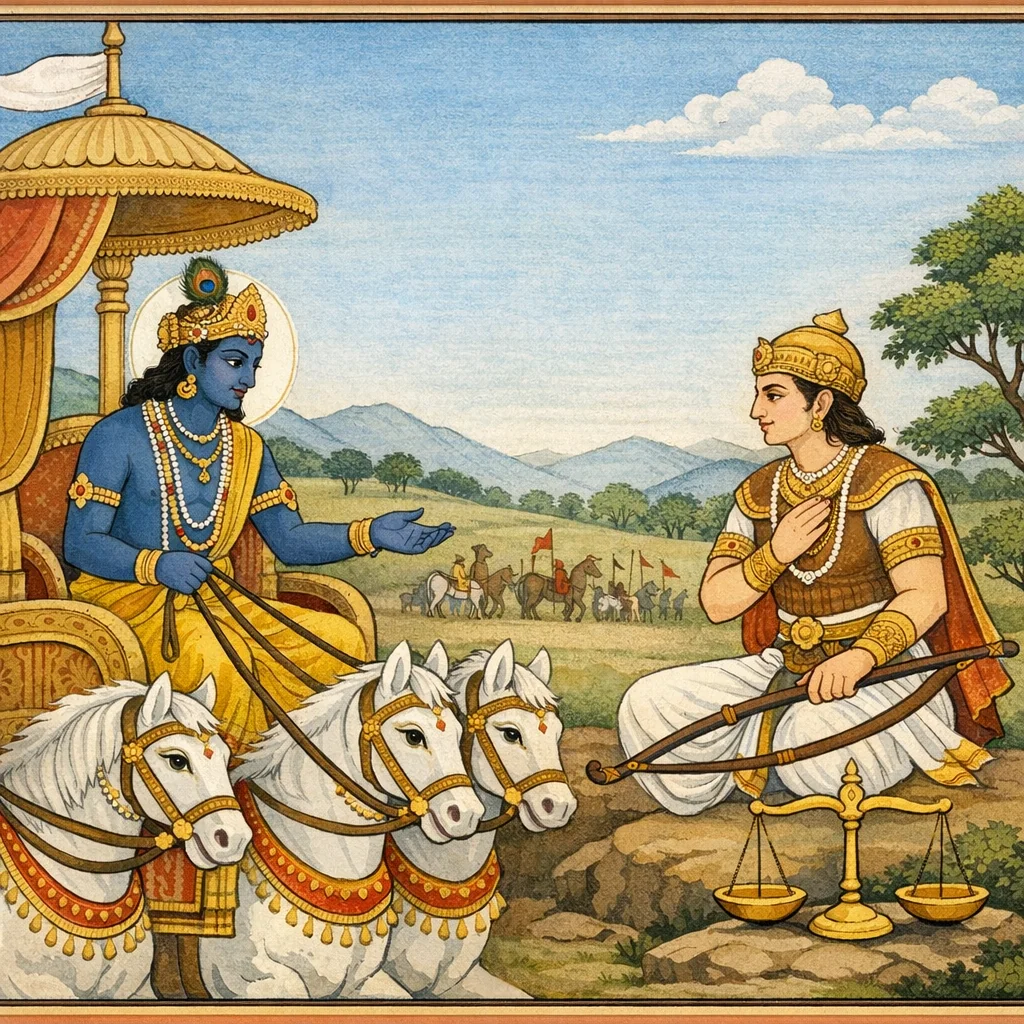
Arjuna’s hesitation is framed as a crisis of action; Krishna replies by redefining action as duty performed with inner freedom rather than as outcome-driven striving.
Commit to ethical work standards and accept uncertainty in results—useful in caregiving, public service, research, and any field where outcomes are not fully controllable.