
Shloka 38
Sankhya Yoga — Sankhya Yoga
सुखदुःखे समे कृत्वा लाभालाभौ जयाजयौ । ततो युद्धाय युज्यस्व नैवं पापमवाप्स्यसि ॥ २.३८ ॥
sukha-duḥkhe same kṛtvā lābhālābhau jayājayau | tato yuddhāya yujyasva naivaṁ pāpam avāpsyasi || 2.38 ||

Gleichgestellt Glück und Leid, Gewinn und Verlust, Sieg und Niederlage, rüste dich dann zum Kampf; so wirst du keine Sünde auf dich laden.
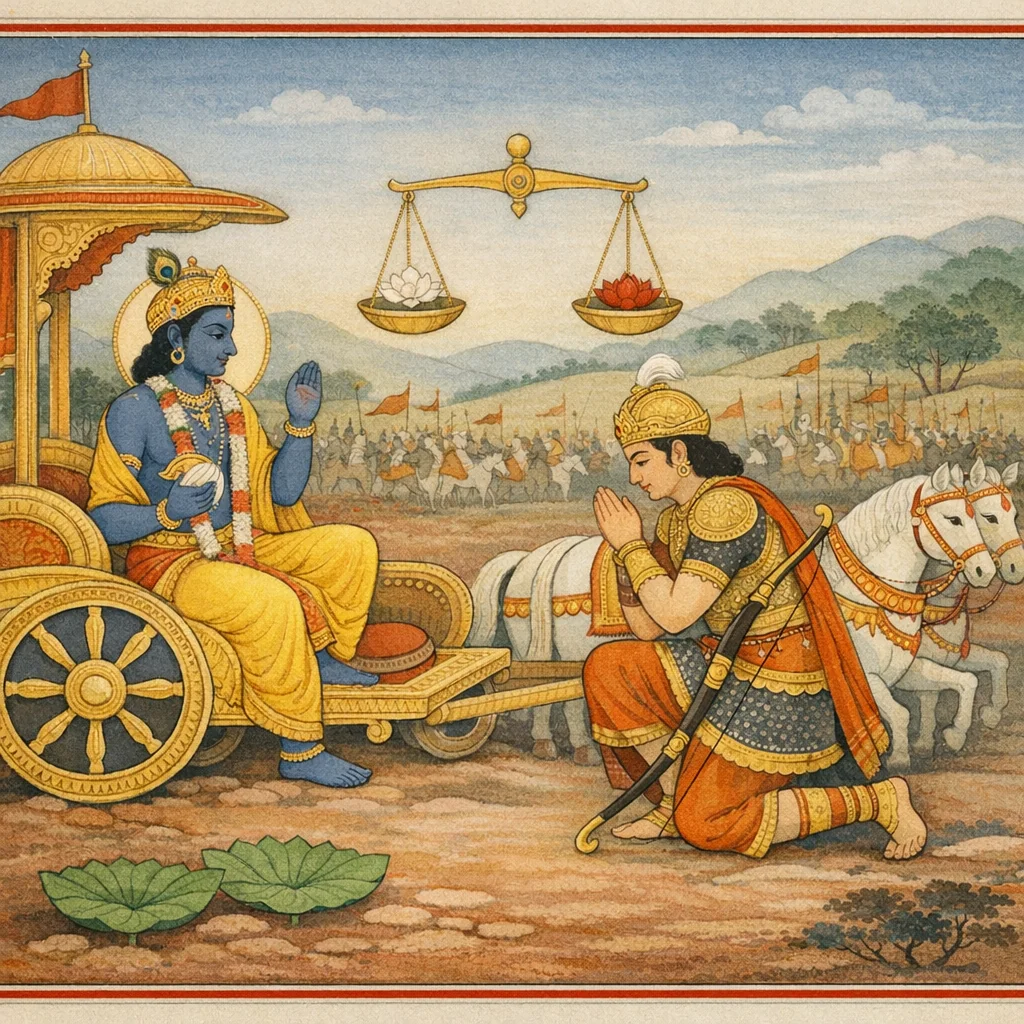
Treating pleasure and pain, gain and loss, victory and defeat alike, engage in battle; thus you shall not incur sin.
Having made pleasure and pain the same, and gain and loss, and victory and defeat, then yoke yourself to the contest; thus you will not obtain demerit.
This is an early formulation of equanimity (samatva) applied to action. pāpa here is best read as moral demerit incurred by acting from attachment/aversion rather than from duty; later verses elaborate this as karma-yoga.
FAQs
It recommends regulating reactivity to opposites (comfort/discomfort, success/failure), a strategy that stabilizes attention and reduces impulsive decision-making.
It implies that ethical quality depends not only on the act but also on the agent’s inner orientation—attachment and aversion bind one to karmic consequences.
Krishna begins shifting from social-ethical persuasion to a yogic discipline: act, but with an even mind toward outcomes.
Useful as a framework for professional and personal resilience: pursue responsibilities with steady effort while holding results more lightly.