
Shloka 24
Sankhya Yoga — Sankhya Yoga
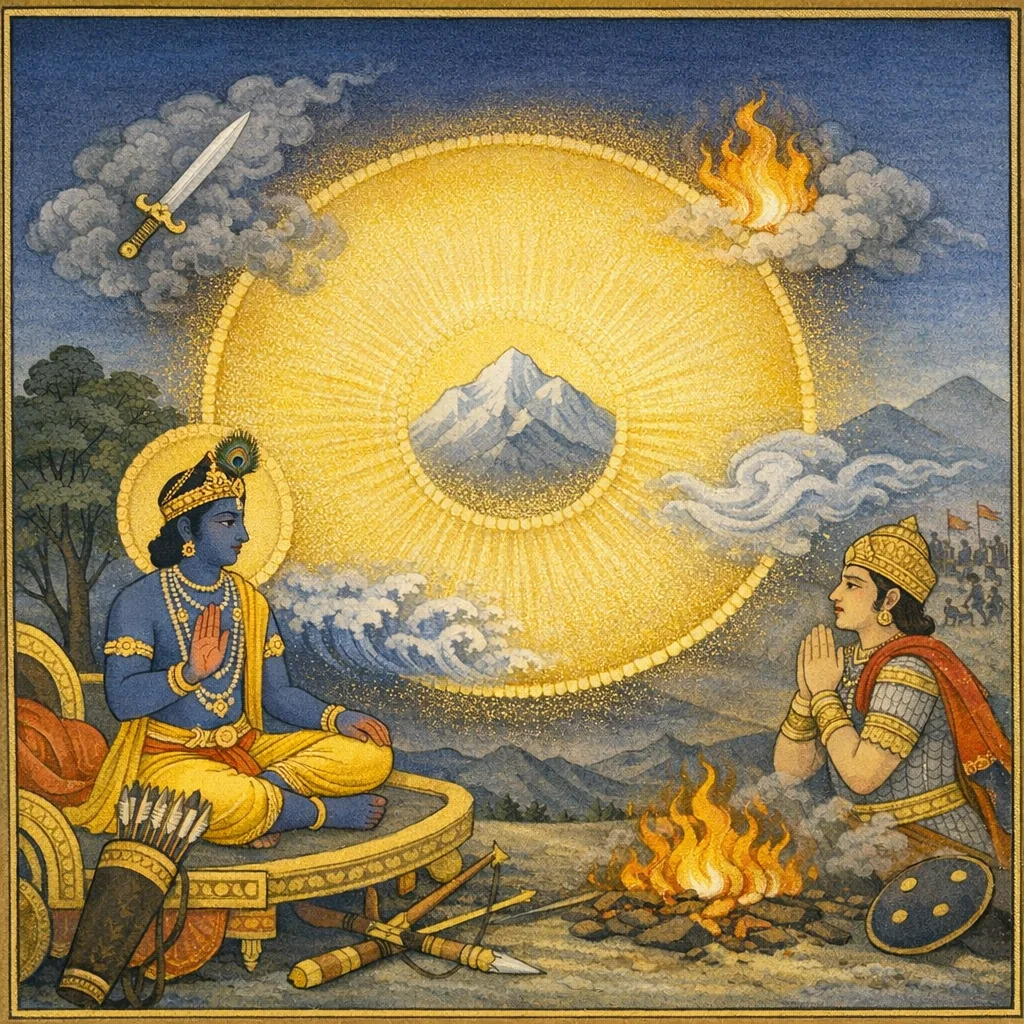
अच्छेद्योऽयमदाह्योऽयमक्लेद्योऽशोष्य एव च । नित्यः सर्वगतः स्थाणुरचलोऽयं सनातनः ॥ २.२४ ॥
acchedyo 'yam adāhyo 'yam akledyo 'śoṣya eva ca | nityaḥ sarva-gataḥ sthāṇur acalo 'yaṃ sanātanaḥ || 2.24 ||

Es ist unzerschneidbar, unverbrännlich, unbenetzbar und auch nicht austrocknend; ewig, allgegenwärtig, fest gegründet, unbeweglich und ur-ewig.
This (Self) cannot be cut, cannot be burned, cannot be wetted, and cannot be dried; it is eternal, all-pervading, stable, immovable, and ancient.
This is uncuttable, unburnable, unwettable, and undryable; eternal, all-pervading, fixed/steadfast, immovable—everlasting.
‘Sthāṇu’ can mean ‘fixed, motionless’ (also ‘pillar’ in other contexts). The sequence summarizes prior negations into a compact ontological profile of permanence and pervasiveness.
FAQs
By emphasizing stability and pervasiveness, it supports a contemplative stance of groundedness amid fluctuating experiences.
The verse consolidates the doctrine of an immutable self that is not subject to physical processes and is present universally.
It concludes a cluster of verses meant to establish the self’s indestructibility before Krishna turns further to ethics and disciplined action.
Can be used in reflective practice to separate enduring awareness from transient moods, sensations, and situational pressures.