
Bhagavad Gita — Raja Vidya Raja Guhya Yoga, Shloka 34
Raja Vidya Raja Guhya Yoga
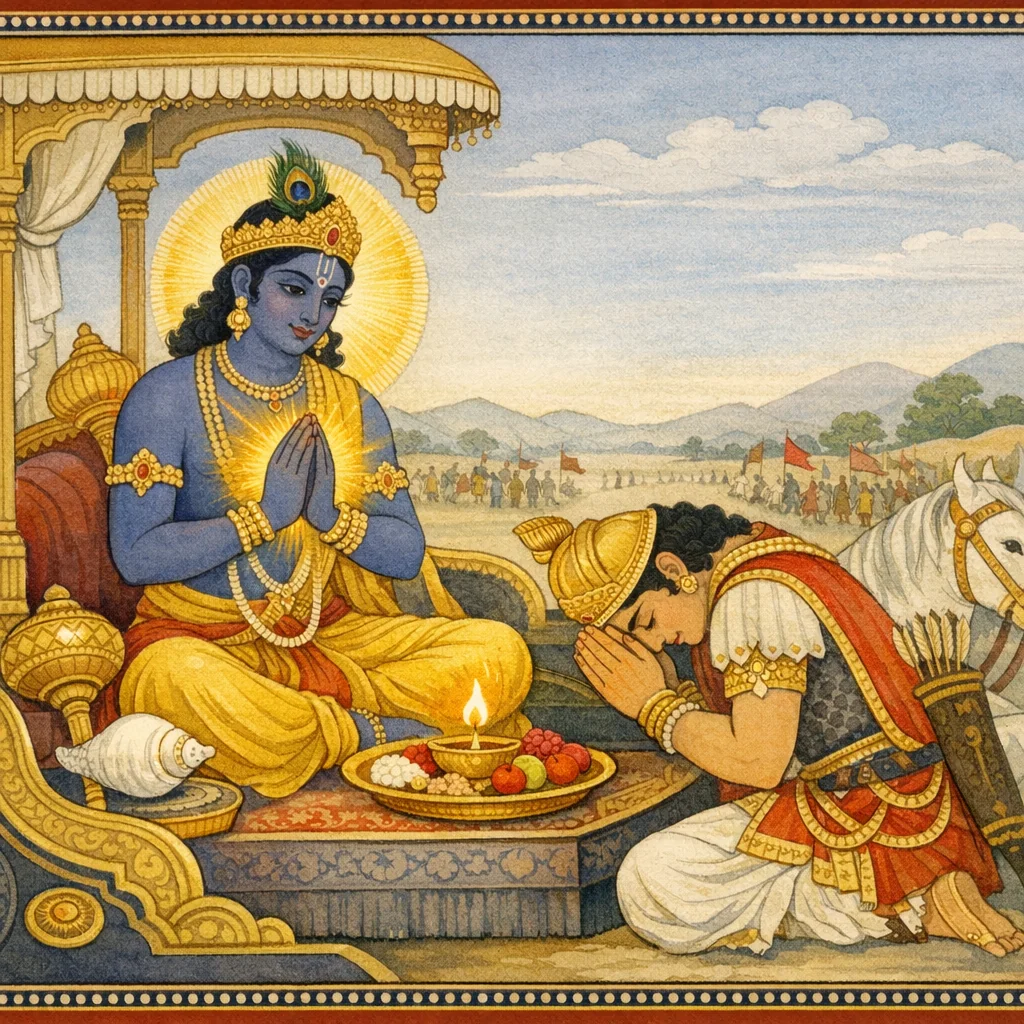
मन्मना भव मद्भक्तो मद्याजी मां नमस्कुरु । मामेवैष्यसि युक्त्वैवमात्मानं मत्परायणः ॥ ९.३४ ॥
man-manā bhava mad-bhakto mad-yājī māṁ namaskuru | mām evaiṣyasi yuktvaivam ātmānaṁ mat-parāyaṇaḥ || 9.34 ||

Richte deinen Geist auf Mich, werde Mein Verehrer, verehre Mich, verneige dich vor Mir. So, indem du dich auf diese Weise mit Mir im Yoga vereinst und Mich als höchstes Ziel und Zuflucht nimmst, wirst du zu Mir allein gelangen.
Fix your mind on Me, be devoted to Me, worship Me, bow to Me; thus uniting yourself with Me and taking Me as the supreme goal, you shall come to Me alone.
Let your mind be on Me; become My devotee; be one who offers worship to Me; pay reverence to Me. Thus, having disciplined yourself in this way and making Me your highest end, you will come to Me.
Translations vary in how they render ‘mad-yājī’ (one who performs worship/sacrificial honoring for Me) and ‘yuktvā ātmanam’ (having yoked/disciplined the self). The verse functions as a compact practical program of bhakti: cognition (mind), affect/commitment (devotion), ritual/act (worship), and embodied humility (reverence).
FAQs
It outlines attentional training: sustained focus (‘mind on Me’) combined with habitual actions (worship, reverence) can stabilize motivation and reduce inner fragmentation.
The promise ‘you will come to Me’ expresses the text’s theistic soteriology: aligning mind and practice with the supreme reality culminates in proximity/union, understood variously across traditions (nearness, participation, or identity in devotion).
As the closing verse of Chapter 9, it serves as a summative injunction, condensing earlier teachings about devotion, grace, and accessibility into a directive formula.
It can be applied as a structured contemplative routine: daily remembrance, ethical devotion expressed as service, intentional rituals (broadly construed), and humility in interpersonal conduct.