
Shloka 10
Purushottama Yoga — Purushottama Yoga
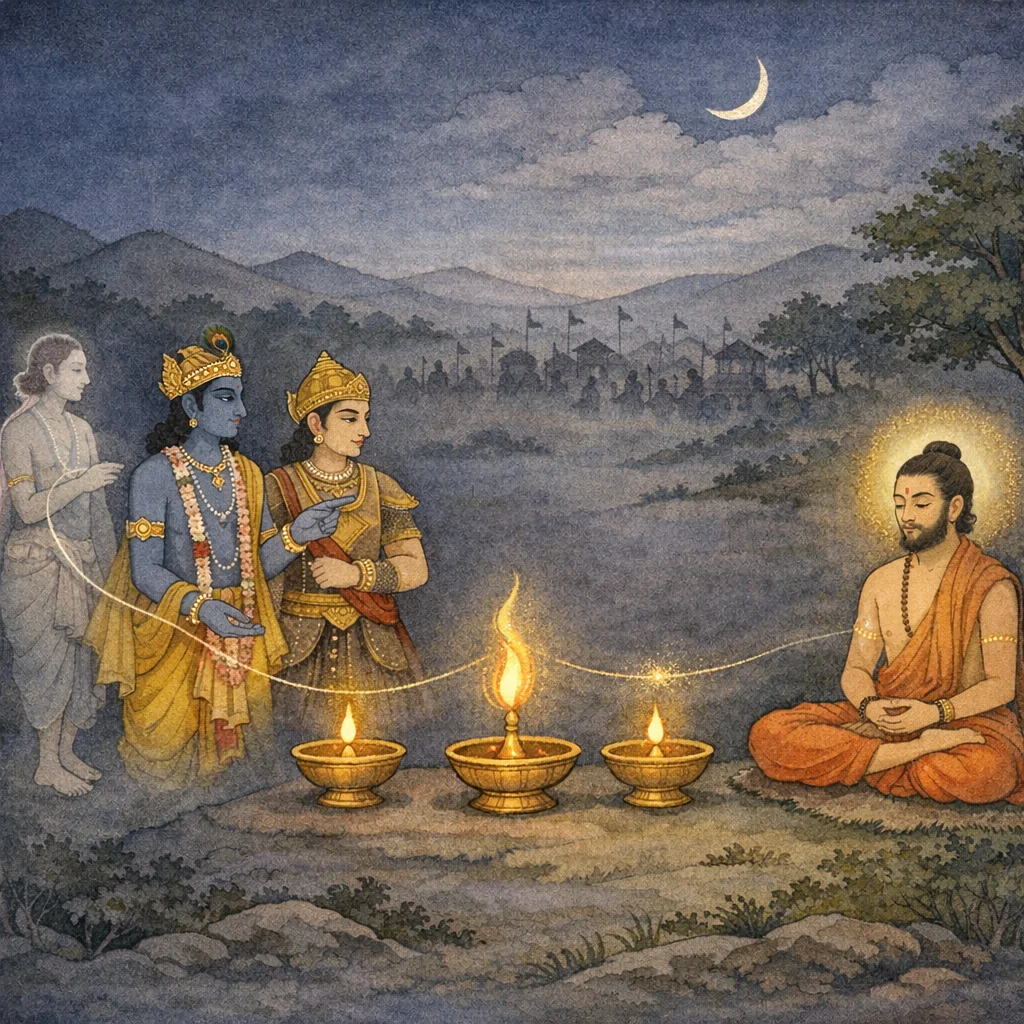
उत्क्रामन्तं स्थितं वापि भुञ्जानं वा गुणान्वितम् ।
विमूढा नानुपश्यन्ति पश्यन्ति ज्ञानचक्षुषः ॥ १५.१० ॥
utkrāmantaṃ sthitaṃ vāpi bhuñjānaṃ vā guṇānvitam |
vimūḍhā nānupaśyanti paśyanti jñānacakṣuṣaḥ || 15.10 ||

Die Verblendeten erkennen sie nicht, weder wenn sie fortgeht noch wenn sie verweilt, noch wenn sie, mit den Gunas verbunden, genießt; doch die mit dem Auge der Erkenntnis sehen sie.
अज्ञानी लोग आत्मा को (शरीर से) निकलते हुए, (शरीर में) स्थित हुए अथवा गुणों के साथ विषयों का भोग करते हुए नहीं देखते; परन्तु ज्ञानरूपी नेत्र वाले ज्ञानी उसे देखते हैं।
The deluded do not discern (the self) as it departs, remains, or experiences (objects) in association with the guṇas; those with the ‘eye of knowledge’ discern it.
Interpretive difference mainly concerns whether ‘bhuñjānam’ is taken as the self ‘enjoying’ or as embodied experience occurring through guṇas; most traditions keep the self as the witnessing principle while experience is mediated by guṇas.
FAQs
The verse contrasts unreflective cognition with trained discernment: without cultivated insight, people miss the distinction between changing experiences and the stable witnessing awareness.
It presents the self as knowable through ‘jñāna-cakṣus’ (insight), while ordinary perception—entangled with guṇas—fails to apprehend the self’s continuity through states like remaining, departing, and experiencing.
Within Chapter 15’s teaching on the Puruṣottama, it supports the claim that the self/principle of consciousness is subtle and requires knowledge to be recognized.
It can be read as guidance to develop reflective awareness (e.g., mindfulness plus philosophical inquiry) to separate identity from transient moods, roles, and sensory pressures.