
Bhagavad Gita — Moksha Sannyasa Yoga, Shloka 56
Moksha Sannyasa Yoga
सर्वकर्माण्यपि सदा कुर्वाणो मद्व्यपाश्रयः । मत्प्रसादादवाप्नोति शाश्वतं पदमव्ययम् ॥ १८.५६ ॥
sarva-karmāṇy api sadā kurvāṇo mad-vyapāśrayaḥ | mat-prasādād avāpnoti śāśvataṁ padam avyayam || 18.56 ||

Auch wenn er stets alle Handlungen vollbringt, erlangt der, der bei Mir Zuflucht nimmt, durch Meine Gnade den ewigen, unvergänglichen Stand.
सदा सब कर्म करते हुए भी जो मेरे आश्रित है, वह मेरी कृपा से अविनाशी शाश्वत पद को प्राप्त होता है।
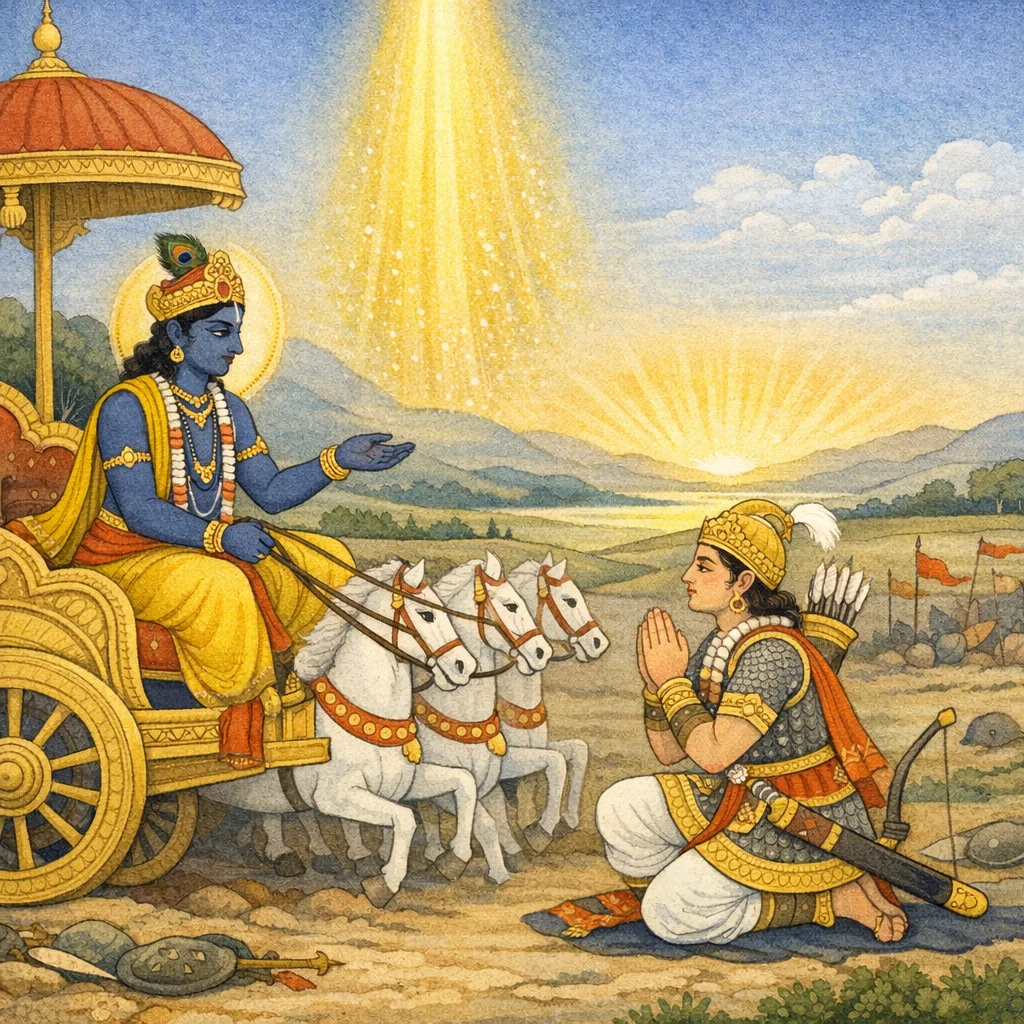
Even while always performing all actions, one who relies on Me attains, by My favor, the eternal, imperishable abode/state.
The verse reconciles continued action with liberation: ‘always doing actions’ does not obstruct attainment when grounded in reliance (vyapāśraya) and divine grace (prasāda). Some interpret ‘pada’ as a theistic abode; others as the imperishable state of liberation.
FAQs
Reliance on a higher principle can reduce performance anxiety and egoic burden, allowing steady action without over-identification with success or failure.
Liberation is portrayed as dependent not only on discipline but also on ‘favor/grace’—a significant theistic element within the Gītā’s synthesis.
It reinforces the chapter’s central reconciliation: renunciation is internal, so one may continue worldly duties while oriented toward the ultimate.
Continue responsibilities while cultivating humility and dedication to something larger than ego—community, truth, or the divine—so work becomes less self-referential.
Read Bhagavad Gita in the Vedapath app
Scan the QR code to open this directly in the app, with audio, word-by-word meanings, and more.