
Bhagavad Gita — Moksha Sannyasa Yoga, Shloka 50
Moksha Sannyasa Yoga
सिद्धिं प्राप्तो यथा ब्रह्म तथाप्नोति निबोध मे । समासेनैव कौन्तेय निष्ठा ज्ञानस्य या परा ॥ १८.५० ॥
siddhiṁ prāpto yathā brahma tathāpnoti nibodha me | samāsenaiva kaunteya niṣṭhā jñānasya yā parā || 18.50 ||

O Sohn der Kuntī, vernimm von Mir in Kürze: wie der Vollendete Brahman erlangt — jene höchste Festigkeit im Wissen.
हे कुन्तीपुत्र! सिद्धि को प्राप्त हुआ पुरुष जिस प्रकार ब्रह्म को प्राप्त होता है, उस ज्ञान की जो परा निष्ठा है, उसे संक्षेप से मुझसे समझ।
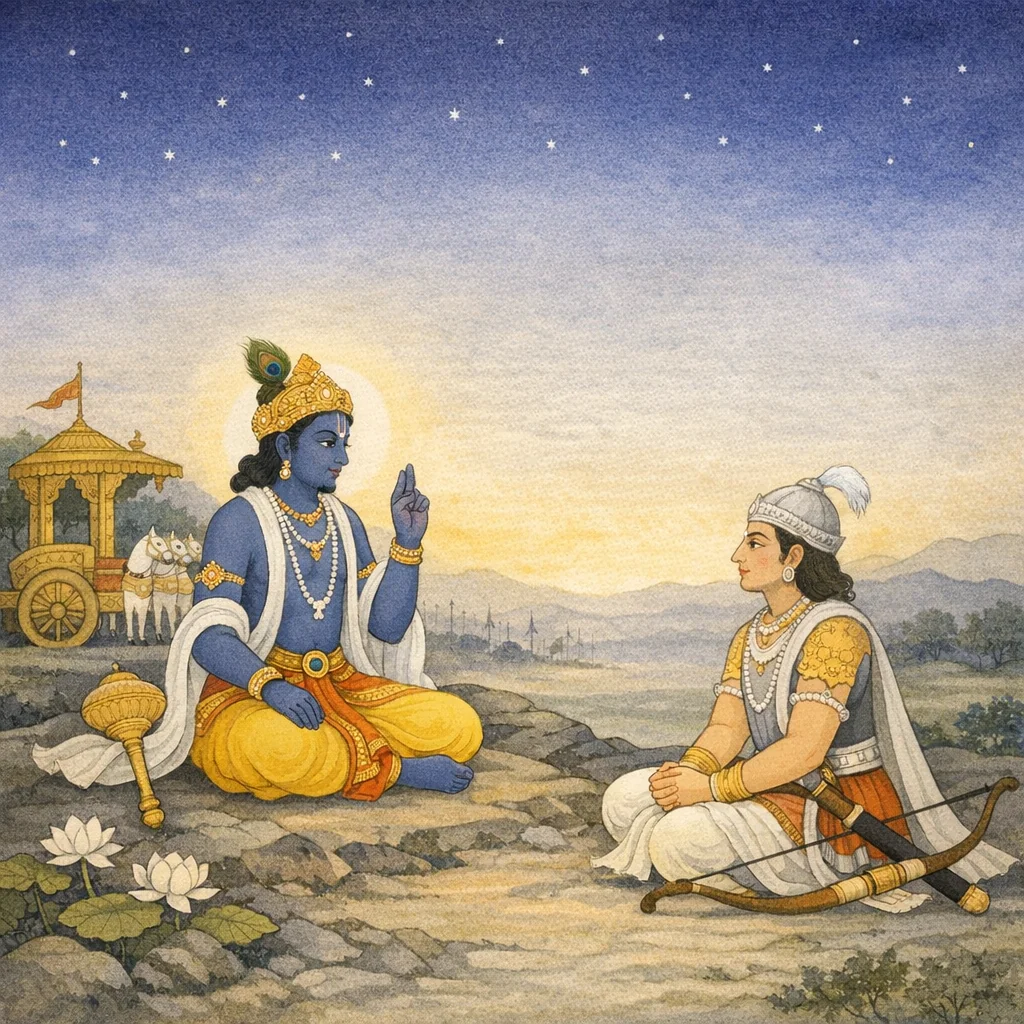
Understand from me, O son of Kuntī, in brief, how one who has attained perfection reaches Brahman—this supreme culmination (niṣṭhā) of knowledge.
‘Brahman’ is variously glossed as impersonal absolute (Advaita-leaning readings) or as the highest reality culminating in devotion (Bhakti and Viśiṣṭādvaita readings). The verse functions programmatically: it introduces the subsequent disciplined practices (18.51–53) as the ‘summary’ route.
FAQs
It frames liberation as a stable orientation (‘niṣṭhā’) rather than a momentary insight, emphasizing sustained integration of understanding into character.
The verse points to Brahman-realization as the endpoint of knowledge—interpretable as identity with the absolute or as highest participation in ultimate reality, depending on school.
This is a bridge: after describing renunciation and non-binding action, Kṛṣṇa outlines the contemplative and ethical disciplines that consolidate knowledge into liberation.
Treat learning not merely as information but as lived practice—habits, attention, and ethical consistency that embody one’s highest understanding.