
Shloka 22
Karma Yoga — Karma Yoga
न मे पार्थास्ति कर्तव्यं त्रिषु लोकेषु किंचन । नानवाप्तमवाप्तव्यं वर्त एव च कर्मणि ॥ ३.२२ ॥
na me pārthāsti kartavyaṁ triṣu lokeṣu kiṁcana | nānavāptam avāptavyaṁ varta eva ca karmaṇi || 3.22 ||

O Pārtha, in den drei Welten gibt es für Mich nichts, was zu tun wäre; auch gibt es nichts Unerlangtes, das Ich noch erlangen müsste; und doch verweile Ich im Handeln.
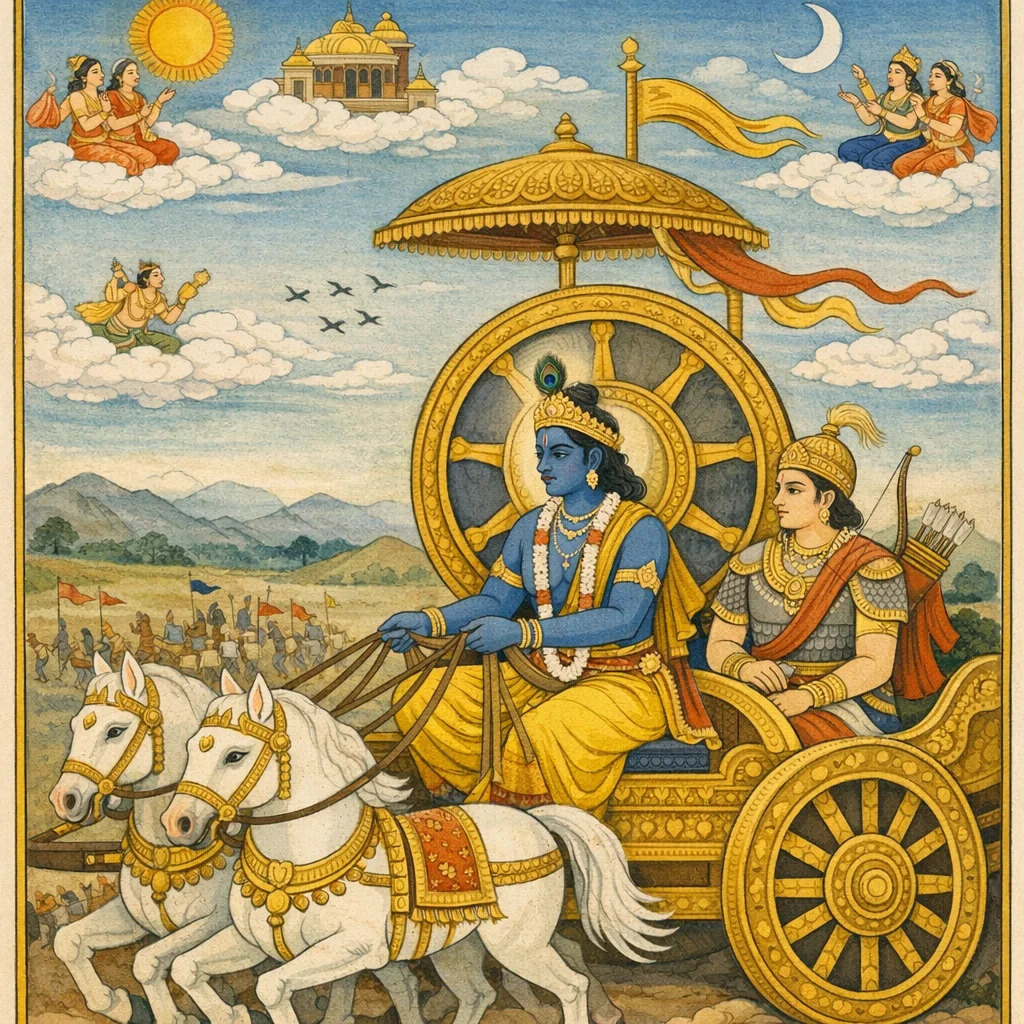
O Pārtha, there is nothing whatsoever for Me to do in the three worlds; nor is there anything unattained that I must attain; yet I engage in action.
For me, O Pārtha, there is no duty at all in the three worlds; nor is there anything not attained that should be attained; yet I remain engaged in action.
Traditional theistic readings take Krishna as the divine teacher: despite completeness, he acts to guide the world. Academic readings emphasize the pedagogical function: the ideal agent acts without need, illustrating nonattached action and social exemplarity.
FAQs
It models ‘non-needy action’: acting from clarity and responsibility rather than from deficiency, ambition, or fear.
In theistic frames, it expresses divine freedom: the supreme is not compelled by karma yet acts for order; in non-theistic readings, it illustrates the ideal of action without personal ends.
Krishna uses himself as the highest example to support the claim that even the most complete agent acts—therefore Arjuna should not justify inaction by appeal to higher insight.
Encourages service-minded professionalism: even when one ‘doesn’t need to,’ one can contribute for the sake of mentoring, stability, and collective benefit.