
Shloka 2
Karma Yoga — Karma Yoga
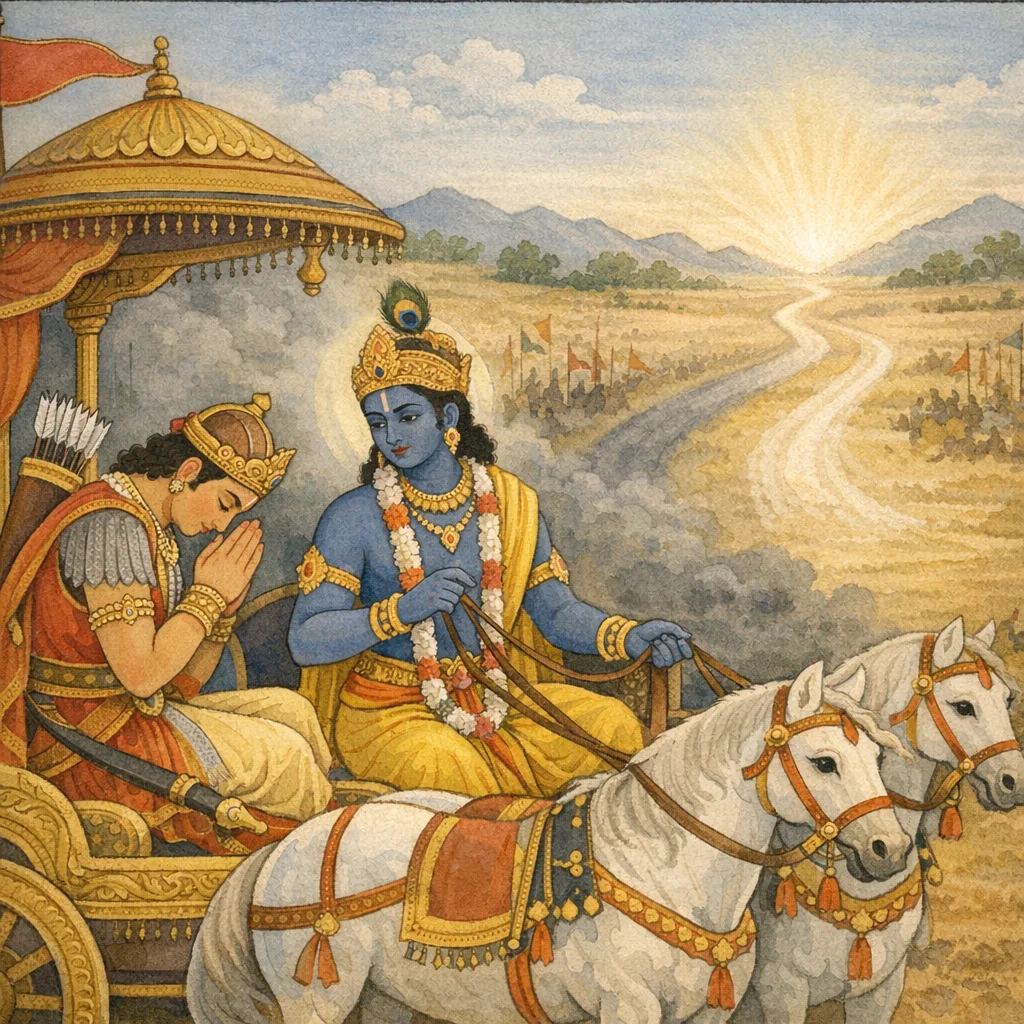
व्यामिश्रेणेव वाक्येन बुद्धिं मोहयसीव मे । तदेकं वद निश्चित्य येन श्रेयोऽहमाप्नुयाम् ॥ ३.२ ॥
vyāmiśreṇeva vākyena buddhiṁ mohayasīva me | tad ekaṁ vada niścitya yena śreyo 'ham āpnuyām || 3.2 ||

Mit Worten, die wie vermischt erscheinen, verwirrst du gleichsam meinen Verstand. Darum sage mir eindeutig den einen Weg, durch den ich das höchste Heil erlangen kann.
With seemingly mixed words, You confuse my understanding. Therefore, tell me decisively the one path by which I may attain the highest good.
By speech as though mixed, you seem to bewilder my understanding. Therefore tell me one (course) decisively, by which I might attain the good (śreyas).
Vyāmiśra (‘mixed/combined’) can indicate perceived inconsistency or a deliberate synthesis. Śreyas is ‘the good/the beneficial,’ often contrasted with preyas (the merely pleasant) in broader Indian ethical vocabulary.
FAQs
It reflects a common learning dynamic: when guidance seems internally complex, the student requests a single actionable principle to reduce uncertainty and paralysis.
The request anticipates the Gītā’s claim that liberation-oriented insight and disciplined action can be harmonized; the ‘one path’ can be understood as a unified orientation rather than a single technique.
This verse motivates Krishna’s forthcoming explanation of karma-yoga and how action can be performed without attachment, resolving the perceived contradiction.
It supports the value of clear decision frameworks: identifying core principles (values, duties, non-attachment to outcomes) that organize complex choices.