
Bhagavad Gita — Gunatraya Vibhaga Yoga, Shloka 19
Gunatraya Vibhaga Yoga
नान्यं गुणेभ्यः कर्तारं यदा द्रष्टानुपश्यति । गुणेभ्यश्च परं वेत्ति मद्भावं सोऽधिगच्छति ॥ १४.१९ ॥
nānyaṃ guṇebhyaḥ kartāraṃ yadā draṣṭānupaśyati | guṇebhyaś ca paraṃ vetti mad-bhāvaṃ so ’dhigacchati || 14.19 ||

Wenn der Schauende erkennt, dass es keinen anderen Handelnden als die Guṇas gibt, und das erkennt, was über die Guṇas hinaus ist, gelangt er zu Meinem Sein (Meiner Wesensnatur).
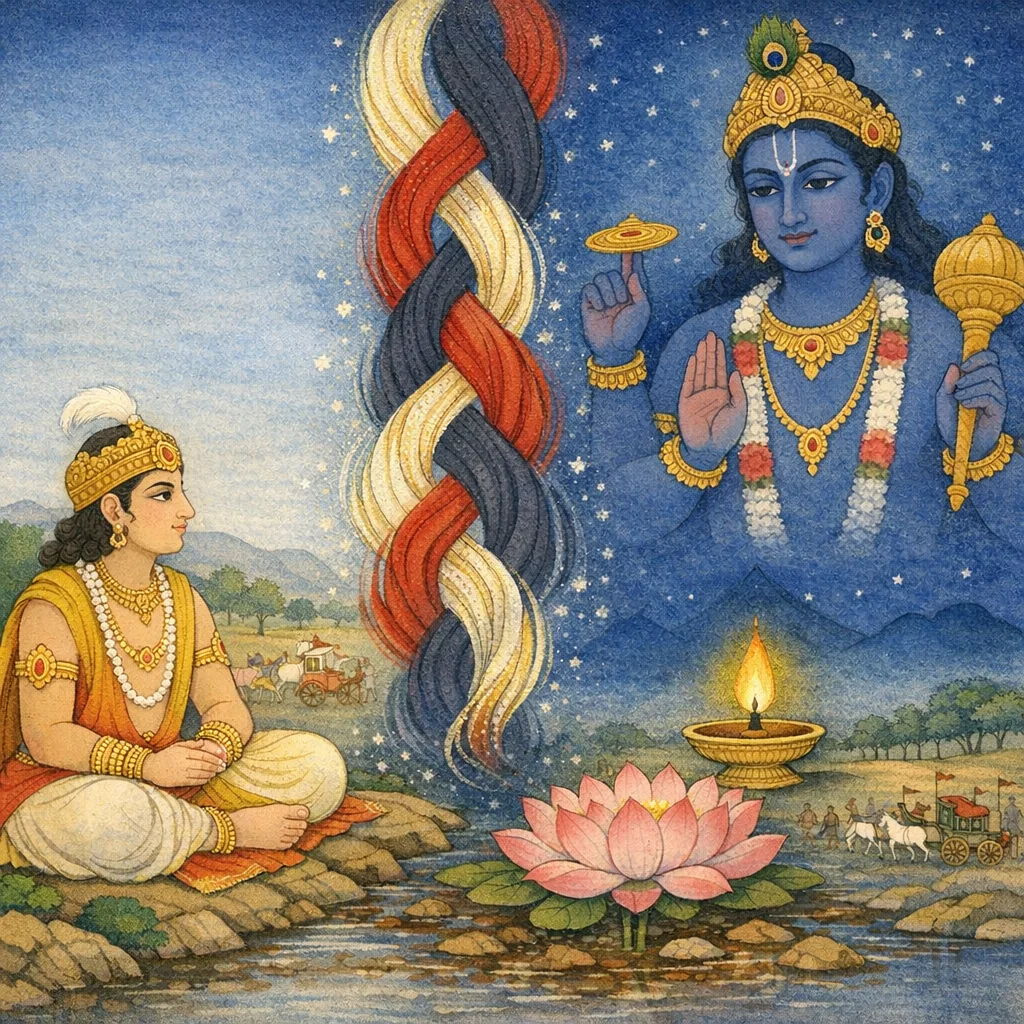
When the seer perceives no doer other than the guṇas, and knows That which is beyond the guṇas, he attains My state/being.
When the observer recognizes no agent other than the guṇas, and knows what is beyond the guṇas, he attains my mode of being (mad-bhāva).
Traditional theistic interpretations take “mad-bhāva” as attaining likeness/union with Krishna (devotional soteriology). Some academic-philosophical readings emphasize a shift in agency attribution—actions belong to prakṛti/guṇas—combined with knowledge of a transcendent principle.
FAQs
It reduces egoic ownership of action by reframing behavior as conditioned by dispositions. This can lessen guilt or pride and support steadier self-observation.
The verse aligns with Sāṃkhya-influenced distinction between prakṛti (guṇas) as operative and a witnessing principle that can know what transcends guṇas. Attaining “mad-bhāva” signals realization of the transcendent ground identified with Krishna.
It marks a turning point: from describing guṇas to indicating the insight by which one ceases to misidentify with them, setting up the subsequent promise of liberation (14.20).
In practice, it encourages observing impulses as conditioned patterns rather than a fixed self. This supports ethical change: one can intervene in conditions (habits, environment) while reducing rigid self-labels.