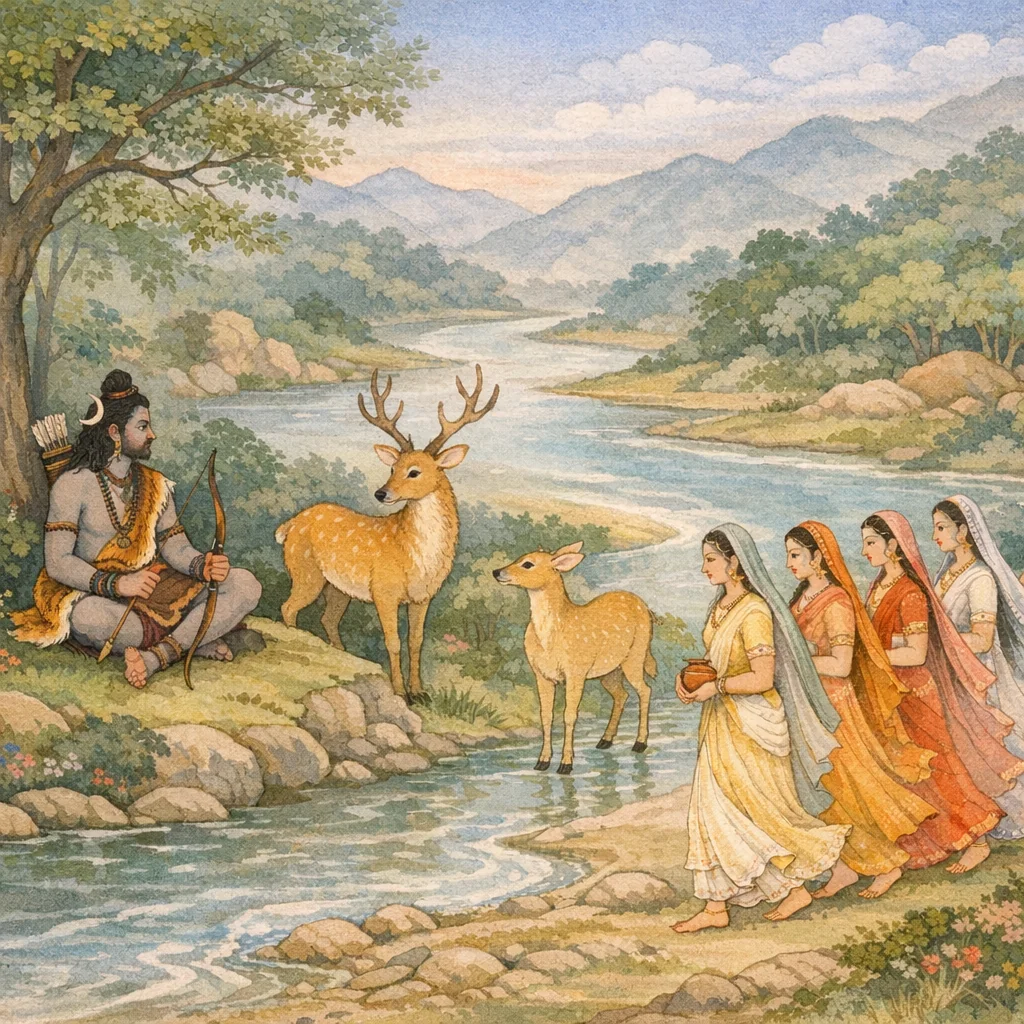
Adhyaya 102: The Five Sacred River-Tirthas: Savitri, Gayatri, Shraddha, Medha, and Sarasvati
অধ্যায় ১০২-এ সাবিত্রী, গায়ত্রী, শ্রদ্ধা, মেধা ও সরস্বতী—এই পাঁচ পবিত্র নদী-তীর্থের মাহাত্ম্য ও উৎপত্তিকথা বর্ণিত। ব্রহ্মা নারদকে বলেন, এগুলি ঋষিদের পরিচিত প্রসিদ্ধ তীর্থ; এখানে স্নান ও জলপান করলে সকল কল্মষ নাশ হয়। তিনি জানান, এরা তাঁর জ্যেষ্ঠ কন্যা এবং ধর্ম-প্রতিষ্ঠার সঙ্গে যুক্ত। পরে লোকসুন্দরী নামে অতিরূপবতী কন্যা পালায়; সে হরিণী হয়, ব্রহ্মা হরিণ; ধর্মরক্ষায় শম্ভু মৃগব্যাধ (শিকারি) রূপ ধারণ করেন। ভীত পাঁচ কন্যা গঙ্গার দিকে গমন করে; ব্রহ্মা অনুচিত ভাব ত্যাগ করে কন্যাটিকে বিবস্বানকে প্রদান করেন। শেষে পাঁচ নদীর সঙ্গম তীর্থরূপে পবিত্র হয়; সেখানে স্নান-দান করলে ভোগ, স্বর্গ ও মোক্ষ লাভ হয়, এবং মৃগব্যাধ-তীর্থ ও ব্রহ্ম-তীর্থের বিশেষ ফলও কথিত।
Chapter Arc
{"opening_hook":"Brahmā, in dialogue with Nārada, abruptly elevates five named river-tīrthas—Sāvitrī, Gāyatrī, Śraddhā, Medhā, Sarasvatī—as “well-known to munis,” whose mere snāna and pāna erase kalmaṣa; the reader is drawn in by the promise of immediate ritual efficacy tied to specific sacred waters.","rising_action":"The tīrtha-listing turns into an etiological genealogy: the five rivers are disclosed as Brahmā’s elder daughters and as instruments of dharmasaṃsthāna. Tension rises when a uniquely beautiful lokasundarī maiden appears and flees, triggering a chain of metamorphoses and moral peril.","climax_moment":"At the narrative peak, the transgressive pursuit is arrested through cosmic role-reversal: the maiden becomes a doe, Brahmā a stag, and Śambhu assumes the form/function of a hunter (mṛgavyādha) to protect dharma—transforming a potentially scandalous episode into a dharma-restorative charter for a new tīrtha (Mṛgavyādha-tīrtha).","resolution":"Fearful, the five daughters/rivers move toward the Gaṅgā, and the story resolves with Brahmā’s withdrawal from the improper act and the gifting of the maiden to Vivasvat. The chapter closes by re-grounding the myth in sacred geography: the five rivers are sanctified as confluential tīrthas whose snāna and dāna yield sarvakāmaprāpti, svarga, and mokṣa, with special fruits for Mṛgavyādha-tīrtha and Brahma-tīrtha.","key_verse":"null"}
Thematic Essence
{"primary_theme":"Tīrtha-māhātmya of five sacred rivers as dharma-bearing daughters of Brahmā","secondary_themes":["Etiological myth: transformation (doe/stag) as a charter for Mṛgavyādha-tīrtha","Dharma-restoration through divine intervention (Śambhu as protector)","Confluence theology: Gaṅgā as purifier and integrator of subsidiary sacred streams","Ritual efficacy: snāna and dāna as instruments for kāma, svarga, and mokṣa"],"brahma_purana_doctrine":"Sacred geography is validated by creator-authority: Brahmā’s own progeny become rivers, so tīrtha is not merely a place but a dharma-function—waters that cleanse kalmaṣa because they embody śraddhā (faith), medhā (intelligence), and vāk (Sarasvatī).","adi_purana_significance":"As “Adi Purāṇa,” it models how primordial order is mapped onto the earth: cosmic genealogy (Brahmā’s daughters) becomes a pilgrim’s itinerary, making liberation accessible through sanctioned places and rites."}
Emotional Journey
{"opening_rasa":"शान्त (śānta)","climax_rasa":"भयानक (bhayānaka)","closing_rasa":"शान्त (śānta)","rasa_transitions":["śānta → अद्भुत (adbhuta) → शृङ्गार (śṛṅgāra) → भयानक (bhayānaka) → शान्त (śānta)"],"devotional_peaks":["The proclamation that snāna and pāna in the five rivers destroy kalmaṣa","The re-sanctification of the episode through Śambhu’s dharma-protecting intervention, converting fear into a tīrtha-boon","The concluding assurance that dāna and snāna at these confluences grant svarga and mokṣa (especially at Brahma-tīrtha)"]}
Tirtha Focus
{"tirthas_covered":["सावित्री-तीर्थ (Sāvitrī)","गायत्री-तीर्थ (Gāyatrī)","श्रद्धा-तीर्थ (Śraddhā)","मेधा-तीर्थ (Medhā)","सरस्वती-तीर्थ (Sarasvatī)","गङ्गा-संगम/गङ्गा (Gaṅgā and confluence setting)","मृगव्याध-तीर्थ (Mṛgavyādha-tīrtha)","ब्रह्म-तीर्थ (Brahma-tīrtha)"],"jagannath_content":null,"surya_content":"Vivasvat (the Sun) receives the maiden, subtly aligning the resolution with solar ṛta/order; no extended Sūrya-stuti is foregrounded in this chapter’s summary.","cosmology_content":"Cosmology appears in applied form: Brahmā’s progeny become rivers, showing creation as the sacralization of landscape; no full sarga/pralaya sequence is central here."}
Shlokas in Adhyaya 102
Verse 1
ब्रह्मोवाच सावित्री चैव गायत्री श्रद्धा मेधा सरस्वती एतानि पञ्च तीर्थानि पुण्यानि मुनयो विदुः //
প্রথম শ্লোক—এখানে পবিত্র পুরাণবচনের প্রবাহ আরম্ভ হয়।
Verse 2
तत्र स्नात्वा तु पीत्वा तु मुच्यते सर्वकल्मषात् सावित्री चैव गायत्री श्रद्धा मेधा सरस्वती //
দ্বিতীয় শ্লোক—ধর্মার্থে কথিত এই জ্ঞান শ্রোতাদের মঙ্গলসাধক হোক।
Verse 3
एता मम सुता ज्येष्ठा धर्मसंस्थानहेतवः सर्वासाम् उत्तमां कांचिन् निर्ममे लोकसुन्दरीम् //
তৃতীয় শ্লোক—শ্রদ্ধায় শ্রবণ করে মানুষ যেন মনে ধারণ করে।
Verse 4
तां दृष्ट्वा विकृता बुद्धिर् ममासीन् मुनिसत्तम गृह्यमाणा मया बाला सा मां दृष्ट्वा पलायिता //
চতুর্থ শ্লোক—এই পুরাণ পুণ্যদায়ক ও পাপক্ষয়কারী বলে স্মৃত।
Verse 5
मृगीभूता तु सा बाला मृगो ऽहम् अभवं तदा मृगव्याधो ऽभवच् छंभुर् धर्मसंरक्षणाय च //
পঞ্চম শ্লোক—যে পাঠ করে বা শোনে, সে মোক্ষপথে প্রবৃত্ত হয়।
Verse 6
ता मद्भीताः पञ्च सुता गङ्गाम् ईयुर् महानदीम् ततो महेश्वरः प्रायाद् धर्मसंरक्षणाय सः //
ষষ্ঠ শ্লোক—এখানে পবিত্র পুরাণবচন ধর্মপ্রবর্তনের উদ্দেশ্যে উচ্চারিত।
Verse 7
धनुर् गृहीत्वा सशरम् ईशो ऽपि मृगरूपिणम् माम् उवाच वधिष्ये त्वां मृगव्याधस् तदा हरः //
সপ্তম শ্লোক—শ্রবণে মন শুদ্ধ হয় এবং মানুষের জ্ঞান বৃদ্ধি পায়।
Verse 8
तत्कर्मणो निवृत्तो ऽहं प्रादां कन्यां विवस्वते सावित्र्याद्याः पञ्च सुता नदीरूपेण संगताः //
অষ্টম শ্লোক—ধর্মই সকলের মূল; অতএব তাকে কখনও ত্যাগ করা উচিত নয়।
Verse 9
ता आगताः पुनश् चापि स्वर्गं लोकं ममान्तिकम् यत्र ताः संगता देव्या पञ्च तीर्थानि नारद //
নবম শ্লোক—সৎকর্মে যশ লাভ হয়, আর পাপে কেবল দুঃখই আসে।
Verse 10
संगतानि च पुण्यानि पञ्च नद्यः सरस्वती तेषु स्नानं तथा दानं यत् किंचित् कुरुते नरः //
দশম শ্লোক—এইভাবে পুরাণশ্রবণে ভক্তি সর্বদা স্থির হয়।
Verse 11
सर्वकामप्रदं तत् स्यान् नैष्कर्म्यान् मुक्तिदं स्मृतम् तत्राभवन् मृगव्याधं तीर्थं सर्वार्थदं नृणाम् स्वर्गमोक्षफलं चान्यद् ब्रह्मतीर्थफलं स्मृतम् //
একাদশ শ্লোক—এখানে মূল শ্লোকটি দেওয়া নেই; তাই যথার্থ অনুবাদ করা সম্ভব নয়।
Frequently Asked Questions
The chapter centers on tīrtha-māhātmya framed by dharma-restoration: sacred waters remove kalmaṣa through snāna and pāna, while the mythic episode of transformation and Śambhu’s intervention functions as an etiological justification for ethical restraint and the re-establishment of dharma.
It emphasizes the five river-tīrthas Savitrī, Gāyatrī, Śraddhā, Medhā, and Sarasvatī, especially at their confluence context with the Gaṅgā, stating that bathing and giving gifts there yield sarvakāmaprada results, svarga-phala, and mokṣa; it also names Mṛgavyādha-tīrtha as sarvārthada and notes Brahma-tīrtha as associated with svarga–mokṣa fruit.
Brahmā identifies the five as his elder daughters who become integrated in river-form; after a disruptive pursuit episode resolved by Śambhu’s dharma-protective role and Brahmā’s renunciation of the act, the daughters proceed to the Gaṅgā and are subsequently described as reunited and sanctified as five punyāḥ nadyaḥ and tīrthas.