
Shloka 45
Vishwarupa Darshana Yoga — Vishwarupa Darshana Yoga
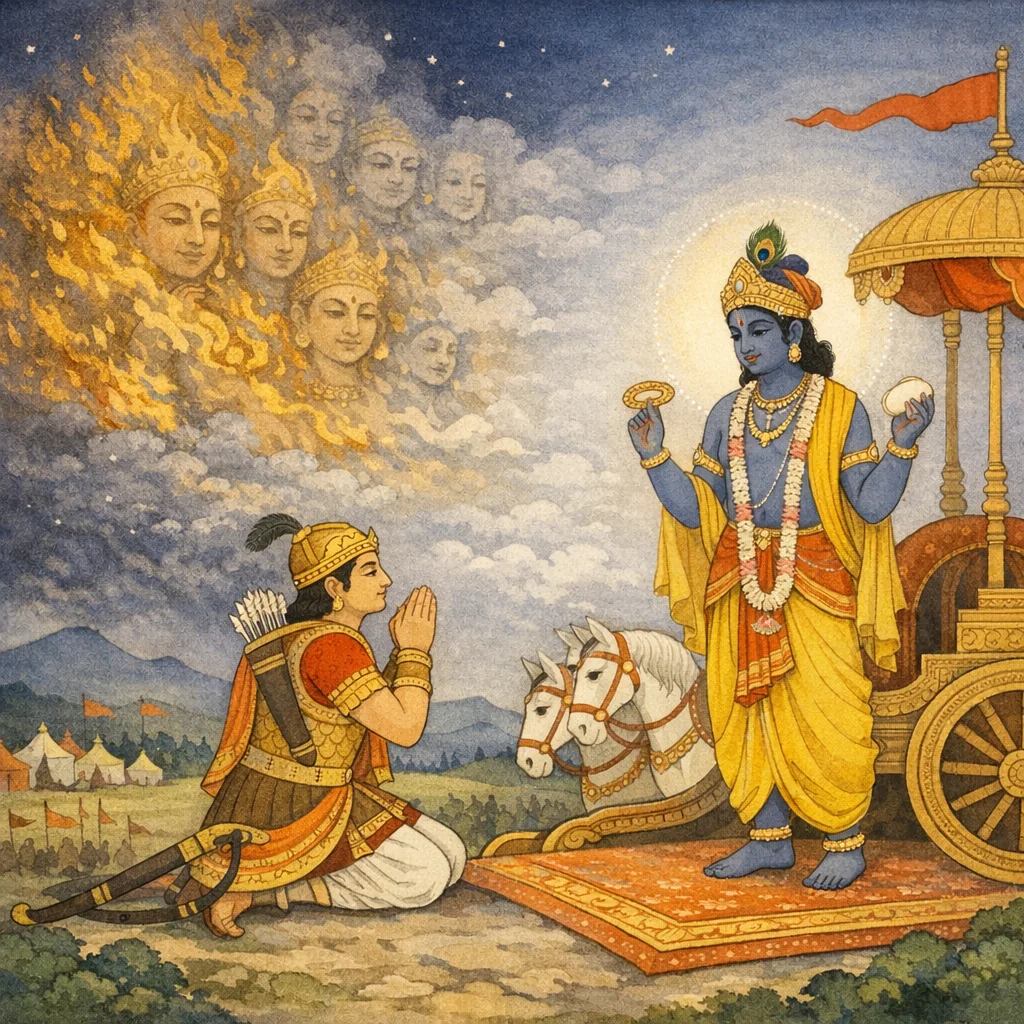
अदृष्टपूर्वं हृषितोऽस्मि दृष्ट्वा भयेन च प्रव्यथितं मनो मे । तदेव मे दर्शय देव रूपं प्रसीद देवेश ...
adṛṣṭapūrvaṃ hṛṣito ’smi dṛṣṭvā bhayena ca pravyathitaṃ mano me | tad eva me darśaya deva rūpaṃ prasīda deveśa ...

পূর্বে কখনও না-দেখা এই (বিশ্বরূপ) দেখে আমি হর্ষিত; কিন্তু ভয়ে আমার মন অত্যন্ত ব্যাকুল ও কাঁপছে। অতএব, হে দেব, হে দেবেশ! প্রসন্ন হয়ে আমাকে সেই (পূর্ববৎ) আপনার সৌম্য রূপই দর্শন করান…
हे देव! पहले कभी न देखे हुए इस (विश्व-रूप) को देखकर मैं हर्षित हूँ, पर भय से मेरा मन अत्यन्त व्याकुल भी हो गया है। इसलिए, हे देवेश! प्रसन्न होकर मुझे वही (पूर्ववत) अपना सौम्य रूप दिखाइए।
Having seen what was never seen before, I am delighted; yet my mind is also shaken by fear. Therefore show me that very form of yours, O god; be gracious, O Lord of gods.
पाठ-परम्पराओं में मुख्य भाव स्थिर है: अर्जुन का ‘आनन्द + भय’ का द्वंद्व और ‘पूर्ववत’ रूप देखने की प्रार्थना। कुछ संस्करणों में आगे के पद (जैसे ‘चतुर्भुज’/‘सौम्य’) अगले श्लोकों (11.46–11.49) में स्पष्ट होते हैं; यहाँ ‘तदेव… देव रूपम्’ का संकेत उसी परिचित, आश्वस्त करने वाले रूप की ओर है।
FAQs
The verse presents a nuanced inner state: wonder and elation coexist with anxiety. It can be read as a classic response to an overwhelming experience—when perception exceeds one’s capacity to assimilate it, the mind oscillates between attraction and destabilization, prompting a request for a more manageable object of attention.
Philosophically, the ‘unseen-before’ vision gestures toward the immeasurable scope of the divine or ultimate reality, while the request for the familiar form indicates that finite cognition often requires mediated, graspable representations. The verse thus balances transcendence (the cosmic form) with immanence (a personal, approachable manifestation).
Within Chapter 11, Arjuna has been granted a revelatory vision of Krishna’s universal form. This verse marks a turning point: after the initial astonishment, Arjuna articulates the human need for reassurance and asks Krishna to return to the earlier, comforting mode of appearance.
It can inform contemporary reflections on intense experiences—spiritual, aesthetic, or existential—suggesting that seeking grounding and clarity is legitimate. The verse also supports a practical ethic of ‘right-sized’ engagement: when overwhelmed, one may return to stable practices, familiar symbols, or supportive frameworks to integrate insight without distress.