
Shloka 24
Vishwarupa Darshana Yoga — Vishwarupa Darshana Yoga
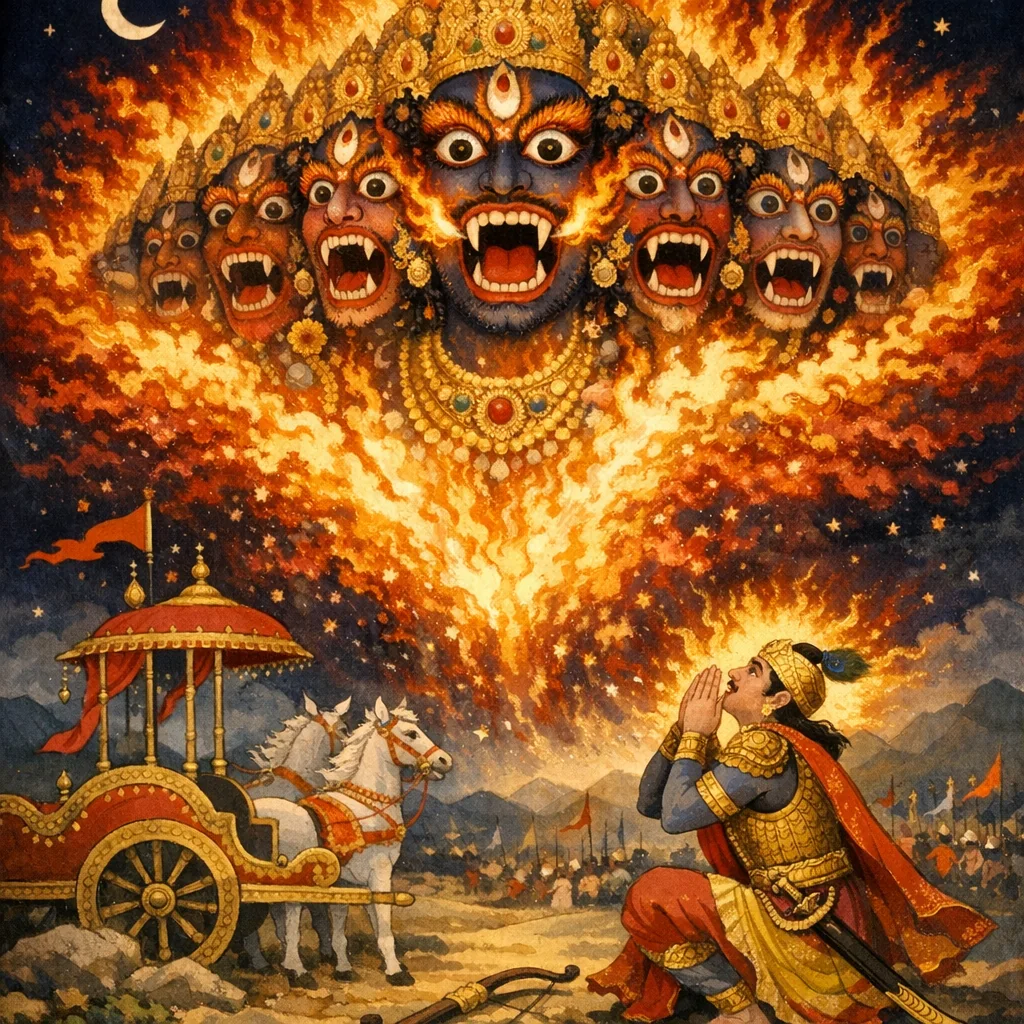
नभःस्पृशं दीप्तमनेकवर्णं व्यात्ताननं दीप्तविशालनेत्रम् । दृष्ट्वा हि त्वां प्रव्यथितान्तरात्मा धृतिं न विन्दामि शमं च विष्णो ॥
nabhaḥspṛśaṃ dīptam aneka-varṇaṃ vyāttānanaṃ dīpta-viśāla-netram | dṛṣṭvā hi tvāṃ pravyathitāntarātmā dhṛtiṃ na vindāmi śamaṃ ca viṣṇo ||

হে বিষ্ণু, আকাশস্পর্শী, দীপ্তিমান ও বহুবর্ণ, উন্মুক্ত মুখ এবং জ্বলন্ত বিশাল নয়নযুক্ত তোমাকে দেখে আমার অন্তরাত্মা কেঁপে ওঠে; আমি না স্থৈর্য পাই, না শান্তি।
Seeing You touching the sky, radiant and multicolored, with open mouth and blazing wide eyes—my inner self shaken—I find neither steadiness nor peace, O Viṣṇu.
Having seen you—sky-reaching, luminous, many-hued, with gaping mouth and shining, vast eyes—my inward self disturbed, I do not find composure or calm, O Viṣṇu.
The address ‘Viṣṇu’ is significant for identifying the vision with a pan-Indian divine idiom. dhṛti (steadfastness) and śama (calm) are technical-ethical terms in Indian philosophy, here presented as temporarily disrupted by the sublime.
FAQs
The verse is a candid report of dysregulation under awe: even a disciplined person may temporarily lose calm when confronted with overwhelming meaning.
The cosmic form is not merely an object of sight but a transformative disclosure that reorders the subject’s inner world, indicating that knowledge can be existential, not only conceptual.
It transitions from description to confession, setting up Arjuna’s request for grace and a more approachable manifestation.
It supports a balanced spirituality: profound experiences may require integration practices (reflection, ethical grounding) to restore steadiness and calm.