
Bhagavad Gita — Arjuna Vishada Yoga, Shloka 26
Arjuna Vishada Yoga
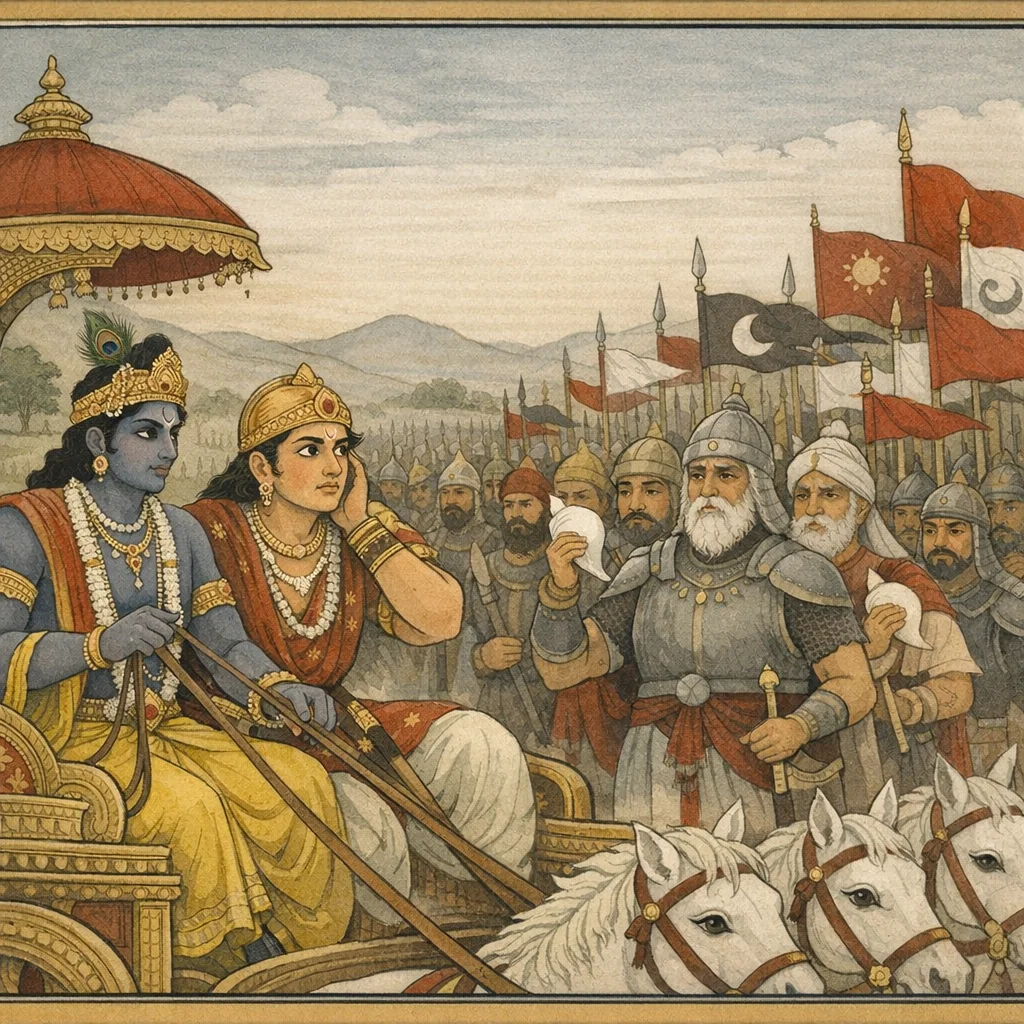
तत्रापश्यत्स्थितान्पार्थः पितॄनथ पितामहान् । आचार्यान्मातुलान्भ्रातॄन्पुत्रान्पौत्रान्सखींस्तथा ॥ १.२६ ॥
tatrāpaśyat sthitān pārthaḥ pitṝn atha pitāmahān | ācāryān mātulān bhrātṝn putrān pautrān sakhīṁs tathā || 1.26 ||

সেখানে পার্থ স্থিত পিতৃগণ ও পিতামহগণ, আচার্যগণ, মাতুলগণ, ভ্রাতৃগণ, পুত্রগণ, পৌত্রগণ এবং বন্ধুদেরও তদ্রূপ দেখলেন।
There Pārtha saw stationed fathers and grandfathers, teachers, maternal uncles, brothers, sons, grandsons, and friends as well.
There Pārtha saw standing: fathers, grandfathers, teachers, maternal uncles, brothers, sons, grandsons, and also friends.
Some recensions continue the list into the next verse(s); the present verse is a catalog of relations, central to the ethical tension. The academic translation maintains the enumerative structure.
FAQs
Recognition of close relations triggers empathic distress and role-conflict: Arjuna’s warrior duty collides with familial and social bonds.
The catalog can symbolize the many identities the self inhabits (son, student, friend), which later teachings interrogate in light of a deeper self-understanding.
This recognition scene is the narrative hinge: Arjuna’s crisis becomes intelligible as a conflict between dharma and attachment.
Ethical decisions often involve multiple roles and relationships; acknowledging them explicitly helps clarify what is at stake.