
Bhagavad Gita — Raja Vidya Raja Guhya Yoga, Shloka 21
Raja Vidya Raja Guhya Yoga
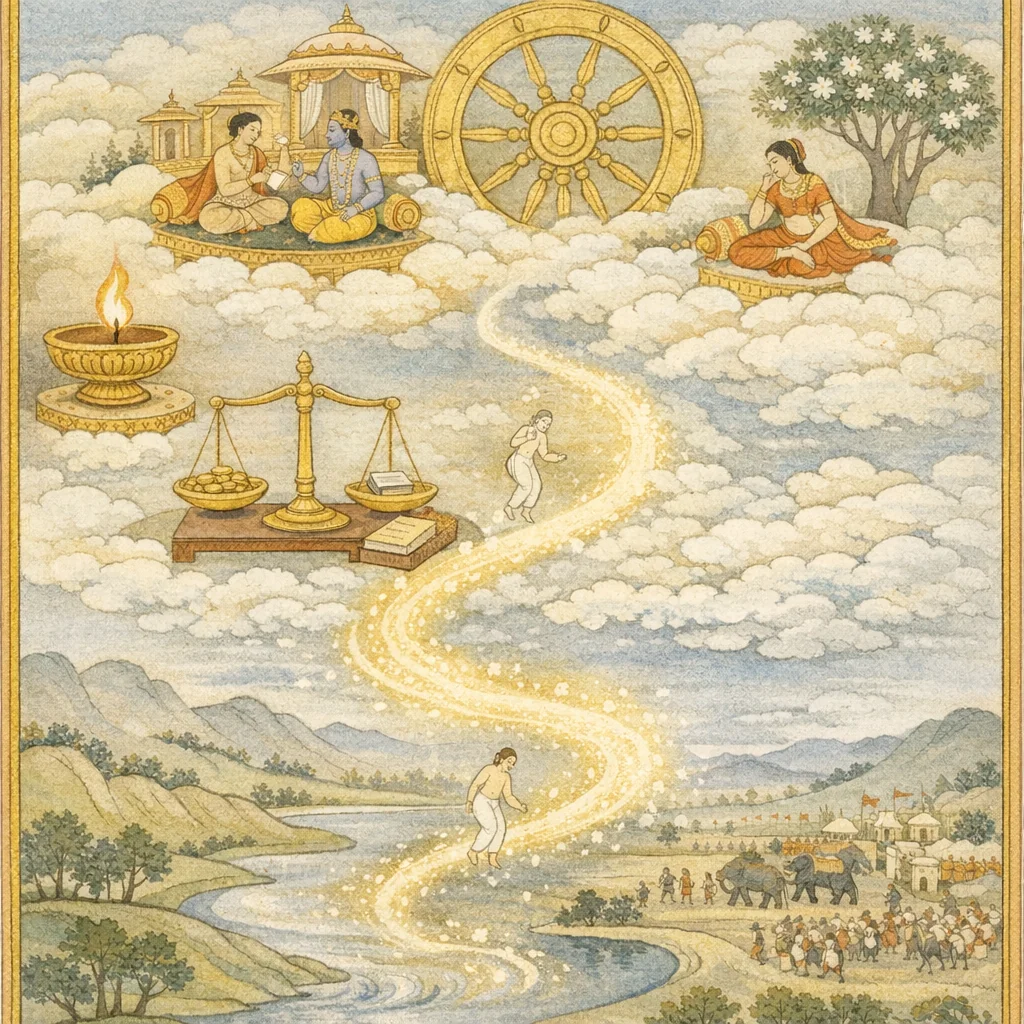
ते तं भुक्त्वा स्वर्गलोकं विशालं क्षीणे पुण्ये मर्त्यलोकं विशन्ति । एवं त्रयीधर्ममनुप्रपन्ना गताग...
te taṃ bhuktvā svarga-lokaṃ viśālaṃ kṣīṇe puṇye martya-lokaṃ viśanti | evaṃ trayī-dharmam anuprapannā gatāg...

সেই বিশাল স্বৰ্গলোক ভোগ কৰি, পুণ্য ক্ষয় হ’লে, তেওঁলোকে মর্ত্যলোকত প্ৰৱেশ কৰে। এইদৰে ত্ৰয়ী-বেদৰ ধৰ্ম অনুসৰণ কৰা লোকসকল গতি-আগতি কৰে ...
Having enjoyed that vast heaven-world, when their merit is exhausted they enter the mortal world. Thus, following the dharma of the three Vedas, they go and return ...
Having experienced that expansive heaven-world, when merit is depleted they enter the human/mortal world. Thus, those who have resorted to the triadic Vedic law go (there) and return ...
The Sanskrit is truncated; the key idea is the impermanence of heaven due to finite merit. “gatāgata” (go-and-return) is a standard expression for cyclic movement, contrasted with liberation.
FAQs
It points to the instability of fulfillment based on external rewards: satisfaction fades when its supporting conditions are spent.
Merit produces finite results within saṃsāra; liberation requires a different kind of realization or devotion not limited by karmic accounting.
It completes the contrast begun in 9.20, preparing for the assurance in 9.22 about sustained care for the devoted.
It can be read as a critique of short-term incentive systems: durable well-being is not secured by temporary ‘highs’ but by stable insight and virtues.