
Bhagavad Gita — Raja Vidya Raja Guhya Yoga, Shloka 16
Raja Vidya Raja Guhya Yoga
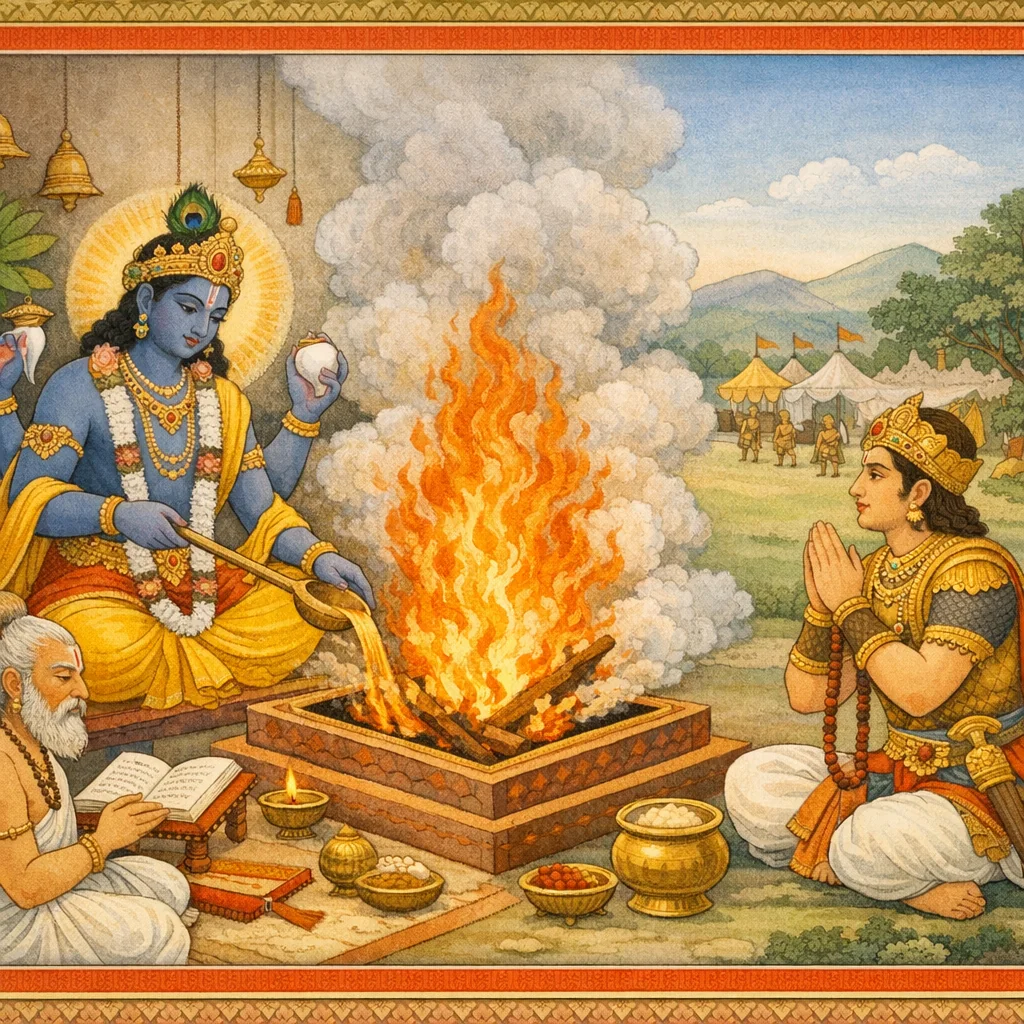
अहं क्रतुरहं यज्ञः स्वधाहमहमौषधम् । मन्त्रोऽहमहमेवाज्यमहमग्निरहं हुतम् ॥ ९.१६ ॥
ahaṃ kratur ahaṃ yajñaḥ svadhāham aham auṣadham | mantro 'ham aham evājyam aham agnir ahaṃ hutam || 9.16 ||

মই ক্ৰতু, মই যজ্ঞ; মই স্বধা (পিতৃ-অৰ্পণ); মই ঔষধি। মই মন্ত্ৰ; মই ঘৃত (আজ্য); মই অগ্নি; আৰু মই হুত (আহুতি)।
I am the Vedic rite, I am the sacrifice, I am the ancestral offering (svadhā), I am the medicinal herb; I am the mantra, I am the ghee, I am the fire, and I am the offering.
I am the (solemn) rite (kratu), I am the sacrifice (yajña); I am svadhā; I am the plant/medicine; I am the mantra; I alone am the clarified butter; I am the fire; I am the oblation.
This is a theological identification of the divine with the constituents of ritual action—agent, means, and object—often read as internalizing ritual into a comprehensive metaphysics.
FAQs
By identifying the sacred with every component of practice, the verse can reduce fragmentation—practice is not ‘for’ the divine but ‘within’ a larger meaningful whole.
It asserts an immanent divine presence: the ultimate is not external to ritual, nature, or speech, but is the underlying reality of them.
Following the acceptance of multiple worship-forms (9.15), this verse supplies a rationale: all forms of offering are encompassed by the same reality.
It can be read as sacralizing ordinary actions—seeing ethical work, study, and service as ‘offerings’ when done with clarity and intention.
Ask anything about this verse
Curious about the meaning, context, or a word? Ask, and continue the conversation in the Vedapath app.
A free Google sign-in keeps your chat saved across web and the app.
Read Bhagavad Gita in the Vedapath app
Scan the QR code to open this directly in the app, with audio, word-by-word meanings, and more.