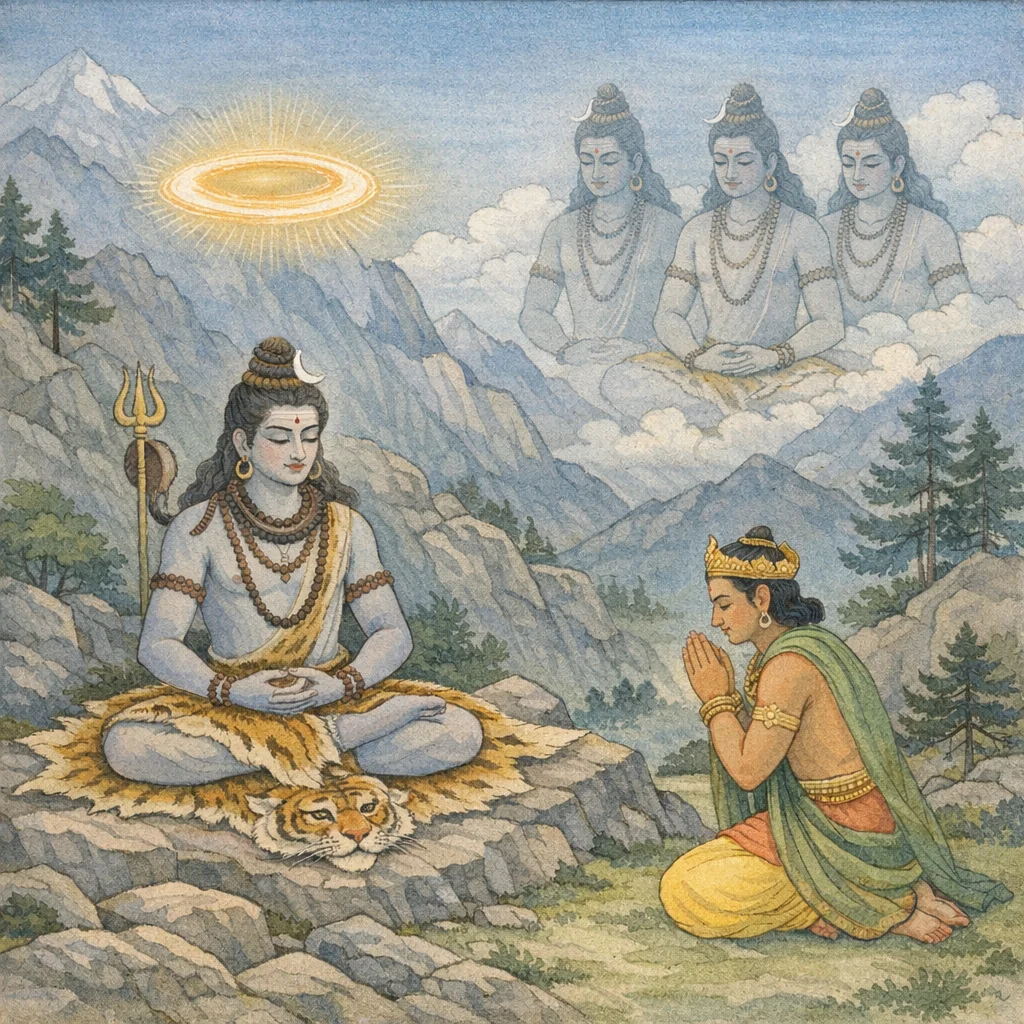
Adhyaya 56: The Gift of Sudarshana: Shiva’s Boon to Vishnu and the Sanctification of Virupaksha
सुदर्शनचक्र-प्रदानम् (Sudarśana-cakra-pradānam)
Sanctification of Virupaksha
Adhyāya 56 unfolds within the Pulastya–Nārada dialogue-frame and articulates a syncretic theology in which Vaiṣṇava power is explicitly grounded in Śaiva grace. Nārada asks why the world-venerated Sudarśana-cakra was bestowed upon Viṣṇu; Pulastya answers through an etiological narrative linking cosmic conflict, ascetic discipline, and sacred naming. Viṣṇu approaches Śaṃbhu (Mahādeva) to destroy the asura Śrīdāma, whose conquest renders the three worlds “niḥśrī” and threatens even Vāsudeva’s Śrīvatsa. Śiva, established in yogic form on Himālaya, grants the radiant, time-wheel-like Sudarśana after Viṣṇu’s prolonged tapas. A dramatic test follows: the cakra appears to “cut” Śiva into three, which Śiva interprets as a non-essential, prākṛta modification, thereby affirming his inviolable nature while simultaneously sanctifying the three resultant forms—Hiraṇyākṣa, Suvarṇākṣa, and Virūpākṣa—as merit-giving. The chapter closes by connecting this mythic event to devotional practice: Upamanyu, son of Vītamanyu, attains milk-food by worshipping Virūpākṣa, demonstrating how sectarian unity becomes lived ritual efficacy.
Divine Beings
Sacred Geography
Mortal & Asura Figures
Key Content Points
- Pulastya answers Nārada’s query by narrating the origin of Sudarśana-cakra within a Śaiva–Vaiṣṇava economy of boon and tapas.
- Viṣṇu’s ascetic worship of Śiva (yogamūrti on Himālaya) culminates in the bestowal of the divine, tejas-filled Sudarśana described with iconographic and calendrical correspondences (months, deities, seasons).
- The cakra’s ‘threefold cutting’ of Śiva is reinterpreted as a prākṛta vikāra, producing sanctified forms/epithets (Hiraṇyākṣa, Suvarṇākṣa, Virūpākṣa) and grounding Upamanyu’s devotional vow that yields milk as a ritual fruit.
Shlokas in Adhyaya 56
Verse 1
इति श्रीवामनपुराणे पञ्चपञ्चाशो ऽध्यायः नारद उवाच भगवंल्लोकनाथाय विष्णवे विषमेक्षणः किमर्थमायुधं चक्रं दत्तवांल्लोकपूजितम्
“Thus (ends) the fifty-fifth chapter in the Śrī Vāmana Purāṇa. Nārada said: ‘O Blessed One—why did Viṣamekṣaṇa (Śiva), for the sake of Viṣṇu, the Lord of the worlds, give the weapon, the discus, which is revered by the world?’”
Verse 2
पुलस्त्य उवाच/ शृणुष्वावहितो भूत्वा कथामेतां पुरातनीम् चक्रप्रदानसंबद्धां शिवमाहात्मयवर्धिनीम्
[]
Verse 4
तस्यात्रेयी महाभागो भार्यासीच्छीलसंमता पतिव्रता पतिप्राणा धर्मशीलेति विश्रुता
His wife was the illustrious Ātreyī, approved for her good conduct—devoted to her husband, holding her husband as her very life-breath; she was renowned as ‘Dharmaśīlā’ (one whose nature is righteousness).
Verse 5
तस्यामस्य महर्षेस्तु ऋतुकालाभिगामिनः संबभूव सुतः श्रीमान् उपमन्युरिति समृतः
And to that great seer—who approached his wife in the proper season—there was born a splendid son, remembered by the name Upamanyu.
Verse 6
तं माता मुनिशार्दूल शालिपिष्टरसेन वै पोषयामास वदती क्षीरमेतत् सुदुर्गता
["Daṇḍaka vana", "mūlaphalāmbubhakṣī", "viprapravareṣu kāñcana dāna", "Bali tapas three months"]
Verse being wise
रुरोदाथ ततो बाल्यात् पोयऽर्थि चातको यथा तं माता रुदती प्राह बाष्पगद्गदया गिरा
Then, out of childishness, he began to cry—like a cātaka bird longing for water. His mother, weeping, spoke to him in a voice choked with tears.
Verse 11
उमापतौ पशुपतौ शूलधारिणि संकरे अप्रसन्ने विरुपाक्षे कुतः क्षीरेण भोजनम्
When Umāpati—Paśupati, the trident-bearer Śaṅkara, the wide-eyed Virūpākṣa—is not pleased, how could there be nourishment by milk?
Verse 12
यदीच्छसि पयो भोक्तुं सद्यः पुष्टिकरं सुत तदाराधय देवेशं विरूपाक्षं त्रिशूलिनम्
“If you wish to partake of milk, which brings nourishment at once, my son, then worship the Lord of the gods—Virūpākṣa, the bearer of the trident.”
Verse 13
तस्मिस्तुष्टे जगद्धाम्नि सर्वकल्याणदायिनि प्राप्यते ऽमृतपायित्वं किं पुनः क्षीरभोजनम्
“When he—abode of the universe, bestower of all auspiciousness—is pleased, one attains even the state of drinking nectar; how much more, then, (is granted) the taking of milk as food!”
Verse 14
तन्मातुर्वचनं श्रुत्वा वीतमन्युसुतो ऽब्रवीत् को ऽयं विरूपाक्ष इति त्वयाराध्यस्तु कीर्तितः
“Hearing his mother’s words, the son of Vītamanyu said: ‘Who is this Virūpākṣa, described by you as the one to be worshipped?’”
Verse 15
ततः सुतं धर्मशीला धर्माढ्यं वाक्यमब्रवीत् यो ऽयं विरुपाक्ष इति श्रूयतां कथयामि ते
Then the virtuous lady, rich in dharma, spoke these words to her son, who was himself devoted to dharma: “Listen; I shall tell you why this one is known as ‘Virūpākṣa.’”
Verse 16
आसीन्महासुरपतिः श्रीदाम इति विश्रुतः तेनाक्रम्य जगत्सर्वं श्रीर्नीता स्ववशं पुरा
There was a great lord of the Asuras, renowned by the name Śrīdāma. Having overrun the entire world, he formerly brought Śrī (Fortune) under his own control.
Verse 17
निःश्रीकास्तु त्रयो लोकाः कृतास्तेन दुरात्माना श्रीवत्सं वासुदेवस्य हर्तुमैच्छन्महाबलः
By that wicked-souled one, the three worlds were made bereft of Śrī; and that mighty one even desired to seize the Śrīvatsa mark of Vāsudeva.
Verse 18
तम्स्य दुष्टं भगवानभिप्रायं जनार्दनः ज्ञात्वा तस्य वधाकाङ्क्षी महेश्वरमुपागमत्
Janārdana (Viṣṇu), having understood that being’s wicked intention, and desiring his destruction, approached Maheśvara (Śiva).
Verse 19
एतस्मिन्नन्तरे शंभुर्योगमूर्तिधरो ऽप्ययः तस्थौ हिमाचलप्रस्थमाश्रित्य श्लुक्ष्णभूतलम्
Meanwhile, Śaṃbhu—bearing the form of Yoga, the imperishable one—stood, taking refuge upon a mountain-terrace of the Himālaya, on smooth ground.
Verse 20
अथाभ्येत्य जगन्नाथं सहस्रशिरसं विभुम् आराधयामास हरिः स्वयमात्मानमात्मना
Then, approaching the Lord of the universe, the all-pervading one of a thousand heads, Hari propitiated him—indeed, by his own self worshipping his own Self.
Verse 21
साग्रं वर्षसहस्रं तु पादाङ्गुष्ठेन तस्तिवान् गृणंस्तत्परमं ब्रह्म योगिज्ञेयमलक्षणम्
For a full thousand years (and more), he stood balanced upon the tip of his great toe, praising that Supreme Brahman—knowable to yogins, yet without defining marks.
Verse 23
तद् दत्त्वा देवदेवाय सर्वभूतभयप्रदम् कालचक्रनिभं चक्रं शङ्करो विष्णुमब्रवीत्
Having given that discus to the God of gods—an instrument that brings fear to all beings, resembling the wheel of Time—Śaṅkara then spoke to Viṣṇu.
Verse 24
वरायुधो ऽयं देवेश सर्वायुधनिबर्हणः सुदर्शनो द्वादशारः षण्णाभिर्द्वियुगो जवी
ಅದು ನಾನಾವರ್ಣದ ಖನಿಜರೇಖೆಗಳಿಂದ ಅಂಕಿತವಾದ ಶೃಂಗಗಳಿಂದ, ಎಲ್ಲ ದಿಕ್ಕುಗಳಲ್ಲಿಯೂ ಹರಿಯುವ ಜಲಧಾರೆಗಳಿಂದ, ಹಾಗೂ ರಮಣೀಯತೆಯಲ್ಲಿ ಖ್ಯಾತಿಯಾದ ಮೂರು ವಿಶಾಲ ಸಾನುಗಳಿಂದ ಶೋಭಿತವಾಗಿತ್ತು।
Verse "
मुरारिकरविभ्रष्टं चक्रमभ्येत्य शूलिनम् त्रिधा चकार विश्वेशं यज्ञेशं यज्ञयाजकम्
{"location": null, "location_type": null, "region": null, "sacred_significance": "The battlefield becomes a site of dharmic correction: power yields to humility before the inviolable divine", "cosmic_realm": "bhuloka"}
Verse 39
उत्तिष्ठ गच्छस्व विभो निहन्तुममरार्दनम् श्रीदाम्नि निहते विष्णो नन्दयिष्यन्ति देवताः
“Rise, O Lord, and go forth to slay Amarārdana. When Śrīdāman is slain, O Viṣṇu, the gods will rejoice.”
Verse 40
इत्येवमुक्तो भगवान् हरेम गरुडध्वजः गत्वा सुरगिरिप्रस्थं श्रीदामानं ददर्श ह
Thus addressed, the Blessed Lord Hari—whose banner bears Garuḍa—went to the mountain-slope of Suragiri and there indeed beheld (the Daitya) Śrīdāman.
Verse 41
तं दृष्ट्वा देवदर्पघ्नं दैत्यं देववरो हरिः मुमोच चक्रं वेगाढ्यं हतो ऽसीति ब्रुवन्मुहुः
Seeing that Daitya, the slayer of the gods’ pride, Hari—the foremost among the gods—released his discus, endowed with great speed, repeatedly declaring, “You are slain!”
Verse 42
ततस्तु तेनाप्रतिपौरुषेण चक्रेण दैत्यस्य शिरो निकृत्तम् संछिन्नसीर्षो निपपात शैलाद् वज्राहतं शैलशिरो यथैव
Then, by that discus of unmatched might, the Daitya’s head was cut off. With his head severed, he fell from the mountain, just like a mountain-peak struck by the thunderbolt.
Verse 44
तसमिन् हते देवरिपौ मुरारिरीशं समाराध्य विरूपनेत्रम् लब्ध्वा च चक्रं प्रवरं महायुधं जगाम देवो निलयं पयोनिधिम् // वम्प्_56.43 सो ऽयं पुत्र निरूपाक्षो देवदेवो महेश्वरः तमाराधय चेत् साधो क्षीरेणोच्छसि भोजनम्
{"cosmic_form_present": false, "three_steps_described": false, "step_one_bhuloka": null, "step_two_bhuvarloka": null, "step_three_svarloka": null, "cosmic_scale_imagery": null, "universe_measurement": null}
Verse 45
तन्मातुर्वचनं श्रुत्वा वीतमन्युसुतो बली तमाराध्य विरूपाक्षं प्राप्तः क्षीरेण भोजनम्
Having heard his mother’s words, Bali—the son of Vītamanyu—propitiated Virūpākṣa (Śiva) and obtained nourishment in the form of milk.
Frequently Asked Questions
The chapter presents a syncretic theology where Viṣṇu’s victory depends on Śiva’s grace: Hari performs sustained tapas to Śaṃbhu, receives Sudarśana as a boon, and even the cakra’s ‘cutting’ of Śiva is framed by Śiva as a non-essential prākṛta vikāra—affirming Śiva’s transcendence while validating Viṣṇu’s weapon as divinely authorized.
This adhyāya is primarily etiological and devotional rather than a Kurukṣetra-style tīrtha-catalogue; its place-markers are macro-sacred (Himālaya as Śiva’s yogic seat, Suragiri-prastha as the battlefield locale, and Payonidhi as Viṣṇu’s cosmic abode). The tīrtha-like function appears through name-sanctification—Virūpākṣa (and the triad Hiraṇyākṣa/Suvarṇākṣa/Virūpākṣa) becomes a merit-giving focus for worship with tangible ritual fruit.
King Bali and the Vāmana avatāra are not advanced in this passage. Instead, the chapter strengthens the Purāṇa’s broader theological program by grounding Vaiṣṇava sovereignty in Śaiva bestowal and by modeling vow-based devotion (Upamanyu) as a paradigm of dharmic practice.