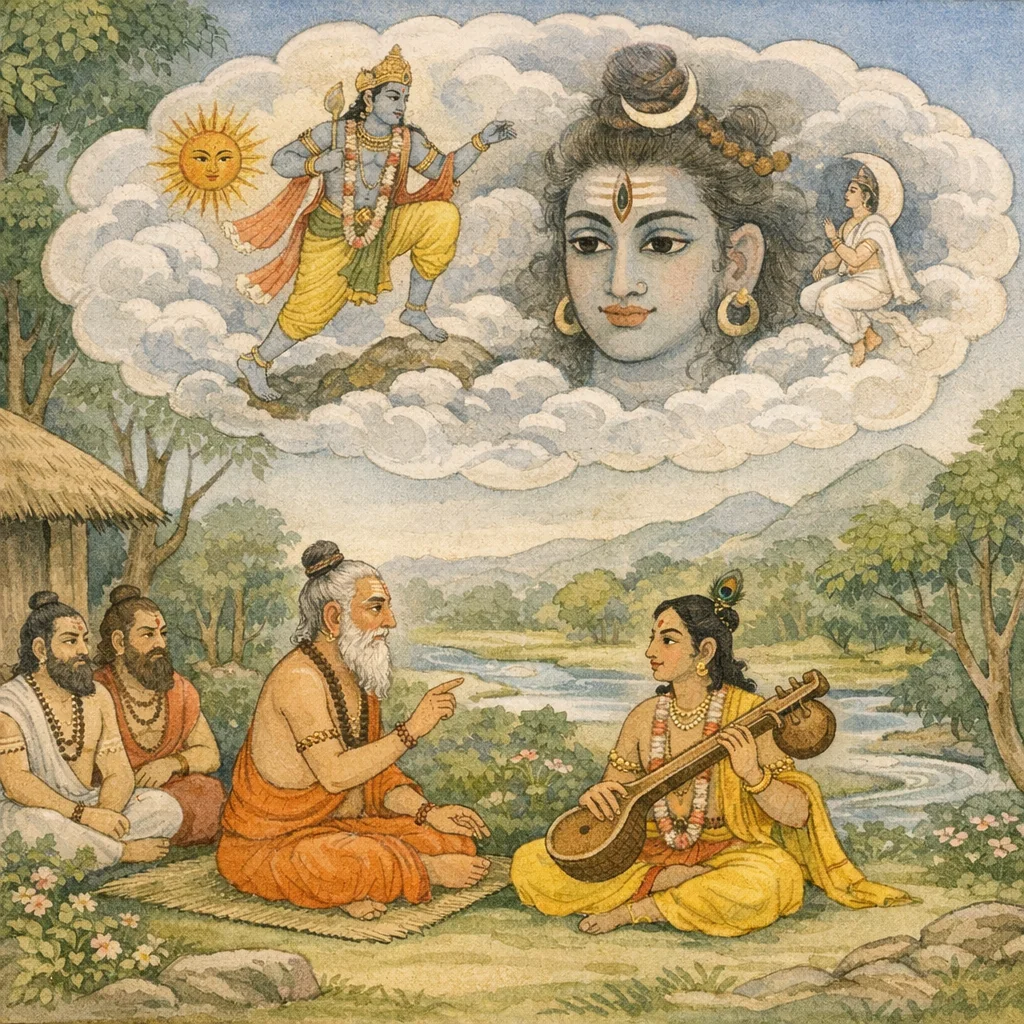
Adhyaya 60: The Second Sin-Destroying Hymn (Pāpaśamana Stava) and the Syncretic Praise of Hari-Hara
द्वितीय-पापशमन-स्तवः (Dvitīya-Pāpaśamana-Stavaḥ)
Papasamana Stava
Within the Pulastya–Nārada dialogic frame, this adhyāya presents a second pāpaśamana-stava, a litany of salutations that deliberately traverses Vaiṣṇava and Śaiva iconographic registers. Pulastya teaches that correct recitation and study of the hymn effects pāpa-nāśa, emphasizing the purificatory power of śravaṇa, smaraṇa, and saṅkīrtana. The stava enumerates multiple forms and epithets—Matsya, Kūrma, Trivikrama, Nārāyaṇa, Garuḍāsana alongside Śiva as Nīlakaṇṭha, Kapardin, Trinayana, and Rudradeveśa—thereby articulating a syncretic theology in which sectarian boundaries are ritually suspended. The hymn also extends praise to cosmic principles and luminaries (Sūrya, Śaśin, Dhruva) and to revered sages (Agastya, Kapila), suggesting a comprehensive sacred hierarchy. The closing verse explicitly frames the material as “paramaṃ purāṇam,” credited to Agastya, and underscores its fame-bestowing and multi-sin-destroying efficacy through recitation, remembrance, and attentive hearing.
Divine Beings
Mortal & Asura Figures
Key Content Points
- Pulastya instructs Nārada in a ‘second’ pāpaśamana-stava, asserting that proper study/recitation leads to pāpa-nāśa (sin-destruction).
- A sustained syncretic litany merges Vaiṣṇava and Śaiva iconographic descriptions (e.g., Trivikrama/Garuḍāsana with Nīlakaṇṭha/Trinayana/Kapardin), functioning as a Hari-Hara style theological synthesis.
- The hymn’s purificatory economy is explicitly tied to saṅkīrtana, smaraṇa, and śravaṇa, and it closes by attributing the purāṇic teaching to Agastya and praising its yaśas-generating, bahu-pāpa-nāśana power.
Shlokas in Adhyaya 60
Verse 1
इति श्रीवामनपुराणे एकोनषष्टितमो ऽध्यायः पुलस्त्य उवाच नमस्ते ऽस्तु जगन्नाथ देवदेवं नमो ऽस्तु ते वासुदेव नमस्ते ऽस्तु बहुरूप नमो ऽस्तु ते
“Thus, in the Śrī Vāmana Purāṇa, the fifty-ninth chapter (has concluded). Pulastya said: ‘Salutations to you, O Lord of the universe; salutations to you, O God of gods. O Vāsudeva, salutations to you; O multiform one, salutations to you.’”
Verse 2
एकशृङ्ग नमस्तुभ्यं नमस्तुभ्यं वृषाकपे श्रीनिवास नमस्ते ऽस्तु नमस्ते भूतभावन
{"primary_rasa": "shanta", "secondary_rasa": "vira", "intensity": 6, "emotional_arc": "Serene devotion is strengthened by martial/royal imagery of banners and steadfastness, ending in calm assurance.", "mood_keywords": ["stuti", "dhvaja", "satya", "dhruva", "rakṣaṇa", "niścaya"]}
Verse 4
यज्ञध्वज नमस्तुभ्यं धर्मध्वज नमो ऽस्तु ते तालध्वज नमस्ते ऽस्तु नमस्ते गरुहध्वज
{"primary_rasa": "vira", "secondary_rasa": "adbhuta", "intensity": 7, "emotional_arc": "Exalted praise crescendos through victory-names, ending in the assurance of the Unconquered (Parājita).", "mood_keywords": ["jaya", "vijaya", "ananta", "parājita", "aiśvarya", "utsāha"]}
Verse 6
कृतावर्तद महावर्त महादेव नमो ऽस्तु ते अनाद्याद्यन्त मध्यान्त नमस्ते पद्मजप्रिय
Salutations to you, O Mahādeva—giver of the (sacred) whirlpool/turning (kṛtāvarta), the Great Whirlpool (mahāvarta). You are without beginning, beginning-and-end, and middle-and-end; salutations to you, O beloved of the lotus-born (Brahmā).
Verse 7
पुरञ्जय नमस्तुभ्यं शत्रुञ्जय नमो ऽस्तु ते शुभञ्जय नमस्ते ऽस्तु नमस्ते ऽस्तु धनञ्जय
[{"question": "Why are Hiraṇyagarbha and Padmagarbha used in a hymn addressed to the Supreme Lord?", "answer": "These epithets compress Purāṇic cosmogony into devotional praise: the Lord is lauded as the ultimate causal ground, while also being described through the familiar creation-imagery of the golden embryo (cosmic egg) and the lotus-source associated with Brahmā’s emergence. The stuti thus treats creation motifs as names of the transcendent deity."}, {"question": "Does this verse identify the deity as Brahmā or Vishnu?", "answer": "The language is compatible with both, but in Purāṇic stuti style the highest deity can be praised with titles that elsewhere denote Brahmā. The intent is typically hierarchical: Brahmā’s cosmogonic functions are traced back to the Supreme Lord as their source."}, {"question": "Is there any tīrtha or geographic marker embedded here?", "answer": "No. Unlike many Vāmana Purāṇa passages that anchor merit in named rivers and tīrthas, this verse is purely theological/cosmogonic in diction."}]
Verse 13
आर्चिषेण महासेन नमस्ते ऽस्तु पुरुष्टुत वहुकल्प महाकल्प नमस्ते कल्पनामुख
Salutations to You—O Ārciṣeṇa, O Mahāsena—praised by many men. O You of many kalpas, O Great Kalpa; salutations to You, the very source/front (mukha) of the kalpas.
Verse None explicitly mentioned in this verse (no rivers, lakes, forests, or tīrthas named)
59
Adhyaya 59 (title not supplied in input; the Rākṣasa petitions for compassion and purification)
Verse 25
मूलं ते ब्राह्मणा ब्रह्मन् स्कन्धस्ते क्षत्रियोर्दिशः नाभ्या ह्यभूदन्तरिक्षं शशाङ्को मनसस्तव
evaṃ kṛtopanayano bhagavān bhūtabhāvanaḥ saṃstūyamāno ṛṣibhiḥ sāṅgaṃ vedamadhīyata
Verse 33
नमस्ते यज्ञपुरुष यज्ञभागभुजे नमः नमः सहस्रधाराय शतधाराय ते नमः
{"location": "Saro-tirtha (Sarasvati–Kurukshetra tirtha cycle)", "location_type": "tirtha", "region": "Kurukshetra", "sacred_significance": "In a tirtha-mahātmya, the deity is praised as the source of both worldly and spiritual gifts; aligns pilgrimage with dāna-dharma.", "cosmic_realm": "bhuloka"}
Verse 59 iti śrīvāmanapurāṇe dviṣaṣṭitamo 'dhyāyaḥ śrībhagavānuvāca ādyaṃ mātsyaṃ mahadrupaṃ saṃsthitaṃ mānase hrade sarvapāpakṣayakaraṃ kīrtanasparśanādibhiḥ
होता होमश्च हव्यं च हूयमानश्चहव्यावाट् पाता पोता च पुतश्च पावनीयश्च ॐ नमः
No explicit river, lake, forest, or tirtha is named in this specific śloka; it functions as a universalizing stuti within the chapter’s broader tirtha-mahātmya frame.
Verse 39
स्रुक्स्रुवौ परधामासि कपालोलूखलो ऽरणिः यज्ञपात्राणेयस्त्वमेकधा बहुधा त्रिधा
["Vishnu", "Shiva"]
Verse 46
अश्ववक्त्रो महामेधाः शंभुः शक्रः प्रभञ्जनः मित्रावरुणमूर्तिस्त्वममूर्तिरनघः परः
You are horse-faced and of great intelligence; you are Śambhu, Śakra (Indra), and Prabhañjana (the Wind). You are embodied as Mitra and Varuṇa—yet you are also formless, stainless, and supreme.
Verse 50
केशवस्याग्रतो गत्वा स्नात्वा तीर्थे सितोदके उपशान्तस्तथा जातो रुद्रः पापवशात् ततः
["Śiva (Tripuradhna/Tripurāntaka)", "Viṣṇu"]
Verse 51
एतत् पवित्रं त्रिपुरध्नभाषितं पठन् नरो विष्णुपरो महर्षे विमुक्तपापो ह्युपशान्तमूर्ति संपूज्यते देववरैः प्रसिद्धैः
O great sage, a man devoted to Viṣṇu who recites this purifying (hymn), spoken by the slayer of Tripura, becomes freed from sin and assumes a pacified disposition; he is honored and worshipped by renowned foremost gods.
Frequently Asked Questions
By structuring the stava as a single uninterrupted sequence of namas-kāras that alternates and overlaps Vaiṣṇava and Śaiva epithets (e.g., Trivikrama/Garuḍāsana alongside Nīlakaṇṭha/Trinayana/Kapardin), the chapter performs syncretic theology ritually: devotion is directed to a shared sacral sovereignty rather than a sect-exclusive deity.
This adhyāya is not organized as a tīrtha-māhātmya and does not name specific rivers, forests, or pilgrimage sites; its sanctifying focus is primarily liturgical (stotra-recitation) rather than topographical sanctification.
Pulastya foregrounds the efficacy of the stava when ‘samyag-adhīta’ (properly learned/recited) and explicitly praises purification through saṅkīrtana (recitation), smaraṇa (remembrance), and śravaṇa (hearing), presenting these as the operative modes of pāpaśamana.