
Shloka 10
Vibhuti Yoga — Vibhuti Yoga
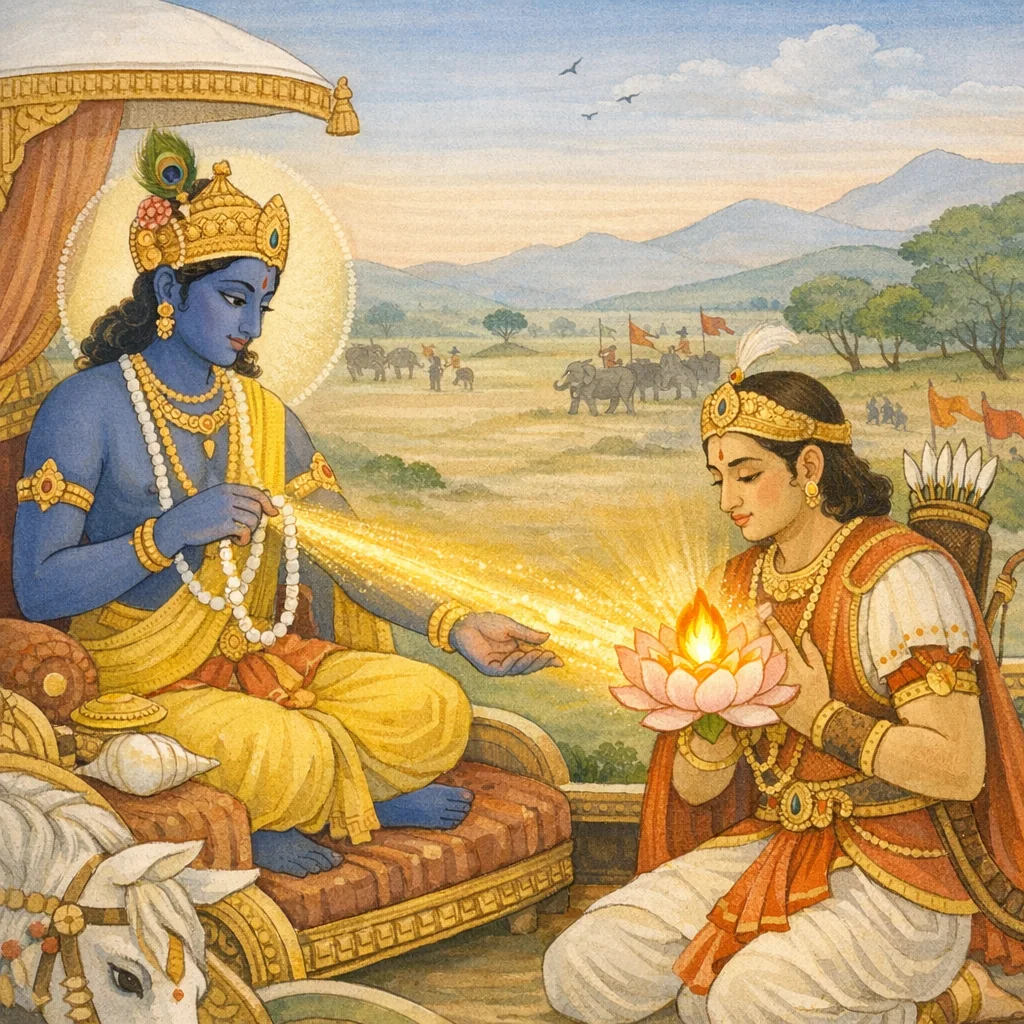
तेषां सततयुक्तानां भजतां प्रीतिपूर्वकम् । ददामि बुद्धियोगं तं येन मामुपयान्ति ते ॥ १०.१० ॥
teṣāṁ satatayuktānāṁ bhajatāṁ prītipūrvakam | dadāmi buddhiyogaṁ taṁ yena mām upayānti te || 10.10 ||

To those who are ever steadfastly united with Me, who worship Me with love, I bestow that buddhi-yoga—the yoga of discerning wisdom—by which they come to Me.
To those who are ever united with Me and who worship Me with love, I grant that discipline of understanding (buddhi-yoga) by which they come to Me.
To those continuously integrated (with Me), who engage in devotion with affection, I give that yoga of insight/understanding, by which they approach Me.
Interpretation varies on buddhi-yoga: some read it as discriminative knowledge leading to liberation, others as divinely guided practical discernment within devotion. The phrase mām upayānti may be taken as ‘attain Me’ (soteriological) or ‘draw near to Me’ (relational).
FAQs
The verse links sustained commitment and positive affect (“with affection”) to enhanced clarity and decision-making (“yoga of understanding”), suggesting that stable motivation can support deeper cognitive integration.
It articulates a theistic epistemology: true insight is not merely self-generated but also ‘given’ through divine support, enabling the practitioner to realize or approach the highest reality.
Following 10.9’s depiction of devoted practitioners, 10.10 explains the resulting epistemic transformation: devotion matures into a divinely supported discernment that leads toward the divine being described in the chapter.
Read as a principle of practice: consistent values-based living and reflective devotion cultivate better judgment—especially when paired with study, mentorship, and ethical self-examination.