
Bhagavad Gita — Raja Vidya Raja Guhya Yoga, Shloka 7
Raja Vidya Raja Guhya Yoga
सर्वभूतानि कौन्तेय प्रकृतिं यान्ति मामिकाम् । कल्पक्षये पुनस्तानि कल्पादौ विसृजाम्यहम् ॥ ९.७ ॥
sarva-bhūtāni kaunteya prakṛtiṁ yānti māmikām | kalpa-kṣaye punas tāni kalpādau visṛjāmy aham || 9.7 ||

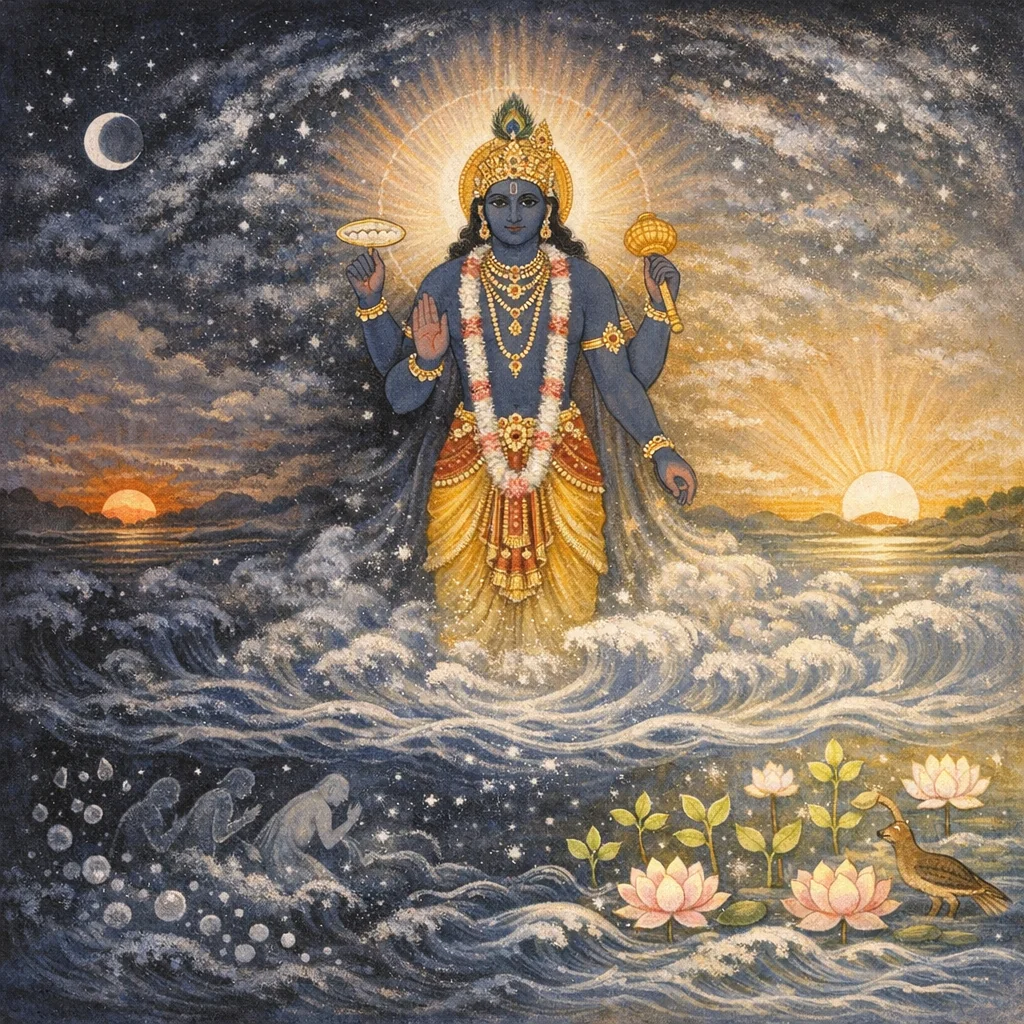
O son of Kunti, at the end of a kalpa all beings enter into My Prakriti; and at the beginning of a kalpa I send them forth again.
हे कौन्तेय! कल्प के अन्त में सब भूत मेरी प्रकृति में प्रवेश करते हैं और कल्प के आदि में मैं उनको फिर उत्पन्न करता हूँ।
O son of Kuntī, at the end of an aeon all beings enter My nature; at the beginning of an aeon I send them forth again.
‘प्रकृति’ is read in Sāṅkhya-inflected terms as primordial materiality, while devotional readings treat it as ‘My power.’ The verse aligns with cyclical cosmology (kalpa) rather than a single creation event.
FAQs
On a metaphorical level, it can suggest periodic ‘return’ to a baseline (rest, silence, or unformed potential) followed by renewed activity—cycles that structure growth and learning.
The verse presents a cyclic universe: beings manifest from prakṛti under divine agency and are reabsorbed into it at cosmic dissolution, then re-emerge.
After describing divine pervasion, Krishna explains cosmic process: how the manifest world arises and subsides without compromising divine transcendence.
It can be approached as a worldview emphasizing recurrence and regeneration rather than linear finality—useful for interpreting change, loss, and renewal in non-finalistic terms.
Read Bhagavad Gita in the Vedapath app
Scan the QR code to open this directly in the app, with audio, word-by-word meanings, and more.