
Bhagavad Gita — Karma Sannyasa Yoga, Shloka 19
Karma Sannyasa Yoga
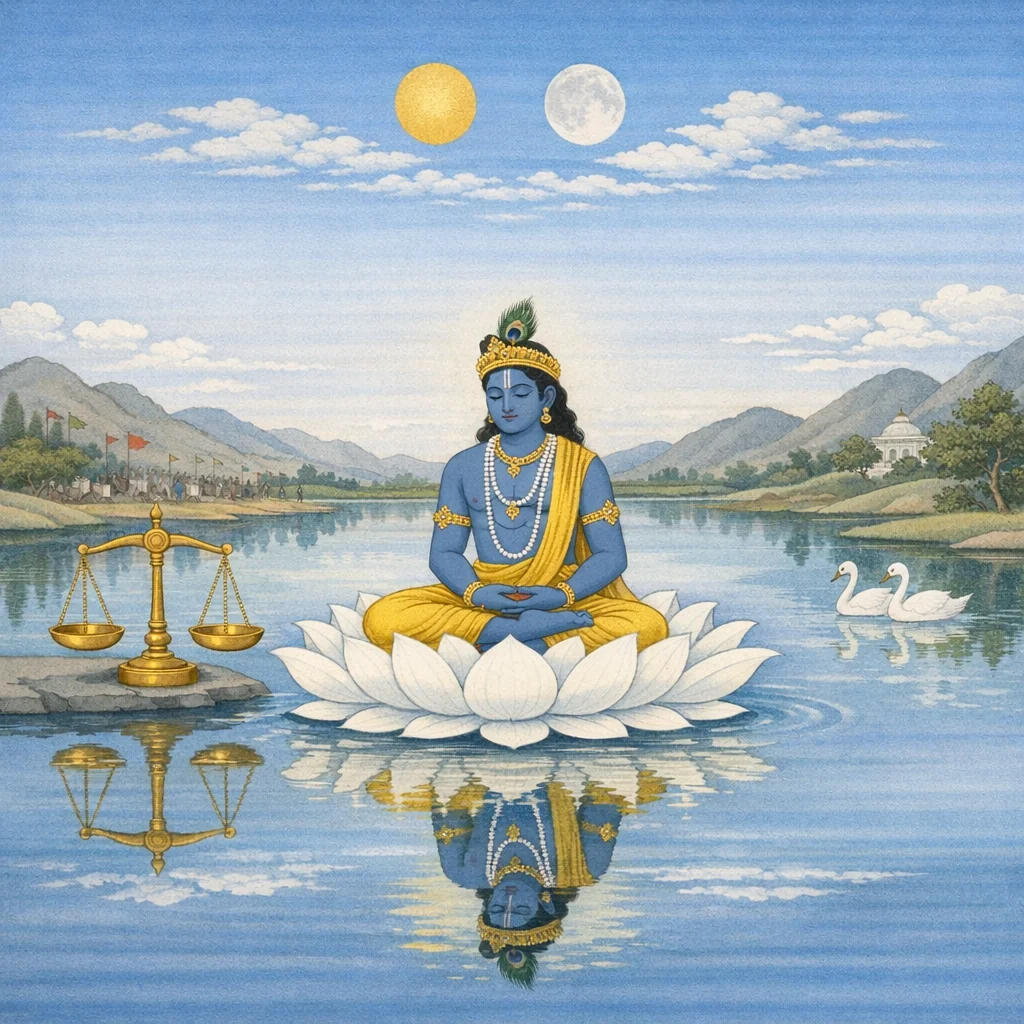
इहैव तैर्जितः सर्गो येषां साम्ये स्थितं मनः ।
निर्दोषं हि समं ब्रह्म तस्माद्ब्रह्मणि ते स्थिताः ॥ ५.१९ ॥
ihaiva tair jitaḥ sargo yeṣāṃ sāmye sthitaṃ manaḥ |
nirdoṣaṃ hi samaṃ brahma tasmād brahmaṇi te sthitāḥ || 5.19 ||

Here itself, creation (the cycle of birth and death) is conquered by those whose mind abides in equality; for Brahman is flawless and equal—therefore they are established in Brahman.
जिनका मन समता में स्थित है, उन्होंने इसी जीवन में (जन्म-मरणरूप) सर्ग को जीत लिया है; क्योंकि ब्रह्म निर्दोष और सम (समभाव) है; इसलिए वे ब्रह्म में स्थित हैं।
Here itself (in this life), for those whose mind is established in equanimity, creation/conditioned becoming is conquered; for Brahman is indeed faultless and even; therefore they abide in Brahman.
Most recensions read essentially as given. The key interpretive variance is semantic: “sarga” can be taken as (a) the cycle/stream of becoming (birth-and-death oriented existence) or (b) the world-process/creation as experienced through partiality. Similarly, “samaṃ brahma” is read either metaphysically (Brahman is intrinsically non-dual and impartial) or ethically/psychologically (realization aligns one’s mind with Brahman’s non-discriminating sameness).
FAQs
The verse frames equanimity (sāmya/samatva) as a stabilized mental disposition: the mind no longer swings with preference, aversion, praise, blame, gain, or loss. In psychological terms, it points to reduced reactivity and a sustained capacity to meet experience without compulsive judgment, which is presented as transformative rather than merely calming.
It links the practitioner’s equanimity with Brahman’s nature: Brahman is described as “nirdoṣa” (without defect or taint) and “sama” (even, impartial). Abiding in Brahman indicates a mode of knowing/being in which distinctions that generate bondage are no longer taken as ultimately real, so the individual is said to have ‘conquered’ conditioned becoming.
Chapter 5 discusses renunciation and disciplined action, arguing that inner renunciation and clarity can be realized while living and acting. This verse supports that thesis by claiming that liberation is attainable ‘here itself’ when the mind is firmly established in equanimity, aligning with earlier statements in the chapter about the wise person’s impartial vision.
As a practical ethic, it encourages cultivating even-mindedness in daily roles—responding to success and failure, approval and disapproval, with steadiness. Applied in contemporary life, it can inform reflective practices (mindfulness, self-inquiry, disciplined action) aimed at reducing bias and impulsive reactions while maintaining responsibility and engagement.