
Shloka 34
Dhyana Yoga — Atma Samyama Yoga
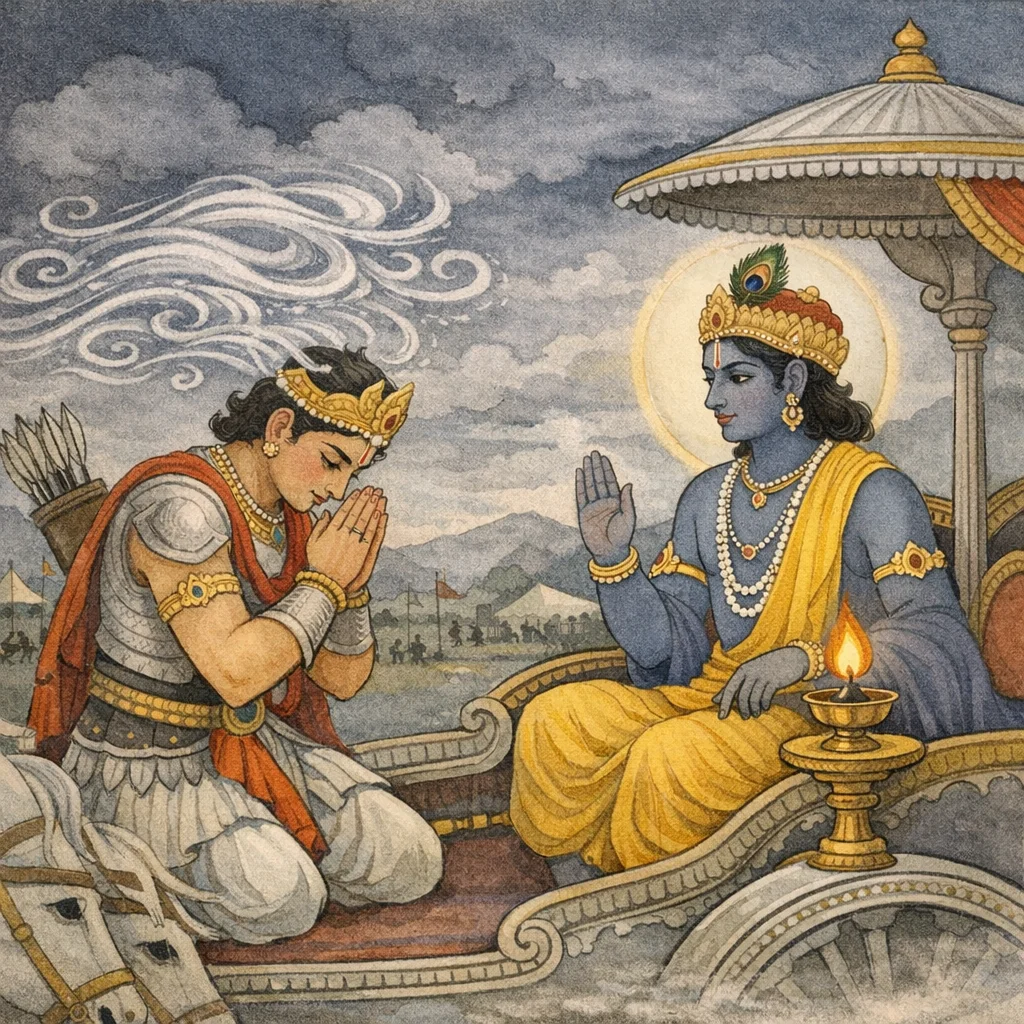
चञ्चलं हि मनः कृष्ण प्रमाथि बलवद्दृढम् । तस्याहं निग्रहं मन्ये वायोरिव सुदुष्करम् ॥ ६.३४ ॥
cañcalaṁ hi manaḥ kṛṣṇa pramāthi balavad dṛḍham | tasyāhaṁ nigrahaṁ manye vāyor iva su-duṣkaram || 6.34 ||

Arjuna said: For the mind, O Kṛṣṇa, is indeed restless, turbulent, strong, and obstinate; I deem its restraint to be exceedingly difficult—like restraining the wind.
For the mind is restless, O Krishna, turbulent, strong and obstinate; I consider its restraint as very difficult, like that of the wind.
Indeed the mind is unsteady, O Krishna—disturbing, powerful, and stubborn; I think its control is exceedingly difficult, as (difficult) as (controlling) the wind.
The verse is stable across common recensions. ‘Pramāthi’ conveys disruptive agitation; translators vary between ‘turbulent,’ ‘violent,’ or ‘tormenting,’ but the context is inner struggle rather than external conflict.
FAQs
The mind is characterized as strong and habit-driven, anticipating modern observations about attention capture and entrenched patterns; the wind metaphor conveys how quickly thoughts can shift.
The verse does not assert a metaphysical doctrine so much as it diagnoses the practical condition of embodied cognition that obstructs contemplative realization.
It intensifies Arjuna’s objection, setting up Krishna’s response that control is possible through systematic training and detachment.
It supports a gradual-training model: expecting immediate control is unrealistic; structured practice, environment design, and reduced compulsive engagement are implied.