
Shloka 3
Dhyana Yoga — Atma Samyama Yoga
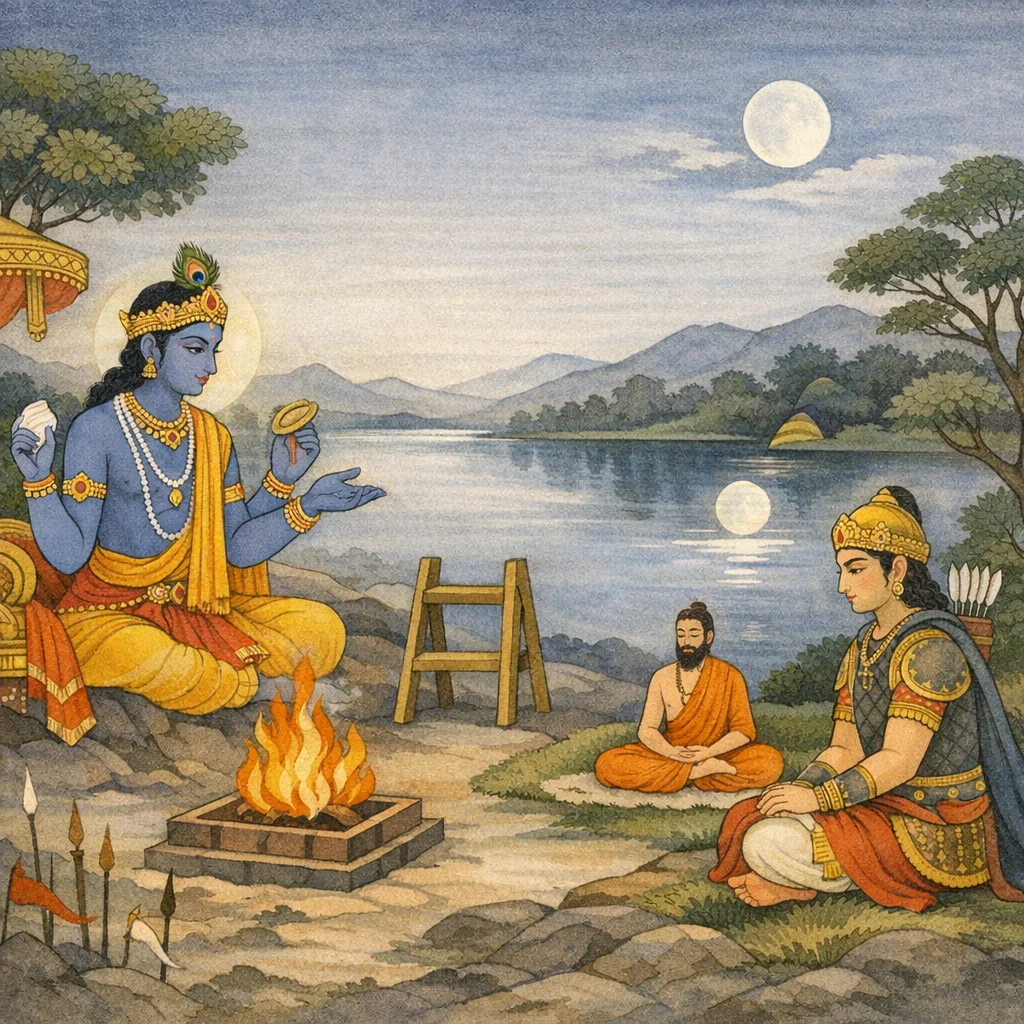
आरुरुक्षोर्मुनेर्योगं कर्म कारणमुच्यते । योगारूढस्य तस्यैव शमः कारणमुच्यते ॥ ६.३ ॥
ārurukṣor muner yogaṁ karma kāraṇam ucyate | yogārūḍhasya tasyaiva śamaḥ kāraṇam ucyate || 6.3 ||

For the sage who seeks to ascend to yoga, action is said to be the means; and for the same one who has ascended to yoga, serenity (śama—quietude of mind) is said to be the means.
योग में आरूढ़ होने की इच्छा रखने वाले मुनि के लिए कर्म साधन कहा गया है; और उसी योगारूढ़ के लिए शम (मन की शान्ति/निवृत्ति) साधन कहा गया है।
For the sage who wishes to ascend to yoga, action is said to be the means; for that same one who has ascended to yoga, tranquility (śama) is said to be the means.
The progression is interpreted either as a two-stage path (disciplinary action → contemplative stillness) or as complementary emphases within a single integrated practice, depending on commentator and school.
FAQs
It reflects skill acquisition: structured activity builds stability and self-efficacy; later, reduced mental agitation becomes the primary support for deeper concentration.
Action purifies and steadies the mind, enabling contemplative knowledge; once steadiness is established, inner quiet becomes the direct condition for insight.
It introduces a developmental model for Chapter 6’s meditation teaching, explaining why disciplined life and duties can precede sustained contemplation.
Begin with consistent routines and ethical commitments; as attention improves, prioritize rest, simplicity, and reduced overstimulation to deepen focus.