Adhyaya 62: Vamana’s Birth during Bali’s Horse-Sacrifice and the Mapping of Vishnu’s Sacred Presences
वामन-प्रादुर्भावः तथा सान्निध्य-निर्देशः (Vāmana-Prādurbhāvaḥ tathā Sānnidhya-Nirdeśaḥ)
At Bali's Horse-Sacrifice
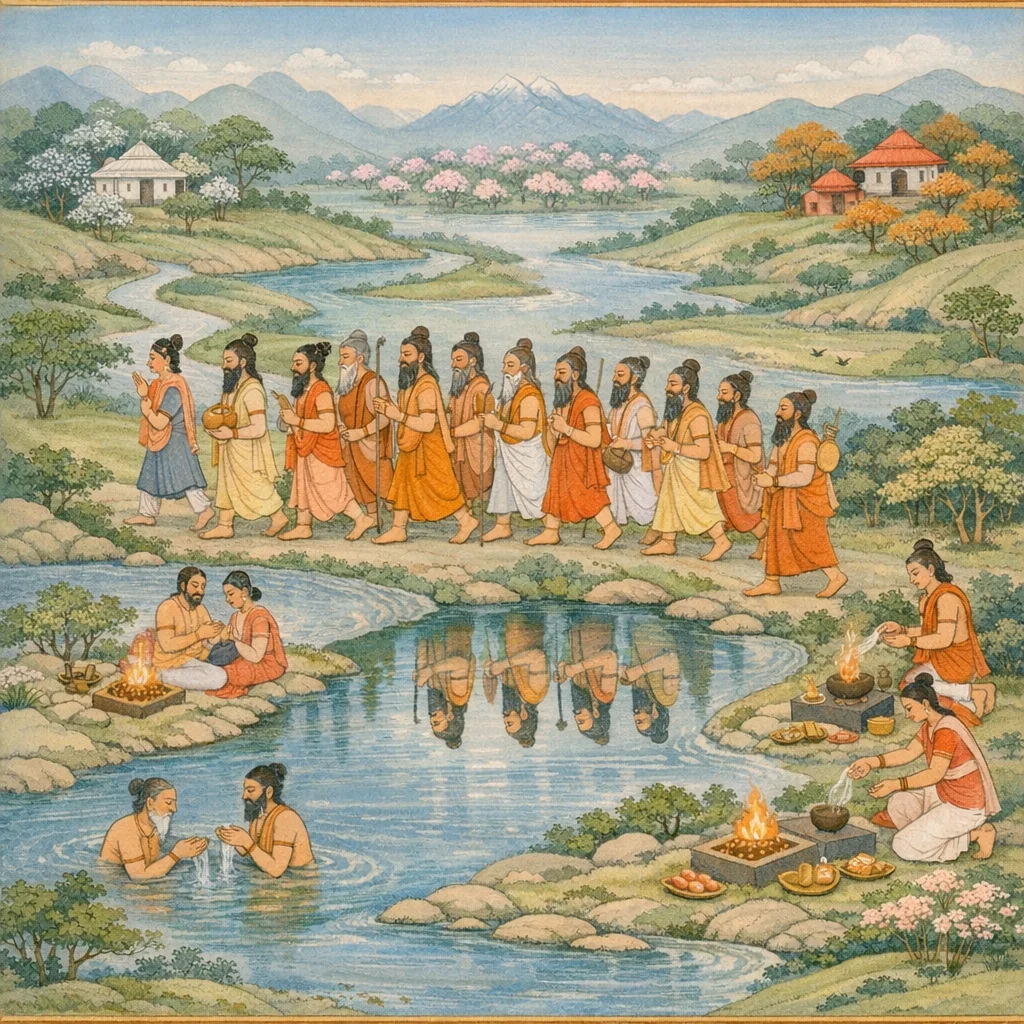
Within the Pulastya–Nārada dialogue-frame, this Adhyāya shifts the Kurukṣetra narrative from Bali’s asura-dharma (royal yajña and dāna) to the divine counter-movement: the birth of Nārāyaṇa as Vāmana. Śukra Bhārgava convenes eminent Brahmins for Bali’s hayamedha at Kurukṣetra, while multiple ṛṣi-groups disperse northward through a chain of sanctified rivers, performing snāna and pitṛ-arcana—an itinerary that functions as topographical sanctification. A striking wonder occurs when the sages perceive their reflections within the water, prompting reflection on hidden presences in tīrthas. They reach an expansive forest and a revered āśrama complex oriented to the four puruṣārthas (dharma, artha, kāma, mokṣa), where Viṣṇu is already established in a fourfold form—an iconographic cue of integrated sacred space rather than sectarian exclusivity. As Bali’s rite proceeds, Devajanani gives birth to Vāmana; Brahmā and ṛṣis hymn the newborn Lord, and the upanayana and Vedic education are narrated with ritual precision. The chapter culminates in Vāmana’s resolve to go to Kurukṣetra and in Bharadvāja’s inquiry into Viṣṇu’s perpetual sānidhya across cosmic and terrestrial domains, grounding avatāra-theology in pilgrimage geography.
Divine Beings
Sacred Geography
Mortal & Asura Figures
Key Content Points
- Bali’s Kurukṣetra hayamedha is organized under Śukra’s priestly authority, presenting asura-dharma through yajña, dīkṣā, and royal ritual display (white garments, consecration, retinue).
- A tīrtha-itinerary of ṛṣis unfolds via successive river-snānās and pitṛ-devatā worship, including an episode of wondrous underwater reflection that signals concealed sacrality in waterscapes.
- Discovery of a vast forest and a lokapūjita āśrama complex aligned to the four puruṣārthas; Viṣṇu is described as caturmūrti and already प्रतिष्ठित, indicating a syncretic sacred architecture of aims and deities.
- Vāmana’s birth (Vāmana-ākṛti Mādhava) is celebrated by Brahmā’s stotra; subsequent jātakarma, upanayana, gifting of ritual implements, and rapid mastery of Veda/śāstra establish the avatāra’s brahmacārin iconography.
- Vāmana announces his journey to Kurukṣetra to encounter Bali’s sacrifice; Bharadvāja requests a doctrinal map of Viṣṇu’s nitya-sānidhya in holy places and across the cosmos.
Shlokas in Adhyaya 62
Verse 3
भृगूनामन्त्र्यमाणान् वै श्रुत्वात्रेयाः सगौतमाः कौशिकाङ्गिरसश्चैव तत्यजुः कुरुजाङ्गलान्
Hearing that the Bhṛgus were issuing invitations (summoning them), the sages of Atri’s lineage—together with the Gautamas, the Kauśikas, and the Āṅgirasas—departed from the Kurujāṅgala region.
Verse 4
उत्तराशां प्रजग्मुस्ते नदीमनु शतद्रुकाम् शातद्रवे जले स्नात्वा विपाशां प्रययुस्ततः
They proceeded toward the northern quarter, following the river Śatadrū. Having bathed in the waters of Śatadrū, they then went on to the Vipāśā.
Verse 5
विज्ञाय तत्राप्यरतिं स्नात्वार्ऽच्य पितृदेवताः प्रजग्मुः किरणां पुण्यां दिनेशकिरणच्युताम्
Knowing that even there dissatisfaction (or lack of ease) persisted, they bathed and, having worshipped the Fathers and the deities, proceeded to the holy (place called) Kiraṇā, associated with the rays of the Sun.
Verse 6
तस्यां स्नात्वार्ऽच्य देवेर्षे सर्व एव महर्षयः ऐरावतीं सुपुण्योदां स्नात्वा जग्मुरथेश्वरीम्
O divine seer, having bathed there and performed worship, all the great ṛṣis then bathed in the Airāvatī—whose waters are exceedingly meritorious—and thereafter proceeded to (another) Īśvarī (a sacred site of the Goddess/Lord).
Verse 7
देविकाया जले स्नात्वा पयोष्ण्यां चैव तापसाः अवतीर्णा मुने स्नातुमात्रेयाद्याः शुभां नदीम्
Having bathed in the waters of the Devikā, and likewise in the Payoṣṇī, the ascetics—O sage—then descended to bathe in the auspicious river, beginning with Ātreya and others.
Verse Adhyaya 64 — Omens before Bali’s sacrifice (Śukra’s counsel episode)
ततो निमग्ना ददृशुः प्रतिबिम्बमथात्मनः अन्तर्जले द्विजश्रेष्ठ महदाश्चर्यकारकम्
Then, while immersed, they beheld the reflection of their own selves within the water—O best of twice-born—something that produced great wonder.
Verse 9
उन्मज्जने च ददृशुः पुनर्विस्मितमानसाः ततः स्नात्वा समुत्तीर्णा ऋषयः सर्व एव हि
And as they rose up (from the water) they beheld (that sight), their minds again filled with amazement. Then, having bathed and come up onto the bank, all the sages indeed (stood there).
Verse 10
जगमुस्ततो ऽपि ते ब्रह्मन् कथयन्तः परस्परम् चिन्तयन्तश्च सततं किमेतदिति विस्मिताः
Then they went on from there as well, O Brāhmaṇa, conversing with one another; and continually reflecting—‘What is this?’—they remained astonished.
Verse 11
ततो दूरादपश्यन्त वनषण्डं सुविस्तृतम् वनं हरगलश्यामं खगध्वनिनिनादितम्
Then, from a distance, they saw a very extensive forest-thicket—a forest dark-hued like the throat of Hara (Śiva), resounding with the calls of birds.
Verse 15
प्रजग्मुस्तुष्टिमतुलां ते ह्लादं परमं ययः विविशुः प्रीतमनसो हंसा इव महासरः
They attained incomparable contentment and the highest delight; with minds filled with joy they entered the great lake, like swans (entering their natural waters).
Verse 17
तन्मध्ये ददृशुः पुण्यमाश्रमं लोकपूजितम् चतुर्णां लोकपालानां वर्गाणां मुनिसत्तम / 62.16 धर्माश्रमं प्राङ्मुखं तु पलाशविटपावृतम् प्रतीच्यभिमुखं ब्रह्मन् अर्थस्येक्षुवनावृतम्
In its midst they beheld a holy hermitage, revered by the world—(a complex) of four divisions associated with the guardians of the worlds, O best of sages. The hermitage of Dharma faced east and was shaded by clusters of palāśa trees; the hermitage of Artha faced west, O brāhmaṇa, and was enclosed by a grove of sugarcane.
Verse 18
दक्षिणाभिमुखं काम्यं रम्भाशोकवनावृतम् उदङ्मुखं च मोक्षस्य शुद्धस्फटिकवर्चसम्
The hermitage of Kāma faced south and was surrounded by a grove of plantain (rambhā) and aśoka trees; and the hermitage of Mokṣa faced north, radiant with the pure luster of crystal.
Verse 29
श्वेताम्बरधरो दैत्यः श्वेतमाल्यानुलेपनः मृगाजिनावृतः पृष्ठे बर्हिपत्रविचित्रितः
The Daitya (Bali), wearing white garments, adorned with a white garland and unguents, had a deer-skin on his back, decorated with variegated peacock-feathers.
Verse 30
समास्ते वितते यज्ञे सदस्यैरभिसंवृतः हयग्रीवप्रलम्बाद्यैर्मयबाणपुरोगमैः
He sat (there) in the sacrifice that had been spread out (fully arranged), surrounded by the officiants and attendants—such as Hayagrīva, Pralamba, and others—with Maya and Bāṇa at the forefront.
Verse 31
पत्नी विन्ध्यावली चास्य दीक्षिता यज्ञकर्मणि ललनानां सहस्रस्य प्रधाना ऋषिकन्यका
His wife Vindhyāvalī too was duly consecrated for the sacrificial rite. She—an ascetic maiden (ṛṣi-kanyā)—was the chief among a thousand noble women.
Verse 32
शुक्रेणाश्वः श्वेतवर्णो मधुमासे सुलक्णः महीं विहर्तुमुत्सृष्टस्तारकाक्षो ऽन्वगाच्च तम्
By Śukra (the preceptor), a white sacrificial horse—well-marked and auspicious—was released in the month of Madhu to roam over the earth; and Tārakākṣa followed after it.
Verse 33
एवमश्वे समुत्सृष्टे वितते यज्ञकर्मणि गते च मासत्रितये हूयमाने च पावके
Thus, when the horse had been released and the sacrificial performance had been set in full motion, and when three months had passed, the oblations were being offered into the fire.
Verse 34
पूज्यमानेषु दैत्येषु मिषुनस्थे दिवाकरे सुषुवे देवजननी माधवं वामनाकृतिम्
When the Daityas were being honored (engaged in rites of reverence), and when the Sun was stationed in Mithuna (Gemini), the Mother of the gods gave birth to Mādhava, who appeared in the form of Vāmana (the Dwarf).
Verse 36
तं जातमात्रं भगवन्तमीशं नारायणं लोकपतिं पुराणम् ब्रह्मा समभ्येत्य समं महर्षिभिः स्तोत्रं जगादाथ विभोर्महर्षे // वम्प्_62.35 नमो ऽस्तु ते माधव सत्त्वमूर्त्ते नमो ऽस्तु ते शाश्वत विश्वरूप नमो ऽस्तु ते शत्रुवनेन्धनाग्ने नमो ऽस्तु वै पापमहादवाग्ने
As soon as that Lord was born—Nārāyaṇa, the sovereign of the worlds, the Ancient One—Brahmā approached him together with the great seers and then uttered a hymn of praise to that all-pervading Lord: “Homage to you, Mādhava, whose form is pure being (sattva). Homage to you, the Eternal One of universal form. Homage to you, the fire for which the forest of enemies is fuel. Homage indeed to you, the great wildfire that burns up sin.”
Verse 37
नमस्ते पुण्डरीकाक्ष नमस्ते विश्वभावन नमस्ते जगादाधार नमस्ते पुरुषोत्तम
Homage to you, Lotus-eyed One. Homage to you, the generator and sustainer of the universe. Homage to you, the support of the world. Homage to you, Supreme Person.
Verse 39
भवांस्त्राता च गोप्ता च विश्वात्मा सर्वगो ऽव्ययः सर्वधारी धराधारी रूपधारी नमो ऽस्तु ते
You are the deliverer and the protector; the very Self of the universe; all-pervading and imperishable; the bearer of all, the support of the earth, the bearer of forms—salutation to You.
Verse 40
वर्धस्व वर्धिताशेषत्रैलोक्य सुरपूजित कुरुष्व दैवतपते मघोनो ऽश्रुप्रमार्जनम्
Prosper—O You who have increased (and sustained) the entire three worlds, worshipped by the gods. O Lord of the deities, bring about the wiping away of Maghavan’s (Indra’s) tears.
Verse 42
त्वं धाता च विधाता च संहर्ता त्वं महेश्वरः महालय महायोगिन् योगशायिन् नमो ऽस्तु ते / 62.41 इत्थं स्तुतो जगन्नाथं सर्वात्मा सर्वगो हरिः प्रोवाच भगवान् मह्यं कुरूपनयनं विभो
“You are the establisher and the ordainer; you are the withdrawer (of the universe), O Maheśvara. O Great Abode, O Great Yogin, O One who reclines in yogic sleep—obeisance to you.” Thus praised, the Lord of the universe—Hari, the Self of all and all-pervading—spoke to me: “O mighty one, (I shall) bring about your upanayana (the rite of initiation with the sacred thread).”
Verse 43
ततश्चकार देवस्य जातकर्मादिकाः क्रियाः भरद्वाजो महातेजा बार्हस्पत्यस्तपोधनः
Then Bharadvāja—of great splendor, the Bārhaspatya (descendant of Bṛhaspati), rich in ascetic merit—performed for the divine child the rites beginning with jātakarma and the other prescribed ceremonies.
Verse 44
व्रतबन्धं तथेशस्त कृतवान् सर्वसास्त्रवित् ततो ददुः प्रीतियुताः सर्व एव वरान् क्रमात्
Likewise, the Lord—knower of all śāstras—performed the rite of ‘binding on the vow’ (vratabandha, i.e., upanayana). Thereafter, all of them, filled with affection, granted boons one after another in due order.
Verse 48
एवं कृतोपनयनो भगवान् भूतभावनः संस्तूयमानो ऋषिभिः साङ्गं वेदमधीयत
Thus, after his upanayana (initiation with the sacred thread) had been performed, the Blessed Lord—benefactor and sustainer of beings—while being praised by the sages, studied the Veda together with its ancillary disciplines (the Vedāṅgas).
Verse 49
भरद्वाजादाङ्गिरसात् सामवेदं महाध्वनिम् महदाख्यानसंयुक्तं गन्धर्वसहितं मुने
From Bharadvāja, the descendant of Aṅgiras, he learned the Sāmaveda—resounding with great chant—together with the great narratives, and accompanied by the Gandharvas, O sage.
Verse 50
मासेनैकेन बगवान् ज्ञानश्रुतिमहार्णवः लोकचारप्रवृत्त्यर्थमभूच्छ्रुतिविशारदः
In a single month, the Blessed Lord—an ocean of knowledge and revelation—became fully proficient in the Śruti, for the purpose of establishing and guiding the proper course of conduct in the world.
Verse 51
सर्वशास्त्रेषु नैपुण्यं गत्वा देवो ऽक्षयो ऽव्ययः प्रोवाच ब्राह्मणश्रेष्ठं भरद्वाजमिदं वचः
Having attained mastery in all the śāstras, the god—imperishable and undecaying—spoke these words to the foremost of brāhmaṇas, Bharadvāja.
Verse 52
श्रीवामन उवाच ब्रह्मन् व्रजामि देह्याज्ञां कुरुक्षेत्रं महोदयम् तत्र दैत्यपतेः पुण्यो हयमेधः प्रवर्तते
Śrī Vāmana said: “O brāhmaṇa, I am going—grant me your permission. To Kurukṣetra, the place of great sacred potency; there the meritorious Aśvamedha of the lord of the Daityas is being set in motion.”
Verse 53
समाविष्टानि पश्यस्व तेजांसि पृथिवीतले ये संनिधानाः सततं मदंशाः पुण्यवर्धनाः तेनाहं प्रतिजानामि कुरुक्षेत्रं गतो बलिः
Behold the splendors that have entered and pervaded the surface of the earth—those ever-present powers, portions of my own being, which increase merit. By that (sign), I affirm: Bali has gone to Kurukṣetra.
Verse 57
ममावतारैर्वसुधा नभस्तलं पातालमम्भोनिधयो दिवञ्च दिशः समस्ता गिरयो ऽम्बुदाश्च व्याप्ता भरद्वाज ममानुरूपैः
“By my descents (avatāras), O Bharadvāja, the earth, the expanse of the sky, the netherworld, the oceans, heaven, all the directions, the mountains, and the clouds are pervaded—each in forms corresponding to me.”
Verse 58
ये दिव्या ये च भौमा जलगगनचराः स्थावरा जङ्गमाश्च सेन्द्राः सार्काः सचन्द्रा यमवसुवरुणा ह्यग्नयः सर्वपालाः ब्रह्माद्याः स्थावरान्ता द्विजखगमहिता मूर्तिमन्तो ह्यमूर्ताः ते सर्वे मत्प्रसूता बहु विविधगुणाः पूरणार्थं पृथिव्याः
“Those who are celestial and those who are earthly; those who move in water and in the sky; the stationary and the moving; together with Indra, the Rudras, the Moon; Yama, the Vasus, Varuṇa, the Fires, and all the guardians—beginning with Brahmā down to the last of immobile beings—honoured by twice-born men and by birds; embodied and unembodied: all of them are born from me, possessing many and varied qualities, for the purpose of completing (filling out) the earth.”
Frequently Asked Questions
It embeds avatāra-theology within a shared sacred landscape: Viṣṇu is already प्रतिष्ठित as a caturmūrti in a lokapūjita āśrama complex structured by the four puruṣārthas, implying that dharma/artha/kāma/mokṣa are coordinated within one sanctified site. The narrative also preserves the Purāṇic dialogic authority (Pulastya–Nārada) and presents ritual orthopraxy (snāna, pitṛ-arcana, dīkṣā, upanayana) as the common grammar of holiness, allowing multiple devotional orientations to converge on the same tīrtha-space.
The chapter functions as a micro-māhātmya by staging a northward pilgrimage sequence: Śatadru, Vipāśā, Kiraṇā, Airāvatī, Devikā, and Payoṣṇī are visited with snāna and pitṛ-devatā worship; Kālindī (Yamunā) appears in a parallel movement of other Brahmins. The itinerary culminates in a vast forest and an āśrama complex aligned to the four puruṣārthas, while Kurukṣetra remains the ritual center where Bali’s hayamedha proceeds—thus linking river purification, forest-āśrama sanctity, and the Kurukṣetra yajña-field into one topographical theology.
This Adhyāya establishes the prelude: Bali arrives at Kurukṣetra to perform a hayamedha under Śukra’s direction; simultaneously, Vāmana is born (Vāmana-ākṛti Mādhava), receives jātakarma and upanayana, masters Veda/śāstra with extraordinary speed, and then declares his intention to go to Kurukṣetra where Bali’s sacrifice is underway. The moral tension is set as a confrontation between asura-dharma expressed through yajña and dāna, and the avatāra’s corrective mission grounded in cosmic sovereignty and sacred presence.