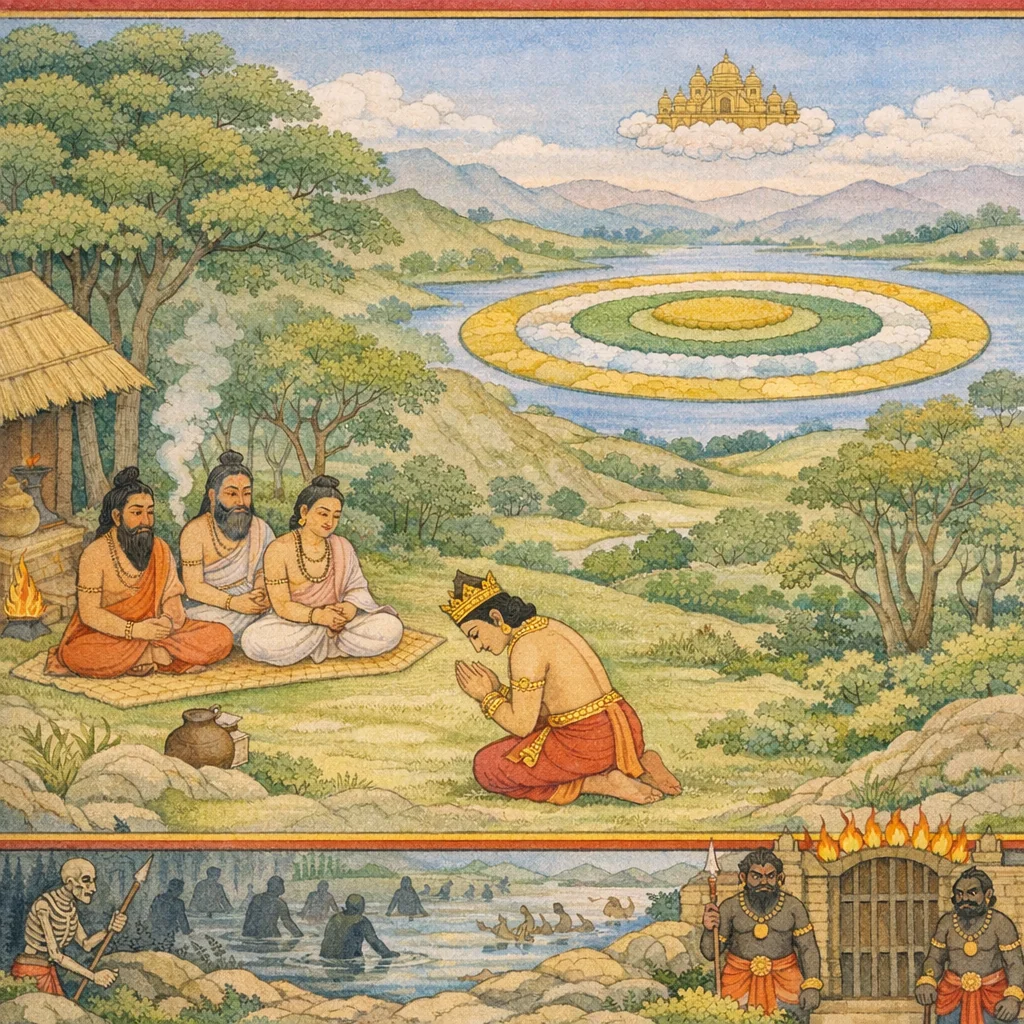
Adhyaya 10: Sukeshi’s Inquiry into Dharma: The Seven Dvipas and the Twenty-One Hells
सुकेशि-धर्मप्रश्नः द्वीप-नरक-वर्णनं च (Sukeśi-Dharma-Praśnaḥ Dvīpa-Naraka-Varṇanaṃ ca)
The Seven Dvipas and Twenty-One Hells
Adhyāya 10 unfolds within the Pulastya–Nārada dialogue-frame: Nārada asks about the rākṣasa Sukeśin—his identity, the aerial city granted to him, and why the Sun (Bhāskara) cast him down. Pulastya narrates Sukeśin’s lineage from the niśācara-lord Vidyutkeśin and his reception of boons from Īśāna (Śaṅkara), including an invincible, sky-moving pura—an episode that foregrounds the Purāṇa’s syncretic theology wherein Śaiva grace structures even rākṣasa destinies. Seeking śreyas (welfare) in both worlds, Sukeśin approaches forest-dwelling ṛṣis, who articulate a typology of dharma across twelve yonis (devas, daityas, siddhas, gandharvas, vidyādharas, kiṃpuruṣas, pitṛs, humans, guhyakas, rākṣasas, piśācas, etc.), integrating ritual action, svādhyāya, yoga, and bhakti to Viṣṇu, Śiva, Bhāskara, and Devī. The chapter then pivots to cosmographic topography: the seven dvīpas with encircling oceans (doubling in extent), culminating in Puṣkara-dvīpa associated with raudra/paiśāca dharma and hell-realms. Finally, the ṛṣis enumerate the rauravādi narakas (twenty-one), giving measurements and characteristic torments, establishing a moral geography that links conduct (dharma/adharma) to post-mortem destinations.
Divine Beings
Sacred Geography
Mortal & Asura Figures
Key Content Points
- Pulastya–Nārada narrative frame: Nārada’s questions about Sukeśin, his sky-city boon from Īśāna (Śiva), and the cause of his downfall by Bhāskara (Sun).
- Asura-dharma and comparative dharma taxonomy: ṛṣis define dharma for multiple yonis, emphasizing svādhyāya, yajña, nīti-śāstra, yoga, and bhakti to Viṣṇu/Śiva/Bhāskara/Devī as a syncretic ethical system.
- Cosmographic and moral topography: seven dvīpas and surrounding oceans (with doubling measures), Puṣkara-dvīpa’s raudra character, and the catalog of twenty-one narakas beginning with Raurava and Mahāraurava.
Shlokas in Adhyaya 10
Verse 1
इती श्रीवामनपुराणे नवमो ऽध्यायः पुलस्त्य उवाच ततः प्रवृत्ते संग्रामे भीरूणां भयवर्धने सहस्रक्षो महाचापमादाय व्यसृजच्छरान्
Thus ends the ninth chapter in the Śrī Vāmana Purāṇa. Pulastya said: Then, when the battle commenced—heightening the fear of the timid—Sahasrākṣa (Indra), taking up his great bow, discharged arrows.
Verse 2
अन्धको ऽपि महावेगं धनुराकृष्य भास्वरम् पुरन्दराय चिक्षेप शरान् बर्हिणवाससः
Andhaka too, drawing back his brilliant bow with great speed, shot arrows at Purandara (Indra), the one clad in peacock-feathers.
Verse 3
तावन्योन्यं सुतीक्ष्णाग्रैः शरैः संनतपर्वभिः रुक्मपुङ्खैर्महावेगैराजघ्नतुरुभावपि
Then both of them struck one another with arrows whose tips were exceedingly sharp, whose joints were well-made, and whose shafts were fitted with golden feathers, driven with great force.
Verse 4
चचः क्रुद्धूः शतमखः कुलिशं भ्राम्य पाणिना चिक्षेप दैत्यराजाय तं ददर्श तथान्धकः
Then Śatamakha (Indra), enraged, whirled the thunderbolt in his hand and hurled it at the king of the daityas; Andhaka saw it coming.
Verse 5
आजघान च बाणौघैरस्त्रैः स नारद तान् भस्मसात्तदा चक्रे नगानिव हुताशनः
And he struck them with torrents of arrows and weapons; O Nārada, he then reduced them to ashes, like Fire (hutāśana) burning mountains.
Verse 6
ततो ऽतिवेगिनं वज्रं दृष्ट्वा बलवतां वरः समाप्लुत्य रथात्तस्थौ भुवि बाहु सहायवान्
Then, seeing a very swift vajra (thunderbolt/weapon), the foremost among the mighty leapt down from the chariot and stood upon the earth, with Bāhu as his ally.
Verse 7
रथं सारथिना सार्धं साश्वध्वजसकूबम् भस्म कृत्वाथ कुलिशमन्धकं समुपाययौ
Having turned the chariot—together with its charioteer, with horses, banner, and pole—into ashes, he then advanced toward Andhaka with the kuliśa (thunderbolt/axe-like weapon).
Verse 8
तमापतन्तं वेगेन मुष्टिनाहत्य भूतले पातयामास बलवान् जगर्ज च तदान्धकः
As he rushed in with speed, the powerful Andhaka struck him with his fist and felled him to the ground; then Andhaka roared.
Verse 9
तं गर्जमानं वीक्ष्याथ वासवः सायकैर्दृढम् ववर्ष तान् वारयन् स समभ्यायाच्छतक्रतुम्
Seeing him roaring, Vāsava (Indra) showered him firmly with arrows; warding them off, he advanced toward Śatakratu (Indra).
Verse 11
आजघान तलेनेभं कुम्भमध्ये पदा करे जानुना च समाहत्य विषाणं प्रबभञ्ज च / 10.10 वाममुष्ट्या तथा पार्श्वं समाहत्यान्धकस्त्वरन् गजेन्द्रं पातयामास प्रहारैर्जर्जरीकृतम्
He struck the lordly elephant on the forehead (temple) with his palm, in the middle of its frontal globes, with foot and hand; he also smote it with his knee and broke its tusk. Then Andhaka, rushing, struck its flank with his left fist and, having battered it with blows, felled the elephant-king, leaving it shattered.
Verse 12
गजेन्द्रात् पतमानाच्च अवप्लुत्य शतक्रतुः पाणिना वज्रमादाय प्रविवेशामरावतीम्
Śatakratu (Indra), leaping down from the falling lord of elephants (Airāvata), took the thunderbolt in his hand and entered Amarāvatī.
Verse 13
परङ्मुखे सहस्राक्षे तदा दैवतबलं महत् पातयामा द्रत्येन्द्रः पादमुष्टितलादिभिः
When Sahasrākṣa (Indra) had turned away, then the mighty force of the gods was struck down by the lord of the Dānavas, using kicks, fists, palms, and the like.
Verse 14
ततो वैवस्वतो दण्डं परिभ्राम्य द्विजोत्तम समभ्यधावत् प्रह्लादं हन्तुकामः सुरोत्तमः
Then Vaivasvata (Yama), whirling his staff, rushed toward Prahlāda, desiring to kill him—O best of twice-born.
Verse 15
तमापतन्तं बाणैघैर्ववर्षं रविनन्दनम् हिरण्यकशिपोः पुत्रश् चापमानम्य वेगवान्
As the son of Ravi (the Sun) advanced, the swift son of Hiraṇyakaśipu, bending his bow, showered him with a fierce barrage of arrows.
Verse 16
तां बाणवृष्टिमतुलां दण्डेनाहत्य भास्करिः शातयित्वा प्रचिक्षेप दण्डं लोकभयङ्करम्
Bhāskari (the solar one) struck that incomparable rain of arrows with his staff; shattering it, he hurled the staff—terrifying to the worlds.
Verse 17
स वायुपथमास्थाय धर्मराजकरे स्थितः जज्वाल कालग्निनिभो यद्वद् दग्धुं जगत्त्रयम्
Taking to the path of the wind and coming to rest in the hand of Dharmarāja, he blazed like the fire of Time, as though to burn the three worlds.
Verse 18
जाज्वल्यमानामायान्तं दण्डं दृष्ट्वा दितेः सुताः प्राक्रोशन्ति हतः कष्टं प्रह्लादो ऽयं यमेन हि
Seeing a blazing staff (daṇḍa) approaching, the sons of Diti cried out: “Alas! Prahlāda has been slain—surely by Yama.”
Verse 19
तमाक्रन्दितमाकर्ण्य हिरण्याक्षसुतो ऽन्धकः प्रोवाच मा भैष्टच मयि स्थिते को ऽयं सुराधमः
Hearing that lamentation, Andhaka, the son of Hiraṇyākṣa, said: “Do not fear while I stand here—who is this wretched god?”
Verse 20
इत्येवसुक्त्वा वचनं वेगेनाबिससार च/ जग्राह पाणिना दणेडं हसन् सव्येन नारद
Having spoken thus, he rushed forward with speed; but Nārada, smiling, seized the staff with his left hand.
Verse 21
तमादाय ततो वेगाद् भ्रामयामास चान्धकः जगर्ज च महानादं यथा प्रावृषि तोयदः
Then Andhaka, seizing it, began to whirl it with force, and he roared with a great sound, like a rain-cloud in the monsoon season.
Verse 22
प्रह्लादं रक्षितं दृष्ट्वा दण्डाद् दैत्येश्वरेण हि साधुवादं ददुर्हृष्टा दैत्यदानवयूथपाः
Seeing Prahlāda protected by the staff indeed by the lord of the Daityas, the chiefs of the Daityas and Dānavas, delighted, offered acclamations of approval.
Verse 23
भ्रामयन्तं महादण्डं दृष्ट्वा भानुसुतो मुने दुःसहं दुर्धरं मत्वा अन्तर्धानमगाद् यमः
O sage, seeing the great staff being whirled, Bhānu’s son (Yama) judged it unbearable and unmanageable, and Yama went into concealment (disappeared).
Verse 24
अन्तर्हिते धर्मराजे प्रह्लादो ऽपि महामुने दारयामास बलवान् देवसैन्यं समन्ततः
When Dharmarāja had disappeared, Prahlāda too, O great sage, being mighty, tore through the army of the gods on all sides.
Verse 25
वरुणः शिशुमारस्थो बद्ध्वा पाशैर्महासुरान् गदया दारयामास तमभ्यागाद् विरोचनः
Varuṇa, stationed upon the Śiśumāra (aquatic mount), bound the great Asuras with nooses and then smashed them with his mace; Virocana advanced against him.
Verse 26
तोमरैर्वज्रसंस्पर्शैः शक्तिभिर्मार्गणैरपि जलेशं ताडयामास मुद्गरैः कणपैरपि
With spears that struck like thunderbolts, with lances and with arrows as well, he struck the lord of waters; with hammers and even with clubs too.
Verse 27
ततस्तं गदयाभ्येत्य पातयित्वा धरातले अभिद्रुत्य बबन्धाथ पाशैर्मत्तगजं बली
Then, approaching him with a mace, he struck him down upon the ground. Rushing forward, Bali bound him with nooses, like a maddened elephant (is bound).
Verse 28
तान् पाशाञ्शतधा चक्रे वेगाच्च दनुजेश्वरः वरुणं च समभ्येत्य मध्ये जग्राह नारद
The lord of the Dānavas shattered those nooses into a hundred pieces with force. Then Nārada, approaching Varuṇa, seized him in the midst (of the fray).
Verse 29
ततो दन्ती च शृङ्गाभ्यां प्रचिक्षेप तदाव्ययः ममर्द च तथा पद्भ्यां सवाहं सलिलेश्वराम्
Then the elephant (or elephant-like one) hurled him with (its) tusks and horns. And then the imperishable one trampled the lord of waters as well, together with his mount.
Verse 30
तं मर्द्यमानं वीक्ष्याथ शशाङ्कः शिशिराशुमान् अभ्येत्य ताडयामास मार्गणैः कायदारणैः
Seeing him being crushed, Śaśāṅka (the Moon), swift with wintry rays, came forward and struck (the assailant) with arrows that tore the body.
Verse 31
स ताड्यमानः शिशिरांशुबाणैरवाप पीडां परमां गजेन्द्रः दुष्टश्च वेगात् पयसामधीशं मुहुर्मुहुः पादतलैर्ममर्द
Struck by the arrows of the wintry rays, the lordly elephant suffered extreme pain; and, enraged and wicked, in his fury he repeatedly trampled the lord of the waters (Varuṇa) with the soles of his feet.
Verse 32
स मृद्यमानो वरुणो गजेन्द्रं पद्भ्यां सुगाढं जगृहे महर्षे पादेषु भूमिं करयोः स्पृशंश्च मूर्द्धानमुल्लाल्य बलान्महात्मा
While being crushed, Varuṇa, O great sage, firmly seized the lordly elephant by its feet; as its feet touched the earth and its hands (trunk/forelimbs) reached (down), the great-souled one lifted up its head by force.
Verse 33
गृह्याङ्गुलीभिश्च गजस्य पुच्छं कृत्वेह बन्धं भुजगेश्वरेण उत्पाट्य चिक्षेप विरोचनं हि सकुञ्जरं खे सनियन्तृवाहम्
Grasping the elephant’s tail with his fingers and binding it here by the lord of serpents, Virocana tore it up and hurled it—together with the elephant—into the sky, (casting away) the controller who rode upon it.
Verse 34
क्षिप्तो जलेशेन विरोचनस्तु सकुञ्जरो भूमितले पपात साट्टं सन्यत्रार्गलहर्म्यभूमि पुरं सुकेशेरिव भस्करेण
But Virocana, hurled by Jaleśa, fell upon the ground together with the elephant; he struck down (things) as though the sun, in the city of Sukeśa, were blazing upon the mansions and the ground, shattering their bars and fastenings.
Verse 35
ततो जलेशः सगदः सपाशः सम्भ्यधावद् दितिजं निहन्तुम् ततः समाक्रन्दमनुत्तमं हि मुक्तं तु दैत्यैर्घनरावतुल्यम्
Then Jaleśa, bearing a mace and a noose, rushed forth to slay the son of Diti. Thereupon the Daityas released an unsurpassed war-cry, like the roaring of thunderclouds.
Verse 36
हा हा हतो ऽसौ वरुणेन वीरो विरोचनो दानवसैन्यपालः प्रह्लाद हे जम्भकुजम्भकाद्या रक्षध्वमभ्येत्य सहान्धकेन
“Alas, alas! That hero Virocana, commander of the Dānava army, has been slain by Varuṇa. O Prahlāda! O Jambha, Kujambha and others—come quickly together with Andhaka and protect (us)!”
Verse 37
अहो महात्मा बलवाञ्जलेशः संचूर्णयन् दैत्यभटं सवाहम् पाशेन बद्ध्वा गदया निहन्ति यथा पशुं वाजिमखे महेन्द्रः
“Ah! How great-souled and powerful is the Lord of the waters! Crushing the Daitya warriors along with their mounts/vehicles, he binds them with his noose and strikes them down with his mace—like Mahendra (Indra) slays an animal in the horse-sacrifice.”
Verse 38
श्रुतत्वाथ शब्दं दितिजैः समीरितं जम्भप्रधाना दितिजेश्वरास्ततः समभ्यधावंस्त्वरिता जलेश्वरं यथा पतङ्गा ज्वलितं हुताशनम्
“Then, hearing the cry raised by the Diti-born (Daityas), the Daitya lords—led by Jambha—swiftly rushed toward the Lord of the waters, like moths (rush) into a blazing fire.”
Verse 39
तानागतान् वै प्रसमीक्ष्य देवः प्राह्लादिसुत्सृज्य वितत्य पाशम् गदां समुद्भ्राम्य जलेश्वरस्तु दुद्राव तान् जम्भमुखानरातीन्
Seeing those enemies approaching, the deity Jaleśvara—having released and cast forth a noose (pāśa) and whirled his mace—rushed upon those foes headed by Jambha.
Verse 40
जम्भं च पाशेन तथा निहत्य तारं तलेनाशनिसंनिभेन पादेन वृत्रं तरसा कुजम्भं निपातयामास बलं च मुष्ट्या
He struck down Jambha with the noose; Tāra with a palm-blow like a thunderbolt; Vṛtra with his foot, swiftly; he felled Kujambha, and (also) Bala with a fist-strike.
Verse 41
तेनार्दिता देववरेण दैत्याः संप्राद्रवन् दिक्षु विमुक्तशस्त्राः ततो ऽन्धकः सत्वरितो ऽभ्युपेयाद् रणाय योद्धुं जलनायकेन
Struck and harassed by that foremost of gods, the daityas fled in all directions, casting away their weapons. Then Andhaka, hastening forward, approached to fight in battle with the leader of the waters (Jaleśvara).
Verse 42
तमापतन्तं गदया जघान पाशेन बद्ध्वा परुणो ऽसुरेशम् तं पाशमाविध्य गदां प्रगृह्य चिक्षेप दैत्यः स च जलेश्वराय
Paruṇa struck the approaching lord of the Asuras with a mace and bound him with a noose. The Daitya, however, tore away that noose and, seizing the mace, hurled it at the lord of the waters.
Verse 43
तमापतन्तं प्रसमीक्ष्य पाशं गदां च दाक्षायणिनन्दनस्तु विवेश वेगात् पयसां निधानं ततो ऽन्धको देवबलं ममर्द
Seeing the noose and the mace rushing toward him, the son of Dakṣāyaṇī entered swiftly into the reservoir of waters. Then Andhaka crusheds (Andhaka) crushed the army of the gods.
Verse 44
ततो हुताशः सुरशत्रुसैन्यं ददाह रोषात् पवनावधूतः तमभ्ययाद् दानवविश्वकर्मा मयो महाबाहुरुदग्रवीर्यः
Then Hutāśa (Agni), fanned by the wind, burned the army of the enemies of the gods in wrath. Thereupon the Dānava ‘Viśvakarman’, Maya—mighty-armed and of formidable valor—advanced toward him.
Verse 45
तमापतन्तं सह शम्बरेण समीक्ष्य वह्निः पवनेन सार्धम् शक्त्या मयं शम्बरमेत्य कण्ठे संताड्य जग्राह बलान्महर्षे
Seeing Maya rushing in together with Śambara, Agni (Fire), accompanied by Vāyu (Wind), advanced and—using his spear—struck Maya and Śambara at the throat and seized them by force, O great sage.
Verse 46
शक्त्या स कायावरणे विदारिते संभिन्नदेहो न्यपतत् पृथिव्याम् मयः प्रजज्वाल च शम्वरो ऽपि कण्ठावलग्ने ज्वलने प्रदीप्ते
When his bodily covering/armor was torn open by the spear, his body shattered, he fell upon the earth. And Maya blazed, and Śambara too, as the blazing fire clung to their throats.
Verse 47
स दह्यमानो दितिजो ऽग्निनाथ सुविस्वरं घोरतरं रुराव सिंहाभिपन्नो विपिने यथैव मत्तो गजः क्रन्दति वेदनार्त्तः
As that son of Diti burned, O lord of fire, he roared in a very loud and most dreadful voice—just as, in a forest, a maddened elephant cries out in pain when attacked by a lion.
Verse 48
तं शब्दमाकर्ण्य च शम्बरस्य दैत्येश्वरः क्रोधविरक्तदृष्टिः आः किं किमेतन्ननु केन युद्धे जितो मयः शम्बरदानवश्च
Hearing that cry of Śambara, the lord of the Daityas, his gaze inflamed with anger, said: “Ah! What is this? By whom in battle have Maya and the Dānava Śambara been conquered?”
Verse 49
ततो ऽब्रुवन् दैत्यभटा दितीशं प्रदह्यते ह्येष हुताशनेन रक्षस्व चाभ्येत्य न शक्यते ऽन्यैर्हुताशनो वारयितुं रणाग्रे
Then the Daitya soldiers said to the lord of Diti: “This one is indeed being burned by Hutāśana (Agni). Come forward and protect (us/him). In the forefront of battle, Hutāśana cannot be checked by others.”
Verse 50
इत्थं स दैत्यैरभिनोदितस्तु हिरण्यचक्षुस्तनयो महर्षे उद्यम्य वेगात् परिघं हुताशं समाद्रवत् तिष्ठ तिष्ठ ब्रुवन् हि
Thus urged on by the Daityas, O great sage, the son of Hiraṇyacakṣus, lifting a parigha (iron bar/club) and rushing with speed toward Hutāśana, ran forward, crying, “Stand! Stand!”
Verse 51
श्रुत्वान्धकस्यापि वचो ऽव्ययात्मा संक्रुद्धचित्तस्त्वरितो हि दैत्यम् उत्पाट्य भूम्यां च विनिष्पिपेष ततो ऽन्धकः पावकमाससाद
Hearing even Andhaka’s words, the imperishable one, his mind inflamed with anger, swiftly uprooted the Daitya and crushed him upon the earth. Then Andhaka approached (took refuge with / went toward) the Fire-god (Pāvaka).
Verse 53
समाजघानाथ हुताशनं हि वरयुधेनाथ वराङ्गमध्ये समाहतो ऽग्निः परिमुच्य शम्बरं तथान्धकं स त्वरितो ऽभ्यधावत् // वम्प्_10.52 तमापतन्तं परिघेण भूयः समाहनन्मूर्ध्नि तदान्धको ऽपि स ताडितो ऽग्निर्दितिजेश्वरेण भयात् प्रदुद्राव रणाजिराद्वि
Then he struck the Fire-god (Hutāśana) with an excellent weapon, in the midst of the battle. Struck, Agni, releasing (letting go of) Śambara, swiftly rushed toward Andhaka. As he came charging, Andhaka again smote him on the head with an iron club. Struck by the lord of the Dānavas, Agni fled in fear from the battlefield.
Verse 54
ततो ऽन्धको मारुतचन्द्रभास्करान् साध्यान् सरुद्राश्विवसून् महोरगान् यान् याञ्शरेण स्पृशते पराक्रमी पराङ्मुखांस्तान्कृतवान् रणाजिरात्
Then Andhaka—the mighty one—made the Wind-god, the Moon, the Sun, the Sādhyas, together with the Rudras, the Aśvins, the Vasus, and the great serpents, turn away and retreat from the battlefield—whomever he touched with his arrows.
Verse 55
ततो विजित्यामरसैन्यसुग्रं सेन्द्रं सरुद्रं सयमं ससोमम् संपूज्यमानो दनुपुङ्गवैस्तु तदान्धको भूमिमुपाजगाम
Then, having conquered the fierce army of the gods—along with Indra, with Rudra, with Yama, and with Soma—Andhaka, while being honored by the foremost of the Dānavas, came to the earth.
Verse 56
आसाद्य भूमिं करदान् नरेन्द्रान् कृत्वा वशे स्थाप्य चराचरं च/ जगत्समग्रं प्रविवेश धीमान् पातालमग्र्यं पुरमश्मकाह्वम्
Having reached the earth, he made the kings pay tribute, brought the moving and unmoving under his control, and—having subdued the whole world—the wise one entered the foremost region of Pātāla, the city called Aśmaka.
Verse 57
तत्र स्थितस्यापि महासुरस्य गन्धर्वविद्याधरसिद्धसंघाः सहाप्सरोभिः परिचारणाय पातालमभ्येत्य समावसन्त
Even while that great Asura was stationed there, hosts of Gandharvas, Vidyādharas, and Siddhas—together with Apsarases—came to Pātāla and dwelt there to attend upon him.
Frequently Asked Questions
The chapter presents a syncretic ethical theology: Sukeśin receives decisive protection and an aerial city through Īśāna/Śaṅkara’s boon, while the ṛṣis simultaneously define dharma as including Viṣṇu-bhakti (Acyuta/Hari) alongside devotion to Śiva (Tryambaka/Śaṅkara), Bhāskara (Sun), and Devī (Bhavānī). Rather than competing sectarian claims, bhakti and svādhyāya are distributed as normative virtues across yonis, implying complementary divine sovereignties within a single moral order.
This Adhyāya is primarily cosmographic rather than Kurukṣetra/Sarasvatī-tīrtha specific: it maps the seven dvīpas (Jambū, Plakṣa, Śālmali, Kuśa, Krauñca, Śāka, Puṣkara) and their encircling oceans with doubling measurements, culminating in the Kṣīrābdhi where Hari rests on Śeṣa. It also introduces a moral geography by situating Puṣkara-dvīpa as raudra/paiśāca-associated and by naming Vaitaraṇī as a hell-river, linking spatial description to karmic consequence.
They function as a didactic extension of the dharma discourse: after defining dharma across yonis, the ṛṣis specify the punitive destinations for adharma by listing the rauravādi hells as twenty-one in number, beginning with Raurava (measured at two thousand yojanas with burning coals) and proceeding through named torments (e.g., Mahāraurava, Tamisra, Andhatāmisra, Asipatravana, etc.), including the fearsome Vaitaraṇī. The catalog concretizes karmic retribution as a structured post-mortem landscape.