Adhyaya 11: Sukesha’s Boon, the Twelve Dharmas of Beings, and the Cosmography of the Seven Dvipas with the Twenty-One Hells
सुकेशि-वरप्राप्तिः द्वादश-धर्म-वर्णनं सप्तद्वीप-प्रमाणं रौरवादि-नरक-निरूपणम् (Sukeśi-Varaprāptiḥ Dvādaśa-Dharma-Varṇanaṃ Saptadvīpa-Pramāṇaṃ Rauravādi-Naraka-Nirūpaṇam)
Cosmography of Seven Dvipas
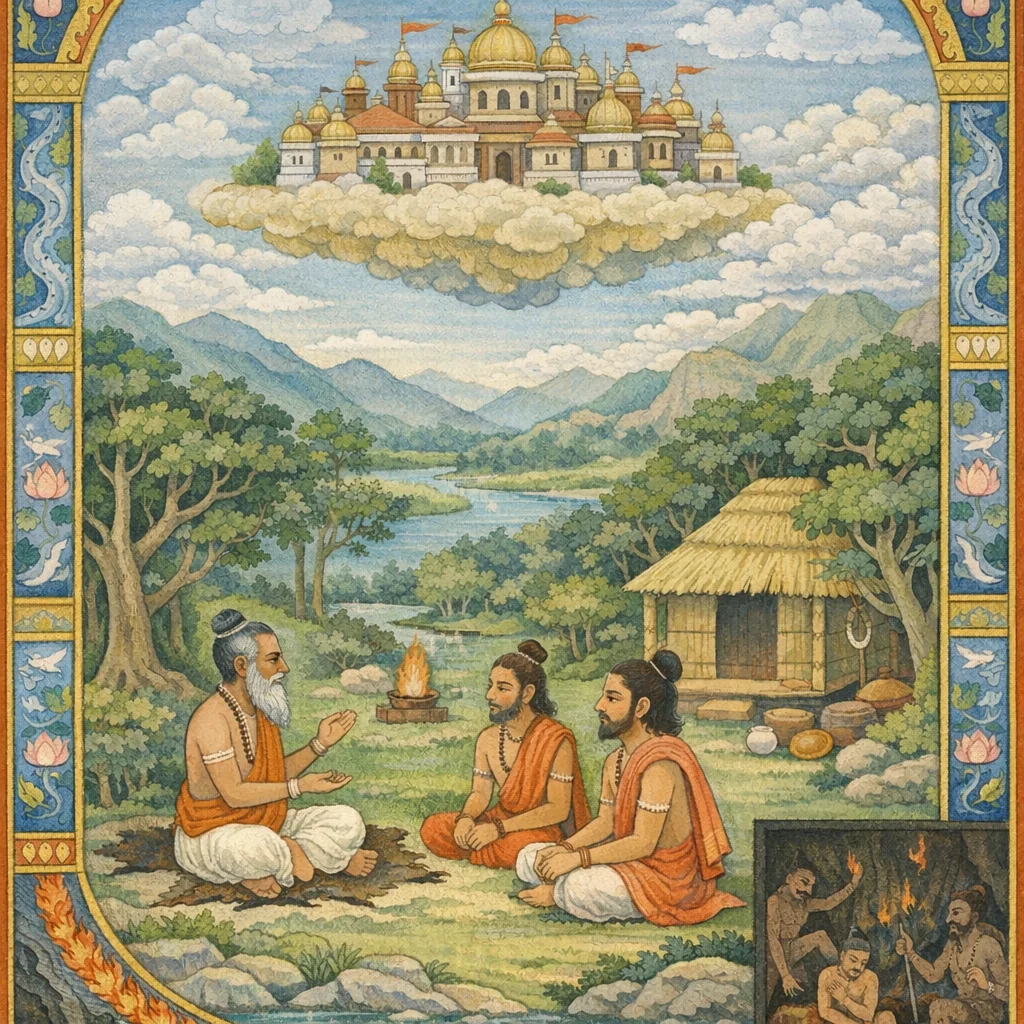
Adhyāya 10 unfolds within the Pulastya–Nārada dialogue-frame: Nārada asks when, where, and why the rākṣasa Sukesha was cast down from the sky by Sūrya. Pulastya narrates Sukesha’s lineage (son of Vidyutkeśin) and his acquisition of an aerial city and near-invulnerability through Śaṅkara’s favor—an early marker of the Purāṇa’s syncretic theology, where Shaiva grace structures an asura’s worldly power. In the Māgadha forest Sukesha approaches perfected ṛṣis and inquires into “śreyas” and the defining marks of dharma. The sages respond with a typology of dharmas across twelve yonis (devas, daityas, siddhas, gandharvas, vidyādharas, kiṃpuruṣas, pitṛs, humans, rākṣasas, piśācas, etc.), integrating ritual action, svādhyāya, and bhakti to Viṣṇu, Hara, Bhāskara, and Devī. The chapter then pivots to cosmographic measurement: the seven dvīpas and encircling oceans in doubling proportions, culminating in Puṣkara-dvīpa and its raudra character. This topographical-cosmological mapping leads into a catalogue of twenty-one hells (beginning with Raurava), establishing a moral geography that links conduct (dharma/adharma) to post-mortem destinations.
Divine Beings
Sacred Geography
Mortal & Asura Figures
Key Content Points
- Pulastya answers Nārada’s query by recounting Sukesha’s origin, Śaṅkara-granted aerial city (gaganaga-pura), and the narrative conditions leading to his later downfall by Sūrya.
- A systematic, comparative taxonomy of dharma across multiple classes of beings (yonis), emphasizing svādhyāya, yajña, yogic discipline, and multi-deity bhakti (Viṣṇu–Hara–Bhāskara–Devī) as a syncretic ethical framework.
- Cosmographic and topographical specification of the seven dvīpas and surrounding oceans in doubling measures, followed by Puṣkara-dvīpa’s raudra/naraka associations and an enumerative description of the twenty-one hells (Raurava, Mahāraurava, Tāmisra, Andhatāmisra, etc.).
Shlokas in Adhyaya 11
Verse 1
इति श्रीवामनपुराणे दशमो ऽध्यायः नारद उवाच यदेतद् भवता प्रोक्तं सुकेशिनकरो ऽम्बरात् पातितो भुवि सूर्योण तत्कदा कुत्र कुत्र च
Thus ends the tenth chapter of the Śrī Vāmana Purāṇa. Nārada said: “What you have stated—namely that Sūrya was struck down from the sky to the earth by the hand of Sukeśin—when did that happen, and in what place (or places) did it occur?”
Verse 2
सुकेशीति च कश्चासौ केन दत्तः पुरो ऽस्य च किमर्थं पातितो भूम्यामाकाशाद् भास्करेण हि
“And who indeed is this one called Sukeśin? By whom was his city (pura) granted to him? And for what reason was the Bhāskara (Sun) cast down from the sky onto the earth?”
Verse 3
पुलस्त्य उवाच/ शृणुष्वावहितो भूत्वा कथामेतां पुरातनीम् यथोक्तवान् स्वयंभूर्मां कथ्यमानां मयानघ
Pulastya said: “Listen attentively to this ancient tale, O sinless one. I shall relate it as Svayambhū (Brahmā) once told it to me.”
Verse 4
आसीन्निशाचरपतिर्विद्युत्केशीति विश्रुतः तस्य पुत्रो गुणज्येष्ठः सुकेशिरभवत्ततः
There was a lord of the night-rangers (demons) famed as Vidyutkeśa. His son, foremost in virtues, was thereafter born as Sukeśin.
Verse 5
तस्य तुष्टस्तथेशानः पुरमाकाशचारिणम् प्रादादजेयत्वमपि शत्रुभिश्चाप्यवध्यताम्
Pleased with him, Īśāna (Śiva) granted him a city that moved through the sky, and also (the boon of) being unconquerable and even invulnerable to enemies.
Verse 6
स चापि शङ्करात् प्राप्य वरं गगनगं पुरम् रेमे निशाचरैः सार्द्धू सदा धर्मपथि स्थितः
And he too, having obtained from Śaṅkara the boon of a sky-going city, delighted (lived in enjoyment) together with the night-rangers, while always remaining established on the path of dharma.
Verse 7
स कदाचिद् गतो ऽरण्यं मागधं राक्षसेश्वरः तत्राश्रमांस्तु ददृशो ऋषीणां भावितात्मनाम्
Once, the lord of the rākṣasas went to the Māgadha forest. There he saw the hermitages of sages whose selves were spiritually cultivated.
Verse 8
महर्षिन् स तदा दृष्ट्वा प्रणिपत्याभिवाद्य च/ प्रत्युवाच ऋषीन् सर्वान् कृतासनपरिग्रहः
Then, seeing the great sages, he bowed down and greeted them, and—having taken a seat—addressed all the sages in reply.
Verse 9
सुकेशिरुवाच प्रष्टुमिच्छामि भवतः संशयो ऽयं हृदि स्थितः कथयन्तु भवन्तो मे न चौवाज्ञापयाम्यहम्
Sukeśi said: I wish to ask you; this doubt remains fixed in my heart. May you tell me—indeed, I do not intend any disrespect.
Verse 10
किंस्विच्छ्रेयः परे लोके किमु चेह द्विजोत्तमाः केन पूज्यस्तथा सत्सु केनासौ सुखमेधते
“What indeed is the highest good in the other world, and what (is the highest good) here? O best of the twice-born—by what is one to be worshipped among the virtuous, and by what does he prosper in happiness?”
Verse 11
पुलस्त्य उवाच/ इत्थं सुकेशिवचनं निशम्य परमर्षयः प्रोचुर्विमृस्य श्रेयोर्ऽथमिह लोके परत्र च
Pulastya said: “Having thus heard the words of Sukeśi, the great sages, after reflecting, spoke about that which is for the sake of the highest good—both in this world and in the next.”
Verse 12
ऋष ऊचुः श्रूयतां कथयिष्यामस्तव राक्षसपुङ्गव यद्धि श्रेयो भवेद् वीर इह चामुत्र चाव्ययम्
The sages said: “Listen; we shall tell you, O foremost of the Rākṣasas, what indeed constitutes the highest good, O hero—(that good) which is imperishable both here and in the hereafter.”
Verse 13
श्रेयो धर्मः परे लोके इह च क्षणदाचर तस्मिन् समाश्रितः सत्सु पूज्यस्तेन सुखी भवेत्
Dharma is the highest good in the next world, and even here it should be practiced promptly. One who takes refuge in that (dharma), among the virtuous, becomes worthy of honor; by that he becomes happy.
Verse 14
सुकेशिरुवाच किंलक्षणो भवेद् धर्मः किमाचरणसत्क्रियः यमाश्रित्य न सीदन्ति देवाद्यास्तु तदुच्यताम्
Sukeśī said: What are the characteristics of dharma? What conduct and proper observances constitute it? That by taking refuge in which the gods and others do not fall into distress—please declare that.
Verse 15
ऋषय ऊचुः देवानां परमो धर्मः सदा यज्ञादिकाः क्रियाः स्वाध्यायवेदवेत्तृत्वं विष्णुपूजारतिः स्मृता
The Ṛṣis said: The supreme dharma of the gods is always the performance of acts beginning with sacrifice (yajña). (It also consists in) self-study and mastery/knowing of the Veda, and delight in the worship of Viṣṇu—so it is remembered.
Verse 16
दैत्यानां बाहुशलित्वं मात्सर्यं युद्धसत्क्रिया वेदनं नीतिशास्त्राणां हरभक्तिरुदाहृता
For the Daityas, strength of arms, jealousy, and proper conduct in battle are stated (as their traits); knowledge of polity/treatises on statecraft, and devotion to Hara (Śiva), are also declared.
Verse 17
सिद्धानामुदितो धर्मो योगयुक्तिरनुत्तमा स्वाध्यायं ब्रह्मविज्ञानं भक्तिर्द्वाभ्यामपि स्थिरा
The dharma proclaimed for the Siddhas is unsurpassed discipline in yoga; (also) self-study and realization/knowledge of Brahman; and devotion that is steady in both (i.e., grounded in these two).
Verse 18
उत्कृष्टोपासनं ज्ञेयं नृत्यवाद्येषु वेदिता सरस्वत्यां स्थिरा भक्तिर्गान्धर्वो धर्म उच्यते
Superior worship is to be understood (as their hallmark); they are skilled in dance and musical instruments; steady devotion to Sarasvatī—this is said to be the dharma of the Gandharvas.
Verse 19
विद्याधरत्वमतुलं विज्ञानं पौरुषे मतिः विद्याधराणां धर्मो ऽयं भवान्यां भक्तिरेव च
Unsurpassed Vidyādhara-hood, discriminative knowledge, and a manly/steadfast resolve—such is said to be the dharma of the Vidyādharas; and also devotion to Bhavānī (the Goddess).
Verse 20
गन्धर्वविद्यावेदित्वं भक्तिर्भानौ तथा स्थिरा कौशल्यं सर्वशिल्पानां धर्मः किंपुरुषः स्मृतः
Knowing the lore of the Gandharvas, steadfast devotion to Bhānu (the Sun), and proficiency in all arts—this is remembered as the defining dharma of the Kiṃpuruṣas.
Verse 21
ब्रह्मचर्यममानित्वं योगाभ्यासरतिर्दृढा सर्वत्र कामचारितवं धर्मो ऽयं पैतृकः स्मृतः
Celibate discipline (brahmacarya), humility (freedom from self-importance), firm delight in the practice of yoga, and the ability to move at will everywhere—this is remembered as the dharma of the Paitṛkas (the ancestral class).
Verse 22
ब्रह्मचर्यं यताशित्वं जप्यं ज्ञानं च राक्षस नियमाद्धर्मवेदित्वमार्थो धर्मः प्रचक्ष्यते
“Celibate discipline, measured eating, recitation (of sacred formulae), and knowledge—O Rākṣasa—through such restraints one becomes a knower of dharma. The purpose (artha) is declared to be dharma.”
Verse 23
स्वाध्यायं ब्रह्मचर्यं च दानं यजनमेव च अकार्पण्यमनायासं दयाहिंसा क्षमा दमः
“Self-study (of sacred texts), celibate discipline, charity, and sacrifice; non-miserliness, effort without strain, compassion, non-violence, forbearance, and self-control.”
Verse 24
जितेन्द्रियत्वं शौचं च माङ्गल्यं भक्तिरच्युते शङ्करे भास्करे देव्यां धर्मो ऽयं मानवः स्मृतः
“Mastery over the senses, purity, auspicious conduct, and devotion to Acyuta; and (reverence) toward Śaṅkara, Bhāskara, and the Goddess—this is remembered as the dharma of human beings.”
Verse 25
धनाधिपत्यं भोगानि स्वाध्यायं शकरर्चनम् अहङ्कारमशौण्डीर्यं धर्मो ऽयं गुह्यकेष्विति
“Lordship over wealth, enjoyment of pleasures, Vedic self-study, worship of Śakara (Śiva), pride, and the absence of boastful bravado—this is said to be the dharma (characteristic code) among the Guhyakas.”
Verse 26
परदारावमर्शित्वं पारक्येर्ऽथे च लोलुपा स्वाध्यायं त्र्यम्बके भक्तिर्धर्मो ऽयं राक्षसः स्मृतः
“Violation of others’ wives, greed for others’ wealth, Vedic self-study, and devotion to Tryambaka (Śiva)—this is remembered as the dharma (characteristic code) of the Rākṣasas.”
Verse 27
अविवेकमथाज्ञानं शौचहानिरसत्यता पिशाचानामयं धर्मः सदा चामिषगृध्नुता
“Lack of discernment, ignorance, loss of purity, untruthfulness—this is the dharma (characteristic code) of the Piśācas; and always, craving for flesh.”
Verse 28
योनयो द्वादशैवैतास्तासु धर्माश्च राक्षस ब्रह्मणा कथिताः पुण्या द्वादशैव गतिप्रदाः
These are indeed the twelve yonis (modes of birth/species). And within them, O Rākṣasa, the dharmas—declared by Brahmā—are meritorious; they are twelve in number and bestow (corresponding) destinations (gatis).
Verse 29
सुकेशिरुवाच भवद्भिरुक्ता ये धर्माः शाश्वता द्वादशाव्ययाः तत्र ये मानवा धर्मास्तान् भूयो वक्तुमर्हथ
Sukeśi said: The dharmas you have spoken of are eternal—twelve and imperishable. Among them, please speak again (in detail) of those dharmas that pertain to humans.
Verse 30
ऋषय ऊचुः शृणुष्व मनुजादीनां धर्मास्तु क्षणदाचर ये वसन्ति महीपृष्ठे नरा द्वीपेषु सप्तसु
The Ṛṣis said: Listen, O night-wanderer (kṣaṇadācara), to the dharmas of humans and the like—of those men who dwell upon the surface of the earth, in the seven dvīpas.
Verse 31
योजनानां प्रमाणेणन पञ्चाशत्कोटिरायता जलोपरि महीयं हि नौरिवास्ते सरिज्जले
Measured in yojanas, the Earth extends for fifty koṭis (of yojanas). Resting upon the waters, this Earth lies like a boat upon the river’s stream.
Verse 32
तस्योपरि च देवेशो ब्रह्म शौलेन्द्रमुत्तमम् कर्णिकाकारमत्युच्चं स्थापयामास सत्त्म
Upon that (Earth/waters), the Lord of the gods—Brahmā—established the supreme (realm/seat), exceedingly lofty and shaped like a lotus-pericarp (karṇikā).
Verse 33
तस्येमां निर्ममे पुण्यां प्रजां देवश्चतुर्दिशम् स्थानानि द्वीपसंज्ञानि कृतवांश्च प्रजापतिः
From that (arrangement), the god created this blessed progeny across the four directions; and Prajāpati also made the abodes known as ‘dvīpas’ (island-continents/regions).
Verse 34
तत्र मध्ये च कृतवाञ्जम्बूद्वीपमिति श्रुतम् तल्लक्षं योजनानां च प्रमाणेन निगद्यते
In the middle there is said to be Jambūdvīpa, established there. Its measure—one hundred thousand yojanas—is stated according to the standard of measurement.
Verse 35
ततो जलनिधी रौद्रो बाह्यतो द्विगुणः स्थितः तस्यापि द्विगुणः प्लक्षो बाह्यतः संप्रतिष्ठितः
Then, outside it, the fierce ocean lies, twice (its size). Outside that again, the Plakṣa continent is established, twice (the preceding).
Verse 36
ततस्त्विक्षुरसोदश्च बाह्यतो वलयासृतिः द्विगुणः शाल्मलिद्वीपो द्विगुणो ऽस्य महोदधेः
Then, outside (that) is the ocean of sugarcane-juice, forming a ring on the outside. The Śālmalī continent is twice (in extent), and twice again is its great ocean.
Verse 37
सुरोदो द्विगुणस्तस्य तस्माच्च द्विगुणः कुशः घृतोदो द्विगुणश्चैव कुशद्वीपात् प्रकीर्तितः
The ocean of surā (liquor) is twice the size of that (preceding one). From that, Kuśa-dvīpa is said to be twice as large; and the ocean of ghee (ghṛta) is likewise declared to be twice the size of Kuśa-dvīpa.
Verse 38
घृतोदाद् द्विगुणः प्रोक्तः क्रौञ्चद्वीपो निशाचर ततो ऽपि द्विगुणः प्रोक्तः समुद्रो दधिसंज्ञितः
O Niśācara, Krauñca-dvīpa is said to be twice the size of the ghee-ocean. Beyond that, the ocean called ‘Dadhi’ (curds/yogurt) is declared to be twice as large.
Verse 39
समुद्राद् द्विगुणः शाकः शाकाद् दुग्धाब्धिरुत्तमः द्विगुणः संस्थितो यत्र शेषपर्यङ्कगो हरिः एते च द्विगुणाः सर्वे परस्परमपि स्थिताः
Śāka-dvīpa is twice the size of that ocean; and beyond Śāka is the excellent ocean of milk. In that realm, Hari, resting upon the couch of Śeṣa, is situated (there); and all these are arranged mutually, each being double the other.
Verse 40
चत्वारिंशदिमाः कोट्यो लक्षाश्च नवतिः स्मृताः योजनानां राक्षसेन्द्र पञ्च चाति सुवुस्तृताः जम्बूद्वीपात् समारभ्य यावत्क्षीराब्धिरन्ततः
“These are said to be forty koṭis and ninety lakṣas (of yojanas), and (with) five (more) yojanas—very extensive, O lord of Rākṣasas—beginning from Jambūdvīpa up to the Milk-Ocean at the end.”
Verse 41
तस्माच्च पुष्करद्वीपः स्वादूदस्तदनन्तरम् कोट्यश्चतस्रो लक्षाणां द्विपञ्चाशच्च राक्षस
“And beyond that is Puṣkaradvīpa, with the Svādūdaka (sweet-water) ocean immediately after it. (Its extent is) four koṭis and fifty-two lakṣas (of yojanas), O Rākṣasa.”
Verse 42
पुष्करद्वीपमानो ऽयं तावदेव तथोदधिः लक्षमण्डकटाहेन समन्तादिभिपूरितम्
“Such is the measure of Puṣkaradvīpa; and the ocean (around it) is of the same extent—filled all around as though by a lakṣa (measure) ‘maṇḍaka-cauldron’ (i.e., a vast vessel/cauldron-like filling).”
Verse 43
एवं द्वीपास्त्विमे सप्त पृथग्धर्माः पृथक्क्रियाः गदिष्यामस्तव वयं शृमुष्व त्वं निशाचर
Thus, these seven continents have distinct duties (dharmas) and distinct practices (rites). We shall describe them to you—listen, O night-roamer (niśācara).
Verse 44
प्लक्षादिषु नरा वीर ये वसन्ति सनातनाः शाकान्तेषु न तेष्वस्ति युगावस्था कथञ्चन
O hero, the eternal men who dwell in Plakṣa and the other (continents/regions), up to Śāka (dvīpa), have no condition of the yugas there in any way.
Verse 45
मोदन्ते देववत्तेषां धर्मो दिव्य उदाहृतः कल्पान्ते प्रलयस्तेषां निगद्येत महाभुज
They rejoice like the gods; their dharma is declared to be divine. At the end of a kalpa, their dissolution (pralaya) is said to occur, O mighty-armed one.
Verse 46
ये जनाः पुष्करद्वीपे वसन्ते रौद्रदर्शने पैशाचमाश्रिता धर्मं कर्मान्ते ते विनाशिनः
Those people who dwell in Puṣkaradvīpa—terrible to behold—having taken refuge in a piśāca-like (demonic/impure) way of life, are destroyed at the end of their karma (i.e., when the fruits of their actions mature).
Verse 47
सुकेशिरुवाच किमर्थं पुष्कद्वीपो भवद्भिः समुदाहृतः दुर्दर्शः शौचरहितो घोरः कर्मान्तनाशकृत्
Sukeśi said: For what reason has Puṣkadvīpa been mentioned by you—hard to look upon, devoid of purity, dreadful, and bringing destruction at the end of karma?
Verse 48
तस्मिन् निशाचर द्वीपे नरकाः सन्ति दारुणाः रौरवाद्यास्ततो रौद्रः पुष्करो घोरदर्शनः
In that island of night-roamers (niśācaras), there are dreadful hells—beginning with Raurava. Therefore Puṣkara is ‘Raudra’ (fierce) and terrible to behold.
Verse 49
सुकेशिरुवाच कियन्त्येतानि रौद्राणि नरकाणि तपोधनः कियन्मात्राणि मार्गेण का च तेषु स्वरूपता
Sukeśin said: “O ascetic rich in austerity, how many are these dreadful hells? What is their extent along the path, and what is their nature (form/character)?”
Verse 50
ऋषय ऊचुः शृणुष्व राक्षसश्रेष्ठ प्रमाणं लक्षणं तथा सर्वेषां रौरवादीनां संख्या या त्वेकविंशतिः
The sages said: “Listen, O best of rākṣasas, to their measure and their characteristics. The total number of all (hells) beginning with Raurava is twenty-one.”
Verse 51
द्वे सहस्रे योजनानां ज्वलिताङ्गारविस्तृते रौरवो नाम नरकः प्रथमः परिकीर्त्तितः
Extending for two thousand yojanas, spread with burning embers, the hell named Raurava is declared as the first.
Verse 52
तप्तताम्रमयी भूमिरधस्ताद्वाह्नितापिता द्वितीयो द्विगुस्तस्मान्महारौरव उच्यते
Below is ground made of heated copper, scorched by fire. The second hell, twofold more severe than that (the previous one), is called Mahāraurava.
Verse 53
ततो ऽपि द्विःस्थितश्चान्यस्तमिस्रो नरकः स्मृतः अन्धतामिस्रको नाम चतुर्थो द्विगुमः परः
Beyond that there is another, twice as severe, known as the hell called Tamisra. Further, the fourth—twofold more intense—is named Andhatāmisra.
Verse 54
ततस्तु कालचक्रेति पञ्चमः परिगीयते अप्रतिष्ठं च नरकं घटीयन्त्रं च सप्तमम्
Then the fifth is sung of as Kāla-cakra (‘Wheel of Time’). Also (there is) the hell called Apratiṣṭha, and the seventh (is) Ghaṭī-yantra.
Verse 55
असिपत्रवनं चान्यत्सहस्राणि द्विसप्ततिः योजनानां परिख्यातमष्टमं नरकोत्तमम्
And another (hell) is Asipatravana, renowned as spanning seventy-two thousand yojanas; it is declared the eighth, a foremost hell.
Verse 56
नमकं तप्तकुम्भं च दशमं कूटशाल्मलिः करपत्रस्तथैवोक्तस्तथान्यः श्वानभोजनः
(There are also the hells called) Namaka and Taptakumbha; the tenth is Kūṭaśālmali. Karapatra is likewise mentioned, and another is Śvānabhojana.
Verse 57
संदंशो लोहपिण्डश्च करम्भसिकता तथा घोरा क्षारनदी चान्या तथान्यः कृमिभोजनः तथाष्टादशमी प्रोक्ता घोरा वैतरणी नदी
(There are also the hells called) Saṃdaṃśa and Lohapiṇḍa, and Karambhasikatā; another dreadful one is the Kṣāranadī (the caustic river), and another is Kṛmibhojana. Thus the eighteenth is declared to be the terrible river Vaitaraṇī.
Verse 58
तथापरः शोणितपूयभोजनः क्षुराग्रधारो निशितश्च चक्रकः संशोषणो नाम तथाप्यनन्तः प्रोक्तास्तवैते नरकाः सुकेशिन्
“And there are other (hells): Śoṇitapūyabhojana (‘eating blood and pus’), Kṣurāgradhāra (‘the stream with razor-sharp edges’), and Niśita-cakraka (‘the place of sharp wheels/discs’). Also (there is) Saṃśoṣaṇa, and likewise Ananta. These hells have thus been declared to you, O Sukeśī.”
Frequently Asked Questions
The sages define dharma through multiple, co-valid modalities—yajña and svādhyāya alongside bhakti—explicitly naming devotion to Viṣṇu (Acyuta/Hari) and to Śiva (Śaṅkara/Tryambaka), and also including Bhāskara and Devī. Sukesha’s power itself is grounded in Śaṅkara’s boon, while the ethical taxonomy treats multi-deity devotion as a legitimate component of right conduct, reflecting the Purāṇa’s syncretic theology rather than sectarian exclusivity.
The chapter gives a concentric cosmography of the seven dvīpas—Jambū, Plakṣa, Śālmali, Kuśa, Krauñca, Śāka, and Puṣkara—each paired with surrounding oceans whose dimensions are described in doubling proportions, extending outward up to the Kṣīrābdhi (Milk Ocean) where Hari is depicted resting on Śeṣa. Puṣkara-dvīpa is singled out for its raudra character and proximity to naraka-imagery, linking cosmic space to moral consequence.
As an extension of moral geography, the sages enumerate a set of twenty-one narakas beginning with Raurava (and Mahāraurava), followed by Tāmisra and Andhatāmisra, and further punitive realms such as Kāla-cakra, Asipatravana, Taptakumbha, Kūṭaśālmali, Śvānabhojana, Kṣāra-nadī, Kṛmibhojana, and the Vaitaraṇī river, among others. The list functions as a consequence-map: adharmic conduct is spatially encoded into specific post-mortem destinations.