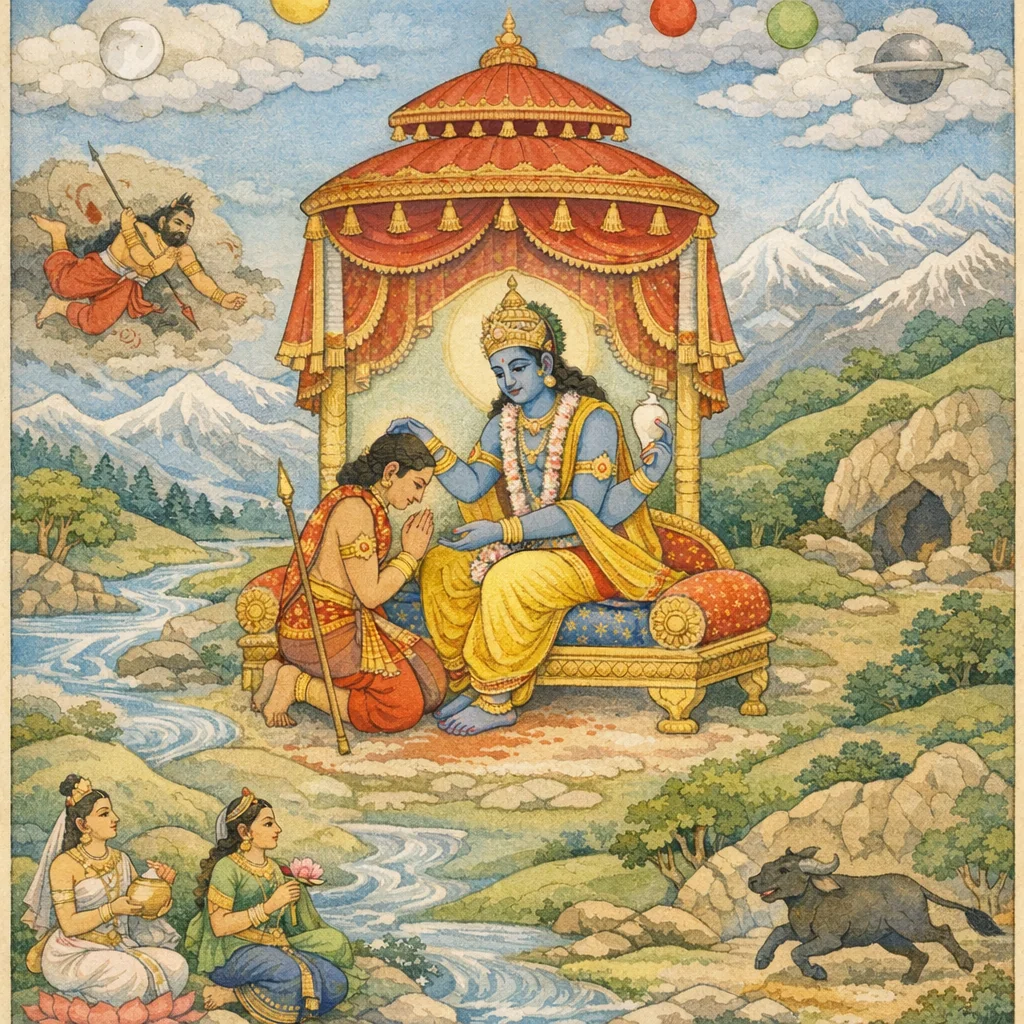
Adhyaya 32: Skanda’s Svastyayana and the Slaying of Taraka and Mahisha
स्कन्द-विजय-स्वस्त्ययन-वर्णनम् (Skanda-Vijaya-Svastyayana-Varṇanam)
Svastyayana and Victory
Within the Pulastya–Nārada narrative frame, this adhyāya presents a syncretic theology in which Skanda’s martial mission is ritually authorized through a Vaiṣṇava act (Hari/Garuḍadhvaja bestowing a svastyayana) while remaining embedded in a Śaiva family-world (Umā–Śaṅkara–Skanda). The chapter opens with Kumāra (Skanda) paying homage to Bhava (Śiva), Girijā (Pārvatī), Agni, the Kṛttikās, and Brahmā, then receiving Viṣṇu’s auspicious benediction that invokes a wide cosmic assembly—planets, ṛṣis, gaṇas, yakṣas, nāgas, rivers, tīrthas, and directional guardians—functioning as an iconographic and cosmographic “protective map” for victory. The narrative then shifts to asura-dharma and battlefield dynamics: the daityas (Tāraka, Mahiṣa, Bāṇa, Andhaka and others) respond to ominous sounds and engage Skanda’s gaṇas and the Mātṛ-maṇḍala. Skanda kills Tāraka; Mahiṣa retreats to Kraunca/Dimācala and is ultimately pierced by Skanda’s śakti. A moral-legal debate follows on kin-slaying versus the greater good (naikasyārthe bahūn hanyāt), after which Viṣṇu redirects Skanda to tīrtha-prāyaścitta (Pṛthūdaka; bathing in Oghavatī; darśana of Hara), restoring radiance and reaffirming Hari–Hara mutuality.
Divine Beings
Sacred Geography
Mortal & Asura Figures
Key Content Points
- Pulastya–Nārada frame: Nārada asks about Viṣṇu’s svastyayana; Pulastya explains the auspicious formula granted for Skanda’s victory and Mahiṣa’s destruction.
- Sectarian synthesis and ritual authorization: Skanda venerates Śiva’s household yet receives decisive protection from Hari (Garuḍadhvaja), with a cosmographic invocation of deities, grahas, ṛṣis, gaṇas, and directional guardians.
- Asura-dharma and war narrative: Tāraka is slain by Skanda’s śakti; Mahiṣa flees to Kraunca/Dimācala and is killed; subsequent dharma-argument (greater-good principle) leads to tīrtha-based expiation and renewed Śaiva devotion.
Shlokas in Adhyaya 32
Verse 1
इति श्रीवामनपुराणे एकत्रिंशो ऽध्यायः पुलस्त्य उवाच सेनापत्ये ऽभिषिक्तस्तु कुमारो दैवतैरथ प्रणिपत्य भवं भक्त्या गिरिजां पावकं शुचिम्
Thus ends the thirty-first chapter in the Śrī Vāmana Purāṇa. Pulastya said: Then Kumāra, having been consecrated by the gods to the office of commander, bowed down with devotion to Bhava (Śiva), to Girijā (Pārvatī), and to the pure Pāvaka (Fire).
Verse 2
षट् कृत्तिकाश्च शिरसा प्रणम्य कुटिलामपि ब्रह्माणं च नमस्कृत्य इदं वचनमब्रवीत्
And, bowing with his head to the six Kṛttikās, and also saluting Kuṭilā, and paying homage to Brahmā, he then spoke these words.
Verse 3
कुमार उवाच नमो ऽस्तु भवतां देवा ॐ नमो ऽस्तु तपोधनाः युष्मत्प्रसादाज्जेष्यामि शत्रू महिषतारकौ
Kumāra said: “Homage to you, O gods. Oṃ—homage to you, O possessors of the wealth of austerity. By your grace I shall conquer the enemies, Mahiṣa and Tāraka.”
Verse 4
शिशुरस्मि न जानामि वक्तुं किञ्चन देवताः दीयतां ब्रह्मणा सार्द्धमनुज्ञ मम साम्प्रतम्
“I am but a child; I do not know how to say anything (adequately), O deities. Grant me, together with Brahmā, your permission—now, at this moment.”
Verse 5
इत्येवमुक्ते वचने कुमारेण महात्मना मुखं निरीक्षन्ति सुराः स्रेवे विगतसाध्यमाः
When these words had thus been spoken by the great-souled Kumāra, the gods gazed upon his face, their (previous) uncertainty/impediment having fallen away.
Verse 6
शङ्कपरो ऽपि सुतस्नेहात् समुत्थाय प्रजापतिम् आदाय दक्षिणे पाणौ स्कन्दान्तिकमुपागमत्
Even Śaṅkara (Śiva), out of affection for his son, rose up, took Prajāpati by the right hand, and approached Skanda.
Verse 7
अथोमा प्राह तनयं पुत्र एह्येहि शत्रुहन् वन्दस्व चरणौ दिव्यौ विष्णोर्लोकनमस्कृतौ
Then Umā said to her son: “Son, come here—O slayer of enemies—bow to the divine feet of Viṣṇu, which are revered by the worlds.”
Verse 8
ततो विहस्याह गुहः को ऽयं मातर्वदस्व माम् यस्यादरात् प्रणामो ऽयं क्रियते मद्विधैर्जनैः
Then Guha, smiling, said: “Who is this, Mother? Tell me—out of what regard is this prostration performed by people like me?”
Verse 9
तं माता प्राह वचनं कृते कर्मणि पद्मभूः वक्ष्यते तव यो ऽयं हि महात्मा गरुडध्वजः
His mother spoke these words: “When the rite has been performed, Padmabhū (Brahmā) will speak to you; for this great-souled one here—he whose banner bears Garuḍa (Viṣṇu)—will declare (it) to you.”
Verse 10
केवलं त्विह मां देवस्त्वत्पिता प्राह शङ्करः नान्यः परतरो ऽस्माद्धि वयमन्ये च देहिनः
“Here, indeed, your father Śaṅkara spoke to me, ‘Only this Deva (the Supreme Lord) [is highest]; there is none superior to him. We and other embodied beings are (all) subordinate.’”
Verse 11
पार्वत्या गदिते स्कन्दः प्रणिपत्य जनार्दनम् तस्थौ कृताञ्जलिपुटस्त्वाज्ञां प्रार्थयते ऽच्युतात्
When Pārvatī had spoken thus, Skanda bowed down to Janārdana. Standing with hands joined in reverence, he sought a command (instruction) from Acyuta.
Verse 12
कृताञ्जलिपुटं स्कन्दं भगवान् भूतभावनः कृत्वा स्वस्त्ययनं देवो ह्यनुज्ञां प्रददौ ततः
Then the blessed Lord, the Benefactor of beings, having performed the auspicious svastyayana rite for Skanda—who stood with hands joined in reverence—thereupon granted him permission (to proceed).
Verse 13
नारद उवाच यत्तत् स्वस्त्ययनं पुण्यं कृतवान् गरुडध्वजः शिखिध्वजाय विप्रर्षे तन्मे व्याख्यातुमर्हसि
Nārada said: ‘That meritorious svastyayana which Garuḍa-bannered (Viṣṇu) performed for the one whose banner bears the peacock (Skanda)—O brahmin-seer—please explain that to me.’
Verse 14
पुलस्त्य उवाच शृणु स्वस्त्ययनं पुण्यं यत्प्राह भगवान् हरिः स्कन्दस्य विजयार्थाय महिषस्य वधाय च
Pulastya said: ‘Listen to the meritorious svastyayana which the blessed Hari proclaimed—intended for Skanda’s victory and for the slaying of Mahiṣa.’
Verse 15
स्वस्ति ते कुरुतां ब्रह्म पद्मयोनी रजोगुणः स्वस्ति चक्राङ्कितकरो विष्णुस्ते विदधत्वाजः
May Brahmā—born from the lotus, constituted of the rajas quality—bring you well-being. May Viṣṇu, whose hand bears the mark of the discus, O unborn one, bestow well-being upon you.
Verse 16
स्वस्ति ते शङ्करो भक्त्या सपत्नीको वृषध्वजः पावकः स्वस्ति तुभ्यं च करोतु शिखिवाहन
May Śaṅkara—devoutly (bestowing grace), accompanied by his consort, bearing the bull as his emblem—bring you well-being. And may Pāvaka (Agni) also grant you well-being, O rider of the peacock.
Verse 17
दिवाकरः स्वस्ति करोतु तुभ्यं सोमः सभौमः सबुधो गुरुश्च काव्यः सदा स्वस्ति करोतु तुभ्यं शनैश्चरः स्वस्त्ययनं करोतु
May the Sun bring you well-being; may the Moon, along with Mars and Mercury, and also Jupiter, (bring you well-being). May Kāvya (Venus) always bring you well-being; and may Śanaiścara (Saturn) secure for you an auspicious course (of life/journey).
Verse 18
मरीचिरत्रिः पुलहः पुलस्त्यः क्रतुर्वसिष्ठो भृगुरङ्गिराश्च मृकण्डुजस्ते कुरुतां हि स्वस्ति स्वस्ति सदा सप्त महर्षयश्च
May Marīci, Atri, Pulaha, Pulastya, Kratu, Vasiṣṭha, Bhṛgu, Aṅgiras, and the son of Mṛkaṇḍu (Mārkaṇḍeya) grant you well-being. May the Seven Great Ṛṣis ever bestow auspiciousness.
Verse 20
विश्वेश्विनौ साध्यमरुद्गणाग्नयो दिवाकराः शूलधरा महेश्वराः यक्षाः पिशाचा वसवो ऽथ किन्नराः ते स्वस्ति कुर्वन्तु सदोद्यतास्त्वमी // वम्प्_32.19 नागाः सुपर्णाः सरितः सरांसि तीर्थानि पुण्यायतनाः समुद्राः महाबला भूतगणा गणेन्द्राः ते स्वस्ति कुर्वन्तु सदा समुद्यताः
May the Viśvedevas, the Aśvins, the Sādhyas, the hosts of Maruts, the Fires (Agni-deities), the Suns, the trident-bearers—Maheśvaras—together with Yakṣas, Piśācas, Vasus, and Kinnaras, ever intent, grant you well-being. May Nāgas, Suparṇas (Garuda-kind), rivers, lakes, tīrthas—holy abodes of merit—oceans, mighty hosts of beings, and the lords of gaṇas, always ready, grant well-being.
Verse 21
स्वस्ति द्विपादिकेभ्यस्ते चतुष्पादेभ्य एव च स्वस्ति ते बहुपादेभ्यस्त्वपादेभ्यो ऽप्यनामयम्
May there be well-being for you from bipeds, and likewise from quadrupeds. May there be well-being for you from many-footed creatures, and from footless beings too—may you be free from illness.
Verse 22
प्राचीं दिग् रक्षतां वज्री दक्षिणां दण्डनायकः पाशी प्रतीचीं रक्षतु लक्ष्मामशुः पातु चोत्तराम्
May the wielder of the thunderbolt protect the eastern direction; may the lord of punishment (the staff-bearing ruler) protect the southern direction; may the noose-bearer protect the western direction; and may Lakṣmāmaśu protect the northern direction.
Verse 23
वह्निर्दक्षिमपूर्वा च कुबेरो दक्षिणापराम् प्रतीचीमुत्तरां वायुः शिवः पूर्वोत्तरामपि
May Agni protect the south-eastern quarter; may Kubera protect the south-western quarter; may Vāyu protect the north-western quarter; and may Śiva protect the north-eastern quarter as well.
Verse 24
उवरिष्टाद् ध्रुवः शिवः पुर्वोत्तरामपि मुसती लाङ्गली चक्री धनुष्मानन्तरेषु च
From above, may Dhruva and Śiva (grant) protection; and in the intermediate spaces as well, may the mace-bearer, the plough-bearer, the discus-bearer, and the bow-bearer protect.
Verse 25
वाराहो ऽम्बुनिधौ पातु दुर्गे पातु नृकेसरी सामवेदध्वनिः श्रीमान् सर्वलतः पातु माधवः
“May Varāha protect (me) in the ocean; may Narasiṃha protect (me) in peril; may Mādhava—auspicious, resonant with the sound of the Sāma-veda—protect (me) on all sides.”
Verse 26
पुलस्त्य उवाच एवं कृतस्वस्त्ययनो गुहः शक्तिधरो ऽग्रणीः प्रणिपत्य सुरान् सर्वान् समुत्पतत भूतलात्
Pulastya said: “Thus, having performed the svastyayana (rite of auspicious protection), Guha—bearer of the spear, the foremost leader—bowed to all the gods and then rose up from the surface of the earth (took flight).”
Verse 27
तमन्वेव गणाः सर्वे दत्ता ये मुदितैः सुरैः अनुजग्मुः कुमारं ते कामरूपा विहङ्गमाः
“All the gaṇas—those who had been granted (to him) by the delighted gods—followed him at once. Those bird-like beings, able to assume forms at will, accompanied the Kumāra (Skanda).”
Verse 28
मातरश्च तथा सर्वाः समुत्पेतुर्नभस्तलम् समं स्कन्देन बलिना हन्तुकामा महासुरान्
Then all the Mothers (Mātṛkās) likewise rose up into the expanse of the sky together with the mighty Skanda, desiring to slay the great Asuras.
Verse 29
ततः सुदीर्घमध्वानं गत्वा स्कन्दो ऽब्रवीद् गणान् भूम्यां तूर्णं महावीर्याः कुरुध्वमवतारणम्
Then, having gone a very long distance, Skanda spoke to the Gaṇas: ‘O mighty ones, quickly make a descent onto the earth.’
Verse 30
गणा गुहवचः श्रुत्वा अवतीर्य महीतलम् आरात् पतन्तस्तद्देशं नादं चक्रुर्भयङ्करम्
Having heard the words of Guha (Skanda), the Gaṇas descended to the earth; swooping down from nearby upon that region, they raised a terrifying roar.
Verse 31
तन्निनादो महीं सर्वामापूर्य च नभस्तलम् विवेशार्णवरन्ध्रेण पातालं दानवालयम्
That roar, filling the entire earth and also the expanse of the sky, entered through a fissure in the ocean into Pātāla, the dwelling-place of the Dānavas.
Verse 32
श्रुतः स महिषेणाथ तारकेम च धीमता विरोजनेन जम्भेन कुजम्भेनासुरेण च
That (roar) was heard by Mahiṣa, and also by the wise Tāraka, by Virocana, by Jambha, and by the Asura Kujambha as well.
Verse 33
ते श्रुत्वा सहसा नादं वज्रपातोपमं दृढम् किमेतदिति संचिन्त्य तूर्णं जग्मुस्तदान्धकम्
Hearing that sudden roar—firm and comparable to a thunderbolt’s strike—they reflected, ‘What is this?’ and then quickly went to Andhaka.
Verse 34
ते समेत्यान्धकेनैव समं दानवपुङ्गवाः मन्त्रयामासुरुद्विग्नास्तं शब्दं प्रति नारद
O Nārada, those foremost of the Dānavas, having assembled together with Andhaka, anxiously held counsel concerning that sound.
Verse 35
मन्त्रयत्सु च दैत्येषु भूतलात् सूकराननः पातालकेतुर्दैत्येन्द्रः संप्राप्तो ऽथ रसातलम्
While the Daityas were deliberating, from the surface of the earth there arrived the boar-faced Daitya-lord Pātālaketu, and then he came to Rasātala.
Verse 36
स बाणविद्धो व्यथितः कम्पमानो मुहुर्मुहुः अब्रवीद् वचनं दीनं समभ्येत्यान्धकासुरम्
He, pierced by an arrow and in pain, trembling again and again, approached Andhaka Asura and spoke a pitiable plea.
Verse 37
पातालकेतुरुवाच गतो ऽहमासं दैत्येन्द्र गालवस्याश्रमं प्रति तं विध्वंसयितुं यत्नं समारब्धं बलान्मया
Pātālaketu said: “O lord of the Daityas, I went toward the hermitage of Gālava. With force I began an effort to destroy it.”
Verse 38
यावत्सूकरूपेण प्रविशामि तमाश्रमम् न जाने तं नरं राजन् येन मे प्रहितः शरः
“As I was entering that hermitage in the form of a boar, O king, I do not know what man it was by whom an arrow was shot at me.”
Verse 39
शरसंभिन्नजत्रुश्च भयात् तस्य महाजवः प्रणष्ट आश्रमात् तस्मात् स च मां पृष्ठतो ऽन्वगात्
“And with my collarbone/neck-region shattered by the arrow, and terrified of him, I—though swift—fled from that hermitage; and he followed me from behind.”
Verse 40
तुरङ्गखुरनिर्घोषः श्रूयते परमो ऽसुर तिष्ठ तिष्ठेति वदतस्तस्य शूरस्य पृष्ठतः तद्भयादस्मि जलधिं संप्राप्तो दक्षिणार्णवम्
“O mighty Asura, the tremendous thunder of a horse’s hooves is heard behind that hero as he cries, ‘Stop! Stop!’ Out of fear of him, I have reached the ocean—the southern sea.”
Verse 41
यावत्पस्यामि तत्रस्थान् नानावेषाकृतीन् नरान् केचिद् गर्जन्ति घनवत् प्रतिगर्जन्ति चापरे
“As far as I can see, there are men standing there in many kinds of dress and forms. Some roar like thunderclouds, and others roar back in reply.”
Verse 42
अन्ये चोचुर्वयं नूनं निघ्नामो महिषासुरम् तारकं घातयामो ऽद्य वदन्त्यन्ये सुतैजसः
“Others said, ‘Surely we shall now slay Mahiṣāsura.’ Others—radiant with their own fiery energy—said, ‘Today we shall kill Tāraka.’”
Verse 43
तच्छ्रुत्वा सुतरां त्रासो मम जातो ऽसुरेश्वर महार्णवं परित्यज्य पतितो ऽस्मि भयातुरः
“Hearing that, O lord of the Asuras, an intense terror arose in me. Abandoning the great ocean, I fell down, overwhelmed by fear.”
Verse 44
धरण्यां विवृतं गर्तं स मामन्वपतद् बली तद्भयात् संपरित्यज्य हिरण्यपुरमात्मनः
“On the earth there was an opened pit; Bali pursued me into it. Out of fear of him, I completely abandoned Hiraṇyapura—my own city.”
Verse 45
तवान्तिकमनुप्राप्तः प्रसादं कर्तुमर्हसि तच्छ्रत्वा चान्धको वाक्यं प्राह मेघस्वनं वचः
“Having come into your presence, you should grant me favor. Hearing that, Andhaka spoke words whose sound was like thunderclouds.”
Verse 46
न भेतव्यं त्वया तस्मात् सत्यं गोप्तास्मि दानव महिषस्तारकश्चोभौ बाणश्च बलिनां वरः
“Therefore you should not be afraid. Truly, O Dānava, I shall protect (you). Mahiṣa and Tāraka—both—and Bāṇa, the foremost among the mighty, (are with us / will support you).”
Verse 47
अनाख्यायैव ते वीरास्त्वन्धकं महिषादयः स्वपरिग्रहसंयुक्ता भूमिं युद्धाय निर्ययुः
“Without informing Andhaka at all, those heroes—Mahiṣa and the others—equipped with their own retinues and possessions, set out across the land for battle.”
Verse 48
यत्र ते दारुमाकारा गणाश्चक्रुर्महास्वनम् तत्र दैत्याः समाजग्मुः सायुधाः सबला मुने
“Where those troops—having the appearance of trees—raised a tremendous roar, there the Daityas assembled, armed and accompanied by their forces, O sage.”
Verse 49
दैत्यानापततो दृष्ट्वा कार्तिकेयगणास्ततः अभ्यद्रवन्त सहसा स चोग्रो मातृमण्डलः
Seeing the Daityas rushing in to attack, the troops of Kārttikeya then charged forward at once; and the fierce circle of the Mothers (Mātṛs) also surged ahead.
Verse 50
तेषां पुरस्सरः स्थाणुः प्रगृह्य परिघं बली निषूदयत् परबलं क्रुद्धो रुद्रः पशूनिव
At their head stood Sthāṇu; the mighty one, seizing an iron club (parigha), destroyed the enemy host—Rudra, enraged, striking them down as if they were mere beasts.
Verse 51
तं निघ्नन्तं महादेवं निरीक्ष्य कलशोदरः कुठारं पाणिनादाय हन्ति सर्वान् महासुरान्
Seeing Mahādeva striking them down, Kalaśodara took an axe in his hand and attacked—slaying the great Asuras on every side (i.e., engaging in a fierce counter-stroke amid the melee).
Verse 52
ज्वालामुखो भयकरः करेणादाय चासुरम् सरथं सगजं साश्वं विस्तृते वदने ऽक्षिपत
The terrifying (warrior) Jvālāmukha, seizing the asura with his hand, hurled him—together with his chariot, elephant, and horses—into his widely opened mouth.
Verse 53
दण्डकश्चापि संक्रुद्धः प्रासपाणिर्महासुरम् सवाहनं प्रक्षिपति समुत्पाट्य महार्मवे
Daṇḍaka too, enraged and holding a spear in his hand, uprooted the great asura and cast him—together with his mount—into the great ocean.
Verse 54
शङ्कुकर्णश्च मुसली हलेनाकृष्य दानवान् संचूर्णयति मन्त्रीव राजानं प्रासभृद् वशी
And Śaṅkukarṇa, the wielder of a pestle, dragging the dānavas with a plough, crushed them—like a powerful minister (crushes/overawes) a king who bears a spear.
Verse 55
खड्गचर्मधरो वीरः पुष्पदन्तो गणेश्वरः द्विधा त्रिधा च बहुधा चक्रे दैतेयदानवान्
The heroic Gaṇa-lord Puṣpadanta, bearing sword and shield, cut the Daityas and Dānavas into two, into three, and into many pieces.
Verse 56
पिङ्गलो दण्डमुद्याम्य यत्र यत्र प्रधावति तत्र तत्र प्रदृश्यन्ते राशयः शावदानवैः
Piṅgala, raising his staff, ran wherever he pleased; and wherever he ran, there were seen heaps of Dānavas as corpses.
Verse 57
सहस्रनयनः शूलं भ्रामयन् वै गणाग्रणीः निजघानासुरान् वीरः सवाजिरथकुञ्जरान्
The heroic Gaṇa-leader Sahasranayana, whirling a spear, struck down the Asuras together with their horses, chariots, and elephants.
Verse 58
भीमो भीमशिलावर्षै स पुरस्सरतो ऽसुरान् निजघान यथैवेन्द्रो वज्रवृष्ट्या नगोत्तमान्
Bhīma, hurling a terrifying shower of rocks, struck down the Asuras who stood in the forefront—just as Indra, by a rain of thunderbolts, shatters the loftiest mountains.
Verse 59
रौद्रः शकटचक्राक्षो गणः पञ्चशिखो बली भ्रामयन् मुद्गरं वेगान्निजघान बलाद् रिपून्
The powerful gaṇa named Raudra—(also called) Śakaṭacakrākṣa and Pañcaśikha—whirling his mace with speed, struck down the enemies by sheer force.
Verse 60
गिरिभेदी तलेनैव सारोहं कुञ्जरं रणे भस्म चक्रे महावेगो रथं च रथिना सह
Giribhedī, of great speed, with a single blow of his palm, reduced to ashes in battle an elephant together with its rider; and likewise a chariot along with its charioteer.
Verse 61
नाडीजङ्घो ऽङ्घ्रिपातैश्च मुष्टिभिर्जानुनासुरान् कीलभिर्वज्रतुल्याभिर्जघान बलवान् मुने
O sage, the mighty (hero) Nāḍījaṅgha struck down the Asuras with blows of his feet, with his fists, and with his knees; and with peg-like (spike-like) weapons, equal to thunderbolts, he slew them.
Verse 62
कूर्मग्रीवो ग्रीवयैव शिरमा चरणेन च लुण्ठनेन तता दैत्यान् निजघान सवाहनान्
Kūrmagrīva struck down the Daityas with his neck itself, with his head, with his feet, and also by rolling (over them); thus he slew the Daityas together with their mounts.
Verse 63
पिण्डारकस्तु तुण्डेन शृङ्गाभ्यां च कलिप्रिय विदारयति संग्रामे दानवान् समरोद्धतान्
But Piṇḍāraka, O beloved of Kali, tore apart in battle the Dānavas who were arrogant in war, using his beak and his two horns.
Verse 64
ततस्तत्सैन्यमतुलं वध्यमानं गणेश्वरैः प्रदुद्रावाथ महिषस्तारकश्च गणाग्रणीः
Then that incomparable army, being cut down by the Gaṇeśvaras (Śiva’s troop-lords), broke and fled. At that time Mahiṣa and Tāraka—leaders among the gaṇas—also ran forth (in the rout).
Verse 65
ते हन्यमानाः प्रमथा दानवाभयां वरायुधैः परिवार्य समन्तात् ते युयुधुः कुपितास्तदा
Those Pramathas, though being struck down, surrounded the Dānava host on all sides with excellent weapons, and then fought on in anger.
Verse 66
हंसास्यः पट्टिशेनाथ जघान महिषासुरम् षोटशाक्षस्त्रिशूलेन शतशीर्षो वरासिना
Then Haṃsāsya struck down the demon Mahiṣa with a paṭṭiśa (battle-axe). Ṣoṭaśākṣa slew (another foe) with a triśūla (trident), and Śataśīrṣa with an excellent sword.
Verse 67
श्रुतायुधस्तु गदया विशोको मुसलेन तु बन्धुदत्तस्तु शूलेन मूर्ध्नि दैत्यमताडयत्
Śrutāyudha struck the Daitya on the head with a mace; Viśoka struck with a pestle; and Bandhudatta struck with a trident, smiting the demon’s head.
Verse 68
तथान्यैः पार्षदैर्युद्धे शूलशक्त्यृष्टिपट्टिशैः नाकम्पत् ताड्यमानो ऽपि मैनाक इव पर्वतः
Likewise, in battle, though struck by other Pārṣadas with tridents, spears (śakti), lances (ṛṣṭi), and axes (paṭṭiśa), he did not tremble—like the mountain Maināka.
Verse 69
तारको भद्रकाल्या च तथोलूखलया रणे वध्यते चैकचूडाया दार्यते परमायुधैः
Tāraka was slain in battle by Bhadrakālī; likewise (another foe) by Ulūkhalā; and (yet another) by Ekacūḍā, being torn apart by supreme weapons.
Verse 70
तौ ताड्यमानौ प्रमथैर्मातृभिश्च महासुरौ न क्षोभं जग्मतुर्विरौ क्षोभयन्तौ गणानपि
Though being struck by the Pramathas and by the Mothers (Mātṛs), those two great Asuras—both heroic—did not become shaken; rather, they themselves threw even the Gaṇas into turmoil.
Verse 71
महिषो गदया तूर्णं प्रहारैः प्रमथानथ पराजित्य पराधावत् कुमारं प्रति सायुधः
Then Mahiṣa, swiftly with blows of his mace, defeated the Pramathas and, still armed, rushed onward toward Kumāra (Skanda).
Verse 72
तमापतन्तं महिषं सुचक्राक्षो निरीक्ष्य हि चक्रमुद्यम्य संक्रुद्धो रुरोध दनुनन्दनम्
Seeing Mahiṣa rushing in, the one with the splendid discus-eye (Sucakrākṣa) raised his discus in anger and checked the son of Danu.
Verse 73
गदाचक्राङ्कितकरौ गणासुरमहारथै अयुध्येतां तद ब्रह्मन् लघु चित्रं च सुष्ठु च
O Brāhmaṇa, then the two—whose hands were marked/armed with mace and discus—fought with the great chariot-warriors among the Gaṇas and Asuras. The combat was swift, wondrous, and well-contested.
Verse 74
गदां मुमोच महिषः समाविध्य गणाय तु सुचक्राक्षो निजं चक्रमुत्ससर्जासुरं प्रति
Mahiṣa hurled his mace, striking a Gaṇa. Then the one of keen/bright discus-vision (‘Su-cakrākṣa’) cast his own discus-weapon against the Asura.
Verse 75
गदां छित्त्वा सुतीक्ष्णारं चक्रं महिषमाद्रवत् तत उच्चुक्रुशुर्दैत्या हा हतो महिषस्तिवति
Having cut the mace, the discus—its edge exceedingly sharp—rushed upon Mahiṣa. Then the Daityas cried out, ‘Alas! Mahiṣa has been slain!’
Verse 76
तच्छ्रुत्वाभ्यद्रवद् बाणः प्रासमाविध्य वेगवान् जघान चक्रं रक्ताक्षः पञ्जमुष्टिशतेन हि
Hearing that, Bāṇa rushed forward; swift, he hurled a spear. The red‑eyed one struck down Cakra with five hundred blows of the fist.
Verse 77
पञ्चबाहुशतेनापि सुचक्राक्षं बबन्ध सः बलवानपि बाणेन निष्प्रयत्नगतिः कृतः
With five hundred arms as well, he bound Sucakrākṣa; and though strong, Sucakrākṣa was rendered helpless in his movement by Bāṇa.
Verse 78
सुचक्राक्षं सचक्रं हि बद्धं बाणासुरेण हि दृष्ट्वाद्रवद्गदापाणिर्मकराक्षो महाबलः
Seeing Sucakrākṣa—together with Cakra—bound by the asura Bāṇa, the mighty Makarākṣa, mace in hand, ran forward.
Verse 79
गदया मूर्ध्नि बाणं हि निजघान महाबलः वेदनार्त्तो मुमोचाथ सुचक्राक्षं महासुरः स चापि तेन संयुक्तो व्रीडायुक्तो महामनाः
Then the mighty one struck Bāṇa on the head with a mace. Tormented by pain, that great Asura—whose eyes were like well-wrought wheels—let out a cry. And he too, having been thus assailed, though high-minded, was filled with shame.
Verse 80
स संग्रामं परित्यज्य सालिग्राममुपाययौ बाणो ऽपि मकाराक्षेण ताडितो ऽभूत्पराङ्मुखः
Abandoning the battle, he went to Śāligrāma. And Bāṇa too—struck by Makārākṣa—turned away (fled) from the fight.
Verse 81
प्रभज्यत बलं सर्वं दैत्यानां सुरतापस ततः स्वबलमीक्ष्यैव प्रभग्नं तारको बली खड्गोद्यतकरो दैत्यः प्रदुद्राव गणेश्वरान्
O ascetic among the gods, all the forces of the Daityas were shattered. Then Tāraka the mighty, seeing his own army broken, the Daitya with sword upraised in his hand, charged at the Gaṇeśvaras.
Verse 82
ततस्तु तेनाप्रतिमेन सासिना ते हंसवक्त्रप्रमुखा गणेश्वराः समातरश्चापि पराजिता रणे स्कन्दं भयार्त्ताः शरणं प्रपेदिरे
Then, defeated in battle by that incomparable wielder of the sword, the chiefs of the Gaṇas—led by Haṃsavaktra—and their mothers as well, having been overcome in the fight, approached Skanda for refuge, distressed with fear.
Verse 83
भगनान् गणान् वीक्ष्य महेश्वरात्मजस्तं तारकं सासिनमापतन्तम् दृष्ट्वैव शक्त्या हृदये बिभेद स भिन्नमर्मा न्यपतत् पृथिव्याम्
Seeing the Gaṇas broken and routed, Maheśvara’s son (Skanda), on beholding Tāraka—the sword-bearing one—rushing forward, immediately pierced him in the heart with his spear; his vital points shattered, he fell to the earth.
Verse 84
तस्मिन्हते भ्रातरि भग्नदर्पो भयातुरो ऽभून्महिषो महर्षे संत्यज्य संग्रामशिरो दुरात्मा जगाम शैलं स दिमाचलाख्यम्
When that brother was slain, Mahiṣa—his pride broken—became terrified, O great sage. Abandoning the forefront of battle, that wicked one went to the mountain called Dimācala.
Verse 85
बाणो ऽपि वीरे निहते ऽथ तारके गते हिमाद्रिं महिषे भयात्ते भयाद् विवेशोग्रमपां निधानं गर्णैर्बले वध्यति सापराधे
When that hero Tāraka had been slain, Bāṇa too—struck with fear of Mahiṣa—fled in fear and entered the Himālaya, the fierce treasure-house of waters. There, the Gaṇas, in their strength, were slaying the guilty (offenders).
Verse 86
हत्वा कुमारो रणमुर्ध्नि तारकं प्रगृह्य शक्तिं महता जवेन मयूरमारुह्य शिखण्डमण्डितं ययौ निहन्तुं महिषासुरस्य
Having slain Tāraka at the very crest of battle, the youthful Kumāra, seizing his spear and with great speed, mounted the peacock adorned with a crest and set out to slay Mahiṣāsura.
Verse 87
स पृष्ठतः प्रेक्ष्य शिकण्डिकेतनं समापतन्तं वरशक्तिपाणिनम् कैलासमुत्सृज्य हिमाचलं तथा क्रौञ्चं समभ्येत्व गुहं विवेश
Looking back, he saw the one whose banner bears the peacock, rushing upon him with the excellent spear in hand. Abandoning Kailāsa, he then reached Himācala; and having approached Krauñca (mountain), he entered a cave.
Verse 89
दैत्यं प्रविष्टं स पिनाकिसूनुर्जुगोप यत्नाद् भगवान् सुहो ऽपि स्वबन्धुहन्ता भविता कथं त्वहं संचिन्तयन्नेव ततः स्थितो ऽभूत् // वम्प्_32.88 ततो ऽभ्यगात् पुष्करसंभवस्तु हरो मुरारिस्त्रिदसेश्वरश्च अभ्येत्य चोचुर्महिषं सशैलं भिन्दस्व शक्त्या कुरु देवकार्यम्
When the Daitya had entered (the scene/realm), the son of the wielder of the Pināka (Skanda), though a blessed hero, carefully held himself back, thinking: “How can I become a slayer of my own kin?” Thus he stood, absorbed in reflection. Then there came Brahmā, born from the lotus, and Hara (Śiva), and Murāri (Viṣṇu), and the lord of the gods (Indra). Approaching, they addressed him: “Split this buffalo-demon together with the mountain by your spear-power; accomplish the work of the gods.”
Verse 90
तत् कार्तिकेयः प्रियमेव तथ्यं श्रुत्वा वचः प्राह सुरान् विहस्य कथं हि मातामहनप्तृकं वधे स्वभ्रातरं भ्रातृसुतं च मातुः
Hearing those words—dear (to them) and yet presented as truth—Kārttikeya spoke to the gods with a wry smile: “How, in this killing, could I strike down my own brother, and also my mother’s nephew—my brother’s son?”
Verse 91
एषा श्रुतिश्चापि पुरातनी किल गायन्ति यां वेदविदो महर्षयः कृत्वा च यस्या मतमुत्तमायाः स्वर्गं व्रजन्ति त्वतिपापिनो ऽपि
Moreover, this is said to be an ancient śruti, which great seers—knowers of the Veda—sing. Having acted according to that supreme ordinance, even those burdened with very great sins go to heaven.
Verse 92
गां ब्राह्मणं वृद्धमथाप्तवाक्यं बालं स्वबन्धुं ललनामदुष्टाम् कृतापराधा अपि नैव वध्या आचार्यमुख्या गुरवस्तथैव
“A cow; a brāhmaṇa; an aged person; one whose speech is trustworthy; a child; one’s own kinsman; and a blameless woman—these, even if they have committed an offence, are not to be slain. Likewise, foremost among teachers and one’s gurus are not to be killed.”
Verse 93
एवं जानन् धर्ममग्र्यं सुरेन्द्रा नाहं हन्यां भातरं मातुलेयम् यदा दैत्यो निर्गामिष्यद् गुहान्तः तदा शक्त्या घातायिष्यामि शत्रुम्
“Knowing thus the foremost dharma, O lord of the gods, I will not kill my brother, my maternal cousin. When the daitya comes out from within the cave, then I shall strike down the enemy with my spear.”
Verse 96
श्रुत्वा कुमारवचनं भगवान्महर्षे कृत्वा मतिं स्वहृदये गुहमाह शक्रः मत्तो भवान् न मतिमान् वदसे किमर्थं वाक्यं शृणुष्व हरिणा गदितं हि पूर्वम् वम्प्_32.94 नैकस्यार्थे बहून् हन्यादिति शास्त्रेषु निश्चयः एकं हन्याद् बहुभ्योर्ऽथे न पापी तेन जायते 32.95 एतच्छ्रुत्वा मया पूर्वं समयस्थेन चाग्निज निहतो नमुचिः पूर्वं सोदरो ऽपि ममानुजः
“Hearing the boy’s words, Śakra—pondering within his heart—said to the sage: ‘You are not speaking wisely to me; for what reason? Listen to the statement formerly spoken by Hari. ‘In the śāstras it is settled: one should not kill many for the sake of one. One may kill one for the sake of many; by that he does not become sinful.’ Having heard this earlier, and abiding by the agreed condition, I formerly slew Namuci, O son of Fire; and earlier still, even my own younger brother.”
Verse 97
तस्मात् बहूनामर्थाय सक्रोञ्चं महिषासुरम् घातयस्व पराक्रम्य शक्त्या पावकदत्तया
Therefore, for the welfare of many, O Śakra, go forth and, exerting your valor, slay the buffalo-demon Mahiṣāsura with the spear (śakti) bestowed by Pāvaka (Agni).
Verse 98
पुरन्दरवचः श्रुत्वा क्रोधादारक्तलोचनः कुमारः प्राह वचनं कम्पमानः शतक्रतुम्
Hearing Purandara’s words, Kumāra—his eyes reddened with anger—spoke, addressing Śatakratu (Indra), who was trembling.
Verse 99
मूढ किं ते बलं बाह्वोः शारीरं चापि वृत्रहन् येनाधिक्षिपसे मां त्वं ध्रुवं न मतिमानसि
‘Fool! What strength do you have in your arms, and what bodily power, O slayer of Vṛtra, by which you presume to challenge me? Surely you are not wise.’
Verse 100
तमुवाच सहस्राक्षस्त्वत्तो ऽहं बलवान् गुह तं गृहः प्राह एह्येहि युद्ध्यस्व बलवान् यदि
Then Sahasrākṣa (Indra) said to him: “O Guha (Skanda), I am stronger than you.” Guha replied to him: “Come then—fight, if you are indeed strong.”
Verse 101
शक्रः प्राहाथ बलवान् ज्ञायते कृत्तिकासुत प्रदक्षिणं शीघ्रतरं यः कुर्यात् क्रौञ्चमेव हि
Śakra (Indra) then said: “O son of the Kṛttikās, the stronger one will be known by this: whoever makes the circumambulation more swiftly—around Krauñca, indeed.”
Verse 102
श्रुत्वा तद्वचनं स्कन्दो मयूरं प्रोह्य वेगवान् प्रदक्षिणं पादचारी कर्त्तु तूर्णतरो ऽब्यगात्
Hearing those words, Skanda—swift in speed—mounted his peacock; yet, proceeding on foot, he set out even more quickly to perform the circumambulation.
Verse 103
शक्रो ऽवतीर्य नागेन्द्रात् पादेनाथ प्रदक्षिणम् कृत्वा तस्थौगुहो ऽभ्येत्य मूढङ्किं संस्थितो भवान्
Śakra (Indra), descending from the lord of serpents (Nāgendra), made a circumambulation with his foot; then he stood there. Guha approached and said, “Deluded one, why are you standing here?”
Verse 104
तमिन्द्रः प्राह कौटिल्यं मया पूर्वं प्रदक्षिणः कृतो ऽस्य न त्वया पूर्वं कुमारः शक्रमब्रवीत्
Indra said to him, “O crooked one! I performed the circumambulation of this (sacred object/place) first, not you.” Then the Kumāra replied to Śakra.
Verse 105
मया पूर्वं मया पूर्वं विवदनतौ परस्परम् प्राप्योचतुर्महेशाय ब्रह्मणे माधवाय च
Saying, “I was first! I was first!” the two argued with each other; having approached, they spoke to Maheśa, to Brahmā, and also to Mādhava (Viṣṇu).
Verse 106
अथोवाच हरिः स्कन्दं प्रष्टुमर्हसि पर्वतम् यो ऽयं वचक्ष्यति पूर्वं क्रौञ्चमभ्येत्य पावकिः पप्रच्छाद्रिमिदं केन कृतं पूर्वं प्रदक्षिणम्
Then Hari said to Skanda: “You should ask the mountain. For earlier, Pāvaki (Agni), having approached Krauñca, asked that mountain: ‘By whom was this circumambulation (pradakṣiṇā) first performed?’”
Verse 107
तन्माधववचः श्रुत्वा क्रौञ्चमभ्येत्य पावकिः पप्रच्छाद्रिमिदं केन कृतं पूर्वं प्रदक्षिणम्
Having heard Mādhava’s words, Pāvaki (Agni) approached Krauñca and asked that mountain: ‘By whom was this circumambulation first performed?’
Verse 108
इत्येवमुक्तः क्रौञ्चस्तु प्राह पूर्वं महामतिः चकार गोत्रभित् पश्चात्त्वाया कृतमथो गुह
Thus addressed, Krauñca spoke—wise in ancient matters: “Formerly, the ‘splitter of mountains’ (Indra) performed it; afterward, it was performed by you, O Guha (Skanda).”
Verse 109
एवं ब्रुवन्तं क्रौञ्चं स क्रोधात्प्रस्फुरिताधरः बिभेद शक्त्या कौटिल्यो महिषेण समं तदा
As Krauñca spoke thus, Kauṭilya—his lower lip quivering with anger—then struck him with a spear, shattering him together with his buffalo-mount.
Verse 111
तस्मिन्हते ऽथ तनये बलवान् सुनाभो वेगेन भूमिधरपार्थिवस्तथागात् ब्रह्मेन्द्ररुद्रश्विवसुप्रधाना जग्मुर्दिवं महिषमीक्ष्य हतं गुहेन // वम्प्_32.110 स्वमातुलं बीक्ष्य बली कुमारः शक्तिं समुत्पाट्य निहन्तुकामः निवारितश्चक्रधरेण वेगादालिङ्ग्य दोर्भ्या गुरुरित्युदीर्य
Then, when that son had been slain, the mighty Sunābha—like a king among mountain-bearers—came swiftly. Seeing the buffalo slain by Guha, the foremost among the hosts of Brahmā, Indra, Rudra, the Aśvins, and the Vasus departed to heaven. And the youthful Bali, seeing his maternal uncle, tore up a spear, desiring to kill him; but the wielder of the discus quickly restrained him, embracing him with his arms and declaring, ‘He is your teacher.’
Verse 112
सुनाभमभ्येत्य हिमाचलस्तु प्रगृह्य हस्ते ऽन्यत एव नीतवान् हरिः कुमारं सशिखण्डिनं नयद्वेगाद्दिवं पन्नगशत्रुपत्रः
Approaching Sunābha, Himācala seized him by the hand and led him away elsewhere. And Hari, the enemy of serpents—Garuḍa-bannered—swiftly carried the youth, adorned with a crest, up to heaven.
Verse 113
ततो गुहः प्राह हरिं सुरेशं मोहेन नष्टो भगवन् विवेकः भ्राता मया मातुलजो निरस्तस्तस्मात् करिष्ये स्वशरीरशोषम्
Then Guha spoke to Hari, the Lord of the gods: “O Blessed One, through delusion my discernment has been destroyed. I have cast out my brother, the son of my maternal uncle. Therefore I shall undertake the wasting away of my own body (self-mortification).”
Verse 114
तं प्राह विष्णुर्व्रज तीर्थवर्थं पृथूदकं पापतरोः कुठारम् स्नात्वौघवत्यां हरमीक्ष्य भक्त्या भविष्यसे सूर्यसमप्रभावः
Viṣṇu said to him: “Go to the sacred ford (tīrtha) called Pṛthūdaka, an axe that fells the tree of sin. Having bathed in (the river) Oghavatī and having beheld Hara with devotion, you shall become radiant like the sun.”
Verse 115
इत्येवमुक्तो हरिणा कुमारस्त्वभ्येत्य तीर्थं प्रसमीक्ष्य शंभुम् स्नात्वार्च्य देवान् स रविप्रकाशो जगाम शैलं सदनं हरस्य
Thus instructed by Hari, the young man approached the tīrtha; having duly beheld Śambhu, and having bathed and worshiped the gods, he—shining with the brilliance of the sun—went to the mountain, the abode of Hara.
Verse 116
सुचक्रनेत्रो ऽपि महाश्रमे तपश्चचार शैले पवनाशनस्तु आराधयानो वृषभध्वजं तदा हरो ऽस्य तुष्टो वरदो बभूव
Even Sucakranetra, dwelling in a great hermitage, performed austerities upon a mountain, subsisting on air alone. While he thus worshipped the Bull-bannered Lord, Hara became pleased with him and became the giver of a boon.
Verse 117
देवात् स वव्रे वरमायुधार्थे चक्रं तथा वै रिपुबाहुषण्डम् छिन्द्याद्यथा त्वप्रतिमं करेण बाणस्य तन्मे भगवान् ददातु
From the god he sought a boon for the sake of a weapon: a discus, so that with your incomparable hand it may cut down the multitude of the enemy’s arms—those of Bāṇa. May the Blessed Lord grant that to me.
Verse 118
तमाह शंभुर्व्रज दत्तमेतद् वरं हि चक्रस्य तवायुधास्य बाणस्य तद्बाहुबलं प्रवृद्धं संछेत्स्यते नात्र विचारणास्ति
Śambhu said to him: “Go—this boon concerning your weapon, the discus, is granted. The greatly increased strength of Bāṇa’s arms will be cut down; there is no doubt about it.”
Verse 119
वरे प्रदत्ते त्रिपुरान्तकेन गणेश्वरः स्कन्दमुपाजगाम निपत्य पादौ प्रतिवन्द्य हृष्टो निवेदयामास हरप्रसादम्
When the boon had been granted by Tripurāntaka (Śiva), the lord of the Gaṇas (Gaṇeśa) approached Skanda. Falling at his feet and bowing again with joy, he reported to him the gracious favor (prasāda) of Hara (Śiva).
Verse 120
एवं तवोक्तं महिषासुरस्य वधं त्रिनेत्रात्मजशक्तिभेदात् क्रौञ्चस्य मृत्युः शरणागतार्थं पापापहं पुण्यविवर्धनं च
Thus has it been declared to you: the slaying of Mahiṣāsura through the piercing power of the weapon of the Three-eyed One’s son (Skanda); and the death of Krauñca (the mountain/demon), undertaken for the sake of one who sought refuge—these are destroyers of sin and increasers of merit.
Frequently Asked Questions
The chapter stages a deliberate syncretic theology: Skanda begins by bowing to Bhava (Śiva), Girijā, Agni, the Kṛttikās, and Brahmā, yet the decisive ritual empowerment comes from Hari (Garuḍadhvaja), who performs the svastyayana for Skanda’s victory. Viṣṇu’s benediction functions as a Vaiṣṇava protective rite operating inside a Śaiva narrative world, and later Viṣṇu also prescribes Śaiva-oriented purification (darśana of Hara) after the conflict—showing mutual legitimacy rather than rivalry.
This adhyāya explicitly sanctifies pilgrimage through named sites and ritual outcomes: Viṣṇu directs Skanda to Pṛthūdaka Tīrtha (described as a ‘pāpataroḥ kuṭhāra’—an axe to the tree of sin) and to bathe in the Oghavatī River, followed by devotional darśana of Hara. These references mark the text’s guidebook function, linking narrative crisis to topographical sanctification and prāyaścitta through tīrtha-snāna and Śiva-darśana.
Indra cites a śāstric maxim (naikasyārthe bahūn hanyāt; ekaṃ hanyād bahubhyor’the) to argue that killing one—even a relative—can be non-sinful when done for the protection of many. This principle resolves Skanda’s hesitation about slaying a maternal relative connected with Krauñca/Mahiṣa, enabling the completion of the devakārya (divine task), after which the narrative still requires purification through tīrtha—balancing necessity (rājadharma/daṇḍa) with expiatory ethics.