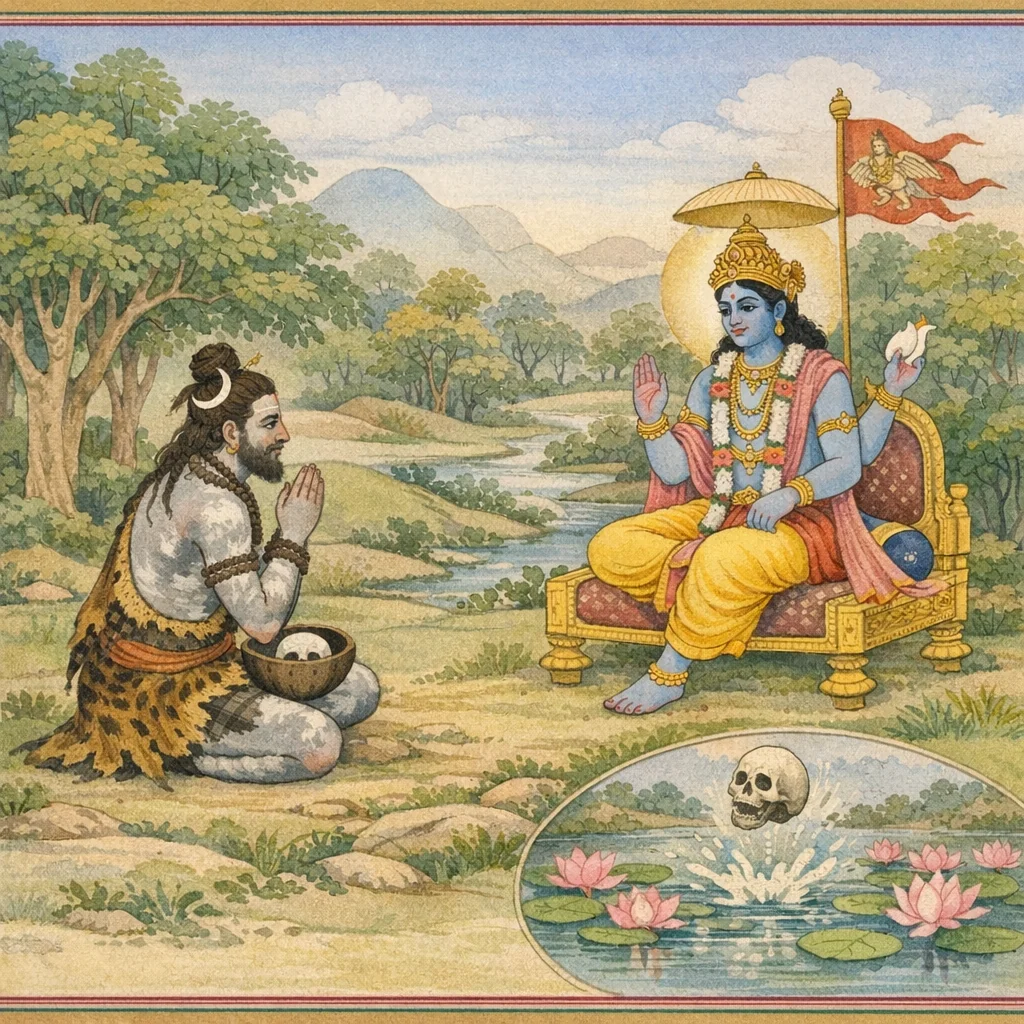
Adhyaya 3: Shiva’s Brahmahatya, Vishnu’s Counsel, and the Kapalamocana Tirtha at Varanasi
कपालमोचन-तीर्थ-माहात्म्य (Kapālamocana-Tīrtha-Māhātmya)
Vishnu's Counsel and Kapalamocana Tirtha
Within the Pulastya–Nārada narrative frame, this Adhyāya presents a syncretic theology in which Śiva’s crisis (brahmahatyā-doṣa) is resolved only through Viṣṇu’s salvific instruction, thereby integrating Śaiva penitential motifs with Vaiṣṇava soteriology. After Rudra becomes afflicted by the personified Brahmahatyā and fails to obtain release through repeated ablutions across multiple rivers, forests, āśramas, and devāyatanas, he approaches Viṣṇu (Cakrapāṇi, Garuḍadhvaja) in Kurujāṅgala and offers an extended hymn that iconographically identifies Viṣṇu with the guṇas, elements, Vedas, and ethical virtues. Viṣṇu then sanctifies sacred geography by directing Śiva to Vārāṇasī—specifically the Daśāśvamedha region—and finally to a lotus-filled hrada named Kapālamocana, where ritual bathing causes the skull (kapāla) to fall from Śiva’s hand. The chapter thus functions as a tīrtha-guide and a doctrinal statement of Harihara reciprocity: Śiva’s purification is achieved through Viṣṇu’s tīrtha and grace.
Divine Beings
Sacred Geography
Mortal & Asura Figures
Key Content Points
- Personified Brahmahatyā enters Rudra, initiating a Shaiva penitential narrative that requires ritual expiation beyond ordinary tapas and yoga.
- Topographical sanctification through failed and successful tīrtha-bathing: multiple sites are traversed before Viṣṇu reveals the uniquely efficacious Kapālamocana tīrtha.
- Syncretic theology articulated via Śiva’s stotra to Viṣṇu, portraying Viṣṇu as nirguṇa and as the embodied guṇa-forms (Brahmā/rajas, Viṣṇu/sattva, Rudra/tamas), culminating in Vaiṣṇava-mediated liberation from brahmahatyā-doṣa.
Shlokas in Adhyaya 3
Verse 1
इति श्रीवामनपुराणे द्वितीयः पुलस्त्य उवाच ततः करतले रुद्रः कपाले दारुणे स्थिते संतापमगमद् ब्रह्मंश्चिन्तया व्याकुलेन्द्रियः
Pulastya said: Then Rudra, with the dreadful skull resting upon his palm, was seized by torment, O Brahman; his senses were agitated with anxious thought.
Verse 2
ततः समागता रौद्रा नीलाञ्चनचयप्रभा सरक्तमूर्द्धजा भीमा ब्रह्महत्या हरान्तिकम्
Then there came Brahmahatyā—fierce, shining like a mass of dark collyrium, terrifying, with blood-red hair—approaching Hara (Śiva).
Verse 3
तामागतां हरो दृष्ट्वा पप्रच्छ विकरालिनीम् कासि त्वमागता रौद्रे केनाप्यर्थेन तद्वद
Seeing her arrive—terrifying in appearance—Hara (Śiva) asked: “Who are you, fierce one, who have come here? For what purpose have you come? Tell me that.”
Verse 4
कपालिनमथोवाच ब्रह्महत्या सुदारुणा ब्रह्मवध्यास्मि संप्राप्तां मां प्रोतीच्छ त्रिलोचन
Then the exceedingly dreadful Brahmahatyā said to the skull-bearing one (Śiva): “I am Brahma-slaughter (Brahmahatyā). I have come—accept me, O three-eyed one.”
Verse 5
इत्येवमुक्त्वा वचनं ब्रह्महत्या विवेश ह त्रिशूलपाणिनं रुद्रं संप्रतापितविग्रहम्
Having spoken these words, Brahmahatyā entered Rudra, the trident-bearing one—whose body/form was then tormented (afflicted).
Verse 6
ब्रह्णहत्याभिभूतश्च शर्वो बदरिकाश्रमम् आगच्छन्न ददर्शाथ नरनारायणावृषी
Overpowered by the sin of brahmin-slaying, Śarva (Rudra) came to Badarikāśrama; but on arriving there he did not see the sages Nara and Nārāyaṇa.
Verse 7
अदृष्ट्वा धर्मतनयौ चिन्ताशोकसमन्वितः जगाम यमुनां स्नातुं सापि शुष्कजलाभवत्
Not seeing the two sons of Dharma (Nara and Nārāyaṇa), he became filled with anxiety and grief. He went to bathe in the Yamunā, but she too had become dry of water.
Verse 8
कालिन्दीं शुष्कसलिलां निरीक्ष्य वृषकेतनः प्लक्षजां स्नातुमगमदन्तर्द्धानं च सा गता
Seeing the Kālindī (Yamunā) with her waters dried up, Vṛṣaketu (Rudra) went to bathe in the Plakṣajā; and she (that river) too vanished from sight.
Verse 9
ततोनु पुष्करारण्यं मागधारण्यमेव च सैन्धवारण्यमेवासौ गत्वा स्नातो यथेच्छया
Thereafter he went to the Puṣkara forest, and also to the Māgadha forest, and likewise to the Saindhava forest; having gone (to them), he bathed according to his wish.
Verse 10
तथैव नैमिषारण्यं धर्मारण्यं तथेश्वरः स्नातो नैव च सा रौद्रा ब्रह्महत्या व्यमुञ्चत
Likewise, Īśvara (Śiva) bathed in the Naimiṣa forest and in the Dharmāraṇya; yet that fierce sin of brahmin-slaying (brahmahatyā) did not leave him.
Verse 11
सरित्सु तीर्थेषु तथाश्रमेषु पुण्येषु देवायतनेषु शर्वः समायुतो योगयुतो ऽपि पापान्नावाप मोक्षं जलदध्वजो ऽसौ
In rivers, at sacred fords, likewise in hermitages, in meritorious places, and in temples, Śarva (Śiva)—though endowed with (spiritual) power and even joined with yoga—did not attain liberation, because of sin; thus was that bearer of the water-and-banner.
Verse 12
ततो जगाम निर्विण्णः शङ्करः कुरुजाङ्गलम् तत्र गत्वा ददर्शाथ चक्रपाणिं खगध्वाजम्
Then Śaṅkara, having become dispassionate (or weary), went to Kurujāṅgala. Having arrived there, he beheld the bearer of the discus, whose banner is the bird (Garuḍa).
Verse 13
तं दृष्ट्वा पुण्डरीकाक्षं शङ्खचक्रगदाधरम् कृताञ्जलिपुटो भूत्वा हरः स्तोत्रमुदीरयत्
Seeing Him—the lotus-eyed Lord, bearing conch, discus, and mace—Hara, with joined hands in reverence, uttered a hymn of praise.
Verse 14
हर उवाच नमस्ते देवतानाथ नमस्ते गरुडध्वज शङ्खचक्रगदापाणे वासुदेव नमो ऽस्तु ते
Hara said: ‘Salutations to You, Lord of the gods; salutations to You whose banner is Garuḍa. O Vāsudeva, You whose hands bear conch, discus, and mace—may salutations be to You.’
Verse 15
नमस्ते निर्गुणानन्त अप्रर्क्याय वेधसे ज्ञानाज्ञान निरालम्ब सर्वालम्ब नमो ऽस्तु ते
Salutations to You—endless, beyond the guṇas, and unfathomable—O Creator (Vedhas). You are the supportless foundation of both knowledge and ignorance, yet the support of all; salutations to You.
Verse 16
रजोयुक्त नमस्ते ऽस्तु ब्रह्ममूर्ते सनातन त्वया सर्वमिदं नाथ जगत्सृष्टं चराचरम्
Salutations to You, endowed with rajas—O Eternal One in the form of Brahmā. By You, O Lord, this entire world—moving and unmoving—has been created.
Verse 17
सत्त्वाधिष्ठित लोकेश विष्णुमूर्ते अधोक्षज प्रजापाल महाबाहो जनार्दन नमो ऽस्तु ते
Salutations to You, established in sattva—O Lord of the worlds, in the form of Viṣṇu, O Adhokṣaja. Protector of creatures, mighty-armed Janārdana—salutations to You.
Verse 18
तमोमूर्त्ते अहं ह्येष त्वदंशक्रोधसंभवः गुणाभियुक्त देवेश सर्वव्यापिन् नमो ऽस्तु ते
O embodiment of darkness (tamas), I indeed am born from the wrath that is a portion of You. O Lord of the gods, endowed with the (three) qualities, all-pervading One—salutations to You.
Verse 19
भूरियं त्वं जगन्नाथ जलाम्बरहुताशनः वायुर्बुद्धिर्मनश् चापि शर्वरी त्वं नमो ऽस्तु ते
You are the earth, O Lord of the world; (you are) water, the sky, and fire. You are the wind, the intellect, and also the mind; you are the night—salutations to You.
Verse 20
धर्मो यज्ञस्तपः सत्यटमहिंसा शौचमार्जवम् क्षमा दानं दया लक्षमीर्ब्रह्मचर्यं त्वमीश्वर
You are Dharma; you are sacrifice (Yajña), austerity, and truth; you are non-violence, purity, and straightforwardness. You are forgiveness, charity, compassion, Lakṣmī, and chastity (brahmacarya), O Lord.
Verse 21
त्वं साङ्गाश्चतुरो वेदास्त्वं वेद्यो वेदपारगः उपवेदा भवानीश सर्वो ऽसि त्वं नमो ऽस्तु ते
You are the four Vedas together with their auxiliaries (Vedāṅgas). You are the One to be known, the knower who has gone to the far shore of the Veda. You are the Upavedas. O Lord, you are everything; salutations be to you.
Verse 22
नमो नमस्ते ऽच्युतत चक्रपाणे नमो ऽस्तु ते माधव मीनमूर्ते लोके भवान् कारुणिको मतो मे त्रायस्व मां केश्व पापबन्धात्
Repeated salutations to you, O Acyuta, O bearer of the discus. Salutations to you, O Mādhava, in the form of the Fish (Matsya). In the world you are regarded by me as compassionate; O Keśava, save me from the bondage of sin.
Verse 23
ममाशुभं नाशय विग्रहस्थं यद् ब्रह्महत्याभिभवं बभूव दग्धो ऽस्मि नष्टो ऽस्म्यसमीक्ष्यकारी पुनीहि तीर्थो ऽसि नमो नमस्ते
Destroy my inauspiciousness that abides in embodied form—what has arisen as the overpowering consequence of brahma-slaughter (brahmahatyā). I am burned; I am ruined—one who acted without due consideration. Purify me; you are a sacred ford (tīrtha). Repeated salutations to you.
Verse 24
पुलस्त्य उवाच इत्थं स्तुतश्चक्रधरः शङ्करेण महात्मना प्रोवाच भगवान् वाक्यं ब्रह्महत्याक्षयाय हि
Pulastya said: Thus praised by the great-souled Śaṅkara, the Blessed Lord, the bearer of the discus (Viṣṇu), spoke words indeed for the destruction (removal) of brahmin-slaying (brahmahatyā).
Verse 25
हिरिरुवाच महेश्वर शृणुष्वेमां मम वाचं कलस्वनाम् ब्रह्महत्याक्षयकरीं शुभदां पुण्यवर्धनीम्
Hari said: O Maheśvara, listen to these words of mine, sweet-sounding—words that bring about the destruction of brahmahatyā, that bestow auspiciousness, and that increase merit.
Verse 26
यो ऽसौ प्राङ्मण्डले पुण्ये मदंशप्रभवो ऽव्ययः प्रयागे वसते नित्यं योगशायीति विश्रुतः
He who, in the sacred eastern region, is imperishable and arises from a portion of me—he dwells eternally at Prayāga and is renowned as ‘Yogaśāyī.’
Verse 27
चरणाद् दक्षीणात्त्स्य विनिर्याता सरिद्वरा विश्रुता वरणेत्वयेव सर्वपापहरा शुभा
From his right foot there issued forth an excellent river, famed by the name ‘Varaṇā’; auspicious, she removes all sins.
Verse 28
सव्यादन्या द्वितीया च असिरित्येव विश्रुता ते उभे सरिच्छ्रेष्ठे लोकपूज्ये बभूवतुः
From the left (foot) another, the second river, issued forth, renowned as ‘Asi’; those two became the best of rivers and were worshipped by the world.
Verse 29
ताभ्यां मध्ये तु यो देशस्तत्क्षेत्रं योगशायिनः त्रैलोक्यप्रवरं तीर्थं सर्वपापप्रमोचनम् न तादृशो ऽस्ति गगने न भूभ्यां न रसातले
The region that lies between those two (rivers)—that is the sacred field of the Yogaśāyin (the Lord who reclines in yogic absorption). It is the foremost tīrtha in the three worlds, releasing one from all sins. Nothing like it exists in heaven, on earth, or in the netherworld.
Verse 30
तत्रास्ति नगरी पुण्या ख्याता वाराणसी शुभा यस्यां हि भोगिनो ऽपीश प्रयान्ति भवतो लयम्
There is there a holy city, renowned and auspicious—Vārāṇasī—where even those attached to enjoyment, O Lord, attain dissolution (release) in You.
Verse 31
विलासिनीनां रशनास्वनेन श्रुतिस्वनैर्ब्रह्मणपुङ्गवानाम् शुचिस्वरत्वं गुरवो निशम्य हास्यादशासन्त मुहुर्मुहुस्तान्
Hearing the jingling of the girdles of the graceful women, together with the sounds of Vedic recitation by the foremost brāhmaṇas, the teachers—recognizing the purity of those sounds—again and again burst into laughter (in delighted amazement) at them.
Verse 32
व्रजत्सु योषित्सु चतुष्पथेषु पदान्यलक्तारुणितानि दृष्ट्वा ययौ शशी विस्मयमेव यस्यां किंस्वित् प्रयाता स्थालपद्मिनीयम्
Seeing, at the crossroads, the footprints of women as they walked—reddened by lac-dye—the Moon came only to wonder in that city, thinking: ‘Has it somehow reached a lotus-pond on land?’
Verse 33
तुङ्गनि यस्यां सुरमन्दिराणि रुन्धन्ति चन्द्रं रजनीसुखेषु दिवापि सूर्यं पवनाप्लुताभिर्दीर्घाभिरेवं सुपताकिकाभिः
In that place, the lofty temples of the gods obstruct the moon during the delights of the night; and even by day they seem to block the sun, because of their long, wind-swept banners.
Verse 34
भृङ्गाश्च यस्यां शशिकान्तभित्तौ प्रलोभ्यमानाः प्रतिबिम्बितेषु आलेश्ययोषिद्विमलाननाब्जेष्वीयुर्भ्रमान्नैव च पुष्पकान्तरम्
There, bees—enticed by reflections on walls gleaming with moonstone-like radiance—wander about and enter the lotus-like, spotless faces of reclining women, and do not go elsewhere in search of flowers.
Verse 35
परिश्रमश्चापि पराजितेषु नरेषु संमोहनखेलनेन यस्यां जसक्रीडनसंगतासु न स्त्रीषु संभो गृहदीर्घोकासु
Even the fatigue of men who have been ‘overcome’ is dispelled there through enchanting play; in that place, O friend, among women engaged in sportive dalliance within long-stretching homes, there is no (need for) further (seeking).
Verse 36
न चैव कश्चित् परमन्दिराणि रुणद्धि शंभो सहसा ऋते ऽक्षन् न चाबलानां तरसा पराक्रमं करोति यस्यां सुरतं हि मक्त्वा
O Śambhu, no one is able to bar the doors of the inner chambers in an instant—except by keeping watch. And none can, by force, restrain the bold advance of the weak (i.e., ordinarily powerless), once they have set their mind upon sexual union.
Verse 37
पाशग्रन्थिर्गजेन्द्राणां दानच्छेदो मदच्युतौ यस्यां मानमदौ पुंसां करिणां यौवनागमे
In that (condition), the bonds (that restrain) lordly elephants are snapped; the flow of ichor is cut off and their rutting intoxication drains away—so too, for men, pride and intoxication (subside) when the vigor of youth passes.
Verse 38
प्रियदोषाः सदा यस्यां कौशिका नेतरे जनाः तारागणे ऽकुलीनत्वं गद्ये वृत्तच्युतिर्विभो
In that (situation), faults become ‘dear’ (i.e., are cherished) always—among the Kauśikas, not among other people. In the host of stars there is ‘low-bornness’; in prose there is a falling away from proper conduct, O Lord.
Verse 39
भृतचिलुब्धा विलासिन्यो भुजङ्गपरिवारिताः चन्द्रभूषितदेहाश्च यस्यां त्वमिव शङ्कर
In that (city/region) are playful, charming women, surrounded by serpents, their bodies adorned with the moon—(appearing) like you yourself, O Śaṅkara.
Verse 40
ईदृशायां सुरेशान वाराणस्यां महाश्रमे वसते भवांल्लोलः सर्वपापहरो रविः
O lord of the gods, in such a Vārāṇasī—this great hermitage—dwells Ravi (the Sun), restless (in his course), who removes all sins.
Verse 41
दशाश्वमेधं यत्प्रोक्तं मदंशो यत्र केशवः तत्र गत्वा सुरश्रेष्ठ पापमोक्षमवाप्स्यसि
That (place) is declared (to yield the merit of) ten Aśvamedha sacrifices; there Keśava is a portion of me. Having gone there, O best of the gods, you will attain release from sin.
Verse 42
इत्येवमुक्तो गरु.डध्वजेन वृषध्वजस्तं शिरसा प्रणम्य जगाम वेगाद् गरुडो यथासौ वाराणसीं पापविमोचनाय
Thus addressed by the one whose banner is Garuḍa (Vishnu), the one whose banner is the bull (Shiva) bowed his head to him in reverence and swiftly went to Vārāṇasī, for the removal of sin.
Verse 43
गत्वा सुपुण्यां नगरीं सुतीर्थां दृष्ट्वा च लोलं सदशश्वमेधम् स्नात्वा च तीर्थेषु विमुक्तपापः स केशवं द्रष्टुमुपाजगाम
Having gone to that supremely meritorious city, rich in holy fords, and having seen the (tīrtha called) Lola, (which is said to grant merit equal to) ten Aśvamedha sacrifices, and having bathed in the tīrthas, freed from sin, he went to behold Keśava (Vishnu).
Verse 44
केशवं शङ्करो दृष्ट्वा प्रणिपत्येदमब्रवीत् तवत्प्रसादाद् हृषीकेश ब्रह्महत्या क्षयं गता
Seeing Keśava, Śaṅkara bowed down and said this: ‘By your grace, O Hṛṣīkeśa, the sin of brahmahatyā has gone to destruction.’
Verse 45
नेदं कपालं देवेश मद्धस्तं परिमुञ्चति कारणं वेद्मि न च तदेतन्मे वक्तुमर्हसि
“O Lord of the gods, this skull-bowl does not leave my hand. I do not know the reason for it; you ought to tell me this.”
Verse 46
पुलस्त्य उवाच/ महादेववचः श्रुत्वा केशवो वाक्यमब्रवीत् विद्यते कारणं रुद्र तत्सर्वं कथयामि ते
Pulastya said: “Having heard Mahādeva’s words, Keśava spoke: ‘O Rudra, there is indeed a cause; I shall tell you all of it.’”
Verse 47
यो ऽसौ ममाग्रतो दिव्यो ह्रदः पद्मोत्पलैर्युतः एष तीर्थवरः पुण्यो देवगन्धर्वपूजितः
“This divine lake that lies before me, adorned with lotuses and water-lilies—this is an excellent, sacred tīrtha, worshipped by gods and Gandharvas.”
Verse 48
एतस्मिन्प्रवरे तीर्थे क्नानं शंभो समाचर स्नातमात्रस्य चाद्यैव कपालं परिमोक्ष्यति
“O Śambhu, perform bathing (snāna) at this excellent sacred ford. For one who has only just bathed here, the skull (kapāla) will be cast off immediately, even today.”
Verse 49
ततः कपाली लोके च ख्यातो रुद्र भविष्यसि कपालमोचनेत्येवं तीर्थं चेदं भविष्यति
“Thereafter, O Rudra, you will become renowned in the world as ‘Kapālī’; and this sacred place will likewise become known as ‘Kapālamocana’.”
Verse 50
पुलस्त्य उवाच एवमुक्तः सुरेशेन केशवेन महेश्वरः कपालमोचने सस्नौ वेदोस्तविधिना मुने
Pulastya said: “Thus addressed by Keśava, the lord of the gods, Maheśvara bathed at Kapālamocana, O sage, according to the procedure of Vedic hymns of praise.”
Verse 51
स्नातस्य तीर्थे त्रिपुरान्तकस्य परिच्युतं हस्ततलात् कपालम् नाम्ना बभूवाथ कपालमोचनं तत्तीर्थवर्यं भगवत्प्रसादात्
When Tripurāntaka (Śiva) bathed at that sacred ford, the skull-bowl slipped from the palm of his hand. By the Lord’s grace, that foremost tīrtha then became known by the name “Kapālamocana” (the place where the skull is released).
Frequently Asked Questions
The chapter stages a doctrinal reciprocity: Śiva, afflicted by brahmahatyā-doṣa, approaches Viṣṇu and praises him as both nirguṇa and the guṇa-embodiments (including Rudra as tamas). Viṣṇu then grants the practical means of expiation through a Vaiṣṇava-revealed tīrtha, showing that Śaiva purification is completed through Viṣṇu’s grace—an explicit Harihara synthesis rather than sectarian rivalry.
It functions as a tīrtha-map culminating in Kāśī: Viṣṇu identifies the Varaṇā and Asi rivers as boundary-markers and elevates the region between them as Yogaśāyin’s supreme tīrtha-field. Within Vārāṇasī, Daśāśvamedha is highlighted, and the lotus-pond Kapālamocana is established as the decisive site where bathing removes the kapāla and ends brahmahatyā-doṣa, thereby instituting an etiological origin for the tīrtha’s name and merit.
No. This Adhyāya is primarily a Śiva–Viṣṇu tīrtha-mahātmya centered on brahmahatyā expiation and the sanctification of Vārāṇasī (Kapālamocana/Daśāśvamedha), framed by Pulastya’s discourse to Nārada.