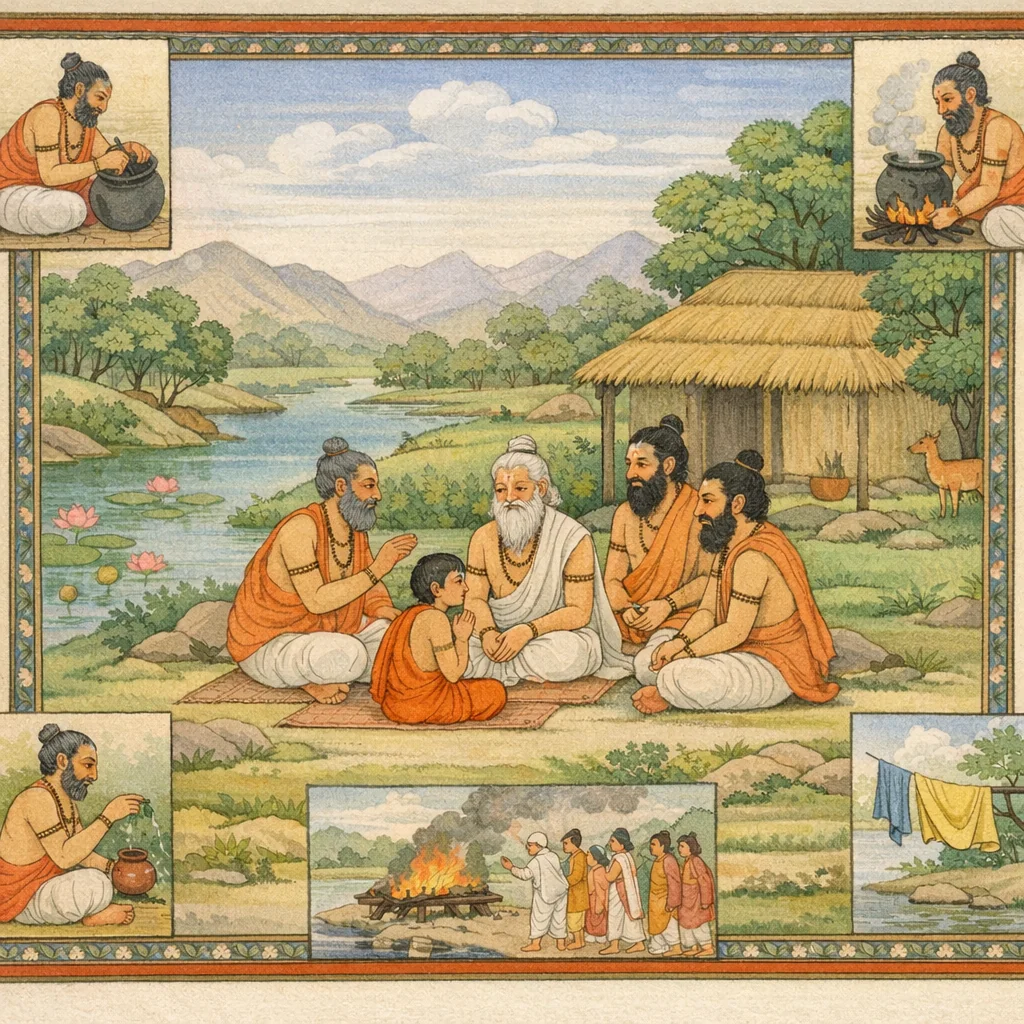
Adhyaya 14: Rules of Purity (Śauca), Permissible Foods, and the Duties of the Householder and Forest-Dweller
शौच-भोज्याभोज्य-निर्णय तथा गृहस्थ-वानप्रस्थ-धर्म (Śauca–Bhojyābhojya-Nirṇaya tathā Gṛhastha–Vānaprastha-Dharma)
Duties of Householder and Forest-Dweller
Within the Pulastya-led narrative frame, the sages instruct Sukeśin on normative dharma as it pertains to śauca (ritual purity), bhojya/abhojya (permissible and forbidden foods), and the graded obligations of the āśramas. The chapter begins with detailed taxonomies of edible items and the purification of foods, vessels, textiles, and spaces through water, heat, ash, alkali, scraping, and wind—an applied dharmaśāstric register embedded in Purāṇic discourse. It then defines socially and ritually “abhojya” persons through ethical criteria (neglect of rites, hypocrisy, malice, partiality, abandonment of svadharma), thereby linking purity to conduct rather than birth alone. Funeral impurity (aśauca), śrāddha-related procedures (udaka-dāna, asthi-saṃcayana, sapiṇḍīkaraṇa), and time-scales of purification by varṇa are outlined. The chapter closes by praising gṛhasthāśrama as foundational while transitioning to vānaprastha disciplines (austerity, brahmacarya, homa, triṣavana-snāna), emphasizing svadharma as a cosmic stabilizer under the oversight of the Sun (Divākara).
Divine Beings
Sacred Geography
Mortal & Asura Figures
Key Content Points
- Śauca protocols: purification of foods, garments, utensils, and dwellings using water, heat, ash, alkali, scraping, sprinkling, and wind; handling contamination (flies, hair, insects) and rules for bathing/ācamanam after contact with impurities.
- Bhojya/abhojya determinations: lists of edible items (including certain meats and pulses) and ethical definitions of ‘abhojya’ categories (sūtikā, ṣaṇḍha, mārjāra, ākhu, śvāna, kukkuṭa, patita, apaviddha, nagnāḥ, cāṇḍāla), with expiations such as trirātra-upavāsa or cāndrāyaṇa.
- Āśrama and antyeṣṭi duties: gṛhastha as the ‘uttama’ āśrama; transition to vānaprastha regimen (homa, triṣavana, jaṭā-valkala, forest fare, non-attachment); death-rites sequence (udaka-dāna, cremation, asthi-saṃcayana, ekoddiṣṭa, sapiṇḍīkaraṇa) and varṇa-based aśauca durations.
Shlokas in Adhyaya 14
Verse 1
इती श्रीवामनपुराणे त्रयोदशो ऽध्यायः ऋषय ऊचुः अहिंसा सत्यमस्तं दानं क्षान्तिर्दमः शमः अकार्पण्यं च शौचं च तपश्च रजनीचर
The sages said: Non-violence, truthfulness, (āstikya/faith), charity, forgiveness, self-restraint, mental tranquility, non-miserliness, purity, and austerity—these (constitute dharma), O night-roamer (rākṣasa).
Verse 2
दशाङ्गो राक्षसश्रेष्ठ धर्मो ऽसौ सार्ववर्णिकः ब्राह्मणस्यापि विहिता चातुराश्रम्यकल्पना
This ten-limbed dharma, O best of rākṣasas, is universal for all social classes. The arrangement of the four āśramas is also prescribed—even for a brāhmaṇa.
Verse 3
सुकेशिरुवाच विप्राणां चातुराश्रम्यं विस्तरान्मे तपोधनाः आचक्षध्वं न मे तृप्तिः शृण्वतः प्रतिपद्यते
Sukeśi said: O sages rich in austerity, explain to me in detail the four-āśrama system of the brāhmaṇas. As I listen, I do not attain satisfaction (I wish to hear more).
Verse 4
ऋषय ऊचुः कृतोपनयनः सम्यग् ब्रह्मचारी गुरौ वसेत् तत्र धर्मो ऽस्य यस्तं च कथ्यमानं निशामय
The sages said: “Having duly undergone the upanayana, the student should properly live with his teacher. Listen as we describe the duties that are his while residing there.”
Verse 5
स्वाध्यायो ऽथाग्निशुश्रुषा स्नानं भिक्षाटनं तथा गुरोर्निंवेद्य तच्चाद्यमनुज्ञातेन सर्वदा
“Self-study, service in relation to the (sacred) fire, bathing, and going for alms—having reported to the guru, he should always eat that food only when it has been permitted (by the guru).”
Verse 6
गुरोः कर्मणि सोद्योगः सम्यक्प्रीत्युपपादनम् तेनाहूतः पठेच्चैव तत्परो नान्यमानसः
“He should be industrious in the guru’s tasks and duly bring about (the guru’s) satisfaction. When summoned by him, he should also study/recite—devoted to that alone, with his mind on nothing else.”
Verse 7
एकं द्वौ सकलान् वापि वेदान् प्राप्य सुरोर्मुखात् अनुज्ञातो वरं दत्त्वा गुरवे दक्षिणां ततः
Having learnt one, or two, or even all the Vedas from the mouth of the guru, and having obtained (the guru’s) permission, he should then grant a boon and thereafter give the teacher the honorarium (guru-dakṣiṇā).
Verse 8
गार्हस्थ्याश्रमकामस्तु गार्हस्थ्याश्रममावसेत् वानप्रस्थाश्रमं वापि चतुर्थं स्वेच्छयात्मनः
If he desires the householder’s stage, he should enter the householder āśrama; or he may (instead) enter the forest-dweller stage, and even the fourth (i.e., renunciation), according to his own choice.
Verse 9
तत्रैव वा गुरोर्गेहे द्विजो निष्ठामवाप्नुयात् गुरोरभावे तत्पुत्रे तच्छिष्ये तत्सुतं विना
There itself, in the guru’s house, the twice-born should attain completion of his discipline (niṣṭhā). If the guru is absent, (he should do so) under the guru’s son or the guru’s disciple—(and) not under the disciple’s son.
Verse 10
शुश्रूषन् निरभीमानो ब्रह्मचर्याश्रमं वसेत् एवं जयति मृत्युं स द्विजः शालकटङ्कट
Serving (the teacher/elders) and free from fear or arrogance, one should dwell in the student stage of life (brahmacarya). In this way that twice-born conquers death—O Śālakaṭaṅkaṭa.
Verse 11
उपावृत्तस्ततस्तस्माद् गृहस्थाश्रमकाम्यया असमानर्षिकुलजां कन्यामुद्वहेद् निशाचर
Then, having returned (from studentship), desiring the householder stage, he should marry a maiden born in a ṛṣi-lineage not the same as his own—O Niśācara.
Verse 12
स्वकर्मणा धनं लब्ध्वा पितृदेवातिथीनपि सम्यक् संप्रीणयेद् भक्त्या सदाचाररतो द्विजः
Having obtained wealth through his own lawful work, the twice-born—devoted to good conduct—should properly satisfy, with devotion, the ancestors, the gods, and guests as well.
Verse 13
सदाचारो निगदितो युष्माभिर्मम सुव्रताः लक्षणं श्रोतुमिच्ःआमि कथयध्वं तमद्य मे
“O you of good vows, you have spoken to me about right conduct (sadācāra). I wish to hear its defining characteristics; tell me those today.”
Verse 14
ऋषय ऊचुः सदाचारो निगदितस्तव यो ऽस्माभिरादरात् लक्षणं तस्य वक्ष्यामस्तच्छृणुष्व निशाचर
The sages said: “The right conduct that we have respectfully described to you—now we shall state its defining characteristics. Listen, O night-roamer (niśācara).”
Verse 15
गृहस्थेन सदा कार्यमाचारपरिपालनम् न ह्याचारविहिनस्य भद्रमत्र परत्र च
“A householder must always maintain and uphold proper conduct; for one devoid of right conduct, there is no good either here (in this world) or hereafter.”
Verse 16
यज्ञदानतपांसीह पुरुषस्य न भूतये भवन्ति यः समुल्लङ्घ्य सदाचारं प्रवर्तते
Here, sacrifices, gifts, and austerities do not lead to the welfare (true flourishing) of that person who, transgressing good conduct, proceeds (to act) otherwise.
Verse 17
हुराचारो हि पुरुषो नेह नामुत्र नन्दते कार्यो यत्नः सदाचारे आचारो हन्त्यलक्षणम्
Indeed, a person of bad conduct rejoices neither here nor hereafter. Therefore, effort should be made toward good conduct; conduct destroys inauspiciousness (ill-marks/ill-fortune).
Verse 18
तस्य स्वरूपं वक्ष्यामः सदाचारस्य राक्षस शृणुष्वैकमनास्तच्च यदि श्रेयो ऽभिवाञ्छसि
I shall declare the true nature of that good conduct, O Rākṣasa. Listen to it with single-pointed mind, if you desire the highest good.
Verse 19
धर्मो ऽस्य मूलं धनमस्य शाखा पुष्पं च कामः फलमस्य मोक्षः असौ सदाचारतरुः सुकेशिन् संसेवितो येन स पुण्यभोक्त
Dharma is its root; wealth (artha) is its branch; desire (kāma) is its flower; liberation (mokṣa) is its fruit. O Sukeśin, this is the tree of good conduct; whoever cultivates and serves it becomes an enjoyer of merit (reaps auspicious results).
Verse 20
ब्रह्मो मुहूर्ते प्रथमं विबुध्येदनुस्मरेद् देववरान् महर्षीन् प्राभातिकं मङ्गलमेव वाच्यं यदुक्तवान् देवपतिस्त्रिनेत्रः
At brahma-muhūrta one should first awaken and remember the best of the gods and the great sages. One should speak only auspicious words in the morning—this is what the three-eyed lord, the ruler of the gods, has declared.
Verse 21
सुकेशिरुवाच किं तदुक्तं सुप्रभातं शङ्करेण महात्मना प्रभाते यत् पठन् मर्त्यो मुच्यते पापबन्धनात्
Sukeśin said: What is that ‘suprabhāta’ (auspicious morning utterance) spoken by the great-souled Śaṅkara, by reciting which at dawn a mortal is freed from the bondage of sin?
Verse 22
ऋषय ऊचुः श्रूयतां राक्षसश्रेष्ठ सुप्रभातं हरोदितम् श्रुत्वा स्मृत्वा पठित्वा च सर्वपापैः प्रमुच्यते
The sages said: “O best of the Rākṣasas, listen to the ‘Suprabhāta’ spoken by Hara (Śiva). By hearing it, remembering it, and reciting it, one is freed from all sins.”
Verse 23
ब्रह्म मुरारिस्त्रिपुरान्तकारी भानुः शशी भूमिसुतो बुधश्च गुरुश्च शुक्रः सह भानुजेन कुर्वन्तु सर्वे मम सुप्रभातम्
May Brahmā, Murāri (Viṣṇu), the destroyer of Tripura (Śiva), the Sun, the Moon, the son of the Earth (Maṅgala/Mars), Budha (Mercury), Guru (Jupiter), and Śukra (Venus) together with Bhānuja (Saturn) — may all of them make my morning auspicious.
Verse 24
भृगुर्वसिष्ठः क्रतुरङ्गिराश्च मनुः पुलस्त्यः पुलहः सगौतमः रैभ्यो मरीचिश्च्यवनो ऋभुश्च कुर्वन्तु सर्वे मम सुप्रभातम्
May Bhṛgu, Vasiṣṭha, Kratu, Aṅgiras, Manu, Pulastya, Pulaha together with Gautama, Raibhya, Marīci, Cyavana, and Ṛbhu — may all of them make my morning auspicious.
Verse 25
सनत्कुमारः सनकः सनन्दनः सनातनो ऽप्यासुरिपिङ्गलौ च सप्त स्वराः सप्त रसातलाश्च कुर्वन्तु सर्वे मम सुप्रभातम्
May Sanatkumāra, Sanaka, Sanandana, and Sanātana—and also Asuri and Piṅgala—together with the seven musical notes and the seven Rasātalas (nether regions), all bestow upon me an auspicious morning.
Verse 26
पृथ्वी सगन्धा सरसास्तथाऽपः स्पर्शश्च वायुर्ज्वलनः सतेजाः नभः सशब्दं महता सहैव यच्छन्तु सर्वे मम सुप्रभातम्
May the earth with its fragrance, and the waters with their savor; may touch as well as wind; may fire with its radiance; and may space with sound—together with Mahat (the great principle)—all grant me an auspicious morning.
Verse 27
सप्तार्णवाः सप्त कुलाचलाश्च सप्तर्षयो द्वीपवराश्च सप्त भूरादि कृत्वा भुवनानि सप्त ददन्तु सर्वे मम सुप्रभातम्
May the seven oceans, the seven principal mountains, the seven sages, and the seven excellent continents—forming the seven worlds beginning with Bhū—may all of them grant me an auspicious morning.
Verse 28
इत्थं प्रभाते परमं पवित्रं पठेत् स्मरेद्वा शृमुयाच्च भक्त्या दुःस्वप्ननाशो ऽनघ सुप्रभातं भवेच्च सत्यं भगवत्प्रसादात्
Thus, at daybreak, one should devoutly recite, remember, or listen to this supremely purifying (teaching). O sinless one, evil dreams are destroyed, and a truly auspicious morning comes to pass by the Lord’s grace.
Verse 29
ततः समुत्थाय विचिन्तयेन धर्मं तथार्थं च विहाय शय्याम् उत्थाय पश्चाद्धरिरित्युदीर्य गच्छेत् तदोत्सर्गविधिं हि कर्तुम्
Then, having risen, one should reflect on dharma and artha, leaving the bed. After rising, uttering ‘Hari’, one should go to perform the prescribed procedure of utsarga (relieving oneself).
Verse 30
न देवगोब्राह्मणवह्निमार्गे न राजमार्गे न चतुष्पथे च कुर्यादथोत्सर्गमपीह गोष्ठे पूर्वापरां चैव समाश्रितो गाम्
One should not perform utsarga on the path (near/associated with) a deity, cows, brāhmaṇas, or fire; nor on the king’s road; nor at a crossroads. Even in a cow-pen here, one should perform it having positioned oneself with attention to the east–west direction (i.e., properly oriented as prescribed).
Verse 31
ततस्तु शौचार्थमुपाहरेन्मृदं गुदे त्रयं पाणितले च सप्त तथोभयोः पञ्च चतुस्तथैकां लिङ्गे तथैकां मृदमाहरेत
Then, for the sake of purification, one should take earth (clay): three applications for the anus, seven for the palm, five for both (hands), four, and likewise one for the liṅga (genital organ), and again one application of earth should be taken.
Verse 32
नान्तर्जलाद्राक्षस मूषिकस्थलात् शौचावशिष्टा शरणात् तथान्या वल्मीकमृच्चैव हि शौचनाय ग्राह्य सदाचारविदा नरेण
One should not take (cleansing) earth from within water, from places haunted by rākṣasas, from rat-holes/rat-grounds, from what is left over after someone’s cleansing, from shelters/refuges, and other such places. But earth from an anthill (valmīka-mṛt) is indeed to be taken for cleansing by a man who knows proper conduct.
Verse 33
उदङ्मुखः प्राङ्मुखो वापि विद्वान् प्रक्षाल्य पादौ भुवि संनिविष्टः समाचमेदद्भिरफेनिलाभिरादौ परिमृज्य मुखं द्विरद्भिः
Facing north or east, the learned person, having washed the feet and seated on the ground, should perform ācamana with water that is free of foam; first wiping the face, (he should sip) twice with water.
Verse 34
ततः स्पृशेत्खानि शिरः करेण संध्यामुपासीत ततः क्रमेण केशांस्तु संशोध्य च दन्तधावनं कृत्वा तथा दर्पणदर्शनं च
Then one should touch the bodily apertures and the head with the hand; thereafter one should perform the Sandhyā worship in due order. Then, having cleaned the hair, one should brush/clean the teeth, and also look into a mirror.
Verse 35
कृत्वा शिरःस्नानमथाङिड्कं वा संपूज्य तोयेन पितॄन् सदेवान् होमं च कृत्वालभनं शुभानां कृत्वा बहिर्निर्गमनं प्रशस्तम्
Having performed the head-bath (or the proper bodily bathing), and having duly honored with water the Pitṛs together with the Devas, and having performed homa and applied auspicious unguents/anointing, going out of the house is considered commendable (i.e., one should depart only after these acts).
Verse 36
दूर्वादधिसर्पिरथोदकुम्भं धेनुं सवत्सां वृषभं सुवर्णम् मृद्गोमयं स्वस्तिकमक्षतानि लाजामधु ब्राह्मणकन्यकां च
Dūrvā grass, curd, ghee, a water-pot; a cow with her calf, a bull, and gold; clay and cow-dung, a svastika sign, unbroken grains (akṣata), parched grains (lājā) and honey—and also a Brahmin maiden (to be honored/engaged according to rite): these are mentioned as auspicious ritual items.
Verse 37
श्वेतानि पुष्पाण्यथ शोभनानि हुताशनं चन्दमर्कबिम्बम् अश्वत्थवृक्षं च समालभेत ततस्तु कुर्यान्निजजातिधर्मम्
One should take (as auspicious supports) white and beautiful flowers, the sacred fire, the moon and the orb of the sun, and also touch/approach the aśvattha (sacred fig) tree. Thereafter, one should perform the duties proper to one’s own birth-community (jāti) and station.
Verse 38
देशानुशिष्टं कुल धर्ममग्र्यं स्वगोत्रधर्मं न हि संत्यजेत् तेनार्थसिद्धिं समुपाचरेत नासत्प्रलापं न च सत्यहीनम्
One should not abandon the foremost family-dharma as taught by one’s region (local tradition), nor one’s own gotra-dharma. By adhering to that, one attains success in aims. One should not indulge in false or improper prattle, nor speak in a manner devoid of truth.
Verse 39
न निष्ठुरं नागमशास्त्रहीनं वाक्यं वदेत्साधुजनेन येन निन्द्यो भवेन्नैव च धर्मःएदी संगं न चासत्सु नरेषु कुर्यात्
One should not speak harsh words, nor words devoid of āgama and śāstra (authoritative teaching), by which one would become blameworthy among the virtuous. Nor should one become a reviler of dharma; and one should not keep company with wicked men.
Verse 40
संध्यासु वर्ज्यं सुरतं दिवा च सर्वासु योनीषु पराबलासु आगारशून्येषु महीतलेषु रजस्वलास्वेव जलेषु वीर
O hero, sexual intercourse is to be avoided at the twilight junctions (sandhyās) and also during the daytime; likewise with women of another’s dependence (i.e., protected/under another’s authority). It should also be avoided in empty houses, on bare ground, with a menstruating woman, and in water.
Verse 41
वृथाटनं था दानं वृथा च पशुमारणम् न कर्त्तव्यं गृहस्थेन वृता दारपरिग्रहम्
Aimless roaming, pointless giving, and the killing of animals without cause should not be done by a householder; nor should one take a wife (enter household life) in a frivolous/ill-considered manner.
Verse 42
वृथाटनान्नित्यहानिर्वृथादानाद्धनक्षयः वृथा पशुघ्नः प्राप्नोति पातकं नरकप्रदम्
From aimless wandering there is daily loss (of time and duty); from pointless giving there is loss of wealth. One who kills animals without purpose incurs sin that leads to hell.
Verse 43
संतत्या हानिरश्लाघया वर्णसंकरतो भयम् भेतव्यं च भवेल्लोके वृथादारपरिग्रहात्
From a useless (unfit) taking of a wife, there is loss of progeny, disgrace, and the fear of intermixture of social orders; therefore one should be afraid of such (conduct) in the world.
Verse 44
परस्वे परदारे च न कार्या बुद्धिरुत्तमैः परस्वं नरकायैव परदाराश्च मृत्यवे
The best of people should not set their mind upon another’s property or another’s wife; another’s property leads to hell, and another’s wife leads to death.
Verse 45
नेक्षेत् परस्त्रियं नग्नां न संभाषेन तस्करान् उद्क्यादर्शनं स्पर्शं संभाषं च विवर्जयेत्
One should not look at another man’s wife when she is unclothed; one should not converse with thieves. One should avoid seeing, touching, and conversing with a woman in her menstrual period (udakyā).
Verse 46
नैकासने तथा स्थेयं सोदर्या परजायया तथैव स्यान्न मातुश्च तथा स्वदुहितुस्त्वपि
One should not sit on the same seat with one’s own sister or with another man’s wife. Likewise, one should not do so with one’s mother, and also with one’s own daughter.
Verse 47
न च स्नायीत वै नग्नो न शयीत कदाचन दिग्वाससो ऽपि न तथा परिभ्रमणमिष्यते/ भिन्नासनभाजनादीन् दूरतः परिवर्जयेत्
One should not bathe naked, and one should never sleep naked. Even if one is clad only in the directions (i.e., scantily clothed), roaming about in that manner is not approved. One should keep away from (or avoid) separate/tainted seats, vessels, and the like from a distance.
Verse 48
नन्दासु नाभ्यङ्गमुपाचरेत क्षौरं च रिक्तासु जयासु मांसम् पूर्णासु योषित्परिवर्जयेत भद्रासु सर्वाणि समाचरेत
On Nandā (tithis), one should not perform oil-massage. On Riktā (tithis), one should avoid shaving. On Jayā (tithis), (one should avoid) meat. On Pūrṇā (tithis), one should abstain from women (sexual indulgence). On Bhadrā (tithis), one may undertake all (these activities).
Verse 49
नाभ्यङ्गमर्के न च भूमिपुत्रे क्षौरं च शुक्रे रविजे च मांसम् बुधेषु योषिन्न समाचरेत शेषेषु सर्वाणि सदैव कुर्यात्
One should not do oil-massage on Sunday (the Sun’s day) nor on Tuesday (Mars’ day). Shaving should not be done on Friday (Venus’ day). Meat should not be eaten on Sunday. On Wednesdays (Mercury’s day) one should not approach women (for sexual intercourse). On the remaining days, all these may be done.
Verse 50
चित्रासु हस्ते श्रवणे च तैलं क्षौरं विशाखास्वभिजित्सुवर्ज्यम् मूले मृगे भाग्रपदासु मांसं योषिन्मघाकृत्तिकयोत्तरासु
Oil (application/anointing) should be avoided under the nakṣatras Citrā, Hasta, and Śravaṇa. Shaving should be avoided under Viśākhā and Abhijit. Meat should be avoided under Mūla, Mṛga(śīrṣa), and the (two) Bhādrapadās. Approaching women should be avoided under Maghā, Kṛttikā, and the Uttarās (Uttaraphālgunī, Uttarāṣāḍhā, Uttarabhādrapadā).
Verse 51
सदैव जर्ज्यं शयनमुदक्शिरास् तथा प्रतीच्यां रजनीचरेश भुञ्जीत नैवेह च दक्षिणामुखो न च प्रतीच्यामभिभोजनीयम्
Sleeping with the head to the north is always to be avoided; likewise (sleeping) with the head to the west, O lord of the night-wanderers. One should not eat facing south, and eating facing west should also not be done.
Verse 53
देवालयं चैत्यतरुं चतुष्पथं विद्याधिकं चापि गुरुं प्रदक्षिणम् माल्यान्नपानं वसनानि यत्नतो नान्यैर्धृतांश्चापि हि धारयेद् बुधः // वम्प्_14.52 स्नायाच्छिरःस्नानतया च नित्यं न कारणं चैव विना निशासु ग्रहोपरागे स्वजनापयाते मुक्त्वा च जन्मर्क्षगते शशङ्के
A wise person should circumambulate a temple, a sacred tree (caitya-taru), a crossroads, one superior in learning, and also one’s teacher. With care, one should not wear garlands, food/drink remnants, or garments that have been used by others. One should perform head-bathing daily, and should not bathe at night without a proper reason—except during an eclipse, at the time of a family death/period of mourning, and when the moon is in one’s birth-asterism (janma-nakṣatra).
Verse 54
नाभ्यङ्गितं कायमुपस्पृशेच्च स्नातो न केशान् विधुनीत चापि गात्राणि चैवाम्बरपाणिना च स्नातो विमृज्याद् रजनीचरेश
After bathing, one should not touch the body that has been anointed with oil (abhyaṅga), nor should one shake out the hair. Having bathed, one should wipe the limbs using the edge of one’s cloth (or cloth held in the hand), O lord of the night-wanderers.
Verse 55
वसेच्च देशेषु सुराजकेषु सुसंहितेष्वेव जनेषु नित्यम् अक्रोधना न्यायपरा अमत्सराः कृषीवला ह्योषधयश्च यत्र
One should live in lands with good governance, and always among well-ordered people—where the inhabitants are free from anger, devoted to justice, without envy, and where there are farmers and medicinal herbs.
Verse 56
न तेषु देशेषु वसेत बुद्धिमान् सदा नृपो दण्डरुचिस्त्वशक्तः जनो ऽपि नित्योत्सवबद्धवैरः सदा जिगीषुश्च निशाचरेन्द्र
O lord of the night-rangers (Niśācara-indra), a wise man should not live in those countries where the king is always fond of punishment yet incapable (of proper rule); and where the people too are perpetually bound in enmity on account of constant festivities, and are ever eager to conquer.
Frequently Asked Questions
Alongside technical purification methods (water, heat, ash, alkali, scraping), the chapter defines ‘abhojya’ persons through conduct—neglect of daily rites, hypocrisy in tapas/japa, malicious speech, partisan judgment, and abandonment of svadharma—showing that impurity is also a moral-ritual condition, not merely physical contact.
While no named Kurukṣetra/Sarasvatī-site is specified here, the chapter gives tirtha-adjacent bathing protocol: one should bathe in devakhātas (sacred reservoirs) and in saras/hṛdas and rivers, with cautions about bathing in another’s water and about maintaining cleanliness around dwellings—practical guidance consistent with Purāṇic topographical sanctification.
It prescribes udaka-dāna for the preta, cremation outside by gotra-kin, asthi-saṃcayana on the 3rd/4th/7th day, and subsequent rites by purified sapiṇḍas; it also mentions ekoddiṣṭa and sapiṇḍīkaraṇa within the annual cycle. Aśauca durations are given by varṇa: one day-night for brāhmaṇas, three days for kṣatriyas, six nights for vaiśyas, and twelve days for śūdras.