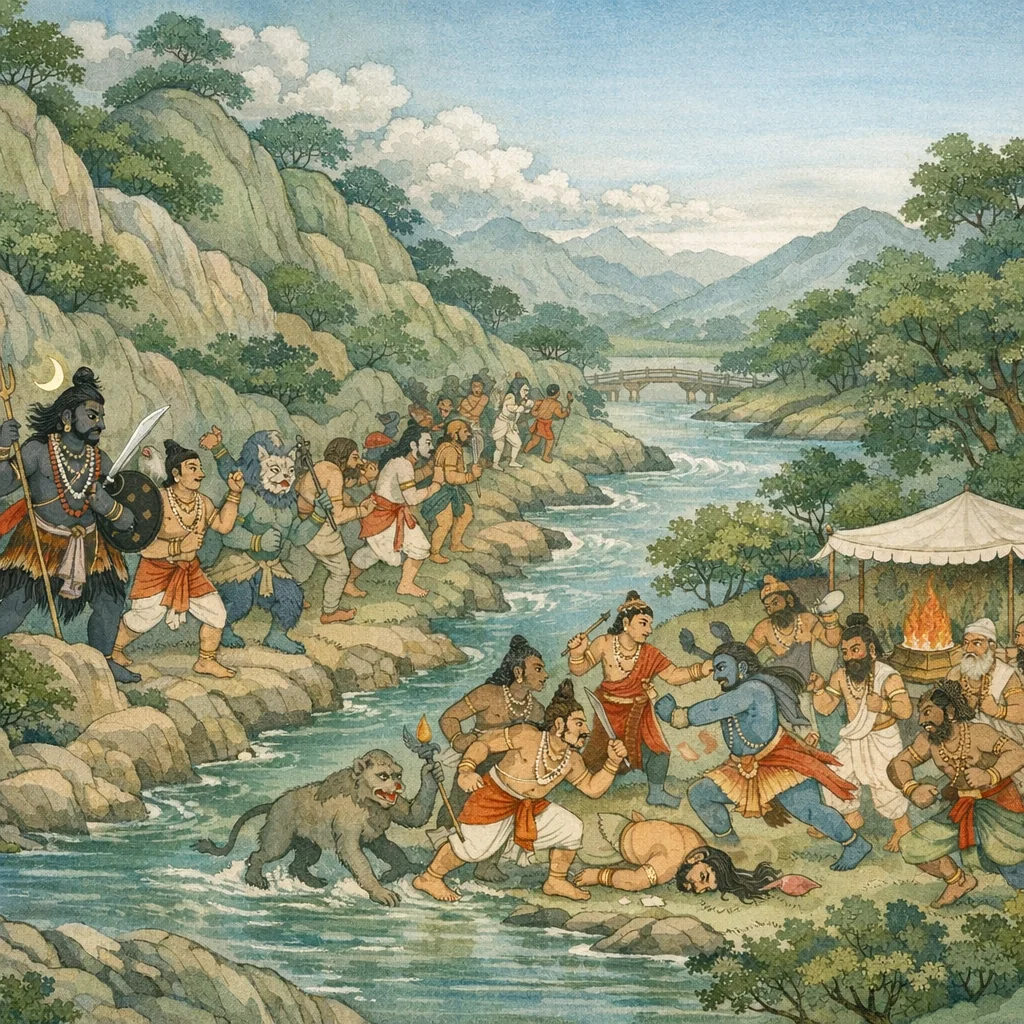
Adhyaya 4: Sati’s Death and the Assault on Daksha’s Sacrifice: Virabhadra versus the Devas
दक्षयज्ञविध्वंस-प्रारम्भः (Dakṣa-Yajña-Vidhvaṃsa-Prārambhaḥ)
The Assault on Daksha's Sacrifice
Within the Pulastya–Nārada narrative frame, this adhyāya intensifies the Dakṣa-yajña cycle by foregrounding the ritual politics that marginalize Śiva and thereby precipitate cosmic disorder. Sati learns—through Jayā—that nearly all beings across the fourteen worlds have been invited to Dakṣa’s sacrifice, while Śiva and Sati are excluded due to Śiva’s “Kapālī” identity. The insult becomes an interiorized violence: Sati collapses into death from grief and wrath, prompting Śiva’s fierce response. From Śiva’s krodha arise gaṇas led by Vīrabhadra, who marches from Mandara toward Kanakhala where Dakṣa performs the rite. A martial theophany follows: Dharma confronts Vīrabhadra, the devas and allied hosts rally, and even Viṣṇu (Keśava/Murāri) engages—yet his weapons are checked, dramatizing a syncretic theology in which Śaiva power can suspend Vaiṣṇava astras without denying Viṣṇu’s eminence. The chapter culminates with Śiva himself entering the yajñavāṭa as a force of ritual dissolution, exposing sacrifice devoid of reverence as spiritually unstable.
Divine Beings
Sacred Geography
Mortal & Asura Figures
Key Content Points
- Sati’s exclusion from Daksha’s yajña is narrated as a sectarian-ritual affront to Śiva (Kapālī), triggering Sati’s death upon hearing Jayā’s report.
- Śiva’s wrath generates gaṇic forces; Vīrabhadra leads an armed descent from Mandara to Kanakhala, initiating the disruption of Daksha’s sacrificial arena.
- A sequence of combats (Dharma vs. Vīrabhadra; devas and hosts vs. gaṇas; Viṣṇu’s intervention) frames a syncretic hierarchy where Śaiva fury can neutralize Vaiṣṇava weaponry, before Śiva personally enters the yajña.
Shlokas in Adhyaya 4
Verse 1
इति श्रीवामपुराणे तृतीयो ऽध्ययः पुलस्त्य उवाच एवं कपाली संजातो देवर्षे भगवान्हरः अनेन कारणेनासौ दक्षेण न निमन्त्रितः
Thus ends the third chapter in the revered Vāmana Purāṇa. Pulastya said: In this way, O divine seer, the Blessed Hara became ‘Kapālī’ (the skull-bearer). For this reason, he was not invited by Dakṣa (to the sacrifice).
Verse 2
कपालिजायेति सतीं विज्ञायाथ प्रजापतिः यज्ञे चार्हापि दुहिता दक्षेण न निमन्त्रिता
Knowing Satī as ‘the wife of Kapālī,’ Prajāpati Dakṣa did not invite his own daughter to the sacrifice, though she was worthy of honor there.
Verse 3
एतस्मिन्नन्तरे देवीं द्रष्टुं गौतमनन्दिनी जया जगाम शैलेन्द्रं मन्दरं चारुकन्दरम्
Meanwhile, Jayā—the daughter of Gautama—went to see the goddess, to the lordly mountain Mandara, whose caves were lovely.
Verse 4
तामागतां सती दृष्ट्वा जयमेकामुवाच ह किमर्थं विजया नागाज्जयन्ती चापराजिता
Seeing Jayā arrive alone, Satī said: “For what reason did Vijayā not come, and (also) Jayantī and Aparājitā?”
Verse 5
सा देव्या वचनं श्रुत्वा उवाच परमेश्वरीम् गता निमन्त्रिताः सर्वा मखे मातामहस्य ताः
Hearing the देवी’s words, she replied to the Supreme Goddess: “All those (others) have gone, having been invited to the sacrifice of the maternal grandfather.”
Verse 6
समं पित्रा गौतमेन मात्रा चैवाप्यहल्यया अहं समागता द्रष्टुं त्वां तत्र गमनोत्सुका
Together with my father Gautama and my mother Ahalyā, I have come to see you, eager to go there (to that event).
Verse 7
किं त्वं न व्रजसे तत्र तथा देवो महेश्वरः नामन्त्रितासि तातेन उताहोस्विद् व्रजिष्यसि
Why do you not go there? (Even) the god Maheśvara is there. Were you not invited by father, or will you go (anyway)?
Verse 8
गतास्तु ऋषयः सर्वे ऋषिपत्न्यः सुरास्तथा मातृष्वसः शशाङ्कश्च सपत्नीको गतः क्रतुम्
All the sages had gone, and the sages’ wives, and the gods as well. The maternal uncles (too), and Śaśāṅka (the Moon) with his wife, went to the sacrifice (kratu).
Verse 9
चतुर्दशसु लोकेषु जन्तवो ये चराचराः निमन्त्रिताः क्रतौ सर्वे किं नासि त्वं निमन्त्रिता
“Among the fourteen worlds, all beings—moving and unmoving—have been invited to the sacrifice. Why, then, have you not been invited?”
Verse 10
पुलस्त्य उवाच/ जयायास्तद्वचः श्रुत्वा वज्रपातसमं सती मन्युनाभिप्लुता ब्रह्मन् पञ्चत्वमगमत् ततः
Pulastya said: “Hearing those words of Jaya—like the fall of a thunderbolt—the virtuous woman, overwhelmed by anger, O Brahman, then met with death.”
Verse 11
जया मृतां सतीं दृष्ट्वा क्रोधशोकपरिप्लुता मुञ्चती वारि नेत्राभ्यां सस्वरं विललाप ह
Seeing Jaya, the virtuous woman, dead, she/that woman—overwhelmed with anger and grief—shed tears from her eyes and lamented aloud.
Verse 12
आक्रन्दितध्वनिं श्रुत्वा शूलपाणिस्त्रिलोचनः आः किमेतदितीत्युक्त्वा जयाभ्याशमुपागतः
Hearing the sound of lamentation, the three-eyed Lord bearing the trident exclaimed, “Ah! What is this?” and approached Jaya.
Verse 13
आगतो ददृशे देवीं लतामिव वनस्पतेः कृत्तां परशुना भूमौ श्लथाङ्गीं पतितां सतीम्
Having come there, he saw the Goddess—like a creeper of a tree—cut down by an axe, fallen upon the ground, her limbs slack, the virtuous one.
Verse 14
देवीं निपतितां दृष्ट्वा जयां पप्रच्छ शङ्करः किमियं पतिता भूमौ निकृत्तेव लता सती
Seeing the Goddess fallen down, Śaṅkara asked Jaya: “Who is this virtuous lady fallen on the ground, like a creeper cut down?”
Verse 15
सा शङ्करवचः श्रुत्वा जया वचनमब्रवीत् श्रत्वा मखस्था दक्षस्य भगिन्यः पतिभिः सह
Having heard Śaṅkara’s words, Jayā spoke. Hearing this, Dakṣa’s sisters—together with their husbands—who were present at the sacrifice (makha), [responded/assembled accordingly].
Verse 16
आदित्याद्यास्त्रिलोकेश समं शक्रादिभिः सुरैः मातृष्वसा विपन्नेयमन्तर्दुःखेन दह्यती
O lord of the three worlds, the Ādityas and other gods, together with Indra and the devas, [are there]; yet this maternal aunt (mātṛṣvasā) is afflicted—she burns with inner sorrow.
Verse 17
पुलस्त्य उवाच एतच्छ्रुत्वा वचो रौद्रं रुद्रः क्रोधाप्लुतो बभौ क्रुद्धस्य सर्वगात्रेभ्यो निश्चेरुः सहसार्चिषः
Pulastya said: Hearing these fierce words, Rudra became flooded with anger. From all the limbs of the enraged one, thousands of flames burst forth.
Verse 18
ततः क्रोधात् त्रिनेत्रस्य गात्ररोमोद्भाव मुने गणाः सिंहमुखा जाता वीरभद्रपुरोगमाः
Then, from the anger of the Three-eyed One (Śiva), O sage, gaṇas arose from the hairs of his body; they were born lion-faced, with Vīrabhadra at their forefront.
Verse 19
गणैः परिवृतस्तस्मान्मन्दराद्धिमसाह्वयम् गतः कनखलं तस्माद् यत्र दक्षो ऽयजत् क्रतुम्
Surrounded by the gaṇas, he (Vīrabhadra) went from Mandara—also called Himavat—to Kanakhala, where Dakṣa was performing a sacrificial rite (kratu).
Verse 20
ततो गणानामधिपो वीरभद्रो महाबलः दिशि प्रतीच्युत्तरायां तस्थौ शूलधरो मुने
Then Vīrabhadra, the mighty leader of the gaṇas, stood in the northwestern direction, O sage, bearing a trident.
Verse 21
जया क्रोधाद् गदां गृह्य पूर्वदक्षिणतः स्थिता मध्ये त्रिरशूलधृक् शर्वस्तस्थौ क्रोधान्महामुने
Out of anger, Jayā seized her mace and stood at the south‑eastern side. In the middle stood Śarva, bearing the trident, enraged—O great sage.
Verse 22
मडगारिवदनं दृष्ट्वा देवाः शक्रपुरोगमाः ऋषयो यक्षगन्धर्वाः किमिदं त्वित्यचिन्तयन्
Seeing a face like that of a maḍagāri, the gods led by Śakra, along with the ṛṣis, yakṣas, and gandharvas, wondered: “What indeed is this?”
Verse 23
ततस्तु धनुरादाय शरांश्चाशीविषोपमान् द्वारपालस्तदा धर्मो वीरभद्रमुपाद्रवत्
Then, taking up his bow and arrows like venomous serpents, Dharma—the gatekeeper—rushed upon Vīrabhadra.
Verse 24
तमापतन्तं सहसा धर्मं दृष्ट्वा गणेश्वरः करेणैकेन जग्राह त्रिशुलं वह्निसन्निभम्
Seeing Dharma suddenly rushing toward him, Gaṇeśvara seized with one hand a trident, blazing like fire.
Verse 25
कार्मुकं च द्वितीयेन तृतीयेनाथ मार्गणान् चतुर्थेन गदां गृह्य धर्ममभ्यद्रवद् गणः
With the second hand he took a bow; with the third, arrows; and with the fourth, taking up a mace, the gaṇa charged toward Dharma.
Verse 26
ततश्चतुर्भुजं दृष्ट्वा धर्मराजो गणेश्वरम् तस्थावष्टभुनजो भूत्वा नानायुधधरो ऽव्ययः
Then, seeing Gaṇeśvara as four-armed, Dharmarāja stood (firm), becoming eight-armed, the imperishable one bearing many kinds of weapons.
Verse 27
खड्गचर्मगदाप्रासपरश्वधवराङ्कुशैः चापमार्गणभृत्तस्थौ हन्तुकामो गणेश्वरम्
Armed with sword and shield, mace, spear, axe, and excellent goad, and standing ready with bow and arrows, he desired to slay Gaṇeśvara.
Verse 28
गणेश्वरो ऽपि संक्रुद्धो हन्तुं धर्म सनातनम् ववर्ष मार्गणास्तीक्ष्णान् यथा प्रावृषि तोयदः
Gaṇeśvara too, enraged, (seeking) to slay (the assailant) for the sake of eternal dharma, showered sharp arrows, like a rain-cloud in the monsoon season.
Verse 29
तावन्योन्यं महात्मानौ शरचापधरौ मुने रुधिरारुणसिक्ताङ्गौ किंशुकाविव रेजतुः
O sage, those two great-souled ones, bearing bow and arrows, facing one another, their limbs drenched and reddened with blood, shone like kiṃśuka trees.
Verse 31
ततो वरास्त्रैर्गणनायकेन जितः स धर्मः तरसा प्रसह्य पराङ्मुखो ऽभूद्विमना मुनीन्द्र स वीरभद्रः प्रविवेश यज्ञम् / 4.30 यज्ञावाटं प्रविष्टं तं वीरभद्रं गणेश्वरम् दृष्ट्वा तु सहसा देवा उत्तस्थुः सायुधा मुने
Then Dharma, overcome by the excellent missiles of the leader of the Gaṇas, was forcibly subdued with speed and, turning away, became dejected, O best of sages. That Vīrabhadra entered the sacrificial rite. Seeing Vīrabhadra, lord of the Gaṇas, who had entered the sacrificial enclosure, the gods suddenly rose up, armed, O sage.
Verse 32
वसवो ऽष्टौ महाभागा ग्रहा नव सुदारुणाः इन्द्राद्या द्वादशादित्या रुद्रास्त्वेकादशैव हि
The eight Vasus, the highly fortunate ones; the nine fierce Grahas; the twelve Ādityas beginning with Indra; and indeed the eleven Rudras (were there).
Verse 33
विश्वेदेवाश्च साध्याश्च सिद्धगन्धर्वपन्नगाः यक्षाः किंपुरुषाश्चैव खगाश्क्रधरास्तथा
And the Viśvedevas and the Sādhyas; the Siddhas, Gandharvas, and serpents (Nāgas); the Yakṣas and Kiṃpuruṣas; and also birds, as well as the Kradharas (a class of beings) (were present).
Verse 34
राजा वैवस्ताद्वंशाद् धर्मकीर्तिस्तु विश्रुतः सोमवंशोद्भवश्चोग्रो भोजकीर्तिर्महाभुजः
There was a king named Dharmakīrti, renowned, born in the Vaivasvata line; and (another) fierce one, Bhojakīrti, a mighty-armed (king), sprung from the Lunar dynasty.
Verse 35
दीतिजा दानवाश्चान्ये ये ऽन्ये तत्र समागताः ते सर्वे ऽभ्यद्रवन् रौद्रं वीरभद्रमुदायुधाः
The sons of Diti and other Dānavas—whoever else had assembled there—all rushed upon the fierce Vīrabhadra, weapons raised.
Verse 36
तानापतत एवाशु चापबाणधरो गणः अभिदुद्राव वेगेन सर्वानेव शरोत्करैः
As they came rushing in, the gaṇa, bearing bow and arrows, quickly charged at them with speed, striking all of them with showers of arrows.
Verse 37
ते शस्त्रवर्षमतुलं गणेशाय समुत्सृजन् गणेशो ऽपि वरास्त्रैस्तान् प्रचिच्छेद बिभेद च
They unleashed an incomparable rain of weapons upon Gaṇeśa. Gaṇeśa too, with excellent missiles, cut them down and shattered them.
Verse 38
शरैः शस्त्रैश्च सततं वध्यमाना महात्मना वीरभद्रेण देवाद्या अवहारमर्कुत
Continuously struck down by arrows and weapons by the great-souled Vīrabhadra, the foremost among the gods were driven into retreat/disarray. (Text as given is difficult; sense follows the combat narrative.)
Verse 39
ततो विवेश गणपो यज्ञमध्यं सुविस्तृतम् जुह्वाना ऋषयो यत्र हवींषि प्रवितन्वते
Then the lord of the gaṇas entered the midst of the sacrifice, which was greatly extended, where the ṛṣis, performing oblations, were duly offering the sacrificial portions.
Verse 40
ततो महर्षयो दृष्ट्वा मृगेन्द्रवदनं गणम् भीता होत्रं परित्यज्य जग्मुः शरणमच्युतम्
Then the great sages, seeing a gaṇa with a lion’s face, became afraid; abandoning their sacrificial rite, they went for refuge to Acyuta (Viṣṇu).
Verse 41
तानार्ताश्चक्रभृद् दृष्ट्वा महर्षीस्त्रस्तमानसान् न भेतव्यमितीत्युक्त्वा समुत्तस्थौ वरायुधः
Seeing those great sages distressed and their minds shaken, the bearer of the discus (Viṣṇu) said, “Do not fear,” and the wielder of excellent weapons rose up (to act).
Verse 42
समानम्य ततः शार्ङ्ग शरानग्निशिखोपमान् मुमोच वीरभद्राय कायावरणदारणान्
Then, taking up (stringing/handling) the Śārṅga bow, he discharged arrows like tongues of fire at Vīrabhadra—arrows that tear through bodily coverings (armor/protection).
Verse 43
ते तस्य कायमासाद्य अमोघा वै हरेः शराः निपेतुर्भुवि भग्नाशा नास्तिकादिव याचकाः
Reaching his body, the unfailing arrows of Hari indeed fell down upon the earth, their aim broken—like beggars (turned away) by an unbeliever.
Verse 44
शरास्त्वमोघान्मोघत्वमापन्नान्वीक्ष्य केशवः दिव्यैरस्त्रैर्वीरभद्रं प्रच्छादयितुमुद्यतः
Seeing that the arrows—though unfailing—had become ineffective, Keśava prepared to overwhelm (cover) Vīrabhadra with celestial weapons.
Verse 45
तानस्त्रान्वासुदेवेन प्रक्षिप्तान्गणनायकः वारयामास शूलेन गदया मार्गणैस्तथा
Those weapons hurled by Vāsudeva were warded off by the leader of the gaṇas—using a trident, a mace, and likewise with arrows.
Verse 46
दृष्ट्वा विपन्नान्यस्त्राणि गदां चिक्षेप माधवः त्रिशुलेन समाहत्य पातयामास भूतले
Seeing the other weapons rendered ineffective, Mādhava hurled his mace. Struck down with a trident, it was made to fall upon the ground.
Verse 47
मुशलं वीरभद्राय प्रचिक्षेप हलायुधः लाङ्गलं च गणेशो ऽपि गदया प्रत्यवारयत्
Halāyudha hurled a pestle at Vīrabhadra; and Gaṇeśa too warded off the plough with a mace.
Verse 48
मुशलं सगदं दृष्ट्वा लाङ्गलं च निवारितम् वीरभद्राय चिक्षेप चक्रं क्रोधात् खगध्वजः
Seeing the pestle and the mace, and the plough too, repelled, Khagadhvaja in anger hurled the discus at Vīrabhadra.
Verse 49
तमापतन्तं शतसूर्यकल्पं सुदर्शनं वीक्ष्य गणेश्वरस्तु शूलं परित्यज्य जगार चक्रं यथा मधुं मीनवपुः सुरेन्द्रः
Seeing Sudarśana—blazing like a hundred suns—descending upon him, the lord of the gaṇas cast aside his trident and seized the discus, just as Indra (in the form of a fish) seized Madhu.
Verse 50
चक्रे निगीर्णे गणनायकेन क्रोधातिरक्तो ऽसितचारुनेत्रः मुरारिरभ्येत्य गणाधिपेन्द्रमुत्क्षिप्य वेगाद् भुवि निष्पिपपेष
When the gaṇa-leader had swallowed the discus, Murāri (Viṣṇu)—his lovely dark eyes reddened with anger—rushed at the chief of the gaṇas, lifted him up, and with force crushed him upon the earth.
Verse 51
हरिबाहूरुवेगेन विनिष्पिष्टस्य भूतले सहितं रुधिरोद्गारैर्मुकाच्चक्रं विनिगतम्
Crushed upon the ground by the force of Hari’s arms and thighs, the discus came out from his mouth, accompanied by gushes of blood.
Verse 52
ततो निःसृतमालोक्य चक्रं कैटभनाशनः समादाय हृषीकेशो वीरभद्रो मुमोच ह
Then, seeing the discus emerge, the slayer of Kaiṭabha (Vishnu), Hṛṣīkeśa, took it up; and Vīrabhadra released (it/struck forth) indeed.
Verse 53
हृषीकेशेन मुक्तस्तु वीरभद्रो जटाधरम् गत्वा निवेदयामास वासुदेवात्पराजयम्
But Vīrabhadra, having been released/let go by Hṛṣīkeśa, went to the matted-haired Lord (Shiva) and reported his defeat at the hands of Vāsudeva.
Verse 54
ततो जटाधरो दृष्ट्वा गणेशं शोणिताप्लुतम् निश्वसन्तं यथा नागं क्रोधं चक्रे तदाव्ययः
Then Jaṭādhara (Shiva), seeing Gaṇeśa drenched in blood and breathing hard like a serpent, became wrathful at that time—the imperishable one.
Verse 55
ततः क्रोधाभिभूतेन वीरभद्रो ऽथ शंभुना पूर्वोद्दिष्टे तदा स्थाने सायुधस्तु निवेशितः
Then, overcome by wrath, Śambhu (Śiva) stationed Vīrabhadra—armed—at the place that had been indicated earlier.
Verse 56
वीरभद्रमथादिश्य भद्रकालीं च शङ्करः विवेश क्रोधताम्राक्षो यज्ञवाटं त्रिशूलभृत्
Having then instructed Vīrabhadra and Bhadrakālī, Śaṅkara—his eyes reddened with anger—entered the sacrificial arena, bearing the trident.
Verse 57
ततस्तु देवप्रवरे जटाधरे त्रिशूलपाणौ त्रिपुरान्तकारिणि दक्षस्य यज्ञं विशति क्षयङ्करे जातो ऋषीणां प्रवरो हि साध्वसः
Then, as that foremost of gods—matted-haired, trident in hand, the slayer of Tripura, the bringer of destruction—entered Dakṣa’s sacrifice, great fear indeed arose among the foremost of sages.
Frequently Asked Questions
The narrative stages direct confrontation without theological negation: Viṣṇu (Keśava/Murāri) intervenes to protect the yajña, yet his astras become ineffective against Vīrabhadra and the gaṇas, indicating that Śiva’s krodha-śakti can suspend even Vaiṣṇava weaponry. This functions as syncretic theology—affirming both deities’ cosmic roles while warning that sacrificial order (yajña) cannot stand when it is severed from reverence toward Śiva.
The chapter anchors the Dakṣa-yajña episode in named sacred space: Kanakhala (the yajña-site) is explicitly identified, with movement traced from Mandara and the Himasāhvaya region toward the sacrificial enclosure (yajñavāṭa). While no river/pond merits are detailed here, the toponym Kanakhala functions as a pilgrimage-memory node within the Purāṇic mapping of North Indian sacred geography.
This adhyāya does not advance the Bali–Vāmana cycle. Its primary function is to develop the Dakṣa-yajña arc within the Pulastya–Nārada framework, emphasizing sectarian-ritual ethics and the consequences of excluding Śiva from sacrificial honor.