Adhyaya 59: The Sarasvata Hymn to Vishnu (Vishnu-Pañjara) and the Redemption of a Rakshasa
विष्णोः सारस्वत-स्तोत्रम् (Viṣṇoḥ Sārasvata-Stotram)
Redemption of a Rakshasa
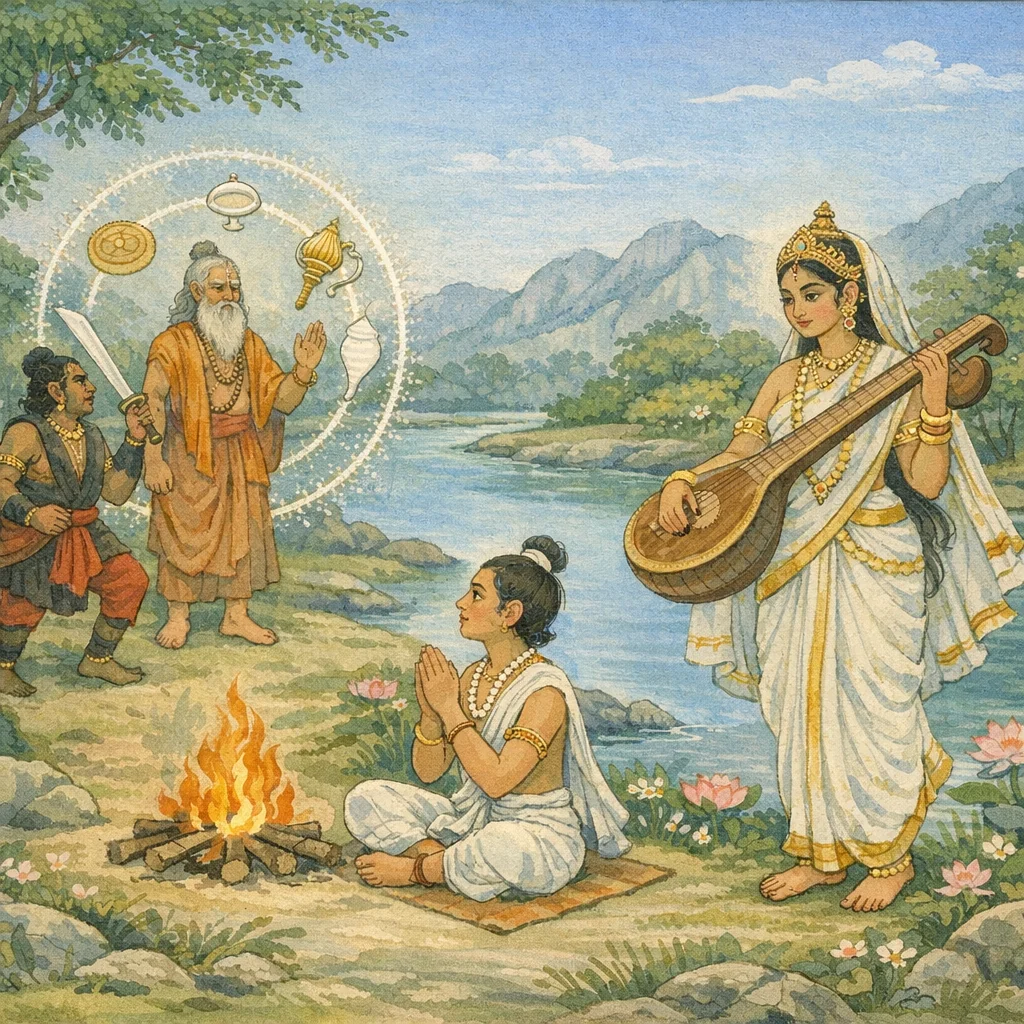
Within the Pulastya–Nārada narrative frame, this adhyāya presents a moral-ritual theology of purification in which violent karmic residue is countered not by sectarian polemic but by protective devotion (rakṣā) and disciplined recitation. A former kṣatriya turned rākṣasa through sustained dvija-droha and cruelty is halted by a brahmarṣi’s “Viṣṇu-pañjara,” an iconographic protective grid that stations Viṣṇu’s weapons and forms in the directions. The rākṣasa’s forced restraint becomes the catalyst for nirveda (ethical disgust), leading him to seek dharma-upadeśa. A brahmacārin, threatened with death, appeals to Agni; Sarasvatī manifests and supplies the Viṣṇu “Sārasvata-stotra,” a litany of divine epithets and cosmological identifications that dissolves sin “like salt in water.” The chapter’s syncretic theology is explicit: Viṣṇu is praised as creator-preserver and also as the Rudra-like end-time destroyer, integrating Vaiṣṇava bhakti with Śaiva eschatological imagery. The rākṣasa undertakes tapas at Śālagrāma and attains Viṣṇuloka, illustrating asura-dharma transformed through nāma-kīrtana and stotra-recitation rather than lineage or ritual status.
Divine Beings
Sacred Geography
Mortal & Asura Figures
Key Content Points
- Karmic causality and moral inversion: a dvija-hating kṣatriya becomes a niśācara; prolonged predation culminates in a crisis of conscience (nirveda) when checked by a sage’s protective rite.
- Ritual-ikonographic protection: the Viṣṇu-pañjara places Viṣṇu’s forms and weapons (cakra, gadā, śārṅga, khaḍga; Varāha and Narasiṃha) in directional guardianship to repel preta/niśācara forces.
- Soteriology through speech: Sarasvatī authorizes a comprehensive Viṣṇu-stotra for daily japa; its theology identifies Viṣṇu with brahman, jagat, yajña, and even Rudra at dissolution, promising pāpa-kṣaya and eventual Viṣṇuloka.
Shlokas in Adhyaya 59
Verse 1
इति श्रीवामनपुराणे अष्टपञ्चाशो ऽध्यायः पुलस्त्य उवाच कश्चिदासीद् द्विजद्रोग्धा पिशुनः क्षत्रियाधमः परपीडारुचिः क्षुद्रः स्वभावादपि निर्घृणः
Thus (ends the previous chapter) in the Śrī Vāmana Purāṇa. Pulastya said: There once was a certain man—one who betrayed/bruised the twice-born, a slanderer, the lowest of kṣatriyas; one who delighted in tormenting others, petty-minded, and by nature itself devoid of compassion.
Verse 2
पर्यासिताः दा तेन पितृदेवद्विजातयः स त्वायुषि परिक्षिणे जज्ञे घोरो निशाचरः
By him the Pitṛs (ancestral spirits), the gods, and the twice-born were harassed and driven into distress. And when his lifespan was running down, he was born as a dreadful night-roaming being (niśācara).
Verse 3
तेनैव कर्मदोषेम स्वेन पापकृतां वरः क्रुरैश्चक्रे ततो वृत्तिं राक्षसत्वाद् विशेषतः
By that very defect of karma—by his own evil-doing—he, foremost among sinners, then adopted a cruel livelihood, especially because of his state of being a rākṣasa.
Verse 4
तस्य पापरतस्यैवं जग्मुर्वर्षशतानि तु तेनैव कर्मदोषेण नान्यां वृत्तिमरोचयत्
Thus, for him—one devoted to sin—hundreds of years passed; and because of that same defect of karma, he found no liking for any other way of life.
Verse 5
यं यं पश्यति सत्त्वं स तं तमादाय राक्षसः चखाद रौद्रकर्मासौ बाहुगोचरमागतम्
Whatever living being he happened to see, that rākṣasa—of savage deeds—would seize it and devour it as soon as it came within the reach of his arms.
Verse 6
एवं तस्यातिदुष्टस्य कुर्वतः प्राणिनां वधम् जगाम च महान् कालः परिणामं तथा वयः
While that exceedingly wicked one thus continued slaughtering living beings, great Time passed on; and with it came change and the advance of age.
Verse 7
स कदाचित् तपस्यन्तं ददर्श सतरितस्तटे महाभागमूर्ध्वभुजं यथावत्संयतेन्द्रियम्
Once, he saw an ascetic engaged in austerities on the bank of a river—an eminent person, with arms raised upward, and with his senses properly restrained.
Verse Having made your devotion firm
अनया रक्षया ब्रह्मन् कृतरक्षं तपोनिधिम् योगाचार्यं शुचिं दक्षं वासुदेवपरायणम्
“O Brahmin, by this protective rite he is made well-guarded—(he who is) a treasure-house of austerity, a teacher of yoga, pure, capable, and wholly devoted to Vāsudeva.”
Verse 12
गदा चेयं सहस्रार्चिरुद्वमन् पावको यथा रक्षोभूतपिशाचानां डाकिनीनां च शातनी
And this mace, emitting a thousand flames like a fire blazing upward, is the destroyer of rākṣasas, bhūtas, piśācas, and also ḍākinīs.
Verse 14
खड्गधाराज्वलज्ज्योत्स्नानिर्धूता ये ममाहिताः ते यान्तु सौम्यतां सद्यो गरुडेनेव पन्नगाः
“May those hostile beings who are repelled by the blazing radiance along the edge of the sword (of divine power) at once become gentle toward me—just as serpents become subdued in the presence of Garuḍa.”
Verse 15
ये कूष्माण्डास्तथा यक्षा दैत्या ये च निशाचराः प्रेता विनायकाः क्रूरा मनुष्या जृम्भकाः खगाः
“Whether they be Kūṣmāṇḍas, Yakṣas, Daityas, and night-roamers; Pretas and fierce Vināyakas; or cruel humans, Jṛmbhakas, and birds—(may all such beings be rendered harmless/benign).”
Verse 16
सिंहादयो ये पशवो दन्दशूकाश्च पन्नगाः सर्वे भवन्तु मे सौम्या विष्णुचक्ररवाहताः
“May lions and other beasts, and biting creatures and serpents—all of them—become gentle toward me, being struck down/overawed by the roar (or impelling force) of Viṣṇu’s discus.”
Verse 17
चित्तवृत्तिहरा ये च ये जनाः स्मृतीहारकाः बलौजसां च हर्तारश्छायाविध्वंसकाश्च ये
May those beings who steal the movements of the mind (disturb mental composure), and those persons who rob one’s memory; those who take away strength and vital vigor, and those who destroy one’s protective ‘shadow’ (well-being/fortune)—may they be driven away (through the ensuing invocation).
Verse 23
ततो द्विजनियुक्तायां रक्षायां रजनीचरः निर्धूतवेगः सहसा तस्थौ मासचतुष्टयम्
Then, when a protective rite appointed by the brahmin had been set in place, the night-roaming being (niśācara) suddenly had his force checked and stood restrained for four months.
Verse 24
यावद् द्विजस्य देवर्षे समाप्तिर्वै समाधितः जाते जप्यावसाने ऽसौ त ददर्श निशाचरम्
When the brahmin’s rite had reached its settled completion, O divine seer, and the recitation (japa) came to its end, he then saw that night-roaming being.
Verse 29
तस्मात् पापादहं मोक्षमिच्छमि त्वत्प्रसादतः पापप्रशमनायालं कुरु मे धर्मदेशनम्
“Therefore I desire release from that sin through your grace. For the pacification of my sin, please give me instruction in dharma.”
Verse 31
वचनं प्राह धर्मात्मा हेतुमच्च सुभाषितम् कथं क्रूरस्वभावस्य सतस्तव निशाचर सहसैव समायाता जिज्ञासा धर्मवर्त्मनि
The righteous-souled one spoke words that were well-spoken and reasoned: “How is it, O niśācara, that for you—one of cruel nature—there has suddenly arisen a desire to inquire into the path of dharma?”
Verse 32
राक्षस उवाच त्वां वै समागतो ऽस्म्यद्य क्षिप्तो ऽहं रक्षया बलात् तव संसर्गतो ब्रह्मन् जातो निर्वेद उत्तमः
The Rākṣasa said: “Today I have come to you; I have been forcibly cast (here) by a certain protective power. O Brahmin, through association with you, the highest dispassion (nirveda) has arisen in me.”
Verse 35
पुलस्त्य उवाच/ इत्येवमुक्तः स मुनिस्तदा वै तेन रक्षसा प्रत्युवाच महाभागो विमृश्य सुचिरं मुनिः
Pulastya said: Thus addressed at that time by that rākṣasa, the great-souled sage, after reflecting for a long while, replied to him.
Verse 36
ऋषिरुवाच/ यन्ममाहोपदेशार्थं निर्विण्णाः स्वेन कर्मणा युक्तमेतद्धि पापानां निवृत्तिरुपकारिका
The sage said: Since you have become disenchanted with your own actions for the sake of receiving my instruction, this is indeed fitting; for sinners, turning back (from sin) is beneficial and helpful.
Verse the God who is the universe; O Universal Self
करिष्ये यातुधानानां नत्वहं धर्मदेशनम् तान् संपृच्छ द्विजान् सौम्य ये वै प्रवचने रताः
I will perform (what is to be done) for the yātudhānas, but I will not give them instruction on dharma. O gentle one, ask those brāhmaṇas who are devoted to expounding (the sacred teaching).
Verse 39
न चखाद स सत्त्वानि क्षुधा संबाधितो ऽपि सन् षष्ठे षष्ठे तदा काले जन्तुमेकमभक्षयत्
Though tormented by hunger, he did not devour living beings; only at each sixth interval of time did he eat a single creature.
Verse 41
स कदाचित्क्षुधाविष्टः पर्यटन् विपुले वने ददर्शाथ फलाहारमागतं ब्रह्मचारिणम् // 59.40 गृहीतो रक्षसा तेन स तदा मुनिदारकः निराशो जीविते प्राह सामपूर्वं निशाचरम्
Once, afflicted by hunger, while wandering in a vast forest, he saw a brahmacārin who had come, living on fruits. Seized by that rākṣasa, the sage’s young disciple—having lost hope for his life—addressed the night-roaming being first with conciliatory words.
Verse ["Viṣṇu (as cosmic Puruṣa/Īśvara)", "Sūrya", "Candra"]
ब्राह्मण उवाच भो भद्र ब्रूहि यत् कार्यं गृहीतो येन हेतुना तदनुब�Vamana Purana
Cosmology
Verse 43
राक्षस उवाच षष्ठे काले त्वमाहारः क्षुधितस्य समागतः निःश्रीकस्यातिपापस्य निर्घृणस्य द्विजद्रुहः
The Rākṣasa said: “At the sixth time you have come as food for me who am hungry—one devoid of fortune, exceedingly sinful, pitiless, and a hater of Brāhmaṇas.”
Verse 45
गुर्वर्थमेतदागत्य यत्फलग्रहणं कृतम् ममात्र निष्ठा प्राप्तस्य फलानि विनिवेदितुम्
“Having come here for the sake of my guru, I have gathered these fruits. I have attained firm resolve here, and (now) I wish to present these fruits as an offering (to my teacher).”
Verse 46
स त्वं मुहूर्तमात्रं मामत्रैवं प्रतिपालय निवेद्य गुरवे यावदिहागच्छाम्यहं फलम्
“Therefore, you protect/stand by me here just for a single muhūrta. Until I present (these) to my guru, I will return here—(having delivered) the fruits.”
Verse 51
आबाल्यान्मम पापेषु न धर्मेषु रतं मनः तत्पापासंक्षयान्मोक्षं प्राप्नुयां येन तद् वद
“From my very childhood my mind has been engaged in sins, not in dharma. Tell me that (means) by which, through the destruction of those sins, I may attain liberation (mokṣa).”
Verse 52
यानि पापानि कर्माणि बालत्वाच्चरितानि च दुष्टां योनिमिमां प्राप्य तन्मुक्तिं कथय द्विज
“Tell me, O twice-born, the means of release from those sinful actions that were committed in childhood; having attained this wretched womb (birth/state of existence), (I seek) liberation from that (condition).”
Verse 53
यद्येतद् द्विजपुत्र त्वं समाख्यास्यस्यशेषतः ततः क्षुधार्तान्मत्तस्त्वं नियतं मोक्षमाप्स्यसि
“If you, O son of a twice-born, will relate this completely, then from me—(who am) afflicted by hunger—you will certainly attain liberation.”
Verse 54
न चेत् तत्पापशीलो ऽहमत्यर्थं क्षुत्पिपासितः षष्ठे काले नृशंसात्मा भक्षयिष्यामि निर्घृणः
“If (you) do not (do that), then I—being of sinful conduct, exceedingly tormented by hunger and thirst—at the sixth (appointed) time, cruel-natured and without compassion, will devour (you).”
Verse 55
पुलस्त्य उवाच एवमुक्तो मुनिसुतस्तेन घोरेम रक्षसा चिन्तामवाप महतीमशक्तस्तदुदीरणे
Pulastya said: “Thus addressed by that dreadful rākṣasa, the sage’s son fell into great anxiety, being unable to reply to (or utter) an answer to that demand.”
Verse 56
स विमृश्य चिरं विप्रः शरणं जातवेदसम् जगाम ज्ञानदानाय संशयं परमं गतः
“After reflecting for a long time, the brāhmaṇa (the sage’s son) went for refuge to Jātavedas (Agni), in order to obtain the gift of right knowledge, having fallen into extreme doubt.”
Verse 57
यदि शुश्रुषितो वह्निर्गुरुशुश्रूषणादनु व्रतानि वा सुचीर्णानि सप्तार्चिः पातु मां ततः
If the Fire-god (Agni) is truly pleased by my service to the guru, and if my vows have been well observed, then may that seven-flamed one protect me from that (danger/evil).
Verse 58
न मातरं न पितरं गौरवेण यथा गुरुम् सर्वदैवावगच्छामि तथा मां पातु पावकः
Just as I always recognize the guru with a reverence (even) greater than (that shown to) mother and father, so may the Purifier, Agni, protect me.
Verse 59
यथा गुरुं न मनसा कर्मणा वचसापि वा अवजानाम्यहं तेन पातु सत्येन पावकः
Since I do not disrespect the guru—whether by mind, by deed, or even by speech—therefore may Agni, through (that) truth, protect me.
Verse 60
इत्येवं मनसा सत्यान् कुर्वतः शपथान् पुनः सप्तर्चिषा समादिष्टा प्रादुरासीत् सरस्वती
Thus, as he again made true vows in his mind, Sarasvatī—having been enjoined by Saptarciṣ (the Seven Sages)—manifested (there).
Verse 61
सा प्रोवाच द्विजसुतं राक्षसग्रहणाकुलम् मा भैर्द्विजसुताहं त्वां मोक्षयिष्यामि संकटात्
She spoke to the brahmin’s son, who was distressed by being seized by a rākṣasa: “Do not fear, O brahmin’s son; I shall free you from this peril.”
Verse 62
यदस्य रक्षसः श्रेयो जिह्वाग्रे संस्थिता तव तत् सर्वं कथयिष्यामि ततो मोक्षमवाप्स्यसि
“That which is the rākṣasa’s advantage—resting upon the tip of your tongue—I shall tell you in full; then you will obtain release.”
Verse 47
प्रातरुत्थाय जप्तव्यं मध्याह्ने ऽह्नक्षये ऽपि वा असंशयं सदा जप्यो जपतां पुष्टिशान्तिदः
ascetic)."
Verse 66
ॐ हरिं कुष्णं हृषीकेशं वासुदेवं जनार्दनम् प्रणतो ऽस्मि जगन्नाथं स मे पापं व्यपोहतु
Om. I bow to Hari—Kṛṣṇa, Hṛṣīkeśa, Vāsudeva, Janārdana—the Lord of the universe. May He remove my sin.
Verse ["Shiva (Maheśvara)"]
चराचरसुरुं नाथं गोविन्दं शेषशायिनम् प्रणतो ऽस्मि परं देवं स मे पापं व्यपोहतु
I bow to the supreme God—the Lord of the moving and unmoving (beings), Govinda, who reclines upon Śeṣa. May He remove my sin.
Verse 69
दामोदरमुदाराक्षं पुण्डरीकाक्षमच्युतम् प्रणतो ऽस्मि स्तुतं स्तुत्यैः स मे पापं व्यपोहतु
I bow to Dāmodara—of generous eyes—Puṇḍarīkākṣa, the Unfailing (Acyuta). Praised with hymns, may he remove my sin.
Verse 70
नारायणं नरं शौरिं माधवं मधुसूदनम् प्रणतो ऽस्मि धराधारं स मे पापं व्यपोहतु
I bow to Nārāyaṇa, to Nara, to Śauri, to Mādhava, to Madhusūdana—the supporter of the earth. May he remove my sin.
Verse 71
केशवं चन्द्रसूर्याक्षं कंसकेशिनिषूदनम् प्रणतो ऽस्मि महाबाहुं स मे पापं व्यपोहतु
I bow to Keśava, whose eyes are the moon and the sun; the slayer of Kaṃsa and Keśin; the mighty-armed. May he remove my sin.
Verse 72
श्रीवत्सवक्षसं श्रीशं श्रीधरं श्रीनिकेतनम् प्रणतो ऽस्मि श्रियः कान्तं स मे पापं व्यपोहतु
I bow to the Lord whose chest bears the Śrīvatsa mark; to the Lord of Śrī (Lakṣmī), the bearer of Śrī, the abode of Śrī. Having prostrated to the beloved of Śrī, may He remove my sin.
Verse 73
यमीशं सर्वभूतानां ध्यायन्ति यतयो ऽक्षरम् वासुदेवमनिर्देश्यं तमस्मि शरणं गतः
That imperishable Lord and ruler of all beings—Vāsudeva—whom ascetics contemplate, and who is beyond verbal definition: in Him I have taken refuge.
Verse bhava: “Bhava,” a name of Śiva; udbhava: origin/source/arising; bhavodbhava: “source of Bhava,” i
समस्तालम्बनेभ्यो यं व्यावृत्त्य मनसो गतिम् ध्यायन्ति वासुदेवाख्यं तमस्मि शरणं गतः
bhavodbhavaṃ vedavidāṃ pariṣṭhaṃ yogātmanāṃ sāṃkhyavidāṃ variṣṭham ādityarudrāśvivasuprabhāvaṃ prabhuṃ prapadye 'cyutamātmavantam
Verse 75
सर्वगं सर्वभूतं च सर्वस्याधारमीश्वरम् वासुदेवं परं ब्रह्म तमस्मि शरणं गतः
I have taken refuge in Vāsudeva—the Supreme Brahman—who pervades all, who is present as all beings, and who is the Lord, the support of everything.
Verse 77
पुण्यपापविनिर्मुक्ता यं प्रविश्य पुनर्भवम् न योगिनः प्राप्नुवन्ति तमस्मि शरणं गतः
I have taken refuge in Him, entering whom—freed from merit and sin—even yogins do not again obtain rebirth.
Verse 78
ब्रह्म भूत्वा जगत् सर्वं सदेवासुरमानुषम् यः सृजत्यच्युतो देवस्तमस्मि शरणं गतः
Having become Brahmā, that Acyuta Deva who creates the entire universe—together with gods, asuras, and humans—to Him I have gone for refuge.
Verse 79
ब्रह्मत्वे यस्य वक्त्रेभ्यश्चतुर्वेदमयं वपुः प्रभुः पुरातनो जज्ञे तमस्मि शरणं गतः
In the state of Brahmāhood, from whose mouths there arose a body constituted of the four Vedas—He, the ancient Lord, was born; to Him I have gone for refuge.
Verse 80
ब्रह्मरूपधरं देवं जगद्योनि जनार्दनम् स्रष्टृत्वे संस्थितं सृष्टौ प्रणतो ऽस्मि सनातनम्
I bow to the eternal Janārdana—the divine one who bears the form of Brahmā, who is the womb/source of the world, and who stands established in creation as the Creator.
Verse 81
स्रष्टा भूत्वा स्थितो योगी स्थितावसुरसूदनः तमादिपुरुषं विष्णुं प्रमतो ऽस्मि जनार्दनम्
Having become the Creator, He abides as the Yogin; abiding (as the Sustainer), He is the slayer of the Asuras. To that Viṣṇu, the primordial Person, to Janārdana, I bow.
Verse ["Śiva", "Agni"]
पातालव�Vamana Purana
Stuti (invocatory salutations)
Verse Composite: Śiva (Rudra/raudra), Viṣṇu (Padmanābha), and Skanda; also cosmic luminaries (Candra, Sūrya) and Dhruva as cosmic axis
सुरासुराः पितृगणाः यक्षगन्धर्वराक्षसाः संभूता यस्य देवस्य सर्वगं तं नमाम्यहम्
Saromahatmya (Sarasvatī–Kurukṣetra Tīrtha Cycle)
Verse 89
यस्मान्नान्यत् परं किञ्चिद् यस्मिन् सर्वं महात्मनि यः सर्वमध्यगो ऽनन्तः सर्वगं तं नमाम्यहम्
Beyond whom there is nothing higher whatsoever; in whom, the Great Self, all this rests; who stands within the midst of all—endless— to that all-pervading One I bow.
Verse 90
यथा सर्वेषु भूतेषु गूढो ऽग्निरिव दारुषु विष्णुरेवं तथा पापं ममाशेषं प्रणश्यतु
“Just as fire lies hidden within pieces of wood, and just as Viṣṇu is (thus) present, concealed within all beings—so may all my sin, without remainder, be destroyed.”
Verse 91
यथा विष्णुमयं सर्वं ब्रह्मदि सचराचरम् यच्च ज्ञानपरिच्छेद्यं पापं नश्यतु मे तथा
“Just as everything—beginning with Brahmā, the moving and the unmoving—is pervaded by Viṣṇu; so too may that sin of mine which is delimited (only) by knowledge (i.e., known/ascertainable as sin) be destroyed.”
Verse 92
शुभशुभानि कर्माणि रजःसत्त्वतमांसि च अनेकजन्मकर्मोत्थं पापं नश्यतु मे तथा
“(From) auspicious and inauspicious actions, and from (the workings of) rajas, sattva, and tamas—may the sin of mine that has arisen from the actions of many births likewise be destroyed.”
Verse 93
यन्निशायां च यत्प्रातर्यन्मध्याह्नापराह्णयोः संध्ययोश्च कृतं पापं कर्मणा मनसा गिरा
Whatever sin has been committed—by deed, by mind, or by speech—at night, at dawn, at midday, in the afternoon, and at the two twilight junctions (morning and evening),
Verse 94
यत् तिष्ठता यद् व्रजता यच्च शय्यागतेन मे कृतं यदशुभं कर्म कायेन मनसा गिरा
whatever inauspicious act has been done by me—whether while standing, while walking, or while lying down—by body, by mind, or by speech,
Verse 95
अज्ञानतो ज्ञानतो वा मदाच्चलितमानसैः तत् क्षिप्रं विलयं यातु वासुदेवस्य कीर्तनात्
whether through ignorance or knowingly, or through minds unsettled by intoxication (pride/delusion), may that (sin) quickly come to dissolution through the praise/chanting of Vāsudeva.
Verse 96
परदारपरद्रव्यवाञ्छाद्रोहोद्भवं च यत् परपीडोद्भवां निन्दां कुर्वता यन्महात्मनाम्
Whatever sin arises from desiring another’s wife and another’s property, and whatever sin arises from treachery; and whatever slander, born of harming others, is committed against great-souled persons—(may all that be removed).
Verse 97
यच्च भोज्ये तथा पेये भक्ष्ये चोष्ये विलेहने तद् यातु विलयं तोये यथा लवणभाजनम्
And whatever (sin) there is in what is eaten and likewise in what is drunk—in what is chewed, sucked, and licked—may that go to dissolution in the water, like salt in a vessel (dissolves).
Verse 98
यद् बाल्ये यच्च कौमारे यत् पापं यौवने मम वयःपरिणतौ यच्च यच्च जन्मातरे कृतम्
Whatever sin (I committed) in childhood, and whatever in boyhood/adolescence; whatever sin of mine in youth; and whatever at the turning of age (maturity/decline); and whatever was done in another birth—(may all that be removed).
Verse 99
तन्नारायण गोविन्द हरिकृष्णेश कीर्तनात् प्रयातु विलयं तोये यथा लवणभाजनम्
By the kīrtana (devotional recitation) of those names—Nārāyaṇa, Govinda, Hari, Kṛṣṇa, and Īśa—may (all sin/impurity) pass into dissolution in water, just as a lump of salt dissolves in water.
Verse 100
विष्णवे वासुदेवाय हरये केशवाय च जनार्दनाय कृष्णाय नमो भूयो नमो नमः
Obeisance to Viṣṇu, to Vāsudeva, to Hari, and to Keśava; to Janārdana, to Kṛṣṇa—salutation again and again, salutation, salutation.
Verse 101
भविष्यन्नरकघ्नाय नमः कंसविघातिने अरिष्टकेशिचणूरदेवारिक्षयिणे नमः
Salutation to the slayer of (the demon) Naraka—(the Lord) who will be (so) in the future; salutation to the destroyer of Kaṃsa; to the one who slew Ariṣṭa, Keśin, and Cāṇūra; to the exterminator of the enemies of the gods—salutation.
Verse 102
को ऽन्यो बलेर्वञ्चयिता त्वामृते वै भविष्यति को ऽन्यो नाशयति बलाद् दर्पं हैहयभूपतेः
“Who else, apart from you, will ever be the one to outwit Bali? Who else will destroy, by sheer power, the arrogance of the Haihaya king?”
Verse 115
अहर्निशं हृषीकेशं स्तवेनानेन राक्षस स्तुहि भक्तिं दृढां कृत्वा ततः पापाद् विमोक्ष्यसे
“Day and night, O Rākṣasa, praise Hṛṣīkeśa with this hymn. Having made your devotion firm, then you will be released from sin.”
Verse 116
स्तुतो हि सर्वपापानि नाशयिष्यत्यसंशयम् स्तुतो हि भक्त्या नॄणां वै सर्वपापहरो हरिः
“For when praised, he will destroy all sins—without doubt. For Hari, praised with devotion by people, is indeed the remover of all sins.”
Verse ["Divine protection (rakṣā)", "Āyudha-mahimā (glory of divine weapons)", "Apotropaic destruction of evil beings", "Purity and radiance as markers of divinity"]
11
11
Verse In the Tretā age
समाराध्य जगन्नाथं स तत्र पुरषोत्तमम् सर्वपापविनिर्मुक्तो विष्णुलोकमवाप्तवान्
Having duly worshiped Jagannātha—Puruṣottama—there, he became completely freed from all sins and attained the world of Viṣṇu.
Verse 121
य एतत् परमं स्तोत्रं वासुदेवस्य मानवः पठष्यति स सर्वेभ्यः पापेभ्यो मोक्षमाप्स्यति
“Any person who recites this supreme hymn of Vāsudeva will obtain liberation from all sins.”
Frequently Asked Questions
The stotra’s syncretic theology identifies Viṣṇu not only as para-brahman and jagat-svarūpa but also as the antapuruṣa who ‘consumes’ creation and ‘dances’ in a Rudra-mode at dissolution. Rather than opposing sects, the chapter absorbs Śaiva eschatological functions into a Vaiṣṇava devotional framework, presenting a unified divine agency across sṛṣṭi–sthiti–saṃhāra.
Topographical sanctification appears through the riverbank setting (sarit-taṭa) and the epiphany of Sarasvatī, aligning the narrative with the Sarasvatī basin’s purificatory prestige. The chapter also culminates at Śālagrāma, a major Vaiṣṇava sacred locus, where sustained japa and tapas are performed—linking mantra-practice to pilgrimage geography.
Two linked practices are taught: (1) the Viṣṇu-pañjara, a directional protective visualization invoking Viṣṇu’s weapons and forms to repel hostile beings; and (2) the Viṣṇu Sārasvata-stotra for regular japa (morning, midday, evening), framed as nāma-kīrtana that dissolves accumulated pāpa across lifetimes and enables eventual liberation (Viṣṇuloka).