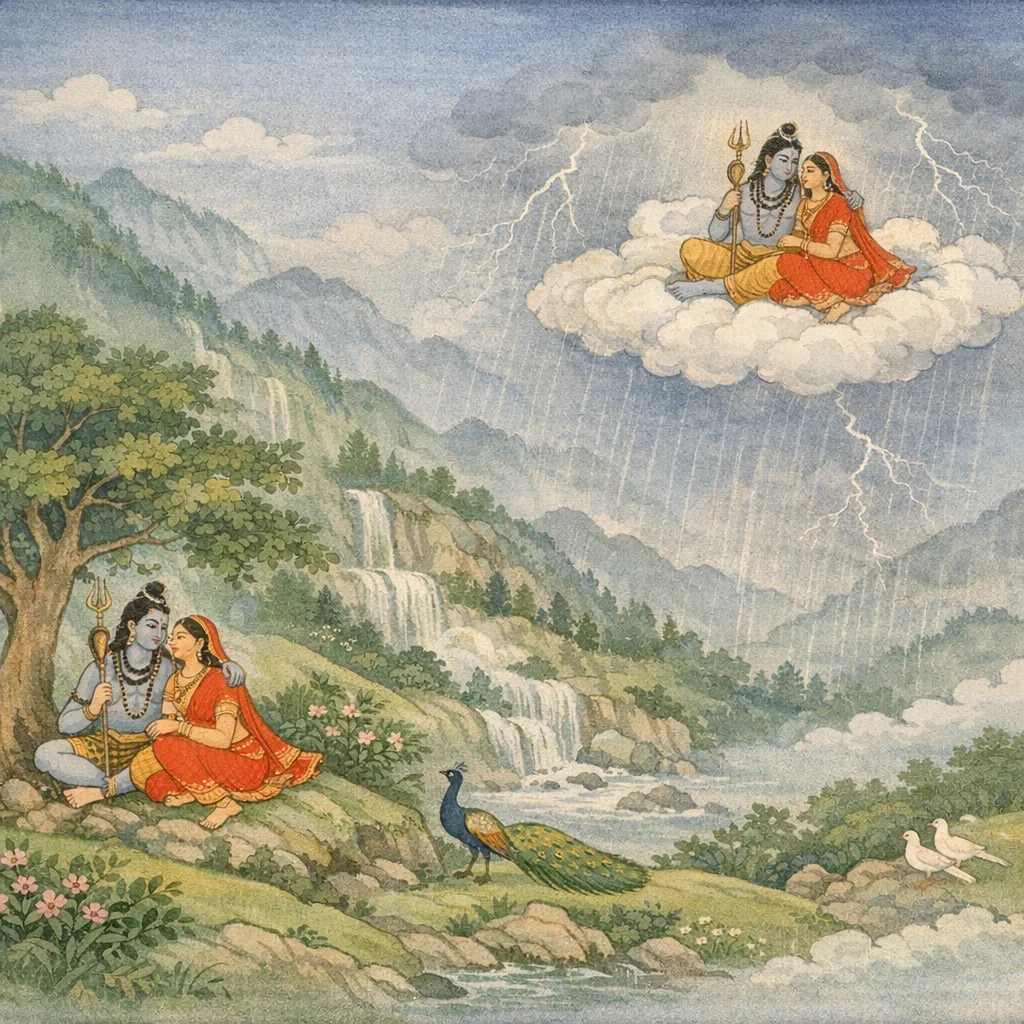
Adhyaya 1: Narada Questions Pulastya: The Vamana Purana Begins and Satī’s Monsoon Lament
वामनपुराण-प्रस्तावना तथा सती-प्रावृड्वर्णन (Vāmanapurāṇa-Prastāvanā tathā Satī-Prāvṛḍ-Varṇana)
The Vamana Purana Begins
Adhyāya 1 opens with a programmatic benediction to Śrīdhara-Viṣṇu in the guise of Vāmana, immediately foregrounding the Purāṇa’s syncretic theology: the same text that will narrate the Bali–Vāmana episode also embeds sustained Śaiva materials. The narrative frame is established through the Pulastya–Nārada saṃvāda, with Nārada requesting a systematic account of the Vāmana Purāṇa and raising doctrinal-historical questions (Vāmana’s assumption of dwarf-form; Prahlāda’s Vaiṣṇava identity amid conflict with the devas; Satī’s death and rebirth as Himavat’s daughter). Pulastya begins the exposition not with Bali but with an iconographically rich Śaiva vignette: Satī (Dakṣa’s daughter) and Śaṅkara dwelling without a house, enduring summer beneath trees, and then witnessing the onset of the monsoon (prāvṛṭ) in elaborate nature-poetry. Satī urges Śiva to build a dwelling; Śiva replies with ascetic poverty and serpent-ornament imagery, culminating in the episode of mounting a rain-cloud (Jīmūtaketu), exemplifying Purāṇic topographical and seasonal sacralization alongside sectarian synthesis.
Divine Beings
Sacred Geography
Mortal & Asura Figures
Key Content Points
- Pulastya–Nārada framework: Nārada petitions Pulastya for the Vāmana Purāṇa in ordered sequence and poses multiple theological-historical doubts (Vāmana’s form, Prahlāda’s role, Satī’s rebirth).
- Sectarian synthesis in narrative design: the opening salutation to Vāmana-Viṣṇu is followed by a substantial Śaiva episode (Satī–Śaṅkara), signaling a syncretic theology rather than a single-sect Purāṇa.
- Seasonal and iconographic description: detailed prāvṛṭ-varṇana (winds, thunder, lightning, rivers, trees, birds) and Śiva’s ascetic regalia (serpents as upavīta/ornaments), ending with the cloud-ascent motif and the epithet Jīmūtaketu.
Shlokas in Adhyaya 1
Verse 1
त्रैलोक्यराज्यमाक्षिप्य बलेरिन्द्राय यो ददौ श्रीधराय नमस्तस्मै छद्मवामनरूपिणे
Salutation to Śrīdhara (Viṣṇu), who—having taken away Bali’s sovereignty over the three worlds—bestowed it upon Indra, assuming the disguised form of Vāmana.
Verse 2
पुलस्त्यमुषिमासीनमाश्रमे वाग्विदां वरम् नारदः परिपप्रच्छ पुराणं वामनाश्रयम्
Nārada questioned the sage Pulastya—seated in his hermitage, foremost among the knowers of sacred speech—about the Purāṇa that is centered on Vāmana.
Verse 3
कथं भगवता ब्रह्मन् विष्णुना प्रभविष्णुना वामनत्वं धृतं पूर्वं तन्ममाचक्ष्व पृच्छतः
O Brāhmaṇa (sage), how did the Blessed Lord—Viṣṇu, the supremely powerful—formerly assume the state/form of Vāmana? Tell me that, as I ask.
Verse 4
कथं च वैष्णवनो भूत्वा प्रह्लादो दैत्यसत्तमः त्रिदशैर्युयुधे सार्थमत्र मै संशयो महान्
How, indeed, did Prahlāda—the best among the Daityas—though being a devotee of Viṣṇu, fight together with the gods? Here I have a great doubt.
Verse 5
श्रूयते च द्विजश्रेष्ठ दक्षस्य दुहिता सती शङ्करस्य प्रिया भार्या बभुव वरवर्णिनी
And it is heard, O best of Brahmins, that Satī, the daughter of Dakṣa, became the beloved wife of Śaṅkara, she of excellent complexion.
Verse 6
किमर्थं सा परित्यज्य स्वरीरं वरानना जाता हिमवतो गेहे गिरीन्द्रस्य महात्मनः
For what reason did that fair-faced one abandon her own body and become born in the house of Himavat, the great-souled lord of mountains?
Verse 7
पुनश्च देवदेववस्य पत्नीत्वमगमच्छुभा एतन्मे संशयं छिन्धि सर्ववित् त्वं मतो ऽसि मे
“And again, how did the auspicious (goddess) attain the state of being the consort of the God of gods? Cut this doubt of mine, for you are regarded by me as omniscient.”
Verse 8
तीर्थानां चैव माहात्म्यं दानानां चैव सत्तम व्रतानां विविधानां च विधिमाचक्ष्व मे द्विज
“O best of the virtuous, explain to me the greatness of sacred fords (tīrthas), and of gifts (dānas), and also the rules for the various vows (vratas), O twice-born.”
Verse 9
एवभुक्तो नारदेन पुलस्त्यो सुनिसत्तमः प्रोवाच वदतां श्रेष्ठो नारदं तपसो निधिम
“Thus addressed by Nārada, Pulastya—the best among the virtuous—spoke; the foremost of speakers addressed Nārada, the treasure-house of austerity.”
Verse 10
पुलस्त्य उवाच पुराणं वामनं वक्ष्ये क्रमान्निखिलमादितः अवधानं स्थिरं कृत्वा शृणुष्व मुनिसत्त्म
Pulastya said: “I shall expound the Vāmana Purāṇa completely, in due order, from the beginning. Having fixed steady attention, listen, O best of sages.”
Verse 11
पुरा हैमवती देवी मन्दरस्थं महेश्वरम् उवाच वचनं दृष्ट्वा ग्रीष्मकालमुपस्थितम्
Formerly, the goddess Haimavatī (Pārvatī), seeing that the summer season had arrived, spoke words to Maheśvara who was dwelling on Mandara.
Verse 12
ग्रीष्मः प्रवृत्तो देवेश न च ते विद्यते गृहम् यत्र वातातपौ ग्रीष्मे स्थितयोर्नौ गमिष्यतः
“Summer has begun, O Lord of the gods, and you have no house—where shall we go, when in summer wind and scorching heat are upon us?”
Verse 13
एवमुक्तो भवान्या तु शङ्करो वाक्यमब्रवीत् निराश्रयो ऽहं सुदती सदारण्यचरः शुभे
Thus addressed by Bhavānī, Śaṅkara spoke: “O fair-toothed one, O auspicious lady, I am without a fixed abode; I ever dwell and move in the forest.”
Verse 14
इत्युक्ता शङ्करेणाथ वृक्षच्छायासु नारद निदाघकालमनयत् समं शर्वेण सा सती
Thus spoken to by Śaṅkara, O Nārada, that Satī (Pārvatī) passed the season of summer beneath the shade of trees, together with Śarva (Śiva).
Verse 15
निदाघान्ते समुद्रभूतो निर्जनाचरितो ऽद्भुतः घनान्धकारिताशो वै प्रावृट्कालोषतिरागवान्
At the end of summer, the wondrous season of the rains arose—frequented by lonely places—its directions darkened by dense clouds, and it was exceedingly impassioned (intense).
Verse 16
तं दृष्ट्वा दक्षतनुजा प्रावृट्कालमुपस्थितम् प्रोवाच वाक्यं देवेशं सती सप्रणयं तदा
Seeing that the rainy season (prāvṛṭ) had arrived, Sati, the daughter of Dakṣa, then affectionately spoke words to the Lord of the gods (Maheśvara).
Verse 17
विवान्ति वाता हृदयावदारणा गर्जन्त्यमी लोयधरा महेश्वर स्फुरन्ति नीलाभ्रगणेषु विद्युतो वाशन्ति केकारवमेव बर्हिणः
Winds blow, rending the heart; these rain-bearing clouds thunder, O Maheśvara. Lightning flashes among the masses of dark-blue clouds, and peacocks cry out with their ke-kā calls.
Verse 18
पतन्ति धारा गगनात् परिच्युता बका बलाकाश्च सरन्ति तोयदान् कदम्बसर्ज्जार्जुनकेतकीद्रुमाः पुष्पाणि मुञ्चन्ति सुमारुताहताः
Streams of rain fall, released from the sky. Herons and cranes move about near the rain-clouds. Kadamba, sāla/sarjja, arjuna, and ketakī trees shed their flowers, struck by the gentle wind.
Verse 19
श्रुत्वैव मघस्य दृढं तु गर्जितं त्यजन्ति हंसाश्च सरांसि तत्क्षणात् यथाश्रयान् योगिगणः समन्तात् प्रवृद्धमूलानपि संत्यजन्ति
Hearing at once the firm thunder of the cloud (Magha), the swans immediately abandon the lakes. Likewise, bands of yogins on all sides abandon even well-rooted abodes (attachments).
Verse 20
इमानि यूथानि वने मृगाणां चरन्ति धावन्ति रमन्ति शंभो तथाचिराभाः सुतरां स्फुरन्ति पश्येह नीलेषु घनेषु देव नूनं समृद्धिं सलिलस्य दृष्ट्वा चरन्ति शूरास्तरुणद्रुमेषु
These herds of deer in the forest roam, run, and sport, O Śambhu. And lightning-flashes shine forth intensely here within the dark, dense clouds, O Deva. Surely, seeing the abundance of water, the bold creatures move about among the young trees.
Verse 21
उद्वत्त्वेगाः सहसैव निम्नगा जाताः शशङ्काङ्कितचारुमैले किमत्र चित्रं यदनुज्ज्वलं जनं निषेव्य योषिद् भवति त्वशीला
The rivers, with their currents suddenly swollen, have become charming—marked by the moon (i.e., moonlight) upon their lovely dark surface. What wonder is there that a woman, associating with a dull (unillustrious) person, becomes ill-conducted?
Verse 22
नीलैश्च मेघैश्च समावृतं नभः पुष्षैश्च सर्ज्जा मुकुलैश्च नीपाः फलैश्च बिल्वाः पयसा तथापगाः पत्रैः सपद्मैश्च महासरांसि
The sky is covered with dark clouds; the śarjja trees are filled with blossoms; the nīpa trees with buds. The bilva trees are laden with fruits; the rivers flow full of water; and the great lakes are covered with leaves and lotuses.
Verse 23
काले सुरौद्रे ननु ते ब्रवीमि गृहं कुरुष्वात्र महाचजलोत्तमे सुनिर्वृता येन भवामि शंभो
In this season of strong heat, I tell you: build a house here, in this excellent great mountain (or best of great mountains), O Śambhu, so that I may dwell in comfort and contentment.
Verse 24
इत्थं त्रिनेत्रः श्रुतिरामणीयकं श्रुत्वा वचो वाक्यमिदं बभाषे न मे ऽस्ति वित्तं गृहसंचयार्थे मृगारिचर्मावरणं मम प्रिये
Thus the three-eyed one, having heard her pleasing words, spoke this reply: ‘I have no wealth for the purpose of building up a household. My covering, my beloved, is the hide of a wild beast.’
Verse 25
ममोपवीतं भुजगेश्वरः शुभे कर्णे ऽपि पद्मश्च तथैव पिङ्गलः केयूरमेकं मम कम्बलस्त्वहिर्द्वितीयमन्यो भुजगो धनञ्जयः
“The lord of serpents is my sacred thread. O auspicious one, Padma and likewise Piṅgala are in my ears. One armlet for me is the serpent Kambala; the second armlet is another serpent, Dhanañjaya.”
Verse 26
सव्येतरे तक्षक उत्तरे तथा नीलो ऽपि नीलाञ्जनतुल्यवर्णः श्रोणीतटे राजति सुप्रतिष्ठः
“On the other side is Takṣaka, and likewise above is Nīla, whose color resembles dark collyrium. Supratiṣṭha shines upon the hip-region.”
Verse 28
पुलस्त्य उवाच इति वचनमथोग्रं शङ्करात्सा मृडानी ऋतमपि तदसत्यं श्रीमदाकर्ण्य भीता अवनितसमवेक्ष्य स्वामिनो वासकृच्छ्रात् परिवदति सरोषं लज्जयोच्छ्वस्य चोष्म् वम्प्_1.27 देव्युवाच कथं हि देवदेवेश प्रावट्कालो गमिष्यति वृक्षमूले स्थिताया मे सुदुःखेन वदाम्यतः
Pulastya said: “Having heard those harsh words from Śaṅkara, Mṛḍānī—though they were true—became frightened. Looking down at the ground, distressed by the hardship of dwelling (thus), she spoke with anger, breathing hotly out of shame.” The Goddess said: “O Lord of the gods, how will the rainy season pass for me as I remain at the root of a tree? I speak this out of great sorrow.”
Verse 30
शङ्कर उवाच घनावस्थितदेहायाः प्रावृट्घनखण्डमुन्नतमारुह्य तस्थौ सह दक्षकन्यया ततो ऽभवन्नाम तेदश्वरस्य जीमूतकेतुस्त्विति विश्रुतं दिवि
Śaṅkara said: Ascending a lofty mass of rain-cloud, she whose body was formed of dense cloud stood there together with Dakṣa’s daughter. Thereupon that excellent horse obtained the name ‘Jīmūtaketu’, famed in heaven.
Frequently Asked Questions
It juxtaposes a Viṣṇu-centered maṅgala (Vāmana who restores Indra’s sovereignty from Bali) with an extended Śaiva narrative (Satī–Śaṅkara), using the Pulastya–Nārada frame to present both as parts of one authoritative Purāṇic discourse—an implicit syncretic theology rather than sectarian exclusivism.
This unit is primarily seasonal-topographical sacralization rather than a tīrtha-catalogue: it locates Śiva on Mandara and sanctifies landscape through prāvṛṭ-varṇana (rivers swelling, forests flowering, lakes filling). No Kurukṣetra/Sarasvatī tīrtha list appears in the provided passage.
Bali–Vāmana is introduced programmatically in the opening salutation (Viṣṇu as Vāmana who ‘seizes the three worlds’ and returns sovereignty to Indra). The chapter then shifts to Nārada’s inquiry—setting up the later detailed account—while Pulastya begins the exposition with the Śaiva episode that exemplifies the Purāṇa’s integrated scope.