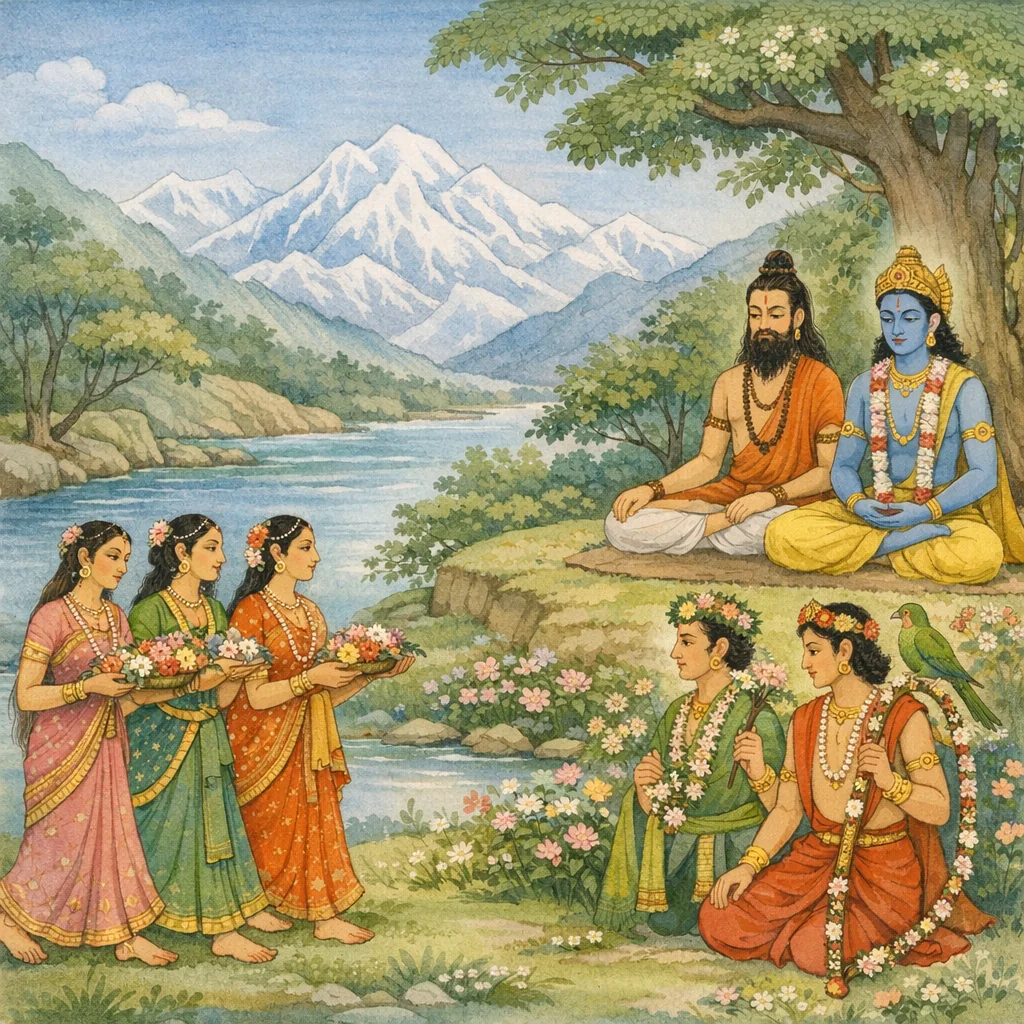
Adhyaya 6: Nara-Narayana’s Tapas, Indra’s Temptation, and the Burning of Kama: The Origin of Ananga and the Shiva-Linga Episode
नरनारायण-तपः । अनङ्ग-उत्पत्ति । दारुवन-लिङ्ग-प्रसङ्ग (Nara-Nārāyaṇa-tapaḥ | Anaṅga-utpatti | Dāruvana-liṅga-prasaṅga)
Indra's Temptation and the Burning of Kama
Within the Pulastya–Nārada dialogue-frame, this Adhyāya stages a syncretic theology in which Vaiṣṇava tapas and Śaiva iconography mutually illuminate one another. Dharma—born from Brahmā—begets Hari and Kṛṣṇa as Nara-Nārāyaṇa, who undertake yogic austerities at Badarikāśrama on the Gaṅgā’s bank. Indra, fearing the cosmic heat of their tapas, dispatches apsarases along with Vasantā and Kandarpa (Kāma), prompting an elaborate iconographic spring-description that culminates in Nārāyaṇa’s recognition of Anaṅga. Pulastya then narrates why Kāma became “bodiless”: after Satī’s death and Dakṣa’s sacrifice’s ruin, Kāma’s arrows drive Śiva into grief-madness, blackening the Kālindī’s waters; later, in Dāruvana, sages curse Śiva’s liṅga to fall, shaking worlds until Brahmā and Viṣṇu hymn the endless liṅga and restore ritual order. The chapter closes with Śiva’s final incineration of Kāma and the etiological birth of fragrant trees and flowers from Kāma’s broken bow—linking myth, ritual, and sacred landscape into a single purāṇic cartography.
Divine Beings
Sacred Geography
Mortal & Asura Figures
Key Content Points
- Pulastya–Nārada narrative frame: Dharma’s lineage and the manifestation of Hari–Kṛṣṇa as Nara-Nārāyaṇa; their yogic tapas at Badarikāśrama (Gaṅgā-tīra) for lokahita.
- Indra’s anxiety and the temptation motif: Śatakratu sends Rambhā and other apsarases with Vasantā and Kandarpa; extended iconographic description of spring (vasanta-śrī) as a deliberate disruption of tapas.
- Anaṅga etiology and Śaiva–Vaiṣṇava synthesis: Kāma’s burning by Śiva (becoming Anaṅga), the Kālindī’s darkened waters, the Dāruvana liṅga-fall shaking the cosmos, Brahmā–Viṣṇu’s stotra to the endless liṅga, restoration of liṅga, and the codification of Śiva-arcana with associated śāstra-streams and lineages; floral/arboreal origins from Kāma’s bow and arrows.
Shlokas in Adhyaya 6
Verse 1
इति श्रीवामनपुराणे पञ्चमो ऽध्यायः पुलस्त्य उवाच हृद्भवो ब्रह्मणो यो ऽसौ धर्मो दिव्यवपुर्मुने दाक्षायाणी तस्य भार्या तस्यामजनयत्सुतान्
Thus ends the fifth chapter in the Śrī Vāmana Purāṇa. Pulastya said: O sage, Dharma—born from the heart of Brahmā, of divine form—had as his wife Dākṣāyaṇī, and with her he begot sons.
Verse 2
हरिं कुष्णं च देवर्षे नारायणनरौ तथा योगाभ्यासरतौ नित्यं हरिकृष्णौ बभूवतुः
O divine seer, Hari and Kṛṣṇa, and likewise Nara and Nārāyaṇa—ever devoted to the practice of yoga—became (manifest as) Hari and Kṛṣṇa.
Verse 3
नरनारायणौ चैव जगतो हितकाम्यया तप्येतां च तपः सौम्यौ पुराणवृषिसत्त्मौ
And Nara and Nārāyaṇa, desiring the welfare of the world, performed austerities—those gentle ones, the foremost among the ancient sages.
Verse 4
प्रालेयाद्रिं समागम्य तीर्थे बदरिकाश्रमे गृमन्तौ तत्परं ब्रह्म गङ्गाया विपुले तटे
Having reached the snow-clad mountain (Himālaya) and the sacred ford at Badarikāśrama, they dwelt there, intent upon the Supreme Brahman, on the broad bank of the Gaṅgā.
Verse 5
नरनारायणाभ्यां च जगदेतच्चराचरम् तापितं तपसा ब्रह्मन् शक्रः क्षोभं तदा ययौ
By Nara and Nārāyaṇa, this entire world—moving and unmoving—was heated (made to tremble) by austerity. Then, O Brahmin, Śakra (Indra) became agitated and went into alarm.
Verse 6
संक्षुब्धस्तपसा ताभ्यां क्षोभमणाय शतक्रतुः रम्भाद्याप्सरसः श्रेष्ठाः प्रेषयत्स महाश्रमम्
Agitated by the austerity of those two, Śatakratu (Indra), seeking to cause disturbance, sent the foremost apsarases beginning with Rambhā to the great hermitage.
Verse 7
कन्दर्पश्च सुदुर्धर्षश्चूताङ्कुरमहायुधः समं सहचरेणैव वसन्तेनाश्रमं गतः
And Kandarpa (Kāma), very difficult to resist, whose great weapon is the mango-bud, went to the hermitage together with his companion, Spring (Vasanta).
Verse 8
ततो माधवकन्दर्पौ ताश्चैवाप्सरसो वराः बदर्याश्रममागम्य विचिक्रीडुर्यथेच्छया
Then Mādhava and Kandarpā, along with those excellent Apsarases, came to Badaryāśrama and sported there at will.
Verse 9
ततो वसन्ते संप्राप्ते सिंशुका ज्वलनप्रभाः निष्पत्राः सततं रेजुः शोमभयन्तो धरातलम्
Then, when spring arrived, the siṃśukā trees—glowing like fire—though leafless, continually shone, as if adorning the surface of the earth.
Verse 10
शिशिरं नाम मातङ्गं विदार्य नखरैरिव वसन्तकेसरी प्राप्तः पलाशकुसुमैर्मुने
Having torn apart the elephant called ‘Winter’ as if with claws, the lion of Spring arrived, O sage, along with palāśa blossoms.
Verse 11
मया तुषारौघकरी निर्जितः स्वेन तेजसा तमेव हसतेत्युच्चैः वसन्तः कुन्दकुड्मलैः
“By me, the (season) that brings torrents of frost has been conquered by my own splendor.” Thus, as if laughing aloud at it, Spring (Vasanta) (appeared) with buds of jasmine.
Verse 12
वनानि कर्णिकाराणां पुष्पितानि विरेजिरे यथा नरेन्द्रपुत्राणि कनकाभरणानि हि
The forests, blossoming with karṇikāra trees, shone splendidly—like the sons of kings adorned with golden ornaments.
Verse 13
तेषामनु तथा नीपाः पिङ्करा इव रेजिरे स्वमिसंलब्धसंमाना भृत्या राजसुतानिव
Following them, the nīpa trees likewise shone, as if tawny-colored—like servants who have obtained honor from their own master, (standing) like the sons of a king.
Verse 14
रक्ताशोकवना भान्ति पुष्पिताः सहसोज्ज्वलाः भृत्वा वसन्तनृपतेः संग्रामे ऽसृक्प्लुता इव
The groves of red aśoka trees shine, blossoming and brightly radiant all at once—like warriors drenched in blood after bearing (the assault of) King Spring in battle.
Verse 15
मृगवृन्दाः पिञ्जरिता राजन्ते गहने वने पुलकाभिर्वृता यद्वत् सज्जनाः सुहृदागमे
Herds of deer, tawny in hue, shine in the dense forest—covered with horripilation (gooseflesh), just as good people do when a dear friend arrives.
Verse 16
मञ्जरीभिर्विराजन्ते नदीकूलेषु वेतसाः वक्तुकामा इवाङ्गुल्या को ऽस्माकं सदृशो नगः
On the riverbanks the vetasa (willow-like trees) shine with their clusters (catkins). As though they wished to speak—like raised fingers—(they seem to say): ‘Which mountain is equal to us?’
Verse 17
रक्ताशोककरा तन्वी देवर्षे किशुकाङ्घ्रिका नीलाशोककचा श्यामा विकासिकमलानना
O divine seer, she is slender; her hands are like the red aśoka blossoms; her feet are like kiśuka (palāśa) flowers. Her hair is like the dark-blue aśoka; she is dark-complexioned, with a face like a fully-bloomed lotus.
Verse 18
नीलेन्दीवरनेत्रा च ब्रह्मन् बिल्वफलस्तनी प्रफुल्लकुन्ददशना मञ्जरीकरशोभिता
O Brahman, her eyes are like blue lotuses; her breasts are like bilva fruits. Her teeth are like fully-bloomed kunda flowers, and her hands are adorned with clusters of blossoms (mañjarīs).
Verse 19
बन्धुजीवाधरा शुभ्रा सिन्दुवारनखाद्भता पुंस्कोकिलस्वना दिव्या अङ्कोलवसना शुभा
Her lips are like bandhujīva blossoms; she is radiant/bright. Her nails are wondrous like the sinduvāra flower. Her voice is like the call of a male cuckoo—divine; she is auspicious, wearing aṅkola blossoms (as adornment/garland).
Verse 20
बर्हिवृन्दकलापा च सारसस्वरनूपुरा प्राग्वंशरसना ब्रह्मन् मत्तहंसगतिस्तथा
“(The land) was adorned with clusters of peacocks; it had the tinkling (as it were) of anklets in the calls of cranes. O Brāhmaṇa, it was girdled with eastern bamboo-groves, and it had the graceful movement of intoxicated swans as well.”
Verse 21
पुत्रजीवांशुका भृङ्गरोमराजिविराजिता वसन्तलक्ष्मीः संप्राप्ता ब3ह्मन् बदरिकाश्रमे
“Clad (as it were) in putrajīva-blossoms and resplendent with rows of black bees, the splendour of spring (Vasanta-Lakṣmī) had arrived, O Brāhmaṇa, in the hermitage of Badarikā.”
Verse 22
ततो नारायणो दृष्ट्वा आश्रमस्यानवद्यताम् समीक्ष्य च दिशः सर्वास्ततो ऽनङ्गमपश्यत
“Then Nārāyaṇa, having seen the blameless excellence of the hermitage and having surveyed all the directions, thereupon beheld Ananga (Kāma).”
Verse 23
नारद उवाच/ को ऽसावनङ्गो ब्रह्मर्षे तस्मिन् बदरिकाश्रमे यं ददर्श जगन्नाथो देवो नारायणो ऽव्ययः
Nārada said: “O brahmarṣi, who is that ‘Anaṅga’ in that hermitage of Badarikā, whom the Lord of the universe—Nārāyaṇa, the imperishable god—saw?”
Verse 24
पुलस्त्य उवाच कन्दर्पो हर्षतनयो यो ऽसौ कामो निगद्यते स शङ्करेण संदग्धो ह्यनङ्गत्वमुपागतः
Pulastya said: “Kandarpa—Harṣa’s son—who is spoken of as Kāma, was burnt by Śaṅkara; indeed, he attained the state of being ‘Anaṅga’ (bodiless).”
Verse 25
नारद उवाच किमर्थं कामदेवो ऽसौ देवदेवेन शंभुना दग्धस्तु कारणे कस्मिन्नेतद्व्याख्यातुमर्हसि
Nārada said: “For what reason was that god Kāma burnt by Śambhu, the God of gods? For what cause (did it happen)? You should explain this.”
Verse 26
पुलस्त्य उवाच यदा दक्षसुता ब्रह्मन् सती याता यमक्षयम् विनाश्य दक्षयज्ञं तं विचचार त्रिलोचनः
Pulastya said: O Brahman, when Dakṣa’s daughter Satī went to the abode of Yama (i.e., died), then, having destroyed that sacrifice of Dakṣa, the three-eyed Lord (Śiva) wandered about.
Verse 27
ततो वृषध्वजं दृष्ट्वा कन्दर्पः कुसुमायुधः अपत्नीकं तदास्त्रेण उन्मादेनाभ्यताडयत्
Then, seeing the bull-bannered Lord (Śiva), Kandarpa (Kāma), whose weapon is flowers, struck that spouse-less one (Śiva) with his weapon—the (arrow of) delusion/madness.
Verse 28
ततो हरः शरेणाथ उन्मादेनाशु ताडितः विचचार तदोन्मत्तः काननानि सरांसि च
Then Hara, quickly struck by that arrow of delusion, wandered about—then becoming frenzied—through forests and also the lakes/ponds.
Verse 29
स्मरन् सतीं महादेवस्तथोन्मादेन ताडितः न शर्म लेभे देवर्षे बाणविद्ध इव द्विपः
O divine seer, remembering Satī, Mahādeva—struck by frenzy—found no peace, like an elephant pierced by an arrow.
Verse 30
ततः पपात देवेशः कालिन्दीसरितं मुने निमग्ने शङ्करे आपो दग्धाः कृष्णात्वमागताः
Then the Lord of the gods fell into the river Kālindī, O sage. When Śaṅkara sank (into it), the waters were scorched and became black.
Verse 31
तदाप्रभृति कालिन्द्या भृङ्गाञ्जननिभं जलम् आस्यन्दत् पुण्यतीर्था सा केशपाशमिवावने
From that time onward, Kālindī’s water flowed, dark like black-bee/collyrium, and that (river), a holy ford, streamed upon the earth like a braid of hair.
Verse 32
ततो नदीषु पुण्यासु सरस्सु च नदेषु च पुलुनेषु च रम्येषु वापीषु नलिनीषु च
Then (he wandered) among holy rivers, and in lakes and streams; on delightful sandy banks, and at stepwells and lotus-ponds.
Verse 33
पर्वतेषु च रम्येषु काननेषु च सानुषु विचारन् स्वेच्छया नैव शर्म लेभे महेश्वरः
And in lovely mountains, and in forests and on slopes, roaming at will, Maheśvara found no comfort at all.
Verse 34
क्षणं गायति देवर्षे क्षणं रोदिति शङ्करः क्षणं ध्यायति तन्वङ्गीं दक्षकन्यां मनोरमाम्
For a moment, O divine seer, Śaṅkara sings; for a moment he weeps; for a moment he meditates upon the slender-limbed, enchanting daughter of Dakṣa.
Verse 35
ध्यात्वा क्षणं प्रस्वपिति क्षणं स्वप्नायते हरः स्वप्ने तथेदं गदति तां दृष्ट्वा दक्षकन्यकाम्
Having reflected for a moment, Hara fell briefly asleep; and in that dream, upon seeing Dakṣa’s daughter (Sati), he spoke as follows.
Verse 36
निर्घृणे तिष्ठ किं मूढे त्यजसे मामनिन्दिते मुग्धे त्वया विरहितो दग्धो ऽस्मि मदनाग्निना
“Cruel one, stop! Why, deluded one, do you abandon me, blameless lady? Innocent one—separated from you, I am burned by the fire of Kāma (love).”
Verse 37
सति सत्यं प्रकुपिता मा कोपं कुरु सुन्दरि पादप्रणामावनतमभिभाषितु मर्हसि
“O Sati—indeed you are truly enraged; do not be angry, fair one. Deign to speak to me, who am bowed down in homage at your feet.”
Verse 38
श्रूयसे दृश्यसे नित्यं स्पृश्यसे वन्द्यसे प्रिये आलिङ्ग्यसे च सततं किमर्थं नाभिभाषसे
Beloved, you are always heard of and seen; you are touched and revered; you are constantly embraced—why then do you not speak to me?
Verse 39
विलपन्तं जनं दृष्ट्वा कृपा कस्य न जायते विशेषतः पतिं बाले ननुप त्वमतिनिर्घृणा
Seeing a person lamenting, in whom does compassion not arise? Especially (seeing) your husband, O young woman—are you not exceedingly merciless?
Verse 40
त्वयोक्तानि वचांस्येवं पूर्वं मम कृशोदरि विना त्वया न जीवेयं तदसत्यं त्वया कृतम्
O slender-waisted one, such were the words you once spoke to me: ‘Without you I would not live.’ That (claim) has been made false by you.
Verse 41
एह्येहि कामसंतप्तं परिष्वज सुलोचने नान्यथा नश्यते तापः सत्येनापि शपे प्रिये
"Come, come! Embrace me, O fair-eyed one, for I am scorched by desire. Otherwise this burning will not be destroyed; by truth itself I swear, beloved."
Verse 42
इत्थं विलप्य स्वप्नान्ते प्रतिबुद्धस्तु तत्क्षणात् उत्कूजति तथारण्ये मुक्तकण्ठं पुनः पुनः
Thus lamenting at the end of the dream, he awoke at that very moment, and then in the forest he cried out loudly, again and again, with unrestrained voice.
Verse 43
तं कूजमानं विलपन्तमारात् समीक्ष्य पाचं तरसा वृषकेतनं हि विव्याध चापं तरसा विनाम्य संतापनाम्ना तु शरेण भूयः
Seeing from nearby that Pāca, who was wailing and crying out, Vṛṣaketu quickly bent his bow with force and pierced him again with an arrow named ‘Saṃtāpa’ (“Torment/Burning”).
Verse 44
संतापनास्त्रेण तदा स विद्धो भूयः स संतप्ततरो बभूव संतापयंश्चापि जगत्समग्रं फूत्कृत्य फूत्कृत्य विवासते स्म
Then, struck by the Saṃtāpana weapon, he became even more intensely scorched. And, scorching the entire world as well, he kept blowing (hot breaths), again and again.
Verse 45
तं चापि भूयो मदनो जघान विजृण्भणास्त्रेण ततो विजृम्भे ततो भृशं कामशरैर्वितुन्नो विजृम्भमाणः परितो भ्रमंश्च
And Madana struck him again with the Vijṛmbhaṇa weapon; then he began to yawn/stagger. Then, sorely pierced by Kāma’s arrows, yawning (repeatedly), he also wandered about in all directions.
Verse 46
ददर्श यक्षाधिपतेस्तनूजं पाञ्चालिकं नाम जगत्प्रधानम् दृष्ट्वा त्रिनेत्रो धनदस्य पुत्रं पार्श्वं समभ्येत्य वचो बभाषे भ्रातृव्य वक्ष्यसि वचो यदद्य तत् त्वं कुरुष्वामितविक्रमो ऽसि
He saw the son of the lord of the Yakṣas, named Pāñcālika, a foremost one in the world. Seeing Dhanada’s (Kubera’s) son, the Three-Eyed One approached his side and spoke: “O rival, whatever word you will speak today—do that (act upon it); you are of immeasurable prowess.”
Verse 47
पाञ्चालिक उवाच यन्नाथ मां वक्ष्यसि तत्करिष्ये सुदुष्करं यद्यपि देवसंघै आज्ञापयस्वातुलवीर्य शंभो दासो ऽस्मि ते भक्तियुतस्तथेश
Pāñcālika said: “O Lord, whatever you tell me, I will do—even if it is extremely difficult even for hosts of gods. Command me, O Śambhu of incomparable power. I am your servant, endowed with devotion, O Lord.”
Verse 48
ईश्वर उवाच नाशं गतायां वरदाम्बिकायां कामाग्निना प्लुष्सुविग्रहो ऽस्मि विजृम्भणोन्मादसरैर्विभिन्नो धृतिं न विन्दामि रतिं सुखं वा
Īśvara said: “Since the boon-giving Ambikā has gone to destruction, I am scorched in body by the fire of desire. Pierced and torn by the arrows of yawning faintness and fierce madness, I find neither steadiness, nor pleasure, nor happiness.”
Verse 50
विजृम्भणं पुत्र तथैव तापमुन्मादमुग्रं मदनप्रणुन्नम् नान्यः पुमान् धारयितुं हि शक्तो मुक्त्वा भवन्तं हि ततः प्रतीच्छ // वम्प्_6.49 पुलस्त्य उवाच इत्येवमुक्तो वृषभध्वजेन यक्षः प्रतीच्छत् स विजृम्भणादीन् तोषं जगामाशु ततस्त्रिशूली तुष्टस्तदैवं वचनं बभाषे
“O son, accept this yawning stupor, and likewise the burning anguish, and the fierce madness driven by Kāma. No other man is able to bear them—except you; therefore accept them.” Pulastya said: Thus addressed by the Bull-bannered Lord (Śiva), the Yakṣa accepted those afflictions beginning with vijṛmbhaṇa. Then the Trident-bearer quickly became satisfied; pleased, he spoke these words.
Verse 51
हर उवाच यस्मात्त्वया पुत्र सुदुर्धराणि विजृम्भणादीन् प्रतीच्छितानि तस्माद्वरं त्वां प्रतिपूजनाय दास्यामि लोक्य च हास्यकारि
Hara said: Since, my son, you have accepted the very difficult (afflictions) beginning with yawning and the like, therefore, as a boon for your due worship, I shall grant you a worldly (fame/boon) that causes laughter (i.e., makes people laugh).
Verse 52
यस्त्वां यदा पश्यति चैत्रमासे स्पृशेन्नरो वार्चयते च भक्त्या वृद्धो ऽथ बालो ऽथ युवाथ योषित् सर्वे तदोन्मादधरा भवन्ति
Whoever, in the month of Caitra, sees you, or a man touches you, or worships you with devotion—whether old, or a child, or a youth, or a woman—all of them then become bearers of madness/rapture (unmāda).
Verse 53
गायन्ति नृत्यन्ति रमन्ति यक्ष वाद्यानि यत्नादपि वादयन्ति तवाग्रतो हास्यवचो ऽभिरक्ता भवन्ति ते योगयुतास्तु ते स्युः
Yakṣas sing, dance, and revel; they even play musical instruments with effort. In your presence they become fond of humorous speech; they indeed become endowed with yoga (yogayuta).
Verse 54
ममैव नाम्ना भवितासि पूज्यः पाञ्चालिकेशः प्रथितः पृथिव्याम् मम प्रसादाद् वरदो नराणां भविष्यसे पूज्यतमो ऽभिगच्छ
“In my very name you shall become worthy of worship, renowned on earth as Pāñcālikeśa. By my favor you shall become a bestower of boons to people; go forth, most worshipful.”
Verse 55
इत्येवमुक्तो विभुना स यक्षो जगाम देशान् सहसैव सर्वान् कालञ्जरस्योत्तरतः सुपुण्यो देशो हिमाद्रेरपि दक्षिणस्थः
“Thus addressed by the Lord, that Yakṣa swiftly went through all the regions. North of Kālañjara there is a very holy land, situated to the south of the Himālaya.”
Verse 57
तस्मिन् सुपुण्ये विषये निविष्टो रुद्रप्रसादादभिपूज्यते ऽसौ तस्मिन् प्रयाते भगवांस्त्रिनेत्रो देवो ऽपि विन्ध्यं गिरिमभ्यगच्छत् // वम्प्_6.56 तत्रापि मदनो गत्वा ददर्श वृषकेतनम् दृष्ट्वा प्रहर्त्तुकामं च ततः प्रादुवचद्धरः
“Settled in that very holy region, he is duly worshiped there by the grace of Rudra. When he had departed, the blessed three-eyed Deva too went toward the Vindhya mountain. There also, Madana went and saw Vṛṣaketu; and seeing him eager to strike, Dhara then spoke forth …”
Verse 58
ततो दारुवनं घोरं मदनाभिसृतो हरः विवेश ऋषयो यत्र सपत्नीका व्यवस्थिताः
Then Hara (Śiva), approached by (the influence of) Kāma/erotic fascination, entered the dreadful Dāruvana forest, where the sages were staying together with their wives.
Verse 59
ते चापि ऋषयः सर्वे दृष्ट्वा मूर्ध्ना नताभवन् ततस्तान् प्राह भगवान् भिक्षा मे प्रतिदीयताम्
And all those sages, upon seeing him, bowed their heads. Then the Blessed Lord said to them: ‘Alms should be given to me.’
Verse 60
ततस्ते मौनिनस्तस्थुः सर्व एव महर्षयः तदाश्रमाणि सर्वाणि परिचक्राम नारदः
Then all those great sages stood silent. At that time Nārada went around through all the hermitages.
Verse 61
तं प्रविष्टं तदा दृष्ट्वा भार्गवात्रेययोषितः प्रक्षोभमगमन् सर्वा हीनसत्त्वाः समन्ततः
Seeing him enter at that time, the wives of the Bhārgavas and the Ātreyas all became agitated on every side, being of weakened self-control.
Verse 62
ऋते त्वरुन्धतीमेकामनसूयां च भामिनीम् एताभ्यां भर्तृपूजासु तच्चिन्तासु स्थितं मनः
Except for Arundhatī alone, and Anasūyā—noble lady—these two had their minds fixed on honoring their husbands and on thoughts of them.
Verse 63
ततः संक्षुभिताः सर्वा यत्र याति महेश्वरः तत्र प्रयान्ति कामार्त्ता मदविह्वलितेन्द्रियाः
Then, all of them, thoroughly agitated, went wherever Maheshvara went—afflicted by desire, their senses bewildered by intoxication (of passion).
Verse 64
त्यक्त्वाश्रमणि शून्यानि स्वानिता मुनियोषितः अनुडजग्मुर्यथा मत्तं करिण्य इव कुञ्जरम्
Abandoning their now-empty hermitages, the sages’ wives followed after (him), like she-elephants following a rut-maddened bull elephant.
Verse 65
ततस्तु ऋषयो दृष्ट्वा भार्गवाङ्गिरसो मुने क्रोधान्विताब्रुवन्सर्वे लिङ्गे ऽस्य पततां भुवि
Then the sages—Bhārgavas and Aṅgirasas—having seen (this), O sage, all spoke in anger: ‘Let his liṅga fall upon the earth!’
Verse 66
ततः पपात देवस्य लिङ्गं पृथ्वीं विदारयन् अन्तर्द्धानं जगामाथ त्रिशूली नीललोहितः
Then the god’s liṅga fell, splitting the earth; and the trident-bearing Nīlalohita thereupon vanished from sight.
Verse 67
ततः स पतितो लिङ्गो विभिद्य वसुधातलम् रसातलं विवेशाशु ब्रह्मण्डं चोर्ध्वतो ऽभिनत्
Then that fallen liṅga, splitting the surface of the earth, swiftly entered Rasātala; and it also struck (or pierced) the cosmic egg (brahmāṇḍa) upward.
Verse 68
ततश्चचाल पृथिवी गिरयः सरितो नगाः पातालभुवनाः सर्वे जङ्गमाजङ्गमैर्वृताः
Then the earth shook—mountains, rivers, and trees (shook); and all the worlds of Pātāla, filled with the moving and the unmoving, were in turmoil.
Verse 69
संक्षुब्धान् भुवनान् दृष्ट्वा भूर्लोकादीन् पितामहः जगाम माधवं द्रष्टुं क्षीरोदं नाम सागरम्
Seeing the worlds—beginning with Bhūrloka—thrown into agitation, Pitāmaha (Brahmā) went to see Mādhava, to the ocean called Kṣīroda (the Milk Ocean).
Verse 70
तत्र दृष्ट्वा हृषीकेशं प्रणिपत्य च भक्तितः उवाच देव भुवनाः किमर्थ क्षुभिता विभो
Seeing Hṛṣīkeśa there, (he) bowed down in devotion and said: “O Lord, O Vibhu, for what reason are the worlds agitated?”
Verse 71
अथोवाच हरिर्ब्रह्मन् शार्वो लिङ्गो महर्षिभिः पातितस्तस्य भारार्ता संचचाल वसुंधरा
Then Hari said: “O Brahman, a Śārva (Śiva’s) liṅga was caused to fall by the great sages; afflicted by its weight, the Earth (Vasundharā) trembled.”
Verse 72
ततस्तदद्भुततमं श्रुत्वा देवः वितामहः तत्र गच्छाम देवेश एवमाह पुनः पुनः
Then, hearing of that most wondrous (occurrence), the god Vitāmaha said: “Let us go there, O Lord of gods,”—thus he spoke again and again.
Verse 73
ततः पितामहो देवः केशवश्च जगत्पतिः आजग्मतुस्तमुद्देशं यत्र लिङ्गं भवस्य तत्
Then the Grandsire (Brahmā) and Keśava, the Lord of the world, went to that place where the liṅga of Bhava (Śiva) was.
Verse 74
ततो ऽनन्तं हरिर्लिङ्गं दृष्ट्वारुह्य खगेश्वरम् पातालं प्रविवेशाथ विस्मयान्तरितो विभुः
Then Hari, seeing the endless liṅga, mounted the lord of birds (Garuḍa) and entered Pātāla; the mighty one became hidden from view, (absorbed) in wonder.
Verse 75
ब्रह्म पद्मविमानेन उर्ध्वमाक्रम्य सर्वतः नैवान्तमलभद् ब्रह्मन् विस्मितः पुनरागतः
Brahmā, ascending upward in every way in the lotus-aerial car, did not find the end (of it), O Brāhmaṇa; astonished, he returned again.
Verse 76
विष्णुर्गत्वाथ पातालान् सप्त लोकपरायणः चक्रपाणिर्विनिष्क्रान्तो लेभे ऽन्तं न महामुने
O great sage, Viṣṇu—whose course extends through the seven worlds—went to the Pātālas; though the discus-bearing Lord emerged (there), he did not find the end (of it).
Verse 77
विष्णुः पितामहश्चोभौ हरलिङ्गं समेत्य हि कृताञ्जलिपुटौ भूत्वा स्तोतुं देवं प्रचक्रतुः
Vishnu and Pitāmaha (Brahmā), both together, approached the Hara-liṅga; having formed their hands into a gesture of reverence, they began to praise the God.
Verse 78
हरिब्रह्माणावूचतुः नमो ऽस्तु ते शूलपाणे नमो ऽस्तु वृषभध्वज जीमूतवाहन कवे शर्व त्र्यम्बक शङ्कर
Hari and Brahmā said: ‘Salutation to you, O bearer of the trident; salutation to you, O whose banner is the bull. O cloud-rider, O sage-poet; O Śarva, O Tryambaka, O Śaṅkara!’
Verse 79
महेश्वर महेशान सुपर्णाक्ष वृषाकपे दक्षयज्ञक्षयकर कालरूप नमो ऽस्तु ते
O Maheśvara, O Maheśāna; O Suparṇākṣa, O Vṛṣākapi; O destroyer of Dakṣa’s sacrifice; O one whose form is Time—salutations to you.
Verse 80
त्वमादिरस्य जगतस्त्वं मध्यं परमेश्वर भवानन्तश्च भगवान् सर्वगस्त्वं नमो ऽस्तु ते
You are the beginning of this world; you are its middle, O Parameśvara. You are also the endless Lord, the Blessed One; you are all-pervading—salutations to you.
Verse 81
पुलस्त्य उवाच/ एवं संस्तूयमानस्तु तस्मिन् दारुवने हरः स्वरूपी ताविदं वाक्यमुवाच वदतां वरः
Pulastya said: Thus being praised, Hara, in that Dāruvana forest—manifest in his own true form—then spoke these words; he is the foremost among speakers.
Verse 82
हर उवाच किमर्थं देवतानाथौ परिभूतक्रमं त्विह मां स्तुवाते भृशास्वस्थं कामतापितविग्रहम्
Hara said: “For what reason do you two lords of the gods praise me here, when I have been set aside/overstepped in due order—(and) while I am greatly unsettled, my body tormented by desire?”
Verse 83
देवावूचतुः / भक्तः पातितं लिङ्गं यदेतद् भुवि शङ्कर एतत् प्रगृह्यतां भूय अतो देव स्तुवावहे
The gods said: “O Śaṅkara, this liṅga which has been cast down upon the earth—please take it up again. Therefore, O god, we praise you.”
Verse 84
हर उवाच/ यद्यर्चयन्ति त्रिदशा मम लिङ्गं सुरोत्तमौ तदेतत्प्रतिगृह्णीयां नान्यथेति कथञ्चन
Hara said: “If the thirty (gods) worship my liṅga, O best of gods, then I shall accept this indeed—never otherwise, in any way.”
Verse 85
ततः प्रोवाच भगवानेवमस्त्विति केशव ब्रह्म स्वयं च जग्राह लिङ्गं कनकपिङ्गलम्
Then the Blessed Lord Keśava said, “So be it.” And Brahmā himself took up a liṅga, golden and tawny-hued.
Verse 87
ततश्चकार भगवांश्चातुर्वर्ण्यं हरार्चने शास्त्राणि चैषां मुख्यानि नानोक्तिविदितानि च / 6.86 आद्यं शैवं परिख्यातमन्यत्पाशुपतं मुने तृतीयं कालवदनं चतुर्थं च कपालिनम्
Then the Lord established the fourfold social order (cāturvarṇya) for the worship of Hara. And the principal scriptures of these (traditions), known through various teachings, are: first, the Śaiva (system) famed as such; next, the Pāśupata, O sage; the third, Kālavadana; and the fourth, the Kapālin.
Verse 88
शैवश्चासीत्स्वयं शक्तिर्वसिष्ठस्य प्रियः श्रुतः तस्य शिष्यो बभूवाथ गोपायन इति श्रुतः
And there was a Śaiva (teacher) named Svayaṃśakti, heard to be dear to Vasiṣṭha. His disciple, it is heard, was then (known as) Gopāyana.
Verse 89
महापाशुपतश्चासीद्भरद्वाजस्तपोधनः तस्य शिष्यो ऽप्यभूद्राजा ऋषभः सोमकेश्वरः
Bharadvāja, rich in ascetic power, was a great Pāśupata. His disciple was also a king—Ṛṣabha, known as Somakeśvara.
Verse 90
कालस्यो भगवानासीदापस्तम्बस्तपोधनः तस्य शिष्योभवद्वैश्यो नाम्ना क्राथेश्वरो मुने
For Kālasya, the venerable Āpastamba—rich in austerity—was (the teacher). His disciple became a Vaiśya, named Krātheśvara, O sage.
Verse 91
महाव्रती च धनदस्तस्य शिष्यश्च विर्यवान् कर्णोदर इति ख्यातो जात्या शूद्रो महातपाः
And Dhanada was a great observer of vows. His disciple, powerful, was known as Karṇodara—by birth a Śūdra, yet a great ascetic.
Verse 92
एवं म भगवान्ब्रह्म पूजनाय शिवस्य तु कृत्वा तु चातुराश्रम्यं स्वमेव भवनं गतः
Thus the blessed Brahmā, having made arrangements for the four āśramas as a means of worshipping Śiva, went back to his own abode.
Verse 94
गते ब3ह्मणि शर्वो ऽपि उपसंहृत्य तं तदा लिङ्गं चित्रवने सूक्ष्मं प्रतिष्ठाप्य चचार ह 6.93 विचरन्तं तदा भूयो महेशं कुसुमायुधः आरात्स्थित्वाग्रतो धन्वी संतापयितुमुद्यतः
When Brahmā had departed, Śarva (Śiva) too, having then withdrawn that (manifest form/arrangement), installed a subtle liṅga in the forest called Citravana and moved about. As Maheśa wandered again, the Flower-weaponed one (Kāma), standing nearby in front with his bow, prepared to torment him.
Verse 95
ततस्तमग्रतो दृष्ट्वा क्रोधाध्मातदृशा हरः स्मरमालोकयामास शिखाग्राच्चरणान्तिकम्
Then, seeing him in front, Hara—his eyes swollen with wrath—looked at Smara (Kāma) from the tip of his topknot down to his feet.
Verse 96
आलोकितस्त्रिनेत्रेण मदनो द्युतिमानपि प्रादह्यत तदा ब्रह्मन् पादादारभ्य कक्षवत्
When Kāma (Madana), though radiant, was looked upon by the three-eyed (Śiva), he was then burned up, O Brahman, beginning from the feet, as if he were dry firewood.
Verse 97
प्रदह्यमानौ चरणौ दृष्ट्वासौ कुसुमायुधः उत्ससर्ज धनुः श्रेष्ठं तज्जगामाथ पञ्चधा
Seeing his feet burning, that flower-weaponed one (Kāma) let go his excellent bow; and it then went into five pieces.
Verse 98
यदासीन्मुष्टिबन्धं तु रुक्मपृष्ठं महाप्रभम् स चम्पकतरुर्जातः सुगन्धाढ्यो गुणाकृतिः
That which had been the bow’s hand-grip—gold-backed and very splendid—became a campaka tree, rich in fragrance and lovely in form.
Verse 99
नाहस्थानं शुभाकारं यदासीद्वज्रभूषितम् तज्जातं केसरारण्यं बकुलं नामतो मुने
O sage, the auspiciously formed region that was at the place of the nose, adorned with vajra-like brilliance, became the Keśara-forest, known by the name Bakula.
Verse 100
या च कोटी सुभा ह्यासीदिन्द्रनीलविभूषिता जाता सा पाटला रम्या भृङ्गराजिविभूषिता
And that auspicious ‘koṭī’ (prominent point/edge/peak) which was adorned with sapphire (indranīla) became the lovely Pāṭalā (grove/region), adorned with rows of bhṛṅgarāja-bees.
Verse 101
नाहोपरि तथा मुष्टौ स्थानं शशिमणिप्रभम् पञ्चगुल्माभवज्जाती शशाङ्ककिरणोज्ज्वला
Likewise, the place above—at the fist—shining like the luster of a moon-gem, became a ‘jātī’ (jasmine) formation as five thickets, radiant with the rays of the moon.
Verse 102
ऊर्द्ध्व मुष्ट्या अधः कोट्योः स्थानं विद्रुमभूषितम् तस्माद्भुपुटा मल्ली संजाता विविधा मुने
At the place between the upper fist and the lower sides/hips—adorned with coral—there arose from that (spot) the jasmine (mallikā), of many kinds, O sage.
Verse 103
पुष्पोत्तमानि रम्याणि सुरभीणि च नारद जातियुक्तानि देवेन स्वयमाचरितानि च
The finest flowers—lovely and fragrant—O Nārada, endowed with their distinct species-characters, and (these were) themselves fashioned/arranged by the deity.
Verse 104
मुमोच मार्गणान् भूम्यां शरीरे दह्यति स्मरः फलोपगानि वृक्षाणि संभूतानि सहस्रशः
He released the arrows onto the ground; (meanwhile) Smara (Kāma) burned in his body. And fruit-bearing trees arose by the thousand.
Verse 105
चूतादीनि सुगन्धीनि स्वादूनि विविधानि च हरप्रसादाज्जातानि भोज्यान्यपि सुरोत्तमैः
Mango and other (fruits), fragrant, sweet, and of many kinds, came into being through Hara’s grace; they are foods (fit to be enjoyed) even by the foremost of the gods.
Verse 106
एवं दग्ध्वा स्मरं रुद्रः संयम्य स्वतनुं विभुः पुष्यार्था शिशिराद्रिं स जगाम तपसे ऽव्ययः
Thus, having burned Smara (Kāma), Rudra—the mighty one—restrained his own body and, for the sake of prosperity/auspicious increase (puṣṭi), went to Śiśirādri to perform austerity, he who is imperishable.
Verse 107
एवं पुरा देववरेण शंभुना कामस्तु दग्धः सशरः सचापः ततस्त्वनङ्गेति महाधनुर्द्धरो देवैस्तु गीतः सुरपूर्वपूजितः
Thus, in former times, by Śambhu—the best among the gods—Kāma was burned, together with his arrows and his bow. Thereafter, the great bow-bearer was sung by the gods as ‘Ananga’ (the bodiless one), honored first among the celestials.
Frequently Asked Questions
The chapter explicitly places Vaiṣṇava ascetic power (Nara-Nārāyaṇa’s tapas) alongside Śaiva cosmic sovereignty (the endless liṅga). When the liṅga’s fall destabilizes the worlds, Brahmā and Viṣṇu approach Śiva’s liṅga with kṛtāñjali devotion and hymn Hara using shared cosmic predicates (ādi–madhya–ananta, sarvaga). The resolution—Brahmā physically re-lifting the liṅga with Viṣṇu’s assent—models ritual cooperation and a syncretic theology in which Śiva’s icon (liṅga) is stabilized through Vaiṣṇava and Brahmāic participation rather than sectarian rivalry.
Badarikāśrama on the Gaṅgā’s broad bank is sanctified as the locus of Nara-Nārāyaṇa’s world-benefiting austerities, while the Kālindī (Yamunā) is given an etiological marker—its waters darken after Śiva’s immersion, turning the river into a myth-charged tīrtha. The narrative also maps a wider pilgrimage-cosmos: Kṣīroda-sāgara as the divine consultation-space, Dāruvana as a charged ritual-forest where liṅga-worship is contested and then reaffirmed, and Pātāla/Rasātala as the vertical axis traversed by the liṅga and Viṣṇu—turning geography into a theological diagram.
Pulastya explains that Kāma (Kandarpa), after provoking Śiva’s grief-madness with desire-arrows, is ultimately incinerated by Śiva’s third-eye gaze and becomes Anaṅga (“bodiless”). The episode functions as a cautionary teaching on the limits of kāma before tapas and vairāgya, while also providing ritual-etiology: Kāma’s broken bow and missiles generate fragrant trees and flowers (campaka, bakula, pāṭalā, jāti, mallikā, etc.), integrating devotional offering-materials into the mythic origin of sacred flora used in pūjā.