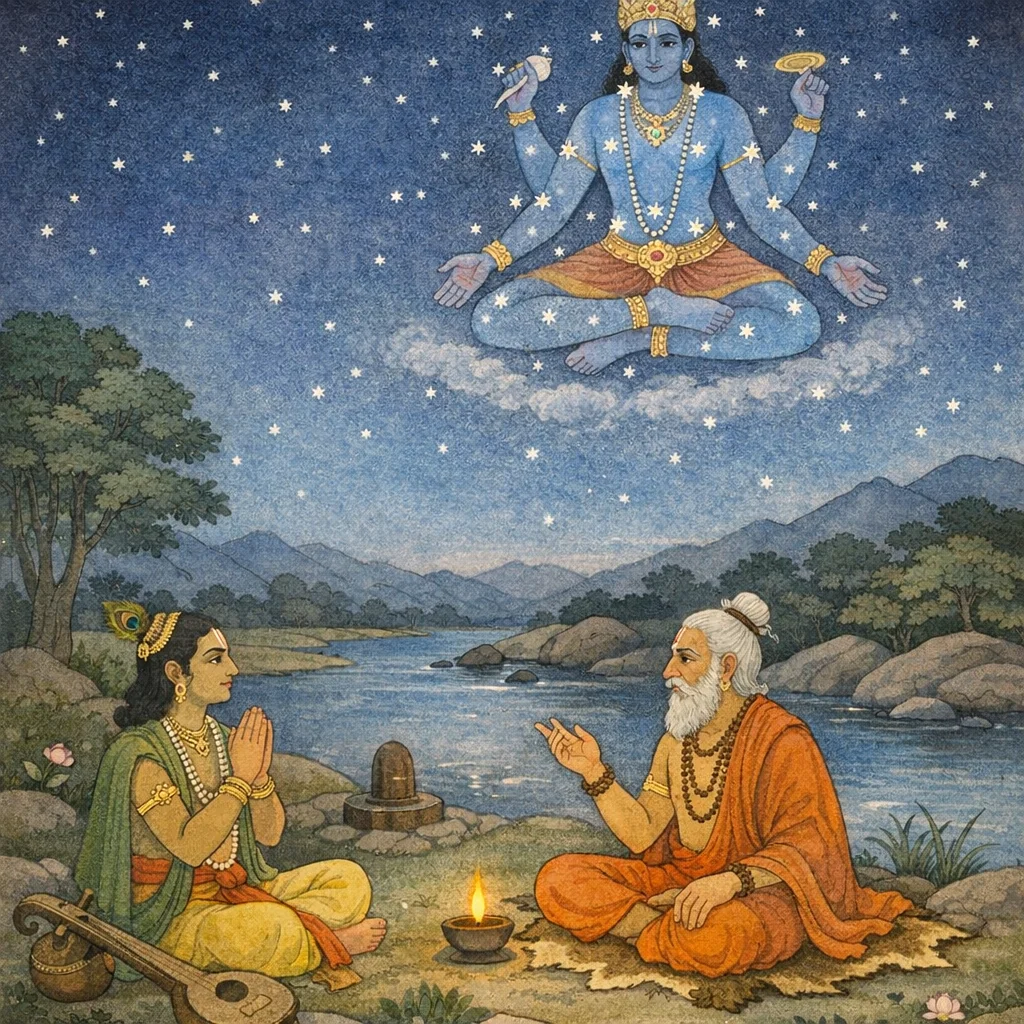
Adhyaya 53: The Nakshatra-Purusha Vrata: Worship of Vishnu’s Body as the Constellations
नक्षत्रपुरुषव्रत-विधान (Nakṣatrapuruṣa-vrata-vidhāna)
Worship of Vishnu as the Constellations
This adhyāya unfolds within the Pulastya–Nārada dialogue-frame, as Nārada asks how King Purūravas worshipped Viṣṇu, the consort of Śrī, through the rite called Nakṣatrapuruṣa. Pulastya responds with an iconographic mapping in which the lunar mansions (nakṣatras) are identified as the limbs and sub-limbs of Hari/Janārdana, presenting a cosmic body-theology where time (astral order) becomes a liturgical anatomy. The chapter then prescribes a sequential ritual regimen keyed to specific nakṣatra-yogas—beginning with Mūla in Caitra—detailing limb-focused pūjā, fasting, offerings (dohada), and brāhmaṇa-feeding, culminating in structured dāna. While explicit Śaiva topography is not foregrounded here, the Purāṇic syncretic impulse appears in the broader strategy of sanctifying cosmic structures (astral, bodily, ritual) as a unified devotional system. The vrata is praised as a supreme, sin-destroying observance, granting beauty, health, eloquence, prosperity, and desired aims, illustrated through exemplary beneficiaries such as Arundhatī, Āditya, Rambhā, Menakā, and Purūravas.
Divine Beings
Mortal & Asura Figures
Key Content Points
- Pulastya explains the Nakṣatrapuruṣa-vrata to Nārada after Nārada’s query about Purūravas’ worship of Viṣṇu as ‘Nakṣatrapuruṣa’.
- Iconographic description: each nakṣatra is assigned to a specific limb of Viṣṇu (feet, knees, thighs, waist, sides, abdomen, chest, back, arms, hands, fingers, nails, neck, ears, mouth, teeth, jaws, nose, eyes, forehead, head, hair).
- Ritual protocol by nakṣatra-yoga: limb-wise pūjā, prescribed dohada offerings (foods/drinks), brāhmaṇa-bhojana, fasting/discipline, and concluding dakṣiṇā (umbrella, footwear, grains, gold, ghee-vessel, garments).
- Doctrinal claim: the ‘nakṣatra-made’ eternal Puruṣa is worshipped through repeated nakṣatra observances; the vrata is credited to Bhṛgu and declared a destroyer of all sins.
- Phalaśruti with exempla: removal of multi-birth sins, attainment of health, beauty, mental joy, eloquence, radiance, progeny, and kingship—citing Arundhatī, Āditya (Revanta), Rambhā, Menakā, and King Purūravas.
Shlokas in Adhyaya 53
Verse 7
तस्यां स्नात्वा समभ्यर्च्य देवदेवं द्विजप्रियम् उपवासी इरावत्यां ददर्श परमेश्वरम्
Bathing in that (river) and worshipping the God of gods—beloved of the twice-born—he, observing a fast, beheld the Supreme Lord at the Irāvatī.
Verse 9
कुष्ठरोगाभिभूतश्च यं समाराघ्य वै भृगुः आरोग्यमतुलं प्राप संतानमपि चाक्षयम्
And Bhṛgu, afflicted by the disease of leprosy, having duly worshipped Him, obtained incomparable health—and also imperishable progeny.
Verse 10
नारद उवाच कथं पुरूरवा विष्णुमाराघ्य द्विजसत्तम विरूपत्वं समुत्सृज्य रूपं प्राप श्रिया सह
Nārada said: O best among the twice-born, how did Purūravas—having worshipped Viṣṇu—cast off deformity and obtain a (beautiful) form together with Śrī (prosperity/fortune)?
Verse 11
पुलस्त्य उवाच श्रूयतां कथयिष्यामि कथां पापुप्रणाशिनीम् पूर्वं त्रेतायुगस्यादौ यथावृत्तं तपोधन
Pulastya said: “Listen; I shall relate a sin-destroying narrative—how it occurred formerly, at the beginning of the Tretā age, O treasure of austerity.”
Verse 12
मद्रदेश इति ख्यातो देशो वै ब्रह्मणः सुत शाकलं नाम नगरं ख्यातं स्थानीयमुत्तमम्
“There is a region renowned as Madradeśa, O son of Brahmā. In it, a city named Śākala is famed, and (there is) the excellent sacred place called Sthānīya.”
Verse 13
तस्मिन् विपणिवृत्तिस्थः सुधर्माख्यो ऽभवद् वणिक् धनाढ्यो गुणवान् भोगी नानासास्त्रविशारदः
“There, engaged in the profession of trade, there lived a merchant named Sudharmā—wealthy, virtuous, a man of enjoyment (prosperity), and well-versed in many treatises.”
Verse 15
गच्छतः पथि तस्याथ मरुभूमौ कलिप्रिय अभवद् दस्युतो रात्रौ अवस्कन्दो ऽतिदुःसहः
Then, as he was traveling along the road, in the desert—dear to Kali—there occurred at night a raid by bandits, exceedingly hard to withstand.
Verse 16
ततः स हृतसर्वस्वो वणिग् गुःखसमन्वितः असहायो मरौ तस्मिंश् चचारोन्मत्तवद् वशी
Thereafter, that merchant—robbed of all his possessions and filled with grief—without any companion, wandered in that desert like a madman, helpless.
Verse 17
चरता तदरण्यं वै दुःखाक्रान्तेन नारद आत्मा इव शमीवृक्षो मरावासादितः शुभः
O Nārada, while he was wandering in that forest, afflicted by suffering, he came upon an auspicious śamī tree—standing like a living being—found in a desert tract.
Verse 18
तं मृगौः पिक्षिक्षिश्चैव हीनं दृष्ट्वा शमीतरुम् / श्रान्तः क्षुत्तृट्परीतात्मा तस्याधः समुपाविशत्
Seeing that śamī tree, bereft (of companions/shelter), and with deer and birds about it, he—wearied, his being overcome by hunger and thirst—sat down beneath it.
Verse 19
सुप्तश्चापि सुविश्रान्तो मध्याह्ने पुनरुत्यितः समपश्यदथायान्तं प्रेतं प्रेतशतैर्वृतम्
Having slept and rested well, he awoke again at midday; then he saw a preta approaching, surrounded by hundreds of pretas.
Verse 20
उद्वाह्यन्तमथान्येन प्रेतेन प्रेतनायकम् पिण्डाशिभिश्च पुरतो धावद्भी रूक्षविग्रहैः
Then the leader of the pretas was being carried off by another preta, while in front ran the eaters of funeral rice-balls (piṇḍas), their bodies gaunt and harsh in appearance.
Verse 21
अथाजगाम प्रेतो ऽसौ पर्यटित्वा वनानि च उपागम्य शमीमूले वणिक्पुत्रं ददर्श सः
Then that preta came, having wandered through forests; approaching the root of a śamī tree, he saw the son of a merchant.
Verse 22
स्वागतेनाभिवाद्यैनं समाभाष्य परस्परम् सुखोपविष्टश्छायायां पृष्ट्वा कुशलमाप्तवान्
Having welcomed and respectfully greeted him, and conversing with one another, he sat comfortably in the shade; after inquiring about his welfare, he obtained (the desired information/rapport).
Verse 23
ततः प्रेताधिपतिना पृष्टः स तु वणिक्सखः कुत आगम्यते ब्रूहि क्व साधो वा गमिष्यसि
Then that companion of the merchant was questioned by the Lord of the Pretas: “From where have you come? Tell me. And where, O good man, will you go?”
Verse 26
तस्य श्रुत्वा स वृत्तान्तं तस्य दुःखेन दुःखितः वमिक्पुत्रं ततः प्राह प्रेतपालः स्वबन्धुवत्
Having heard that account, Pretapāla—pained by his (the other’s) sorrow—then spoke to Vamikputra as though he were his own kinsman.
Verse 28
भाग्यक्षयेर्ऽथाः क्षीयन्ते भवन्त्यभ्युदये पुनः क्षीणस्यास्य शरीरस्य चिन्तया नोदयो भवेत्
When fortune is exhausted, one’s resources diminish; when it rises again, they return. But for this body, already worn down, no recovery comes from worry.
Verse Adhyaya 55 (Saromahatmya / Devahrada–Maṇimanta tīrtha-prasaṃsā)
इत्युच्चार्य समाहूय स्वान् भृत्यान् वाक्यमब्रवीत् अद्यातिथिरयं पूज्यः सदैव स्वजनो मम
Having spoken thus, he summoned his own attendants and addressed them: “Today this guest must be honored; indeed, he is always one of my own people.”
Verse 36
भुक्तवत्सु च सर्वेषु कामतो ऽम्भसि सेविते अनन्तरं सबुभुजे प्रेतपालो बराशनम्
And when all of them had eaten, and when the water had been used to their satisfaction, immediately thereafter the guardian of the pretas ate the excellent food.
Verse 43
अहमासं पुरा विप्रः शाकले नगरोत्तमे सोमशर्मेति विख्यातो बहुलागर्भसंभवः
Formerly, I was a brāhmaṇa in Śākala, that excellent city—known by the name Somaśarman, born from the womb of Bahulā.
Verse Nadī Viśālā (the broad river ‘Viśālā’); taṭa (its two banks)
सो ऽहं कदर्यो मूढात्मा धने ऽपि सति दुर्मतिः न ददामि द्विजातिभ्यो न चाश्नाम्यन्नमुत्तमम्
“Yet I am a miser, of deluded mind, of perverse understanding—even though I possess wealth. I do not give to the twice-born, nor do I partake of excellent food.”
Verse ṣaḍbhiḥ: by six; yojana-koṭibhiḥ: by koṭis of yojanas; tapaḥ/tapo-nāma: named ‘Tapo’ (Tapo-loka); tapasvi-juṣṭaḥ: inhabited/served by ascetics; tiṣṭhanti: they remain/abide; asura: O Asura (vocative); sādhya-varyāḥ: the best/foremost among the Sādhyas (a class of celestial beings); niḥśvāsa: exhalation/breath; marut: wind/air; asahyaḥ: unbearable, unendurable
प्रमादाद् यदि भुञ्जामि दधिक्षीरघृतान्वितम् ततो रात्रौ नृभिर् घोरैस्ताड्यते मम विग्रहः
tato 'paro yojanakoṭibhistu ṣaḍbhistapo nāma tapasvijuṣṭaḥ tiṣṭhanti yatrāsura sādhyavaryā yeṣāṃ hi naśvāsamarut tvasahyaḥ
Verse 47
प्रातर्भवति मे घोरा मृत्युतुल्या विषूचिका न च कश्चिन्माभ्यासे तत्र तिष्ठति बान्धवः
“At dawn a dreadful illness—viṣūcikā, equal to death—comes upon me; and no kinsman remains there near me, staying by my side.”
Verse 48
कथं कथमपि प्राणा मया संप्रतिधारिताः एवमेतादृशः पापी निवसाम्यतिनिर्घृणः
“Somehow—only somehow—have I kept my life-breaths going; and thus, being such a sinner, I live on, utterly without compassion.”
Verse 49
सौवीरतिलपिण्याकसक्तुशाकादिभोनैः क्षपयामि कदन्नाद्यैरात्मानं कालयापनैः
“With meals of sour gruel (sauvīra), sesame-cake, barley-flour, greens and the like—wretched foods taken merely to pass the time—I wear away my body, sustaining myself on inferior fare.”
Verse 63
यत् त्वया तात कर्त्तव्यं मद्धितार्थं महामते कथयिष्यामि तत् सम्यक् तव श्रेयस्करं मम
‘Dear one, what you must do for my benefit, O wise-minded one—I shall explain that correctly; it will bring welfare to you and to me.’
Verse 64
गयायां तीर्थजुष्टायां स्नात्वा शौचसमन्वितः मम नाम समुद्दिश्य पिण्डनिर्वपणं कुरु
‘At Gayā—resorted to as a tīrtha—having bathed and being endowed with purity, invoking my name, perform the offering of piṇḍas (funerary rice-balls).’
Verse 65
तत्र पिण्डप्रदानेन प्रेतभावादहं सखे मुक्तस्तु सर्वदातृणां यास्यामि सहलोकताम्
“There, by the offering of a piṇḍa, I, O friend, have been released from the condition of a preta. Now liberated, I shall go to the world attained by all givers (the charitable), to dwell in their company.”
Verse 66
यथेयं द्वादशी पुण्या मासि प्रौष्ठपदे सिता बुधश्रवणसंयुक्ता सातिश्रेयस्करी स्मृता
“Thus, this Dvādaśī (the twelfth lunar day) is holy—occurring in the month of Prauṣṭhapada, in the bright fortnight; when conjoined with Wednesday and the Śravaṇa constellation, it is remembered as exceedingly conducive to supreme welfare.”
Verse 67
इत्येवमुक्त्वा वणिजं प्रेतराजो ऽनुगैः सह स्वनामानि यथान्यायं सम्यगाख्यातवाञ्छुचिः
“Having spoken thus to the merchant, the lord of the pretas (Yama), together with his attendants, the pure one, then duly and correctly declared his own names (i.e., identified himself in proper form).”
Verse Vamana-Bali Narrative
प्रेतस्कन्धे समारोप्य त्याजितो मरुमण्डलम् रम्ये ऽथ शूरसेनाख्ये देशे प्राप्तः स वै वणिक्
Having placed (the dead body) upon the bier, and having abandoned it in the desert region, that merchant thereafter came to the delightful country called Śūrasena.
Verse the mighty-armed one
एवं प्रदत्तेष्वथ वै पिण्डेषु प्रेतभावतः विमुक्तास्ते द्विज प्रेता ब्रह्मलोकं ततो गताः
When those piṇḍas had thus been offered, those brāhmaṇa-pretas—released from the condition of being pretas—became free and then went to Brahmaloka.
Verse 75
स्वधर्मकर्मवृत्तिस्थः श्रवणद्वादशीरतः कालधर्ममवाप्यासौ गुह्यकावासमाश्रयत्
Established in the conduct of his own dharma and its duties, and devoted to the Śravaṇa-dvādaśī (the twelfth lunar day in the month of Śravaṇa), when he reached the law of Time (i.e., death in due course), he took refuge in the abode of the Guhyakas.
Verse 77
तत्रापि क्षत्रवृत्तिस्थो दानभोगरतो वशी गोग्रहे ऽरिगणाञ्जित्वा कालधर्ममुपेयिवान् शक्रलोकं स संप्राप्य देवैः सर्वैः सुपूजितः
There too, established in the conduct proper to a kṣatriya, self-controlled and devoted to charity and rightful enjoyments, he conquered hosts of enemies in the protection of cattle. In due course, having met the law of time (i.e., death), he attained the world of Śakra (Indra) and was highly honored by all the gods.
Verse the months
पुण्यक्षयात् परिभ्रष्टः शाकले सो ऽभवद् द्विजः ततो विकटरूपो ऽसौ सर्वशास्त्रार्थपारगः
When his merit was exhausted, he fell (from that heavenly state) and became a brāhmaṇa in Śākala. Thereafter, he was of formidable appearance, yet he became one who had crossed to the far shore of the meanings of all the śāstras (i.e., a master of scriptural learning).
Frequently Asked Questions
Pulastya presents a ritual-iconographic theology in which Viṣṇu/Janārdana is envisioned as ‘Nakṣatrapuruṣa’, a cosmic person whose limbs correspond to specific nakṣatras. Worship is performed by honoring the relevant limb when the corresponding nakṣatra-yoga occurs, thereby sacralizing astral time as a devotional anatomy.
No. This adhyāya is primarily a vrata-manual and iconographic mapping of nakṣatras onto Viṣṇu’s body, with ritual offerings and dāna. It does not specify pilgrimage sites, rivers, forests, or sarovaras; the only calendrical marker is the Caitra bright eighth with the Moon in Mūla.
The rite proceeds nakṣatra-by-nakṣatra with limb-focused pūjā, fasting/discipline, specific dohada offerings (foods/drinks), brāhmaṇa-feeding, and concluding dakṣiṇā (e.g., umbrella, footwear, grains, gold, ghee-vessel, garments). The phalaśruti claims destruction of accumulated sins (even across births), bodily health, beauty, radiance, eloquence, mental joy, progeny, and worldly success—illustrated through figures like Arundhatī, Āditya (who gains Revanta), and King Purūravas.