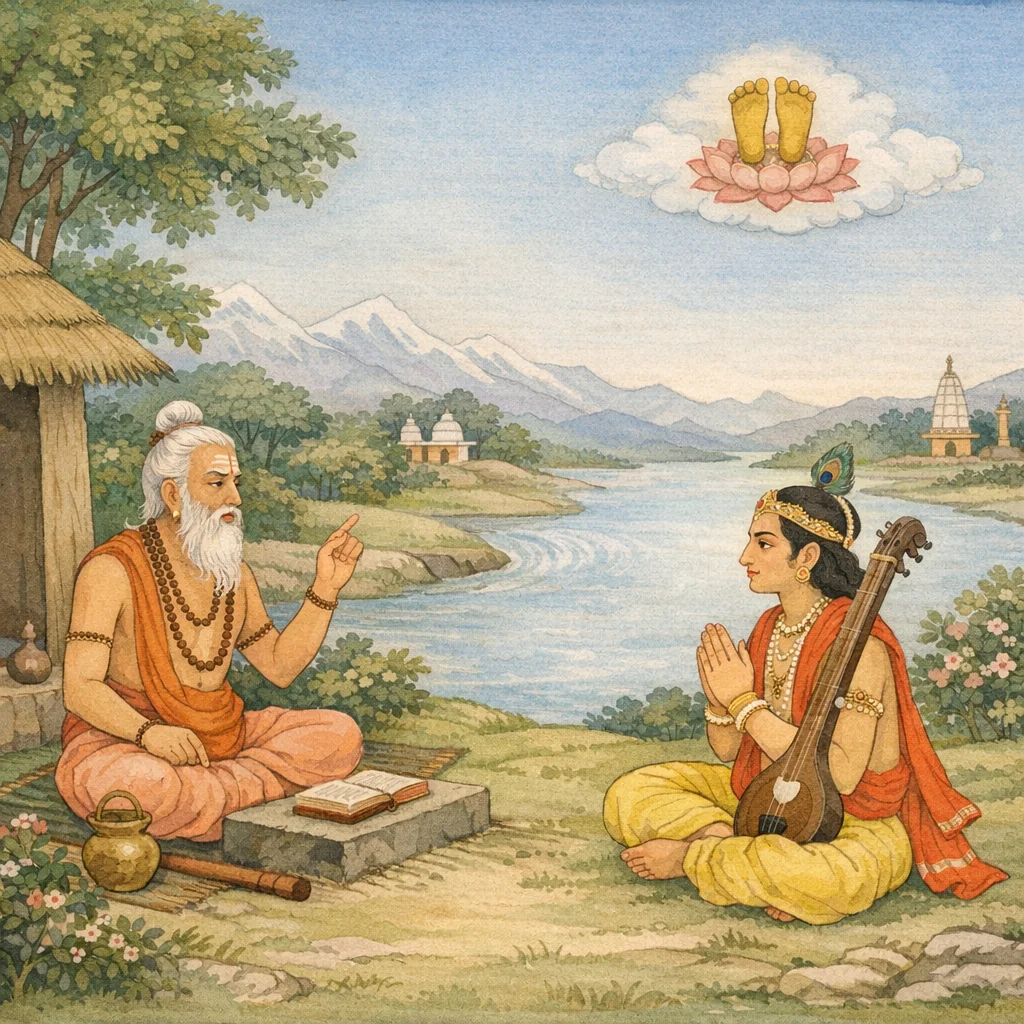
Adhyaya 69: The Merit of Hearing and Reciting the Vamana Purana (Phalaśruti)
वामनपुराण-श्रवणपाठ-फलश्रुति (Vāmana-purāṇa-śravaṇa-pāṭha-phalaśruti)
Phalashruti - Fruit of Hearing
Adhyāya 69 is framed as Pulastya’s concluding instruction to Nārada, presenting a formal phalaśruti that sacralizes the Vāmana Purāṇa through the theology of śravaṇa (hearing), pāṭha (recitation), and kīrtana (praise). The chapter equates Purāṇic reception with paradigmatic purificatory acts—most notably immersion in Gaṅgā—thereby positioning the text itself as a portable tīrtha. It promises apotropaic benefits (freedom from disease, poison, and hostile rites) and soteriological ascent to Viṣṇu’s pada through bhakti, while also mapping textual devotion onto Vedic sacrificial economies by claiming equivalence to aśvamedha and rājasūya fruits. A brief tīrtha-register appears (Gaṅgā, Naimiṣa, Puṣkara, Prayāga in Māgha), integrating pilgrimage topography with textual piety. The sectarian synthesis is implicit: while Viṣṇu/Vāmana is the salvific focus, the Purāṇic mode of dharma—devāgni-vipra-ṛṣi-pitṛ service and ethical charity—functions as a shared, pan-sectarian religious grammar within the Pulastya–Nārada discourse.
Divine Beings
Sacred Geography
Mortal & Asura Figures
Key Content Points
- Pulastya instructs Nārada that hearing/reciting the Vāmana Purāṇa purifies sin like Gaṅgā-immersion and leads the devotee to Viṣṇu’s supreme abode (Viṣṇoḥ pada).
- Textual devotion is presented as ritually equivalent to major śrauta sacrifices (aśvamedha, rājasūya) and high-value dāna (gold, land, horses, cows, chariots), reframing sacrificial merit through bhakti-centered Purāṇic practice.
- A tīrtha-and-calendar nexus is invoked—Gaṅgā, Naimiṣa, Puṣkara, Kokāmukha, and Prayāga in Māgha—linking pilgrimage bathing to the amplified merit of Purāṇa-śravaṇa/pāṭha.
- Ethical and ritual protocols are specified: secrecy from the non-devout, honoring the reciter with gifts, avoidance of financial deceit, and thrice-daily recitation/hearing as a comprehensive sin-destroyer and prosperity-giver.
Shlokas in Adhyaya 69
Verse 1
इति श्रीवामनपुराणे अष्टषष्टितमो ऽध्यायः पुलस्त्य उवाच एतन्मया पुण्यतमं पुराणं तुभ्यं तथा नारद कीर्तितं वै श्रुत्वा च कीर्त्या परया समेतो भक्त्या च विष्णोः पदमभ्युपैति
Pulastya said: “Thus ends the sixty-eighth chapter of the Śrī Vāmana Purāṇa. This most meritorious Purāṇa has indeed been recounted by me to you, O Nārada. Having heard it, and being endowed with supreme fame and devotion, one attains the abode (supreme state) of Viṣṇu.”
Verse 2
यथा पापानि पूयन्ते गङ्गावारिविगाहनात् तथा पुराणश्रवणाद् दुरितानां विनाशनम्
Just as sins are cleansed by immersing oneself in the waters of the Gaṅgā, so too, by hearing the Purāṇa, the misdeeds (durita) are destroyed.
Verse 3
न तस्य रोगा जायन्ते न विषं चाभिचारिकम् शरीरे च कुले ब्रह्मन् यः श्रुणोति च वामनम्
For the one who hears the Vāmana (Purāṇa), O Brāhmaṇa, no diseases arise for him—nor (does) poison or sorcery take effect—either in his body or in his lineage.
Verse 4
श्रणोति नित्यं विधिवच्च भक्त्या संपूजयन् यः प्रणतश्च विष्णुम् स चाश्वमेधस्य सदक्षिणस्य फलं समग्रं परिहिनपापः
Whoever, bowing down, worships Viṣṇu with devotion and in the prescribed manner, and listens (to this sacred account) daily—he, freed from sin, obtains in full the complete fruit of an Aśvamedha sacrifice performed with proper gifts (dakṣiṇā).
Verse 6
प्राप्नोति दत्तस्य सुवर्णभूमेरश्वस्य गोनागरथस्य चैव नारी नरश्चापि च पादमेकं शृण्वन् शुचिः पुण्यतमः पृथिव्याम् 69.5 स्नाने कृते तीर्थवरे सुपुण्ये गङ्गाजले नैमिषपुष्करे वा कोकामुखे यत् प्रवदन्ति विप्राः प्रयागमासाद्य च माघमासे
A man or a woman—pure and attentive—who listens (to this sacred account) gains even a single ‘quarter’ of the merit that arises from giving gold, land, a horse, cows, elephants, and chariots. Moreover, when bathing is performed at the supremely meritorious foremost tīrthas—whether in the waters of the Gaṅgā, at Naimiṣa, at Puṣkara, at Kokāmukha as the brāhmaṇas declare, and also at Prayāga in the month of Māgha—(such acts are renowned for great merit).
Verse 7
स तत्फलं प्राप्य च वामनस्य संकीर्तयन् नान्यमनाः पदं हि गच्छेन्मया नारद ते ऽद्य चोक्तं यद् राजसूयस्य फलं प्रयच्छेत्
Having obtained that fruit, one should then proceed to the supreme state by singing the praises of Vāmana with undistracted mind. O Nārada, today I have told you that (this practice) bestows the fruit of the Rājasūya sacrifice.
Verse 8
यद् भूमिलोके सुरलोकलभ्ये महत्सुखं प्राप्य नरः समग्रम् प्रापनोति चास्य श्रवणान्महर्षे सौत्रामणेर्नास्ति च संशयो मे
O great sage, whatever complete and great happiness a man attains in the human world—happiness that is otherwise obtainable only in the world of the gods—he attains that (same) through hearing this account of Saṃtrāmaṇī; of this I have no doubt.
Verse 9
रत्नस्य दानस्य च यत्फलं भवेद् यत्सूर्यस्य चेन्दोर्ग्रहणे च राहोः अन्नस्य दानेन फलं यथोक्तं बुभुक्षिते विप्रवरे च साग्निके
Whatever fruit arises from gifting jewels, and whatever (merit arises) at the time when Rāhu seizes the Sun and the Moon (i.e., during eclipses), that same fruit is obtained—so it is declared—by the gift of food to a hungry, excellent brāhmaṇa who maintains the sacred fire.
Verse 11
दुर्भिक्षसंपीडितपुत्रभार्ये यामी सदा पोषणतत्परे च देवाग्निविप्रर्षिरते च पित्रोः शुश्रुषके भ्रातरि ज्येष्ठसाम्ने यत्तत्फलं संप्रवदन्ति देवाः स तत् फलं लभते चास्य पाठात् // वम्प्_69.10 चतुर्दशं वामनमाहुरग्र्यं श्रुते च यस्याघचयाश्च नाशम् प्रयान्ति नास्त्यत्र च संशयो मे महान्ति पापान्यपि नारदाशु
In a time of famine, one who is afflicted along with children and wife, yet remains ever intent on their support; who delights in (service to) the gods, the sacred fire, brāhmaṇas, and ṛṣis; who serves the parents; and who attends upon an elder brother—whatever fruit the gods declare for such conduct, that very fruit he obtains by the recitation of this (passage). They call this ‘the excellent Fourteenth (chapter/passage) of Vāmana’; by hearing it, heaps of sins are destroyed and perish—of this I have no doubt, O Nārada—even great sins swiftly.
Verse 12
पाठात् संश्रवणाद् विप्र श्रावणादपि कस्यचित् सर्वपापानि नश्यन्ति वामनस्य सदा मुदे
O brāhmaṇa, by recitation, by attentive listening, or even by causing someone else to hear (this account), all sins are destroyed—ever to the joy of Vāmana.
Verse 13
इदं रहस्यं परमं तवोक्तं न वाच्यमेतद्धरिभक्तिवर्जिते द्विजस्य निन्दारतिहिनदक्षिणे सहेतुवाक्यावृतपापसत्त्वे
This supreme secret has been spoken to you; it should not be taught to one devoid of devotion to Hari—nor to one who delights in reviling brāhmaṇas, who is deficient in generosity, and whose sinful nature is concealed beneath clever, reasoned speech.
Verse 14
नमो नमः कारण वामनाय नित्यं यो वदेन्नियतं द्विजः तस्य विष्णुः पदं मोक्षं ददाति सुरपूजितः
‘Homage, homage to Vāmana, the (first) cause!’—the brāhmaṇa who regularly and with discipline recites this, to him Viṣṇu—worshipped by the gods—grants the station of liberation.
Verse 15
वाचकाय प्रदातव्य गोभूस्वर्णविभूषणम् वित्तशाठ्यं न कर्तव्यं कुर्वन् श्रवणनाशकम्
One should give to the reciter (vācaka) gifts consisting of cows, land, gold, and ornaments. One should not practice deceit regarding wealth; for, if one does so, it destroys the merit of listening (to the sacred narration).
Verse 16
त्रिसंध्यं च पठन् शृण्वन् सर्वपापप्रणाशनम् असूयारहितं विप्र सर्वसम्पत्प्रदायकम्
Reciting and listening at the three junctions of the day (morning, noon, and evening) becomes the destroyer of all sins. O brāhmaṇa, when done free from malice or envy (asūyā), it bestows every prosperity.
Frequently Asked Questions
Pulastya teaches Nārada that śravaṇa, pāṭha, and kīrtana of the Vāmana Purāṇa function as a bhakti-based soteriology: the devotee becomes purified of durita, gains protection from afflictions, and ultimately reaches Viṣṇoḥ pada. Merit is also translated into the idiom of śrauta religion by asserting equivalence to aśvamedha and rājasūya fruits, thereby integrating Vedic sacrificial valuation into Purāṇic textual devotion.
The chapter names Gaṅgā-jala, Naimiṣa, Puṣkara, Kokāmukha, and Prayāga—especially Prayāga during Māgha-māsa. These references create a topographical sanctification map in which bathing at renowned tīrthas and hearing/reciting the Purāṇa mutually reinforce one another, effectively presenting the text as a ‘mobile tīrtha’ whose merit can equal or surpass pilgrimage austerities.
It instructs that the teaching is not to be given to those devoid of Hari-bhakti or engaged in disparagement of dvijas, and it mandates honoring the vācaka (reciter) with gifts such as cows, land, gold, and ornaments. It also condemns financial deceit that would undermine śravaṇa, and recommends disciplined, thrice-daily recitation/hearing as a means to destroy all sins and secure well-being and prosperity.