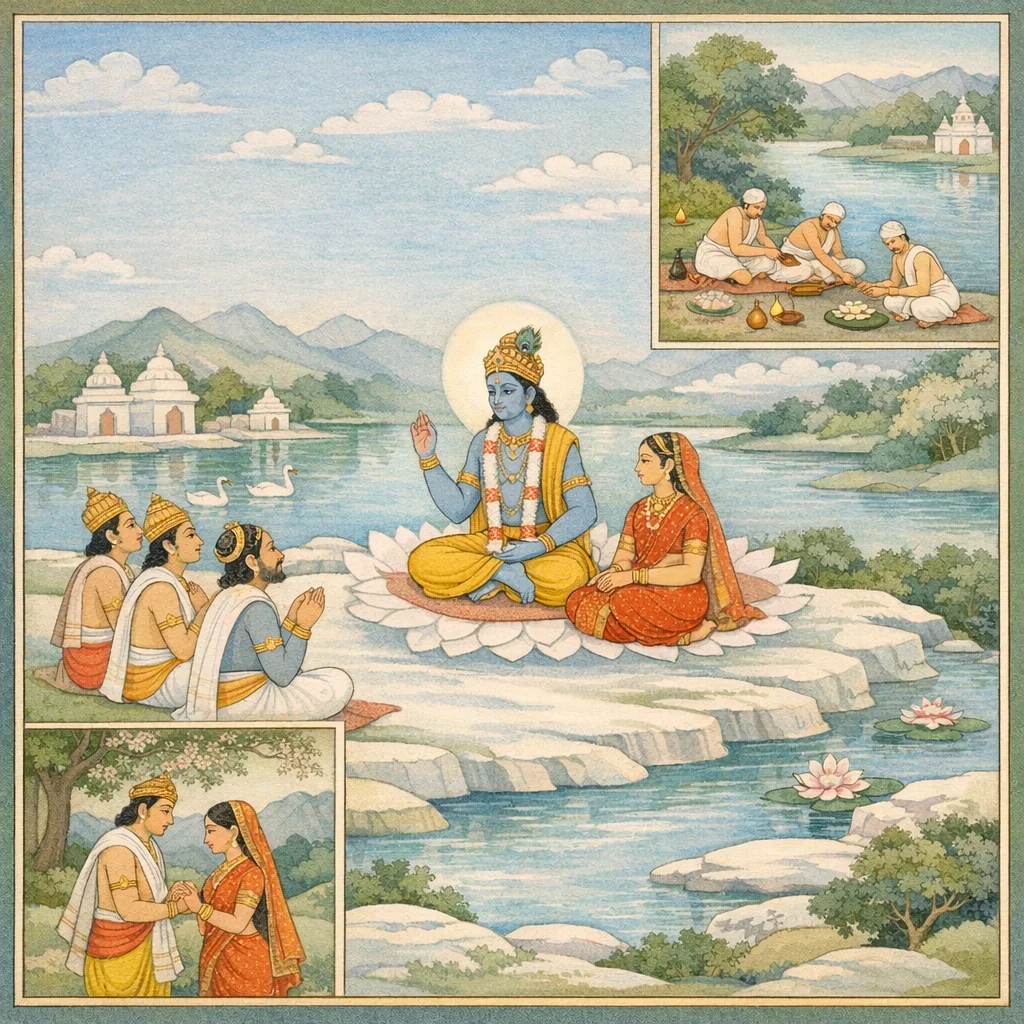
Adhyaya 22: Kurukshetra, Pṛthūdaka Tīrtha, and the Marriage of Saṃvaraṇa with Tapatī
कुरुक्षेत्र-प्रथूदक-तीर्थमाहात्म्य तथा संवरण-तपती-विवाह (Kurukṣetra-Pṛthūdaka-Tīrtha-Māhātmya tathā Saṃvaraṇa-Tapatī-Vivāha)
Marriage of Samvarana with Tapati
Within the Pulastya–Nārada dialogue-frame, this Adhyāya pivots from Devī’s future manifestation (Kauśikī for the slaying of Śumbha–Niśumbha) to a Vaiṣṇava-guided program of topographical sanctification. After Sati’s loss, Rudra is described as established in brahmacarya, while the devas—defeated by the daitya Mahīṣa—seek refuge in Hari at Śvetadvīpa. Viṣṇu (Murāri, Kaiṭabhārdana) instructs them to propitiate the Agniṣvātta Pitṛs at Kurukṣetra, specifically at the tīrtha Pṛthūdaka, on the supremely meritorious Mahātithī, thereby linking victory over asuric power to pitṛ-yajña and tīrtha-ritual. The narrative then grounds this sacred geography through an etiological royal genealogy: King Saṃvaraṇa (son of Ṛkṣa), educated by Vasiṣṭha, encounters the solar maiden Tapatī; Vasiṣṭha petitions Sūrya, and the marriage is solemnized. The chapter thus integrates syncretic theology—Hari as savior and ritual legislator, Rudra’s ascetic posture, and pitṛ-devotion—while embedding Kurukṣetra’s tīrtha-network into dynastic memory and dharmic praxis.
Divine Beings
Sacred Geography
Mortal & Asura Figures
Key Content Points
- Pulastya answers Nārada: Devī’s further manifestation is foretold—Kauśikī emerges from Pārvatī’s kośa and proceeds to Vindhya with bhūta-gaṇas to slay Śumbha and Niśumbha.
- After the devas are defeated by Mahīṣa, they approach Viṣṇu in Śvetadvīpa; Hari prescribes a ritual strategy: worship of the Agniṣvātta Pitṛs at Kurukṣetra’s Pṛthūdaka tīrtha on Mahātithī for asura-parābhava (enemy-overthrow).
- Viṣṇu narrates an origin-linked royal episode: Saṃvaraṇa (Ṛkṣa’s son), guided by Vasiṣṭha, meets Tapatī (Sūrya’s daughter); iconographic marks and auspicious lakṣaṇas are described, and Vasiṣṭha secures the विवाह (pāṇigrahaṇa) through Sūrya’s consent.
Shlokas in Adhyaya 22
Verse 1
इती श्रीवामनपुराणे एकविंशो ऽध्यायः नारद उवाच पुलस्त्य कथ्यतां तावद् देव्या भूयः समुद्भवः महत्कौतूहलं मे ऽद्य विस्तराद् ब्रह्मवित्तम
Thus ends the twenty-first chapter in the Śrī Vāmana Purāṇa. Nārada said: ‘O Pulastya, please narrate, then, the further re-manifestation of the Goddess. Great is my curiosity today—(tell it) in detail, O best knower of Brahman.’
Verse 2
पुलस्त्य उवाच श्रूयतां कथयिष्यामि भूयो ऽस्याः संभवं मुने शुम्भासुरवधार्थाय लोकानां हितकाम्यया
Pulastya said: “Listen, O sage; I shall again recount her manifestation—how, desiring the welfare of the worlds, she came forth for the purpose of slaying the demon Śumbha.”
Verse 3
या सा हिमवतः पुत्री भवेनोढा तपोधना उमा नाम्ना च तस्याः सा कोशाञ्जाता तुकौशिकी
She who was the daughter of Himavat, the ascetic treasure, wedded to Bhava (Śiva) and named Umā—she, from her sheath/outer covering (kośa), was born as Kauśikī.
Verse 4
संभीय विन्ध्यं गत्वा च भृयो भूतगणैर्वृता शुम्भं चैव निशुम्भं च वधिष्यति वरायुधैः
Having gathered (her forces) and gone to the Vindhya, and again being surrounded by hosts of bhūtas, she will slay both Śumbha and Niśumbha with excellent weapons.
Verse 5
नारद उवाच ब्रह्मंस्त्वया समाख्याता मृता दक्षत्मजा सती सा जाता हिमवत्पुत्रीत्येवं मे वक्तुमर्हसि
Nārada said: “O Brahmā, you have described that Satī, the daughter of Dakṣa, died. (Now) that she was born as the daughter of Himavat—please explain this to me in that manner.”
Verse 6
यथा च पार्वतीकोशात् समुद्धभूता हि कौशिकी यथा हतवती शुम्भं निसुम्भं च महासुरम्
“And (tell me) how Kauśikī indeed arose from Pārvatī’s sheath (kośa), and how she slew Śumbha and also Niśumbha, the great asura.”
Verse 7
कस्य चेमौ सुतौ वीरौ ख्यातौ शुम्भनिशुम्भकौ एतद् विस्तरतः सर्वं यथावद् वक्तुमर्हसि
“And whose sons are these two heroic, well-known ones—Śumbha and Niśumbha? Please tell me all of this in detail, properly.”
Verse 8
पुलस्त्य उवाच एतत्ते कथयिष्यामि पार्वत्याः संभवं मुने शृणुष्वावहितो भूत्वा स्कन्दोत्पत्तिं च शाश्वतीम्
Pulastya said: I shall tell you, O sage, about the origin of Pārvatī. Listen attentively, and (I shall relate) the eternal account of Skanda’s birth as well.
Verse 9
रुद्रः सत्यां प्रणष्टायां ब्रह्मचारिव्रते स्तितः निराश्रयत्वमापन्नस्तपस्तप्तुं व्यवस्थितः
When Satyā had perished, Rudra remained established in the vow of celibate discipline. Having fallen into a state of being without refuge/support, he resolved to perform austerities.
Verse 10
स चासीद् देवसेनानीर्दैत्यदर्फविनाशनः
And he became the commander of the gods’ army, the destroyer of the pride of the Daityas.
Verse 11
ततो निराकृता देवाः सेनानाथेन शंभुना दानवेन्द्रेण विक्रम्य महिषेण पराजिताः
Then the gods were repulsed and defeated—overpowered by the lord of the Daityas, the mighty Mahiṣa, who advanced in valor like Śambhu, the commander of armies.
Verse 12
ततो जग्मुः मुरेशानं द्रष्टुं चक्रगदाधरम् श्वेत्दवीपे महाहंसं प्रपन्नाः शरणं हरिम्
Then they went to see the Lord, the slayer of Mura—bearing discus and mace—(who dwells) in Śvetadvīpa as the Great Swan; having surrendered, they sought Hari as their refuge.
Verse 13
तानागतान् सुरान् दृष्ट्वा ततः शक्रपुरोगमान् विहस्य मेघगम्भीरं प्रोवाच पुरुषोत्तमः
Seeing those gods who had arrived, led by Śakra (Indra), the Supreme Person (Puruṣottama) smiled and spoke in a voice deep as thunderclouds.
Verse 14
किं जितास्त्वसुरेन्द्रेण महिषेण दुरात्मना येन सर्वे समेत्यैवं मम पार्श्वमुपागताः
“Have you been conquered by the lord of Asuras—by the evil-souled Mahiṣa—so that all of you have assembled and thus come to my side?”
Verse 15
तद् युष्माकं हितार्थाय यद् वदामि सुरोत्तमाः तत्कुरुध्वं जयो येन समाश्रित्य भवेद्धि वः
“Therefore, O best of the gods, do what I say for your welfare; relying upon which, victory will indeed be yours.”
Verse 16
य एते पितरो दिव्यास्त्वग्निष्वात्तेति विश्रुताः अमीषां मानसी कन्या मेना नाम्नास्ति देवताः
“These divine Pitṛs who are renowned as the Agniṣvāttas—of them there is a mind-born daughter, a goddess named Menā.”
Verse 17
तामाराध्य महातिथ्यां श्रद्धया परयामराः प्रार्थयध्वं सतीं मेनां प्रालेयाद्रेरिहार्थतः
“Having duly propitiated her on the great (auspicious) tithi with supreme faith, O immortals, beseech the virtuous Menā—here, for the sake of the Snow-mountain (Himālaya).”
Verse 18
तस्यां सा रूपसंयुक्ता भविष्यति तपस्विनी दक्षकोपाद् यया मुक्तं मलवज्जीवितं प्रियम्
“In her (Menā), she will be born—endowed with beauty, an ascetic. Through her, beloved life will be freed, as it were, from Dakṣa’s wrath.”
Verse 19
सा शङ्करात् स्वतेजोंऽशं जनयिष्यति यं सुतम् स हनिष्यति दैत्येन्द्रं महिषं सपदानुगम्
“She will bear a son who is a portion of Śaṅkara’s own splendor. He will slay the lord of the daityas—Mahīṣa—together with his followers.”
Verse 20
तस्माद् गच्छत पुण्यं तत् कुरुक्षेत्रं महाफलम् तत्र पृथूदके तीर्थे पूज्यन्तां पितरो ऽव्ययः
Therefore, go to that holy Kurukṣetra which yields great fruit. There, at the sacred ford called Pṛthūdaka, let the (ancestral) Pitṛs be worshipped—(their merit being) unfailing/imperishable.
Verse 21
महातिथ्यां महापुण्ये यदि शत्रुपराभवम् जिहासतात्मनः सर्वे इत्थं वै क्रियतामिति
On a great (auspicious) tithi, in a greatly meritorious (setting/act), if all (of you), intent on casting off (your distress/obstacle), desire the defeat of enemies—then indeed, let it be done in this manner.
Verse 22
पुलस्त्य उवाच इत्युक्त्वा वासुदेवेन देवाः शक्रपुरोगमाः कृताञ्जलिपुटा भूत्वा पप्रच्छुः परम्श्वरम्
Pulastya said: Having been addressed thus by Vāsudeva, the gods—led by Śakra (Indra)—with hands joined in reverence, questioned the Supreme Lord.
Verse 23
देवा ऊचुः को ऽयं कुरुक्षेत्र इति यत्र पुण्यं पृथूदकम् उद्भवं तस्य तीर्थस्य भगवान् प्रब्रवीतु नः
The Devas said: “What is this called Kurukṣetra, where the sacred Pṛthūdaka is found? Let the Blessed Lord tell us the origin of that tīrtha.”
Verse 24
केयं प्रोक्ता महापुण्या तिथीनामुत्तमा तिथिः यस्यां हि पितरो दिव्याः पूज्यास्माभिः प्रयन्ततः
“Which is that greatly meritorious tithi, said to be the best among tithis—on which, indeed, the divine Pitṛs should be worshipped by us as they depart (or proceed)?”
Verse 25
ततः सुराणां वचनान्मुरारिः कैटभार्दनः कुरुक्षेत्रोद्भवं पुण्यं प्रोक्तवांस्तां तिथीमपि
Then, in response to the words of the gods, Murāri, the slayer of Kaiṭabha, explained the sacred origin of Kurukṣetra—and also that tithi.
Verse 26
श्रीभगवानुवाच सोमवंशोद्भवो राजा ऋक्षो नाम महाबलः कृस्यादौ समभवदृक्षात् संवरणो ऽवत्
The Blessed Lord said: “There was a mighty king named Ṛkṣa, born in the Lunar (Soma) dynasty. In the line beginning with Kṛśya, from Ṛkṣa there arose Saṃvaraṇa.”
Verse 27
स च पित्रा निजे राज्ये बाल एवाभिषेचितः बाल्ये ऽपि धर्मनिरतो मद्भक्तश्च सदाभवत्
“And he was consecrated by his father in his own kingdom while still a child. Even in childhood he was devoted to dharma, and he was always devoted to Me.”
Verse 28
पुरोहितस्तु तस्यासीद् वसिष्ठो वरुणात्मजः स चास्याध्यापयामास साङ्गान् वेदानुदारधीः
“His priest was Vasiṣṭha, the son of Varuṇa. That noble-minded sage taught him the Vedas together with their ancillary disciplines (Vedāṅgas).”
Verse 29
ततो जगाम चारण्यं त्वनध्याये नृपात्मजः सर्वकर्मसु निक्षिप्य वसिष्ठं तपसां निधिम्
Then the king’s son went to the forest wilderness during a time of (Vedic) non-study, having entrusted Vasiṣṭha—treasure-house of austerities—with all affairs (and duties).
Verse 30
ततो मृगयाव्याक्षेपाद् एकाकी विजनं वनम् वैभ्राजं स जगामाथ अथोन्मादनमभ्ययात्
Then, due to the distraction of hunting, he went alone into a lonely forest called Vaibhrāja; thereafter he came upon (or fell into) a state of madness/delusion.
Verse 31
ततस्तु कौतुकाविष्टः सर्वतुकुसुमे वने अवितृपतः सुगन्धस्य समन्ताद् व्यचरद् वनम्
Then, seized by curiosity, in that forest filled everywhere with flowers, he wandered about on all sides—unsated by the fragrance.
Verse 32
स वनन्तं च ददृशे फुल्लकोकनदावृतम् कह्लारपद्मकुमुदैः कमलेन्दीवरैरपि
He beheld the interior of a forest, covered with blooming red lotuses, and also filled with white lotuses, water-lilies, kumudas, lotuses, and blue lotuses.
Verse 33
तत्र क्रीडन्ति सततमप्सरो ऽमरकन्यकाः तासां मध्ये ददर्शाथ कन्यां संवरणो ऽधिकाम्
There the apsarases—celestial maidens—were always sporting. Among them, Saṃvaraṇa then saw a maiden who was surpassingly excellent.
Verse 34
दर्शनादेव स नृपः काममार्गणपीडितः जातः सा च तमीक्ष्यैव कामबाणातुराभवत्
By mere sight, that king became afflicted by Kāma’s arrows; and she too, upon looking at him, became distressed by the shafts of desire.
Verse 35
उभौ तौ पीडितौ मोहं जग्मतुः काममार्गणैः राजा चलासनो भूम्यां निपपात तुरङ्गमात्
Both of them, tormented by the arrows of desire, fell into delusion. The king, his seat unsteady, fell from his horse onto the ground.
Verse 36
तमभ्येत्य महात्मानो गन्धर्वाः कामरूपिणः सिषिचुर्वारिणाभ्येत्य लब्धसंज्ञो ऽभवत् क्षणात्
Approaching him, the great-souled Gandharvas, capable of assuming forms at will, sprinkled him with water; and he regained consciousness in an instant.
Verse 37
सा चाप्सरोभिरुत्पात्य नीता पितृकुलं निजम् ताभिराश्वासिता चापि मधुरैर्वचनाम्बुभिः
And she, carried off by the Apsarases, was taken to her own paternal household; and they also comforted her with sweet, water-like words.
Verse 38
स चाप्यरुह्य तुरगं प्रतिष्ठानं पुरोत्तमम् गतस्तु मेरुशिखरं कामचारी यथामरः
Mounting a horse, he set out from Pratiṣṭhāna, the excellent city, and went to the summit of Mount Meru, moving at will like a god.
Verse 39
यदाप्रभृति सा दृष्टा आर्क्षिणा तपती गिरौ तदाप्रभृति नाश्नाति दिवा स्वपिति नो निशि
From the moment Ārkṣi saw her—Tapatī—on the mountain, from that time onward he does not eat; he sleeps by day, but not at night.
Verse 40
ततः सर्वविदव्यग्रोविदित्वा वरुणात्मजः तपतीतापितं वीरं पार्थिवं तपसां निधिः
Then Varuṇa’s son—an eager all-knower, a treasure-house of austerities—came to know that the heroic king was tormented by Tapatī.
Verse 41
समुत्पत्य महायोगी गगनं रविमण्डलम् विवेश देवं तिग्मांशु ददर्श स्यन्दने स्थितम्
Rising up, the great yogin entered the sky, the orb of the Sun. He beheld the god Tigmāṃśu (the Sun), stationed upon his chariot.
Verse 42
तं दृष्ट्वा भास्करं देवं प्रणमद् द्विजसत्तमः प्रतिप्रणमितश्चासौ भास्करेणाविशद् रथे
Seeing that god Bhāskara (the Sun), the best of twice-born ones bowed down. And being bowed to in return by Bhāskara, he entered the chariot.
Verse 43
ज्वलज्जटाकलापो ऽसौ दिवाकरसमीपगः शोभते वारुणिः श्रीमान् द्वितीय इव भास्करः
With his mass of matted locks blazing, and moving near Divākara (the Sun), that illustrious Vāruṇi shone—like a second Bhāskara (Sun).
Verse 44
ततः संपूजितोर्ऽघार्भास्करेण तपोधनः पृष्टश्चागमने हेतुं प्रत्युवाच दिवाकरम्
Then the ascetic rich in austerity, having been duly honored with an offering of arghya by Bhāskara (the Sun), and being asked the reason for his arrival, replied to Divākara (the Sun).
Verse 45
समायातो ऽस्मि देवेश याचितुं त्वां महाद्युते सुतां संवरणस्यार्थे तस्य त्वं दातुमर्हसि
I have come, O Lord of the gods, O great-lustrous one, to request you: for the sake of Saṃvaraṇa, (grant) your daughter; you ought to give her to him.
Verse 46
ततो वसिष्ठाय दिवाकरेण निवेदिता सा तपती तनूजा गृहागताय द्विजपुङ्गवाय राज्ञोर्ऽथतः संवरणस्य देवाः
Then Divākara (the Sun) presented (introduced) his daughter Tapatī to Vasiṣṭha, the foremost of twice-borns who had come to his house, for the purpose of King Saṃvaraṇa.
Verse 47
सावित्रिमादाय ततो वसिष्ठः स्वमाश्रमं पुण्यमुपाजगाम सा चापि संस्मृत्य नृपात्मजं तं कृताञ्जलिर्वारुणिमाह देवी
Then Vasiṣṭha, taking Sāvitrī with him, went to his own sacred hermitage. And she too, remembering that prince, with joined palms, spoke to Vāruṇī, the goddess.
Verse 48
तपत्युवाच ब्रह्मन् मया खेदमुपेत्य यो हि सहाप्सरोभिः परिचारिकाभिः दृष्टो ह्यरण्ये ऽमरगर्भतुल्यो नृपात्मजो लक्षणतो ऽभिजाने
Tapatī said: ‘O Brahmin, the one whom I saw in the forest—when I had fallen into distress—along with apsarases and attendant maidens, that prince, like one born from a god (or like a divine offspring), I recognize by his marks.’
Verse 49
पादौ शुभौ चक्रगदासिचिह्नौ जङ्घे तथोरू करिहस्ततुल्यौ कटिस्तथा सिंहकटिर्यथैव क्षामं च मध्यं त्रिबलीनिबद्धम्
His feet were auspicious, bearing the marks of a discus, a mace, and a sword. His shanks and thighs were like an elephant’s trunk/forearm. His waist was like that of a lion; and his middle was slender, bound with three folds (of skin).
Verse 50
ग्रीवास्य शङ्खाकृतिमादधाति भुजौ च पीनौ कठनौसुदीर्घौ हस्तौ तथा पद्मदलोद्भवाङ्कौ छत्राकृतिस्तस्य शिरो विभाति
His neck bears the form of a conch; his arms are full, firm, and very long. His hands have marks like lotus-petals, and his head shines with a canopy-like shape.
Verse 52
नीलाश्च केशाः कुटिलाश्च तस्य कर्णौ समांसौ सुसमा च नासा दीर्घाश्च तस्याङ्गुलयः सुपर्वाः पद्भ्यां कराभ्यां दशनाश्च सुभ्राः // वम्प्_22.51 समुन्नतः षड्भिरुदारवीर्यस्त्रिभिर्गभीरस्त्रिपु च प्रलम्बः रक्तस्तथा पञ्चसु राजपुत्रः कृष्णश्चतुर्भिस्त्रिभिरानतो ऽपि
His hair is dark and curly; his ears are evenly fleshed, and his nose is well-proportioned. His fingers are long with excellent joints; and his feet, hands, and teeth are bright and fair.
Verse 54
द्वाभ्यां च शुक्लः सुराभिश्चतुर्भिः दृश्यन्ति पद्मानि दशैव चास्य वृतः स भर्ता भगवान् हि पूर्वं तं राजपुत्रं भुवि संविचिन्त्य // वम्प्_22.53 ददस्व मां नाथ तपस्विने ऽस्मै गुणोपपन्नाय समीहिताय नेहान्यकामां प्रवदन्ति सन्तो दातुं तथान्यस्य विभो क्षमस्व
O Lord, give me to this ascetic—one endowed with virtues and seeking (me) as desired. The good do not declare another to be ‘unwanted’ here; therefore, O mighty one, permit (me) to be given to another.
Verse 55
देवदेव उवाच इत्येवमुक्तः सवितुश्च पुत्र्या ऋषिस्तदा ध्यानपरो बभूव ज्ञात्वा च तत्रार्कसुतां सकामां मुदा युतो वाक्यमिदं जगाद
Devadeva said: Thus addressed by the daughter of Savitṛ, the sage then became absorbed in meditation. And, having understood there the daughter of Arka (the Sun) to be filled with desire, he joyfully spoke these words.
Verse 56
स एव पुत्रि नृपतेस्तनूजो दृष्टः पुरा कामयसे यमद्य स एव चायाति ममाश्रमं वै ऋक्षात्मजः संवरणो हि नाम्ना
O daughter, that very son of the king whom you saw before—whom you now desire—he himself is coming to my hermitage indeed. He is the son of Ṛkṣa, named Saṃvaraṇa.
Verse 58
अथाजगाम स नृपस्य पुत्रस्तमाश्रमं ब्राह्मणपुङ्कवस्य दृष्ट्वा वसिष्ठं प्रणिपत्य मूर्ध्ना स्थितस्त्वपश्यत् तपतीं नरेन्द्रः // वम्प्_22.57 दृष्ट्वा च तां पद्मविशालनेत्रां तां पूर्वदृष्टामिति चिन्तयित्वा पप्रच्छ केयं ललना द्विजेन्द्र स वारुणिः प्राह नराधिपेन्द्रम्
Then the king’s son came to the hermitage of that foremost Brāhmaṇa. Seeing Vasiṣṭha, he bowed with his head; standing there, the ruler beheld Tapatī. Seeing her—lotus-eyed, with large wide eyes—and thinking, “She is the one I saw before,” he asked, “Who is this maiden, O best of twice-born?” Then Vāruṇi spoke to the lord of men.
Verse 59
इयं विवस्वद्दुहिता नरेन्द्र नाम्ना प्रसिद्धा तपती पृथिव्याम् मया तवार्थाय दिवाकरो ऽर्थितः प्रादान्मया त्वाश्रममानिनिन्ये
“O king, this is the daughter of Vivasvān (the Sun), renowned on earth by the name Tapatī. For your sake I requested Divākara (the Sun), and he granted (her); therefore I have brought you to the hermitage.”
Verse 60
तस्मात् मसुत्तिष्छ नरेन्द्र देव्याः पाणिं तपत्या विधिवद् गृहाण इत्येवमुक्तो नृपतिः प्रहृष्टो जग्राह पाणिं विधिवत् तपत्याः
“Therefore, arise, O king, and accept the hand of the lady Tapatī according to proper rite.” Thus addressed, the king, delighted, took the hand of Tapatī in due form.
Verse 61
सा तं पतिं प्राप्य मनो ऽभिरामं सूर्यामजा शक्रसमाप्रभावम् रराम तन्वी भवनोत्तमेषु यता महैन्द्रं दिवि दैत्यकन्या
Having obtained that husband—pleasing to the heart, born of Sūrya, and possessing power comparable to Indra—slender Tapatī delighted in the finest palaces, just as a daughter of the Daityas (delights) with great Indra in heaven.
Frequently Asked Questions
Pulastya’s narration juxtaposes Rudra’s post-Satī brahmacarya and Devī’s impending śākta intervention (Kauśikī) with Viṣṇu’s decisive salvific role at Śvetadvīpa. Hari functions as ritual legislator—directing pitṛ-propitiation at Kurukṣetra—while Śaṅkara remains the source of tejas for the future son who will destroy Mahīṣa. The chapter thus models syncretic theology: distinct divine agencies (Hari’s protection, Hara’s ascetic power, Devī’s martial manifestation) coordinated toward loka-hita and asura-dharma’s defeat.
Viṣṇu explicitly sanctifies Kurukṣetra as a mahāphala-kṣetra and singles out Pṛthūdaka as the operative tīrtha where the Agniṣvātta Pitṛs are to be worshipped on the supremely meritorious Mahātithī. The promised fruit is śatru-parābhava (overcoming hostile asuric forces), presenting tīrtha-yātrā and pitṛ-yajña as a practical dharmic technology for cosmic and political restoration.
Yes. It foreshadows Kauśikī’s emergence from Pārvatī’s kośa and her Vindhya-based campaign culminating in the slaying of Śumbha and Niśumbha, while also setting the Mahīṣa conflict in motion: the devas’ defeat leads them to Hari, whose counsel establishes the ritual precondition for victory. Additionally, the prophecy that Devī (as Menā’s future daughter) will bear Śaṅkara’s tejo’ṃśa—whose son will kill Mahīṣa—connects genealogical destiny with asura-dharma’s downfall.