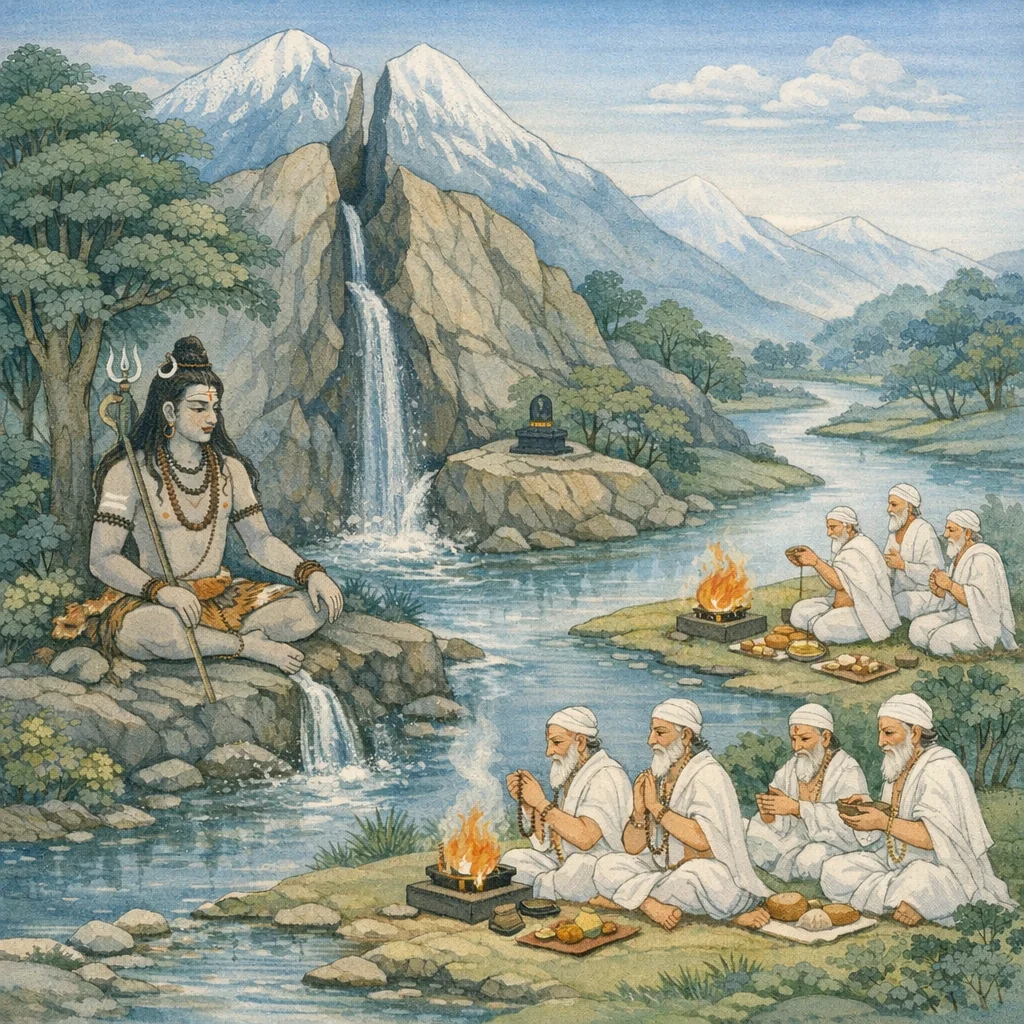
Adhyaya 34: Shiva’s Kedara-Tirtha and the Rise of Mura: From Shaiva Pilgrimage to Vaishnava Theology
केदार-तीर्थ-माहात्म्य तथा मुरासुरोपाख्यान (Kedāra-Tīrtha-Māhātmya tathā Murāsura-Upākhyāna)
Rise of Mura and Vaishnava Theology
Framed as a Pulastya–Nārada dialogue, this Adhyāya moves from Śaiva ascetic iconography to a distinctly Vaiṣṇava theological horizon, exemplifying the Vāmana Purāṇa’s syncretic theology. Pulastya first explains Śaṅkara’s post-conflict withdrawal into tapas: the Lord adopts a mahāvrata-like observance, wanders with kapāla and kamaṇḍalu, and sanctifies Himalayan terrain. A pivotal act—splitting the mountain—generates Kedāra as a tīrtha, and Śiva grants boons that convert ritual acts (snāna, dāna, japa, homa, śrāddha) into “akṣaya” merit and mokṣa-sādhana, thereby topographically sacralizing the landscape. The narrative then pivots to cosmic disturbance when Śiva remains submerged in Sarasvatī, prompting devas to seek Viṣṇu. This transition opens the Murāsura cycle: Mura’s Brahmā-granted lethal touch, Indra’s displacement, and the asura’s challenge to Yama culminate in the asura’s march toward Kṣīroda (Śvetadvīpa) where the fourfold (caturmūrti) Janārdana is introduced, setting up a doctrinal exposition via Sanatkumāra and Brahmā.
Divine Beings
Sacred Geography
Mortal & Asura Figures
Key Content Points
- Pulastya narrates Śiva’s tapas and ascetic iconography (kapāla, kamaṇḍalu, mahāvrata), culminating in the creation and consecration of Kedāra-Tīrtha with akṣaya ritual fruits (snāna, dāna, japa, homa, śrāddha) and mokṣa-sādhana claims.
- Śiva’s prolonged submersion in Sarasvatī triggers cosmic instability; the devas, led by Śakra, consult Brahmā and are directed to seek Cakragadādhara (Viṣṇu), marking a deliberate Shaiva-to-Vaishnava narrative handoff.
- The Murāsura upākhyāna begins: Mura (a Danu-born asura) receives a boon from Brahmā that his touch kills even immortals, seizes Amarāvatī, displaces Indra, confronts a Sūryavaṃśa king at Sarayū, and challenges Yama—who identifies Viṣṇu of Kṣīroda/Śvetadvīpa as the true ‘saṃyantṛ’—leading into the doctrine of Viṣṇu’s caturmūrti and the Sanatkumāra–Brahmā teaching frame.
Shlokas in Adhyaya 34
Verse 1
इति श्रीवाम्नपुराणे त्रयस्त्रिंशोंऽध्यायः नारद उवाच क्व गतः शङ्करो ह्यासीद्येनाम्बा नन्दिना सह अनधकं योधयामास एतन्मे वक्तुमर्हसि
Thus ends the thirty-third chapter in the Śrī Vāmana Purāṇa. Nārada said: ‘Where had Śaṅkara gone—he who, together with Ambā and Nandin, fought Andhaka? You should tell me this.’
Verse 2
पुलस्त्य उवाच यदा वर्षसहस्रं तु महामोहे स्थितो ऽभत् तदाप्रभृति निस्तेजाः क्षीणवीर्यः प्रदृश्यते
Pulastya said: ‘When he remained for a thousand years in great delusion, from that time onward he appeared lusterless, his vigor exhausted.’
Verse 3
स्वमात्मानं निरीक्ष्याथ निस्तेजोङ्गं महेश्वरः तपोर्थाय तथा चक्रे मतिं मतिमतां वरः
Then Maheśvara, having looked upon his own self—his body bereft of radiance—formed the resolve to undertake austerity; he, the best among the wise, set his mind upon tapas for that purpose.
Verse 4
स महाव्रतमुत्पाद्य समाश्वास्याम्बिकां विभुः शैलादिं स्थाप्य गोप्तारं विचचार महीतलम्
Having undertaken a great vow, the all-pervading Lord consoled Ambikā; and, establishing Śailādi as a protector, he wandered over the surface of the earth.
Verse 5
महामुद्रार्पितग्रीवो महाहिकुतकुण्डलः धारयाणः कटीदेशे महाशङ्खस्य मेखलाम्
With his neck marked/adorned by a great seal (mudrā), wearing massive hikuta-earrings, and bearing at his waist a girdle fashioned from a great conch, he (thus arrayed) proceeded.
Verse 6
कपालं दक्षिणे हस्ते सव्ये गृह्य कमण्डलुम् एकाहवासी वृक्षे हि शैलसानुनदीष्वटन्
Holding a skull-bowl in his right hand and taking a water-pot in his left, he lived for a single day at each place, wandering among trees, along mountain-slopes, and beside rivers.
Verse 7
स्थानं त्रैलोक्यमास्थाय मूलाहारो ऽम्बुभोजनः वाय्वाहारस्तदा तस्थौ नववरिषशतं क्रमात्
Having taken his station as though encompassing the three worlds, he subsisted on roots, then on water, then on air; thus he remained (in austerity) for nine hundred years, in due course.
Verse 8
ततो वीटां सुखे क्षिप्य निरुच्छ्वासो ऽभवद् यतिः विस्तृते हिमवत्पुष्ठे रम्ये समशिलातले
Then, casting away his seat/haunch-rest at ease, the ascetic became without breath; (he remained) on a broad, Himālaya-nourished, delightful expanse with an even surface of stone.
Verse 9
ततो वीटा विदार्यैव कपालं परमेष्ठनः सार्चिष्मती जटामध्यान्निषण्णा धरणीतले
Then, having split open the skull of Parameṣṭhin (Brahmā) with the vīṭā, the blazing (vīṭā) fell and came to rest on the surface of the earth, from the midst of (Śiva’s) matted locks.
Verse 10
वीटया तु पतन्त्याद्रिर्दारितः क्ष्मासमो ऽभवत् जातस्तीर्थवरः पुम्यः केदार इति विश्रुतः
And by that falling vīṭā, the mountain was split and became level with the earth; there arose a supremely excellent, holy tīrtha, renowned by the name ‘Kedāra’.
Verse 11
ततो हरो वरं प्रादात् केदाराय वृषध्वजः पुण्यवृद्धिकरं ब्रह्मन् पापघ्नं मोक्षसाधनम्
Then Hara, whose banner bears the bull, granted a boon to Kedāra: ‘O Brahman, it increases merit, destroys sin, and serves as a means to liberation.’
Verse 12
ये जलं तावके तीर्थे पीत्वा संयमिनो नराः
Men who, having drunk the water at your sacred ford (tīrtha), become self-restrained…
Verse 13
षण्मासाद् धारयिष्न्ति निवृत्ताः परपाकतः तेषां हृत्पङ्कजेष्वेव मल्लिङ्गं भविता ध्रुवम्
For six months they will maintain (that discipline), having turned away from the ‘cooking’ (i.e., the ripening) of others’ food; and within the lotus of their hearts, the spotless liṅga will certainly manifest.
Verse 14
न चास्य पापाभिरतिर्भविष्यति कदाचन पितॄणामक्षयं श्राद्धं भविष्यति न संशयः
And for him there will never be any delight in sin; and for the ancestors, the śrāddha will become inexhaustible—of this there is no doubt.
Verse 15
स्नानदानतपांसीह होमजप्यादिकाः क्रियाः भविष्यन्त्यक्षया नॄणां मृतानामपुनर्भवः
O lion among ascetics, acts such as bathing (at a sacred place), giving gifts, austerities, fire-offerings, recitation, and related rites become imperishable for people; and for the departed there is non-return (i.e., freedom from rebirth).
Verse 16
एतद् वरं हरात् तीर्थं प्राप्य पुष्णाति देवताः पुनाति पुंसां केदारस्त्रिनेत्रवचनं यथा
Having reached this excellent tīrtha granted by Hara, one nourishes (i.e., pleases and strengthens) the deities; Kedāra purifies people, just as the word of the Three-eyed One (Śiva) is unfailing.
Verse 17
केदाराय वरं दत्त्वा जगम त्वरितो हरः स्नातुं भानुसुतां देवीं कालिन्दीं पापनाशिनीम्
Having bestowed a boon upon Kedāra, Hara departed in haste to bathe in the goddess Kāлиндī—daughter of the Sun—who destroys sins.
Verse 18
तत्र स्नात्वा शुचिर्भूत्वा जगामाथ सरस्वतीम् वृतां तीर्थशतैः पुण्यैः प्लक्षजां पापनाशिनीम्
Having bathed there and become purified, he then went to the river Sarasvatī—surrounded by hundreds of meritorious sacred fords—born of the Plakṣa (tree/region), the destroyer of sins.
Verse 19
अवतीर्मस्ततः स्नातुं निमग्नश्च महाम्भसि द्रुपदां नाम गायत्रीं जजापान्तर्जले हरः
Then, having descended to bathe, Hara immersed himself in the great waters and, within the water, recited the Gāyatrī called ‘Drupadā’.
Verse 20
निमग्ने शङ्करे देव्यां सरस्वत्यां कलिप्रिय साग्राः संवत्सरो जातो न चोन्मज्जत ईश्वरः
When Śaṅkara was immersed in the goddess Sarasvatī—O beloved of Kali—more than a full year passed, yet the Lord did not rise up (from the water).
Verse 21
एतस्मिन्नन्तरे ब्रह्मन् भुवनाः सप्त सार्णवाः चेलुः पेतुर्धरण्यां च नक्षत्रास्तारकैः सह
O Brāhmaṇa, in the meantime the seven worlds together with their oceans trembled; and the constellations, along with the stars, fell down upon the earth.
Verse 22
आसनेभ्यः प्रचलिता देवाः शक्रपुरोगमाः स्वस्त्यस्तु लोकेभ्य इति जपन्तः परमर्षयः
The gods, led by Śakra (Indra), were shaken from their seats; and the supreme seers, murmuring ‘May there be well-being for the worlds,’ began to recite (that benediction).
Verse 23
ततः क्षुब्धेषु लोकेषु देवा ब्रह्माणमागमन् दृष्ट्वोचुः किमिदं लोकाः क्षुब्धाः संशयमागताः
Then, when the worlds were in turmoil, the gods approached Brahmā. Having seen him, they said: ‘What is this? The worlds are agitated and have fallen into uncertainty.’
Verse 24
तानाह पद्मसंभूतो नैतद् वेद्मि च कारणम् तदागच्छत वो युक्तं द्रष्टुं चक्रगदाधरम्
Padma-born Brahmā said to them: “I do not know the cause of this. It is proper for you to go now and behold the bearer of the discus and mace (Viṣṇu).”
Verse 25
पितामहेनैवमुक्ता देवाः शक्रषुरोगमाः पितामहं पुरस्कृत्य मुरारिसदनं गताः
Thus addressed by Pitāmaha (Brahmā), the devas—led by Śakra (Indra) and the foremost among them—placing Pitāmaha at their head, went to the abode of Murāri (Viṣṇu).
Verse 26
नारद उवाच को ऽसौ सुरारिर्देवर्षे देवो यक्षो नु किन्नरः दैत्यो राक्षसो वापि पार्थिवो वा तदुच्यताम्
Nārada said: “O devarṣi, who is that enemy of the gods? Is he a god, a Yakṣa, or a Kinnara? Or is he a Daitya, a Rākṣasa, or perhaps a human king? Let that be told.”
Verse 27
पुलस्त्य उवाच यो ऽसौ मुरारिर्देवर्षे देवो यक्षो नु किन्नरः दैत्यो राक्षसो वापि पार्थिवो वा तदुच्यताम्
Pulastya said: “O divine seer, who is that ‘Murāri’ (the foe of Mura)? Is he a god, a Yakṣa, or a Kinnara; or is he a Daitya, a Rākṣasa, or perhaps a human king? Let that be stated.”
Verse 28
नारद उवाच यौऽसौ मुर इति ख्यातः कस्य पुत्रः स गीयते कथं च नहतः संख्ये विष्णुना तद् वदस्व मे
Nārada said: “That one who is famed as ‘Mura’—whose son is he said to be? And how was he slain in battle by Viṣṇu? Tell me that.”
Verse 29
पुलस्त्य उवाच श्रुयतां कथयिष्यामि मुरासुरनिबर्हणम् विचित्रमिदमाख्यानं पुण्यं पापप्रणाशनम्
Pulastya said: “Listen; I shall recount the destruction of the asura Mura. This narrative is wondrous; it is meritorious and it destroys sin.”
Verse 30
कश्यपस्यौरसः पुत्रो मुरो नाम दनुद्भवः स ददर्श रणे शस्तान् दितिपुत्रान् सुरोत्तमैः
Mura, a son born directly of Kaśyapa and sprung from Danu’s line, saw in battle the sons of Diti struck down by the foremost of the gods.
Verse 31
ततः स मरणाद् भीतस्तप्त्वा वर्षगणान्बहून् आराधयामास विभुं ब्रह्माणमपराजितम्
Then, frightened of death, he performed austerities for many multitudes of years and propitiated the mighty Brahmā, the unconquered.
Verse 32
ततो ऽस्य तुष्टो वरदः प्राह वत्स वरं वृणु स च वव्रे वरं दैत्यो वरमेनं पितामहात्
Then the boon-giver, pleased with him, said: ‘Dear child, choose a boon.’ And that Daitya chose a boon—this boon—from the Grandfather (Brahmā).
Verse 33
यं यं करतलेनाहं स्पृशेयं समरे विभो स स मद्धस्तसंस्पृष्टस्त्वमरो ऽपि मरत्वतः
“Whomever I touch with the palm of my hand in battle, O Lord—whoever is touched by my hand—becomes subject to death, even if he is an immortal.”
Verse 34
बाढमित्याह भगवान् ब्रह्म लोकपितामहः ततो ऽभ्यागान्महातेजा मुरः सुरगिरिं बली
“‘So be it,’ said the Blessed Brahmā, the grandsire of the worlds. Then the mighty, radiant Mura, powerful (as he was), went forth toward the mountain of the gods.”
Verse 35
समेत्याह्वयते देवं यक्षं किन्नरमेव वा न कश्चिद् युयुधे तेन समं दैत्येन नारद
“Approaching, he would challenge a deva, a yakṣa, or even a kinnara; yet no one fought on equal terms with that daitya, O Nārada.”
Verse 36
ततो ऽमरावतीं ऋद्धः स गत्वा शक्रमाह्वयत् न चास्य सह योद्धुं वै मतिं चक्रे पुरन्दरः
Then, swollen with power, he went to Amarāvatī and challenged Śakra (Indra). But Purandara (Indra) did not form the resolve to fight him face to face.
Verse 37
ततः स करमुद्यम्य प्रविवेशामरावतीम् प्रविशन्तं न तं कश्चिन्निवारयितुमुत्सहेत्
Then, raising his hand (in threat), he entered Amarāvatī; and as he entered, no one dared to restrain him.
Verse 38
स गत्वा शक्रसदनं प्रोवाचेन्द्रं मुरस्तदा देहि युद्धं सहस्राक्ष नो चेत् स्वर्गं परित्यज
Having gone to Śakra’s palace, he then spoke to Indra: “Grant me battle, O thousand-eyed one; otherwise abandon Svarga.”
Verse 39
इत्येवमुक्तो मुरुणा ब्रह्मन् हरिहयस्तदा स्वर्गराज्यं परित्यज्य भूचरः समजायत
O Brahman, thus addressed by Muru, Harihaya (Indra) then abandoned the sovereignty of heaven and became one who moved upon the earth (i.e., lived as an earthly wanderer/exile).
Verse 40
ततो गजेन्द्रकुलिशौ हृतौ शक्रस्य शत्रुणा सकलत्रो महातेजाः सह देवैः सुतेन च
Then the enemy seized from Śakra both the lordly elephant (Airāvata) and the thunderbolt (Vajra). Deprived of all his (royal) insignia/means, the greatly radiant one (Indra) remained together with the gods and with his son as well.
Verse 41
कालिन्दाया दक्षिमे कूले निवेश्य स्वपुरं स्थितः मुरुश्चापि महाभोगान् बुभुजे स्वर्गसंस्थितः
Having established his own city on the southern bank of the Kālindī (Yamunā), he remained there; and Muru too enjoyed great pleasures, as though established in heaven.
Verse 42
दानवाश्चापरे रौद्रा मयतारपुरोगमाः मुरमासाद्य मोदन्ते स्वर्गे सुकुतिनो यथा
Other fierce Dānavas as well—led by Maya and Tāraka—having reached Mura, rejoice, as the meritorious rejoice in heaven.
Verse 43
स कदाचिन्महीपृष्ठं समायातो महासुरः एकाकी कुञ्जरारूढं सरयूं निम्नगां प्रति
At some time, that great Asura came to the surface of the earth, alone, mounted on an elephant, heading toward the river Sarayū.
Verse 44
स सरय्वास्तटे वीरं राजानं सूर्यवंशजम् ददृशो रघुनामानं दीक्षितं यज्ञकर्मणि
On the bank of the Sarayū he saw a heroic king of the Solar dynasty, named Raghu, consecrated (initiated) for the performance of a sacrifice.
Verse 45
तमुपोत्याव्रवीद् दैत्यो युद्धं मे दीयतामिति नो चेन्निवर्ततां यज्ञो नेष्टव्या देवतास्त्वया
Approaching him, the Daitya said: “Grant me battle. Otherwise, let this sacrifice be stopped; you shall not complete the worship of the gods.”
Verse 46
तमुपेत्य महातेजा मित्रावरुमसंभवः प्रोवाच बुद्धिमान् ब्रह्मन् वसिष्ठस्तपतां वरः
Then the great-lustrous Vasiṣṭha—born of Mitra and Varuṇa, wise, O Brahman, the foremost among ascetics—approached him and spoke.
Verse 47
किं ते जितैर्नरैर्दैत्य अजिताननुशासय प्रहर्तुमिच्छसि यदि तं निवारय चान्तकम्
“What use to you, O Daitya, are men already conquered? Discipline those who are unconquered. If you truly wish to strike, then restrain Antaka (Death) as well.”
Verse 48
स बली शासनं तुभ्यं न करोति महासुर तस्मिञ्जिते हि विजितं सर्वं मन्यस्व भूतलम्
That great Asura, Bali, does not submit to your command. When he is conquered, you should consider the entire earth as conquered.
Verse 49
स तद् वसिष्ठवचनं निशम्य दनुपुङ्गवः जगाम धर्मराजानं विजेतुं दण्डपाणिनम्
Hearing those words of Vasiṣṭha, that foremost of the Dānavas went to conquer Dharmarāja—Yama, the wielder of the staff of punishment.
Verse 50
तमायान्तं यमः श्रुत्वा मत्वावध्यं च संयुगे स समारुह्य महिषं केशवान्तिकमागमत्
Hearing that he (Bali) was coming, Yama—judging him to be invincible in battle—mounted his buffalo and went to Keśava’s presence.
Verse 51
समेत्य चाभिवाद्यैनं प्रोवाच मुरचेष्टितम् स चाह गच्छ मामद्य प्रेपयस्व महासुरम्
Having come together and paid obeisance to him, he reported the undertaking concerning Mura. He (the Lord) then said: “Go today to me (i.e., to my presence/command) and dispatch (summon/send forth) the great Asura.”
Verse 52
स वासुदेववचनं श्रुत्वाभ्यागात् त्वरान्वितः एतस्मिन्नन्तरे दैत्यः संप्राप्तो नगरीं मुरः
Having heard the word of Vāsudeva, he hurriedly came (set out/arrived). Meanwhile, the Daitya Mura reached the city.
Verse 53
तमागतं यमः प्राह किं मुरो कर्त्तुमिच्छसि वदस्व वचनं कर्त्ता त्वदीयं दानवेश्वर
Seeing him arrived, Yama said: “Mura, what do you wish to do? Speak your intention; I shall carry out your command, O lord of the Dānavas.”
Verse 54
मुरुरुवाच यम प्रजासंयमानन्निवृत्तिं कर्त्तुमर्हसि नो चेत् तवाद्य छित्त्वाहं मूर्धानं पातये भुवि
Muru said: “O Yama, you must desist from restraining (i.e., punishing and controlling) the creatures. If not, then today I shall cut off your head and cast it upon the earth.”
Verse 56
तमाह धर्मराड् ब्रह्मन् यदि मां संयमाद् भवान् गोपायति मुरो सत्यं करिष्ये वचनं तव/छ 34.55 मुरस्तमाह भवतः कः संयन्ता वदस्व माम अहमेन पराजित्य वारयामि न संशयः
Dharmarāja said to him: “O Brahman, if you (truly) protect me from restraint (i.e., from being checked/controlled), then, Muru, I shall indeed carry out your word.” (34.55) Muru said to him: “Who is your restrainer? Tell me. Having defeated him, I will stop him—there is no doubt.”
Verse 57
यमस्तं प्राहं मां विष्णुर्देवश्चक्रगदाधरः श्वेतद्वीपनिवासी यः स मां संयमते ऽव्ययः
Yama said to him: “Viṣṇu—the god who bears the discus and the mace, who dwells in Śvetadvīpa—he, the imperishable one, restrains me.”
Verse 58
तमाह दैत्यशार्दूलः क्वासौ वसति दुर्जयः स्वयं तत्र गमिष्यामि तस्य संयमनोद्यतः
Then the tiger among the Daityas said (to Yama): “Where does that unconquerable one dwell? I myself will go there, intent on restraining (subduing) him.”
Verse 59
तमुवाच यमो गच्छ क्षीरोदं नाम सागरम् तत्रास्ते भगवान् विष्णुर्लोकनाथो जगन्मयः
Yama said to him: “Go to the ocean called Kṣīroda. There abides Bhagavān Viṣṇu—the Lord of the worlds, pervading the universe.”
Verse 60
मुरस्तद्वाक्यमाकर्ण्य प्राह गच्छामि केशवम् किं तु त्वया न तावद्धि संयम्या धर्म मानवाः
Hearing those words, Mura said: “I will go to Keśava. But first, indeed, by you—O Dharma—humans should be restrained (kept in check).”
Verse 61
स प्राह गच्छ त्वं तावत् प्रवर्तिष्ये जयं प्रति संयन्तुर्वा यथा स्याद्धि ततो युद्धं समाचर
He said: “You go ahead for now. I shall set forth toward victory. When the army is properly marshalled, then undertake the battle.”
Verse 62
इत्येवामुक्त्वा वचनं दुग्धाब्धिमगमन्मुरः यत्रास्ते शेषपर्यङ्के चतुर्मूर्तिर्जनार्दनः
Having spoken these words, Mura went to the Ocean of Milk, where Janārdana—of fourfold manifestation—reposes upon the couch of Śeṣa.
Verse 63
नारद उवाच चतुर्मूर्त्तिः कथं विष्णुरेक एव निगद्यते सर्वगत्वात् कथमपि अव्यक्तत्वाच्च तद्वद
Nārada said: “How is Vishnu—though one alone—spoken of as ‘four-formed’? Since he is all-pervading, and also unmanifest, explain that to me.”
Verse 64
पुलस्त्य उवाच अव्यक्तः सर्वगो ऽपीह एक एव महामुने चतुर्मूर्तिर्जगन्नाथो यता ब्रह्मंस्तथा शृणु
Pulastya said: “Here, O great sage, the Unmanifest—though all-pervading—is one alone. The Lord of the universe is four-formed. Hear, O Brahman, how this is so.”
Verse 65
अप्रतर्क्यमनिर्देश्यं शुक्लं शान्तं परं पदम् वासुदेवाख्यमाव्यक्तं स्मृतं द्वादशपत्रकम्
“That supreme state is inconceivable and beyond description—pure, tranquil, the highest abode. That Unmanifest is remembered as bearing the name ‘Vāsudeva’ and as ‘twelve-petaled’.”
Verse 66
नारद उवाच कथं शुक्लं कथं शान्तमप्रतर्क्यमनिन्दितम् कान्यस्य द्वादशैवोक्ता पत्रका तानि मे वद
Nārada said: “In what sense is it ‘pure’, and in what sense ‘tranquil’—inconceivable and blameless? And which twelve ‘petals’ have been stated as belonging to it? Tell me those.”
Verse 67
पुलस्त्य उवाच शृणुष्व गुह्यं परमं परमेष्ठिप्रभाषितम् श्रतं सनत्कुमारेम तेनाख्यातं च तन्मम
Pulastya said: “Listen to this supreme secret, spoken by Parameṣṭhin (Brahmā). I heard it from Sanatkumāra, and he in turn related it to me.”
Verse 68
नारद उवाच को ऽयं सनत्कुमारेति यस्योक्तं ब्रह्मणा स्वयम् तवापि तेन गदितं वद मामनुपूर्वशः
Nārada said: “Who is this Sanatkumāra, of whom Brahmā himself spoke? And he also instructed you—tell me about him in proper sequence.”
Verse 69
पुलस्त्य उवाच/ धर्मस्य भार्याहिंसाख्या तस्यां पुत्रचतुष्टयम् संजातं मुनिसार्दुल योगशास्त्रविचारकम्
Pulastya said: “Dharma’s wife was named Ahiṃsā. From her, O tiger among sages, a set of four sons was born—examiners/expounders of the discipline of Yoga and the śāstras.”
Verse 70
ज्येष्ठः सनत्कुमारो ऽभूद् द्वितीयश्च सनातनः तृतीयः सनको नाम चतुर्थश्च सनन्दनः
The eldest was Sanatkumāra; the second was Sanātana. The third was named Sanaka, and the fourth was Sanandana.
Verse 71
सांख्येवेत्तारमपरं कपिलं वोढुमासुरिम् दृष्ट्वा पञ्चशिखं श्रेष्ठं योगयुक्तं तपोनिधिम्
Seeing Pañcaśikha—excellent, disciplined in yoga, a treasury of austerity—they (others) sought to uphold/accept Kapila as another knower of Sāṃkhya (as well), in an āsurī (demonic/anti-divine) manner.
Verse 72
ज्ञानयोगं न ते दद्युर्ज्यायांसो ऽपि कनीयसाम् मानमुक्तं महायोगं कपिलादीनपासतः
They would not impart the yoga of knowledge to those younger than themselves, even though they were elders; and they rejected the great yoga—free from pride—(as taught) by Kapila and others.
Verse 73
सनत्कुमारश् चाभ्येत्य ब्रह्माणं कमलोद्भवम् अपृच्छद् योगविज्ञानं तमुवाच प्रजापतिः
Sanatkumāra approached Brahmā, the lotus-born, and asked him about the higher knowledge of Yoga; thereupon the Lord of creatures (Prajāpati) spoke to him.
Verse 74
ब्रह्मोवाच कथयिष्यामि ते साध्य यदि पुत्रत्वमिच्छसि यस्य कस्य न वक्तव्यं तत्सत्यं नान्यथेति हि
Brahmā said: “I shall teach it to you, O worthy one, if you desire the status of a son. It is not to be told to just anyone; this is true—certainly not otherwise.”
Verse 75
सनत्कुमार उवाच/ पुत्र एवास्मि देवेश यतः शिष्यो ऽस्म्यहं विभो न विसेषो ऽस्ति पुत्रस्य शिष्यस्य च पितामह
Sanatkumāra said: “Indeed I am your son, O Lord of the gods, for I am your disciple, O all-pervading one. There is no distinction between a son and a disciple, O Grandfather.”
Verse 76
ब्रह्मोवाच विशेषः शिष्यपुत्राभ्यां विद्यते धर्मनन्दन धर्मकर्मसमायोगे तथापि गदतः श्रुणु
Brahmā said: “O delight of Dharma, there is indeed a distinction between a disciple and a son in their respective roles; yet, in the conjunction of dharma and ritual action, listen to what I declare.”
Verse 77
पुन्नाम्नो नरकात् त्राति पुत्रस्तेनेह गीयते सेषपापहरः शिष्य इतीयं वैदिकी श्रुतिः
“He delivers (his forefathers) from the hell called Punnāma; therefore he is sung of here as ‘putra’ (son). The disciple removes the remaining sins—thus declares this Vedic śruti.”
Verse 78
सनत्कुमार उवाच को ऽयं पुन्नामको देव नरकात् त्राति पुत्रकः कस्माच्छेषं ततः पापं हरेच्छिष्यश्च तद्वद
Sanatkumāra said: “O god, what is this hell called Punnāma from which the son delivers? And why, then, does the disciple remove the remaining sin? Tell me that.”
Verse 79
ब्रह्मोवाच एतत् पुराणं परमं महर्षे योगाङ्गयुक्तं च सदैव यच्च तथैव चोग्रं भयहारि मानवं वदामि ते साध्य निशामयैनम्
Brahmā said: “O great seer, this Purāṇa is supreme—ever endowed with the limbs of yoga; it is also formidable (in its power) and removes fear for human beings. I shall declare it to you; O worthy one, listen to it.”
Frequently Asked Questions
The chapter stages a deliberate sectarian synthesis: Śiva’s ascetic withdrawal and tīrtha-bestowing grace (Kedāra) is immediately followed by a cosmic crisis that only resolves through recourse to Viṣṇu (Cakragadādhara). The narrative thus presents complementary sovereignties—Śiva as topographical sanctifier and mokṣa-sādhana through tīrtha, and Viṣṇu as the transcendent regulator (saṃyantṛ) even of Yama—without polemical hierarchy, a hallmark of the Vāmana Purāṇa’s syncretic theology.
It functions as a tīrtha-māhātmya for Kedāra: Śiva’s act of splitting the mountain produces a famed sacred site, and he grants akṣaya efficacy to rites performed there—snāna, dāna, tapas, homa, japa, and śrāddha—explicitly linking pilgrimage practice to purification (pāpa-ghna) and liberation (mokṣa-sādhana). The chapter also sacralizes a riverine circuit (Kālindī/Yamunā and Sarasvatī), embedding theology in a mapped pilgrimage landscape.
By introducing the Murāsura conflict as the catalyst for approaching Viṣṇu: Mura’s Brahmā-granted power destabilizes Indra’s sovereignty and provokes Yama’s appeal to Keśava, identifying Viṣṇu as the ultimate cosmic governor. The movement toward Kṣīroda/Śvetadvīpa and the explicit mention of Viṣṇu’s caturmūrti sets up a doctrinal exposition (via Sanatkumāra and Brahmā) that frames subsequent Vaiṣṇava action against the asura.