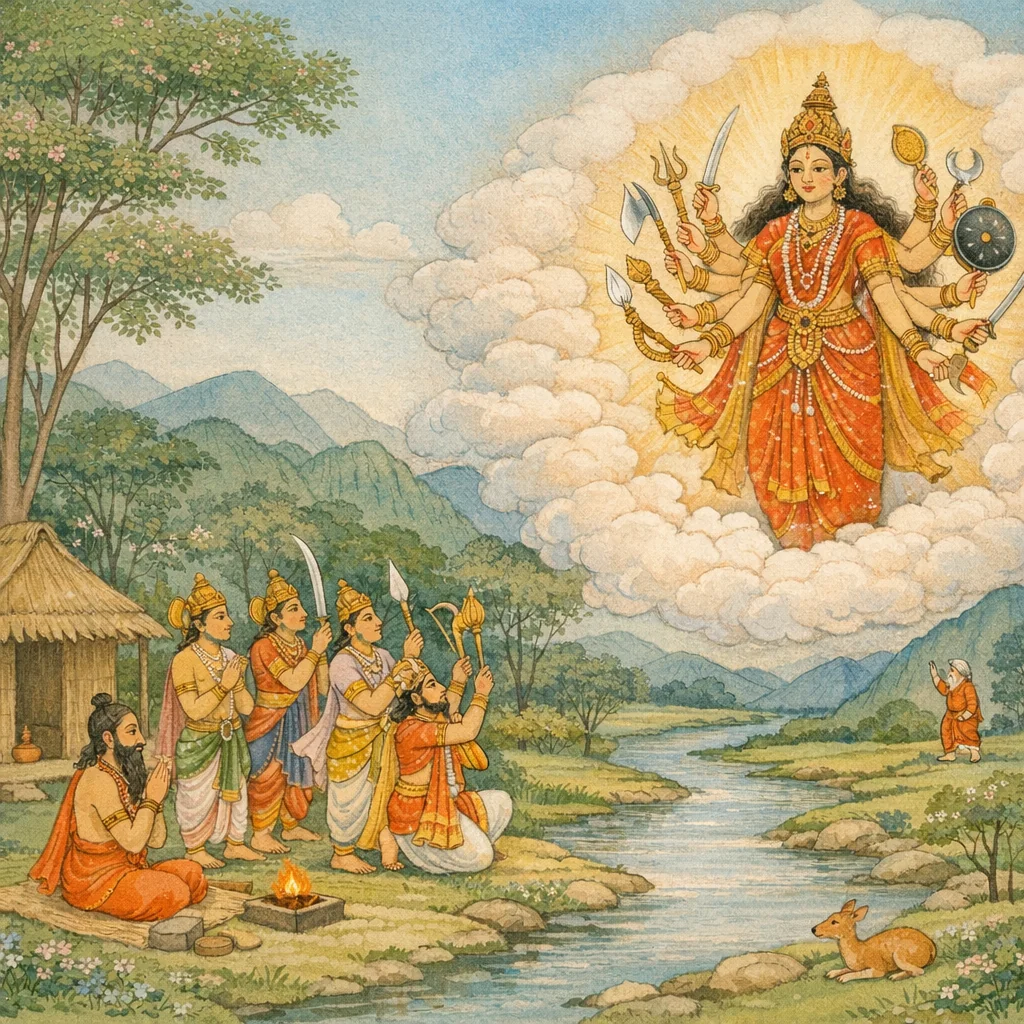
Adhyaya 19: The Manifestation of Katyayani (Durga) and the Humbling of the Vindhya by Agastya
कात्यायनी-प्रादुर्भावः तथा विन्ध्य-निम्नीकरणम् (Kātyāyanī-Prādurbhāvaḥ tathā Vindhya-Nimnīkaraṇam)
Humbling of the Vindhya by Agastya
Within the Pulastya–Nārada dialogue-frame, this adhyāya narrates a crisis of divine sovereignty and its resolution through syncretic theology. Defeated by Mahiṣāsura, the devas approach Viṣṇu (Śrīpati, Cakradhara) and Śaṅkara together, signaling a deliberate Hari–Hara concord rather than sectarian rivalry. Their combined wrath and consent generate a single, mountain-like tejas that is ritually received in the āśrama of the sage Kātyāyana, from which Kātyāyanī—yogaviśuddha-dehā—manifests. The text offers iconographic construction by distributing bodily features and weapons across multiple deities, presenting the Goddess as a composite condensation of divine powers. The narrative then pivots to topographical sanctification: the Vindhya’s obstruction of the Sun is corrected by Agastya’s vow, permanently lowering the mountain’s peak. Kātyāyanī/Durgā is installed upon Vindhya’s summit for dānava-nāśana, while devas, siddhas, and vidyādharas assemble in celebratory devotion.
Divine Beings
Sacred Geography
Mortal & Asura Figures
Key Content Points
- Devas, routed by Mahiṣāsura, seek refuge jointly in Viṣṇu and Śiva; the episode foregrounds syncretic theology (Hari–Hara cooperation) within the Pulastya–Nārada narrative frame.
- A unified tejas, aggregated from major deities, is entrusted to sage Kātyāyana; Kātyāyanī manifests with explicit iconographic detailing (multiple limbs, tri-netra, and deity-derived bodily attributes).
- Weapon-bestowal catalogue: trident, discus, conch, bow, vajra, staff, mace, sword, ornaments, garlands—establishing a pan-deva armamentarium for the Goddess’ asura-slaying mission.
- Topographical myth: Vindhya halts Sūrya’s course; Agastya compels Vindhya to remain lowered until his return, explaining the mountain’s ‘nīcaśṛṅga’ state and sanctifying Vindhya as a Devi-sthāna.
- Kātyāyanī/Durgā is stationed on Vindhya’s upper peak for dānava-nāśana; celestial beings (devas, siddhas, vidyādharas, bhūtas, apsarases) gather in praise and relief.
Shlokas in Adhyaya 19
Verse 2
इति श्रीवामनपुराणे अष्टादशो ऽध्यायः पुलस्त्य उवाच ततस्तु देवा महिषेम निर्जिताः स्थानानि संत्यज्य सवाहनायुधाः जग्मुः पुरस्कृत्य रिचामहं ते द्रष्टुं तदा चक्रधरं श्रियः पतिम् // वम्प्_19.1 गत्वा त्वपश्यंश्च मिथः सुरोत्तमौ स्थितौ खगेन्द्रासनशङ्करौ हि दृष्टावा प्रणम्यैव च सिद्दिसाधकौ न्यवेदयंस्तन्महिषादिचेष्टितम्
Pulastya said: Then the Devas, defeated by Mahīṣa (and his forces), abandoning their stations—along with their mounts and weapons—went, placing at their head Ṛcāmaha (Brahmā), to see the wielder of the discus, the Lord of Śrī (Viṣṇu). Having gone, they beheld the two best of the gods standing together—Śaṅkara and he who is seated upon the lord of birds (Viṣṇu on Garuḍa). Seeing them, the accomplished ones bowed and reported the actions of Mahīṣa and the others.
Verse 3
प्रभो ऽश्विसूर्येन्द्वनिलाग्निवेधसां जलेशशक्रादिषु चाधिकारान् आक्रम्य नाकात्तु निराकृता वयं कृतावनिस्था महिषासुरेण
O Lord, after seizing the offices and authorities of the Aśvins, the Sun, the Moon, Vāyu, Agni, the Creator (Brahmā), Varuṇa, Indra, and the rest, Mahīṣāsura has expelled us from heaven; we have been cast down and made to dwell upon the earth.
Verse 4
एतद् भवन्तौ शरणागतानां श्रुत्वा वचो ब्रूत हितं सुराणाम् न चेद् व्रजामो ऽद्य रसातलं हि संकाल्यमाना युधि दानवेन
Therefore, you two—having heard the words of us who have sought refuge—declare what is beneficial for the gods; otherwise, we shall today go down to Rasātala, being crushed in battle by the Dānava.
Verse 5
इत्थं मुरारिः सह शङ्करेण श्रुत्वा वचो विप्लुतचेतसस्तान् दृष्ट्वाथ चक्रे सहसैव कोपं कालाग्निकल्पो हरिरव्ययात्मा
Thus, Murāri (Vishnu), together with Śaṅkara, having heard those words of the distressed (devas) and seeing them, suddenly became enraged—Hari, of imperishable nature, like the fire of time at the end (kālāgni).
Verse 6
ततो ऽनुकोपान्मधुसूदनस्य सशङ्करस्यापि पितामहस्य तथैव शक्रादिषु दैवतेषु महर्द्धि तेजो वदनाद् विनिःसुतम्
Then, from the benevolent resolve of Madhusūdana (Viṣṇu), and also of Śaṅkara and Pitāmaha (Brahmā), and likewise among the deities beginning with Śakra (Indra), a supremely powerful radiance issued forth from their mouths.
Verse 7
तच्चैकतां पर्वतकूटसन्निभं जगाम तेजः प्रवराश्रम् मुने कात्यायनस्याप्रतिमस्य तेन महर्षिणा तेज उपाकृतं च
That radiance became a single concentrated mass, resembling a mountain peak, and came to you, O sage of excellent hermitage. It was then received/collected by the incomparable Kātyāyana, that great ṛṣi.
Verse 8
तेनार्षिसृष्टेन च तेज-सा वृतं ज्वलत्प्रकाशार्कसहस्रतुल्यम् तस्माच्च जाता तरलायताक्षी कात्यायनी योगविशुद्धदेहा
Enveloped by that radiance fashioned through the seer, blazing like the light of a thousand suns, from it was born Kātyāyanī—she of bright, wide eyes—whose body was purified by yoga.
Verse 9
माहेश्वराद् वक्त्रमथो बभूव नेत्रत्रयं पावकतेजसा च याम्येन केशा हरितेजसा च भुजास्तथाष्टादश संप्जज्ञिरे
From Maheśvara’s power the face arose; and the three eyes from the fiery radiance (of Agni). From Yama’s power the hair arose; and from Hari’s radiance the eighteen arms were produced.
Verse 10
सौम्येन युग्मं स्तनयोः सुसंहतं मध्यं तथैन्द्रेण च तेजसाभवत् ऊरब चजङ्घे च नितम्बसंयुते जाते जलेशस्य तु तेजसा हि
By Saumya’s (Soma’s) power the well-formed pair of breasts came into being; the waist (middle) arose through Indra’s radiance. The thighs and shanks, together with the hips, were produced indeed by the energy of the Lord of Waters.
Verse 11
पादो च लोकप्रपितामहस्य पद्माभिकोशप्रतिमौ बभूवतुः दिवाकराणमपि तेजसाङ्गुलीः कराङ्गुलीश्च वसुतेजसैव
And the feet, belonging to the great forefather of the worlds, became like lotus-buds. By the radiance of the Sun-gods the toes came to be; and the fingers of the hands likewise (arose) from the radiance of the Vasus.
Verse 13
प्रजापतीनां दशनाश्च तेजसा याक्षेण नासा श्रवणौ च मारुतात् साध्येन च भ्रयुगलं सुकान्तिमत् कन्दर्पबाणासनसन्निभं बभौ // वम्प्_19.12 तर्थार्षितेजोत्तममुत्तमं महन्नाम्ना पृथिव्यामभवत् प्रसिद्धम् कात्यायनीत्येव तदा बभौ सा नाम्ना च तेनैव जगत्प्रसिद्धा
By the radiance of the Prajāpatis her teeth came forth; by that of the Yakṣa her nose; by that of Māruta her ears. By that of the Sādhyas her pair of eyebrows appeared—beautiful, resembling Kāma’s bow and arrow-seat (i.e., exquisitely arched). That supreme, great splendor became renowned on earth by an exalted name; then she shone as “Kātyāyanī,” and by that very name she became famous in the world.
Verse 14
ददौ त्रिशूलं वरदस्त्रिशूली चक्रं मुरारिर्वरुणश्च शङ्खम् शक्तिं हुताशः श्वसनश्च चापं तूणौ तथाक्ष्य्यशरौ विवस्वान्
The trident-bearer (Śiva), the boon-giver, gave a trident; Murāri (Viṣṇu) gave a discus; Varuṇa gave a conch. The Fire-god gave a spear (śakti); the Wind-god gave a bow; and Vivasvān (the Sun) gave quivers and imperishable arrows.
Verse 15
वज्रं तथेन्द्रः सह घण्टया च यमो ऽथ दण्डं धनदो गदां च ब्रह्मऽक्षमालां सकमण्डलुं च कालो ऽसिमुग्रं सह चर्मणा च
Indra gave the thunderbolt, along with a bell; Yama then gave a staff; Dhanada (Kubera) gave a mace. Brahmā gave a rosary together with a water-pot; and Kāla gave a fierce sword along with a shield/leather-guard.
Verse 16
हारं च सोमः सह चामरेण मालं समुद्रो हिमवान् मृगेन्द्रम् चूडामणिं कुण्डलमर्द्धचन्द्रं प्रादात् कुठारं वसुशिल्पकर्त्ता
Soma gave a necklace along with a yak-tail fan; the Ocean gave a garland; Himavān gave a lion. (Others) gave a crest-jewel, an earring, and the half-moon (ornament). And the divine craftsman of the Vasus presented an axe.
Verse 17
गन्धर्वराजो रजतानुलिप्तं पानस्य पूर्णं सदृशं च भाजनम् भुजङ्गहारं भुजगेश्वरो ऽपि अम्लानपुष्पामृतवः स्रजं च
The king of the Gandharvas gave a vessel suitable for drinking, smeared/covered with silver, filled (for drink). And the lord of serpents too gave a serpent-necklace, and a garland from the nectar-bearing tree, made of unfading flowers.
Verse 18
तदातितुष्टा सुरस्त्तमानां अट्टाट्टहासं मुमुचे त्रिनेत्रा तां तुष्टुवुर्देववराः सहेन्द्राः सविष्णुरुद्रेन्द्वनिलाग्निभास्कराः
Then, greatly pleased with those best of the gods, the Three-Eyed One released a loud peal of laughter. The foremost gods praised Him—together with Indra—along with Viṣṇu, Rudra, the Moon, Wind, Fire, and the Sun.
Verse 19
नमो ऽस्तु दैव्यै सुरपूजितायै या संस्थिता योगविशुद्धदेहा निद्रास्वरूपेण महीं वितत्य तृष्णा त्रपा क्षुद् भयदाथ कान्तिः
Salutations to the divine Goddess, worshipped by the gods, established with a body purified by yoga. Pervading the earth in the form of Sleep, she is (also) thirst, modesty, hunger, fear, and radiance.
Verse 20
श्रद्धा स्मृतिः पुष्टिरथो क्षमा च छाया च शक्तिः कमलालया च वृत्तिर्दया भ्रान्ति रथेह माया नमो ऽस्तु दैव्यै भवरूपिकायै
She is faith, memory, nourishment, and also forbearance; she is shadow, power, and the abode of Lakṣmī. She is conduct/occupation, compassion, delusion; indeed here she is Māyā. Salutations to the divine Goddess whose form is (this) becoming/existence.
Verse 21
ततः स्तुताः देववरैर्मृगेन्द्रमारुह्य देवी प्रगतावनीध्रम् विन्ध्यं महापर्वतमुच्चशृङ्गं चकार यं निम्नतरं त्वगस्त्यः
Then, having been praised by the best of the gods, the Goddess mounted the lord of beasts (a lion) and went to the mountain-bearing earth. (She went to) Vindhya, the great mountain with lofty peaks—(that Vindhya) which Agastya made lower.
Verse 22
नारद उवाच किर्मथमद्रिं भगवानगस्त्यस्तं निम्नशृङ्गं कृतवान् महर्षिः कस्मै कृते केन च कारणेन एतद् वदस्वामलसत्त्ववृत्ते
Nārada said: “How did the blessed sage Agastya make Mount Kirmatha (i.e., the Vindhya) low-crested? For whose sake, and for what reason, did he do this? Tell me this, O you whose conduct is of stainless goodness.”
Verse 23
पुलस्त्य उवाच पुरा हि विन्ध्येन दिवाकरस्य गतिर्निरुद्धा गगनेचरस्य रविस्ततः कुमभभवं समेत्य होमावसाने वचनं बभाषे
Pulastya said: “Formerly, the Vindhya obstructed the course of the Sun, the sky-traveller. Then the Sun, approaching Kumbhabhava (Agastya), spoke words to him at the conclusion of his fire-offering.”
Verse 24
समागतो ऽहं द्विज दूरतस्त्वां कुरुष्व मामुद्धरणं मुनीन्द्र ददस्व दानं मम यन्मनीषिनं चरामि येन त्रिदिवेषु निर्वृतः
(The Sun said:) “O twice-born, I have come to you from afar. O lord of sages, provide me deliverance (relief). Grant me this ‘gift’—that wise intention of mine—so that I may move about and thereby be at ease among the gods in the three heavens.”
Verse 28
इत्थं दिवाकरवचो गुणसंप्रयोगि श्रुत्वा तदा कलशजो वचनं बभाषे दानं ददामि तव यन्मनसस्त्वभीष्टं नार्थि प्रयाति विमुखो मम कश्चिदेव // वम्प्_19.25 श्रुत्वा वचो ऽमृतमयं कलशोद्भवस्य प्राह प्रभुः करतले विनिधाय मूर्ध्नि एषो ऽद्य मे गिरिवरः प्ररुणाद्धि मार्गं विन्ध्यस्य निम्नकरणे भगवन् यतस्व वम्प्_19.26 इति रविवचनादथाह कुम्भजन्मा कुतमिति विद्धि मया हि नीचशृङ्गम् तव किरणजितो भविष्यते महीध्रो मम चरणसम्श्रितस्य का व्यथा ते // वम्प्_19.27 इत्येवमुक्त्वा कलशोद्भावस्तु सूर्यं हि संस्तूय विनम्य भक्त्या जगाम संत्यज्य हि दण्डकं हि विन्ध्याचलं वृद्ध्वपुर्महर्षिः
Having thus heard the Sun’s words, Agastya (born from the jar), endowed with virtue, spoke: “I grant you the boon that your mind desires; no supplicant ever departs from me disappointed.”
Verse 30
गत्वा वचः प्राह मुनिर्महीध्रं यास्ये महातीर्थवरं सुपुण्यम् वृद्धोस्मयशक्तश्च तवाधिरोढुं तस्माद् भवान् नीचतरो ऽस्तु सद्यः // वम्प्_19.29 इत्येवमुक्तो मुनिस्त्तमेन स नीचशृङ्गस्त्वभवन्महीध्रः समाक्रमच्चापि महर्षिमुक्यः प्रोल्लङ्घ्य विन्ध्यं त्विदमाह शैलम्
Having approached, the sage spoke to the mountain: “I am going to a supremely holy, excellent great tīrtha. I am old and unable to climb you; therefore, you should become lower at once.”
Verse 31
यावन्न भूयो निजमाव्रजामि महाश्रमं धौतवपुः सुतीर्थात् त्वया न तावत्त्विह वर्धितव्यं नो चेद् विशप्स्ये ऽहमवज्ञया ते
Until I return again to my own great hermitage, having purified my body at the sacred tīrtha, you must not grow here. Otherwise, if you disregard (my word), I shall curse you.”
Verse 32
इत्येवमुक्त्वा भगवाञ्जगाम दिशं स याम्यां सहसान्तरिक्षम् आक्रम्य तस्थौ स हि तां तदाशां काले व्रजाम्यत्र यदा मुनीन्द्रः
Having spoken thus, the Blessed One quickly went through the sky toward the southern quarter. Reaching that direction, he halted there, thinking: “In due time I shall go here, when the best of sages arrives.”
Verse 33
तत्राश्रमं रम्यतरं हि कृत्वा संशुद्धजाम्बूनदतोरणान्तम् तत्राथ निक्षिप्य विदर्भपुत्रीं स्वमाश्रमं सौम्यमुपाजगाम
There he made a most delightful hermitage, with a gateway adorned (or finished) with purified Jāmbūnada gold. Then, having placed the princess of Vidarbha there, he returned to his own gentle hermitage.
Verse 34
ऋतावृतौ पर्वकालेषु नित्यं तम्मबरे ह्याश्रममावसत् सः शेषं च कालं स हि दण्डकस्थस् तपश्चारामितकान्तिमान् मुनिः
In the seasons and at the parva (sacred juncture) times, he regularly stayed in that excellent hermitage. For the rest of the time, the sage—dwelling in the Daṇḍaka (forest)—practised austerities, possessing immeasurable radiance.
Verse 35
विनन्ध्यो ऽपि दृष्ट्वा गगने महाश्रमं वृद्धिं न यात्येव भयान्महर्षेः नासौ निवृत्तेति मतिं विधाय स संस्थितो नीचतराग्रशृङ्गः
Even though he was the Vindhya (mountain), seeing the great ascetic (Agastya) in the sky, he did not continue to grow, out of fear of the great sage. Thinking, “He has not yet returned,” he remained settled with his peak kept lower.
Verse 36
एवं त्वगस्त्येन महाचलेन्द्रः स नीचशृङ्गे हि कृतो महर्षे तस्योर्ध्वशृङ्गे मुनिसंस्तुता सा दुर्गा स्थिता दानवनाशनार्थम्
Thus, by Agastya, that great lord of mountains was indeed made to have a low peak, O great sage. Upon its higher summit, the Goddess Durgā—praised by sages—stood (was established) for the purpose of destroying the Dānavas.
Verse 37
देवाश्च सिद्धाश्च महोरगाश्च विद्याधरा भूतगणाश्च सर्वे सर्वाप्सरोभिः प्रतिरामयन्तः कात्यायनीं तस्थुरपेतशोकाः
The Devas, the Siddhas, the great Nāgas, the Vidyādharas, and all the hosts of Bhūtas—delighting together with all the Apsarases—stood attending upon Kātyāyanī, free from sorrow.
Frequently Asked Questions
The devas approach Viṣṇu (Cakradhara, Śriyaḥpati) and Śaṅkara simultaneously, and the narrative treats their joint response as a single salvific agency. The ‘one tejas’ formed from multiple deities—prominently including Hari and Hara—models a syncretic theology in which sectarian powers are not competing but convergent, culminating in Kātyāyanī as the composite embodiment of divine energies.
The chapter functions as a topographical etiology for the Vindhya range: Vindhya obstructs Sūrya’s movement, and Agastya compels the mountain to remain ‘nīcaśṛṅga’ (lowered peak) until his return. This myth sacralizes Vindhya as a Devi-abode (Durgā/Kātyāyanī established on the summit) and explains a permanent landscape feature through ascetic authority and vow-based constraint.
This adhyāya does not advance the Bali–Vāmana cycle directly. Instead, it develops a parallel purāṇic theme—restoration of cosmic order through divine manifestation—by narrating the rise of Kātyāyanī for asura-dharma correction (Mahiṣāsura-vadha context) and by embedding a landscape-origin account (Vindhya–Agastya) within the Pulastya–Nārada framework.