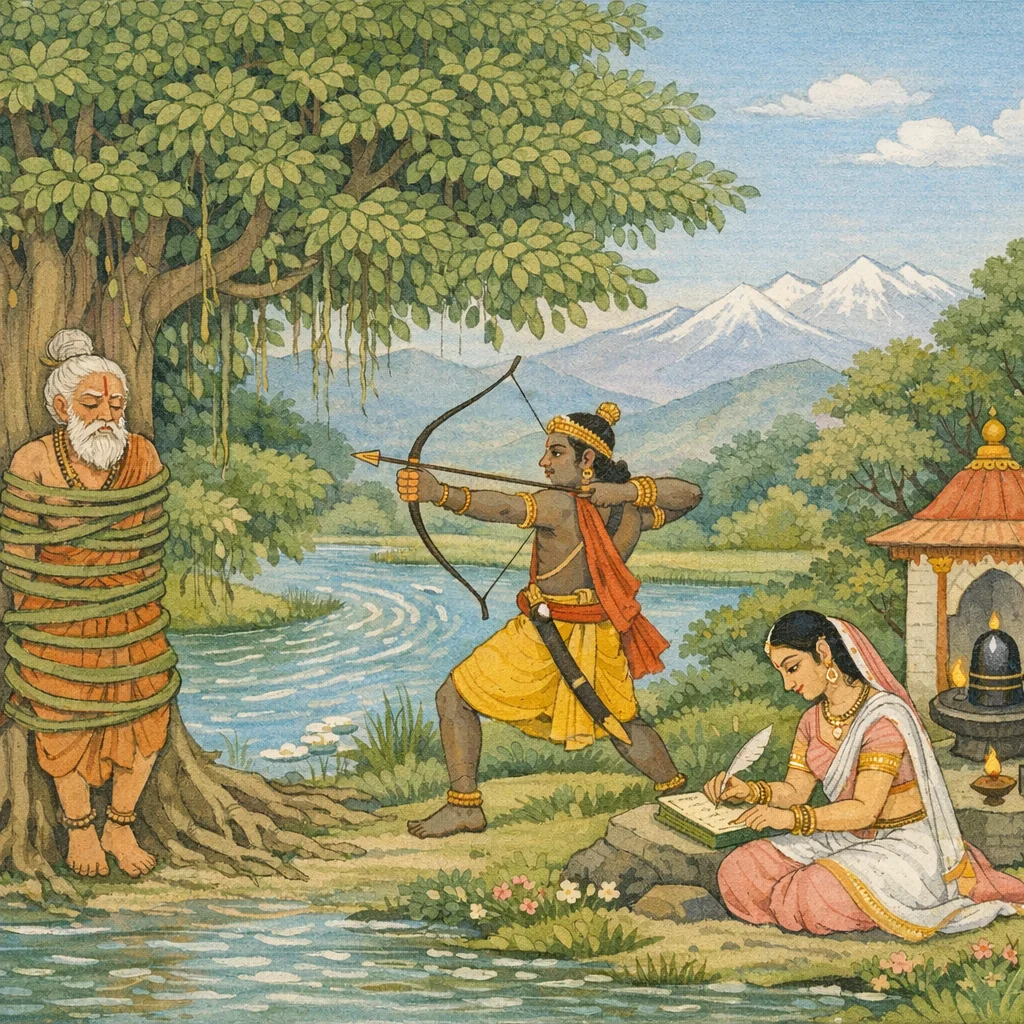
Adhyaya 38: Jabali Bound by the Monkey: Nandayanti’s Ordeal and the Yamuna–Hiranyavati Sacred Corridor
जाबालिबन्धन-नन्दयन्तीचरित (Jābāli-bandhana–Nandayantī-carita)
Yamuna-Hiranyavati Sacred Corridor
Within the Pulastya–Nārada narrative frame of the Vāmana Purāṇa, this adhyāya presents a tightly woven episode of curse, displacement, and rescue that simultaneously sacralizes a Shaiva landscape. Viśvakarmā, cursed into a vānaratā (monkey-form), becomes the agent of a chain of events involving the daitya Kandara, his daughter Devavatī, and the yakṣa-born Nandayantī. The action moves through a marked tirtha-network—Yamunā (Kālindī), Hiraṇvatī, and the Śrīkaṇṭha (Śiva) locus on the Yamunā bank—where devotion and topography intersect. The narrative foregrounds syncretic theology: Śiva’s presence (Śrīkaṇṭha/Maheśvara) anchors the episode’s moral order, while ascetic power (tapas) and mantra-knowledge preserve Jābāli’s life despite violent bondage. The chapter culminates in royal–ascetic cooperation: Ṛtadhvaja approaches the Ikṣvāku king at Ayodhyā, and the prince Śakuni’s archery (astra-vidhi) becomes the instrument of liberation, illustrating dharma enacted through both tapas and kṣatra.
Divine Beings
Sacred Geography
Mortal & Asura Figures
Key Content Points
- Viśvakarmā’s curse into monkey-form triggers a conflict around Devavatī; the vānaratā figure abducts/controls the narrative movement across forests and rivers.
- Sacred-geographic anchoring at Śrīkaṇṭha on the Yamunā (Kālindī): Nandayantī is directed to Śiva’s tirtha, inscribes a prophetic verse, and the ashram-space becomes a site of recognition and reunion.
- Jābāli’s prolonged bondage on a banyan (vaṭa/nyagrodha) by latā-pāśa ‘yantra’ is resolved only through kṣatriya archery (Śakuni), integrating tapas (ascetic endurance) with royal dharma and technical astravidyā.
Shlokas in Adhyaya 38
Verse 1
इति श्रीवामनपुराणे सप्तत्रिंशो ऽध्यायः दण्ड उवाच चित्राङ्गदायास्त्वरजे तत्र सत्या यथासुखम् स्मरन्त्याः सुरथं वीरं महान् कालः समभ्यगात्
Thus (ends) the thirty-seventh chapter in the Śrī Vāmana Purāṇa. Daṇḍa said: ‘Then, as Citrāṅgadā’s younger sister Satyā lived at ease, remembering the heroic Suratha, a long time passed.’
Verse 2
विश्वकर्मापि मुनिना शप्तो वानरतां गतः न्यपतन्मेरुशिखराद् भूपृष्ठं विधिचोदितः
Viśvakarmā too, having been cursed by a sage, assumed the state of a monkey; and, impelled by fate/ordinance, he fell from the peak of Meru down onto the surface of the earth.
Verse 3
वनं घोरं सुगुल्माढ्यं नदीं शालूकिनीमनु शाक्वेयं पर्वतश्रेष्ठं समावसति सुन्दरि
O fair lady, he dwelt on the excellent mountain named Śākveya, along the river called Śālūkinī, in a dreadful forest thick with shrubs.
Verse 4
तत्रासतो ऽस्त सुचिरं फलमूलान्यथाश्नतः कालो ऽत्यगाद् वरारोहे बहुवर्षगणो वने
Living there for a long time and eating fruits and roots, O lady of beautiful hips, a great many years passed for him in that forest.
Verse 5
एकदा दैत्यशार्दूलः कन्दराख्यः सुतां प्रियाम् प्रतिगृह्य समभ्यागात् ख्यातां देववतीमिति
Once, the tiger among Daityas—named Kandara—having taken (with him) his beloved daughter, came (there); she was renowned by the name Devavatī.
Verse 6
तां च तद् वनमायान्तीं समं पित्रा वराननाम् ददर्श वानरश्रेष्ठः प्रजग्राह बालत् करे
And as she—fair-faced—was coming to that forest together with her father, the foremost of monkeys saw her and seized her by the hand, (snatching her) away from the girl.
Verse 7
ततो गृहीतां कपिना स दैत्यः स्वसुतां शुबे कन्दरो वीक्ष्य संक्रुद्धः ख्ड्गमुद्यम्य चाद्रवत्
Then, seeing his own daughter seized by the monkey, that Daitya—Kandara—became enraged; raising his sword, he rushed forward.
Verse 8
तमापतन्तं दैत्येन्द्रं दृष्ट्वा शाखामृगो बली तथैव सह चार्वङ्ग्या हिमाचलमुपागतः
Seeing that lord of the Daityas rushing upon him, Bali—(the one called) “the branch-dwelling monkey”—likewise went to the Himālaya, together with the fair-limbed (lady companion).
Verse 9
ददर्श च महादेवं श्रीकण्ठं यमुनातटे तस्याविदूरे गहनमाश्रमं ऋषिवर्जितम्
And he saw Mahādeva, Śrīkaṇṭha, on the bank of the Yamunā; and not far from him (there was) a dense (wooded) āśrama, devoid of ṛṣis.
Verse 10
तस्मिन् महाश्रमे पुण्ये स्थाप्य देववतीं कपिः न्यमञ्जत स कालिन्द्यां पश्यतो दानवस्य हि
In that holy great hermitage, the monkey, having installed Devavatī, plunged into (bathed in) the Kālinḍī—indeed while the Dānava looked on.
Verse 11
सो ऽजानत् तां मृतां पुत्रीं समं शाखामृगेण हि जगाम च महातेजाः पातालं निलयं निजम्
Not knowing that his daughter had died, that mighty one went—together with the monkey of the branches—down to Pātāla, to his own dwelling.
Verse 12
स चापि वानरो देव्या कालिन्द्या वेगते हृतः नीतः शिवीति विख्याते देशं शुभजनावृतम्
That monkey too, swept away by the current of the goddess Kāliṇdī, was carried to a region renowned as ‘Śivīti,’ a place filled with auspicious people.
Verse 13
ततस्तीर्त्वाथ वेगेन स कपिः पर्वतं प्रति गन्तुकामो महातेजा यत्र न्यस्ता सुलोचना
Then, having crossed over, that monkey—impelled by speed—wished to go toward the mountain, the mighty one, to the place where Sulocanā had been laid down.
Verse 14
अथापश्यत् समायान्तमञ्जनं गुह्यकोत्तमम् नन्दयन्त्या समं पुत्र्या गत्वा जिगमिषुः कपिः
Then the monkey, intending to go (there), saw Anjanā approaching—she who was the most excellent among the Guhyakas—together with Nandayantī and her daughter.
Verse 15
तां दृष्ट्वामन्यत श्रीमान् सेयं देववती ध्रुवम् तन्मे वृथा श्रमो जातो जलमज्जनसंभवः
Seeing her, the illustrious one thought: ‘Surely this is Devavatī. Then my exertion—arising from bathing in the water—has been in vain.’
Verse 16
इति संचिन्तयन्नेव समाद्रवत् सुन्गदरीम् सा तद् भयाच्च न्यपतन्नदीं चैव हिरण्वतीम्
Thinking thus, he ran swiftly toward Suṅgadarī; but she, out of fear of him, fell into the river Hiraṇvatī.
Verse 17
गुह्यको वीक्ष्य तनयां पतितामापगाजले दुःखशोकसमाक्रान्तो जगामाञ्जनपर्वतम्
Seeing his daughter fallen into the waters of the river, the Guḥyaka—overwhelmed by sorrow and grief—went to Mount Añjana.
Verse 18
तत्रासौ तप आस्थाय मोनव्रतधरः शुचिः समास्ते वै महातेजाः संवत्सरगणान् बहून्
There, undertaking austerity, pure and observing the vow of silence, that great-splendored one remained (in ascetic practice) for many sets of years.
Verse 19
नन्दयन्त्यपि वेगेन हिरण्यत्यापवाहिता नीता देशं महापुण्यं कोशलं साधुभुर्युतम्
Carried away downstream by the swift current of the Hiraṇyā, she was borne to the supremely meritorious land of Kośala, abundant in holy persons.
Verse 20
गच्छन्ती सा च रुदती ददृशो वटपादपम् प्ररोहप्रावृततनुं जटाधरमिवेश्वरम्
As she went on, weeping, she saw the Lord of the banyan-foot (Vaṭapādapa), whose body was covered with fresh shoots, appearing like the Supreme Lord bearing matted locks.
Verse 21
तं दृष्ट्वा विपुलच्छायं विशश्राम वरानना उपविष्टा शिलवापट्टे ततो वाचं प्रशुश्रवे
Seeing him/it with its vast shade, the fair-faced woman rested. Seated upon a stone slab, she then heard a voice.
Verse 22
न सो ऽस्ति पुरुषः कश्चिद् यस्तं ब्रूयात् तपोधनम् यथा स तनयस्तुभ्यमुद्बद्धो वटपादपे
“There is no man at all who could tell you, O treasure of austerity, how that son of yours has been bound up (hung/fastened) upon the banyan-footed (Lord/tree).”
Verse 23
सा श्रुत्वा तां तदा वार्णीं विस्पष्टाक्षरसंयुताम् तिर्यगूर्ध्वमधश्चैव समन्तादवलोकयत्
Having heard that speech then—articulated with clearly formed syllables—she looked all around: sideways, upward, and downward.
Verse 24
ददृशे वृक्षशिखरे शिशुं पञ्चाब्दिकं स्थितम् पिङ्गलाभिर्जटाभिस्तु उद्ब्द्धं यत्नतः शुभे
She saw, on the top of a tree, a child of five years standing there—bound up tightly with tawny matted locks, O auspicious one.
Verse 25
तं विब्रुवन्तं दृष्ट्वैव नन्दयन्ती सुदुःखिता प्राह केनासि बद्ध्स्तवं नन्दयन्ती सुदुःखिता प्राह केनासि बद्धस्त्वं पापिना वद बालक
Seeing him speaking, Nandayantī—deeply distressed—said: “By whom are you bound? Tell me, child—by what sinner (pāpī) have you been bound?”
Verse 26
स तामाह महाभागे बद्धो ऽस्मि कपिना वटे जटास्वेवं सुदुष्टेन जीवामि तपसो बलात्
He said to her: “O noble lady, I am bound at the Kapinā-vata (the ‘Kapinā’ banyan). Thus, by this exceedingly wicked one, I am held fast in my matted locks; yet I continue to live by the power of my austerity.”
Verse 27
पुरोन्मत्तपुरेत्येव तत्र देवो महेश्वरः तत्रास्ति तपसो राशिः पिता मम ऋतध्वजः
“(The place is) indeed called Puronmattapura. There the god Maheśvara (Śiva) is present. There exists a great accumulation of austerity—my father, Ṛtadhvaja.”
Verse 28
तस्यास्मि जपमानस्य महायोगं महात्मनः जातो ऽलिवृन्दसंयुक्तः सर्वशास्त्रविशारदः
“While that great-souled one was performing japa of the Great Yoga, I came into being—accompanied by a swarm of bees—and (I became) one well-versed in all the śāstras.”
Verse 29
ततो मामब्रवीत् तातो नाम कृत्वा शुभानने जाबालीति परिख्याय तच्छृणुष्व शुभानने
Then my father spoke to me, O fair-faced one: having given (me) a name and making it known as ‘Jābāli’, listen to that, O fair-faced one.
Verse 30
पञ्चवर्षसहस्राणि बाल एव भविष्यसि दशवर्षसहस्राणि सुमारत्वे चरिष्यसि
For five thousand years you will remain only a child; for ten thousand years you will live in a state of excellent youthfulness/prime vigor.
Verse 31
विंशतिं यौवनस्थायी वीर्येण द्विगुणं ततः पञ्चवर्षशतान् बालो भोक्ष्यसे बन्धनं दृढम्
For twenty (thousand years) you will remain established in youth; thereafter, (you will become) twice as potent in vigor. Then, for five hundred years, while still a child, you will undergo firm bondage.
Verse 32
दशवर्षशतान्येव कौमारे कायपीडनम् यौवने पारमान् भोगान् द्विसहस्रसमास्तथा
[The father said:] ‘For ten hundred years (i.e., a thousand years) in childhood you will undergo bodily affliction; and in youth you will enjoy supreme pleasures for two thousand years.’
Verse 33
चत्वारिशच्छतान्येव वार्धके क्लेशमुत्तमम् लप्स्यसे भूमिशय्याढ्यं कदन्नाशनभोजनम्
‘And for four hundred years in old age you will obtain intense hardship—abounding in sleeping on the ground, and eating wretched food as your fare.’
Verse 34
इत्येवमुक्तः पित्राहं बालः पञ्चाब्ददेशिकः विचरामि महीपृष्ठं गच्छन् स्नातुं हिरण्वतीम्
‘Thus addressed by my father, I—still a boy, five years of age—wandered upon the surface of the earth, setting out to bathe in the Hiraṇvatī (river).’
Verse 35
ततो ऽपश्यं कपिवरं सो ऽवदन्मां क्व यास्यसि इमां देववतीं गृह्यं मूढ न्यस्तां महाश्रमे
Then I saw an excellent monkey. He said to me, “Where are you going? Fool! Having seized this Devavatī, you have been placed (or deposited) in this great hermitage.”
Verse 36
ततो ऽसौ मां समादाय विस्फुरन्तं प्रयत्नतः वटाग्रे ऽस्मिन्नुद्ब्बन्ध जटाभिरपि सुन्दरि
Then he, taking hold of me—though I struggled violently with effort—bound (me) upon the top/branch of this banyan tree, even with (his) matted locks, O beautiful one.
Verse 37
तथा च रक्षा कपिना कृता भीरु निरन्तरैः लतापाशैर्महायन्त्रमधस्ताद् दुष्टबुद्धिना
And thus, O timid one, protection was made by the monkey: below, by the evil-minded one, a great contrivance was set up with continuous nooses of creepers.
Verse 38
अभेद्यो ऽयमनाक्रम्य उपरिष्टात् तथाप्यधः दिशां मुकेषु सर्वेषु कृतं यन्त्रं लतामयम्
“This (place/region) is unassailable—one cannot force an entry, whether from above or from below. At the ‘faces’ (approaches) of all the directions a protective device (yantra) has been set up, made of creepers.”
Verse 39
संयम्य मां कपिवरः प3यतो ऽमरपर्वतम् यथेच्छया मया दृष्टमेतत् ते गदितं शुभे
“A foremost monkey restrained me while (I was) looking at the mountain of the immortals. What I saw there, as I wished (to see), I have told you, O auspicious lady.”
Verse 40
भवती का महारण्ये ललना परिवर्जिता समायाता सुचार्वङ्गी केन सार्थेन मां वद
“Who are you, lady, who have come into this great forest, unaccompanied by other women? O fair-limbed one, tell me—by what caravan/company have you come?”
Verse 41
साब्रवीदढ्जनो नाम सुह्यकेन्द्रः पिता मम नन्दयन्तीति मे नाम प्रम्लोचागर्भसंभवा
She said: “My father is named Aḍhjana, the lord of the Suhyakas. My name is Nandayantī; I was born from the womb of Pramlocā.”
Verse 42
तत्र मे जातके प्रोक्तमृषिणा मुद्गलेन हि इयं नरेन्द्रमहिषी भविष्यति न संशयः
At my birth, the sage Mudgala indeed declared: ‘This girl will become the chief queen of a king—there is no doubt.’
Verse 43
तद्वाक्यसमकालं च व्यनदद् देवदुन्दुभिः शिवा चाशिवनिर्घोषा ततो भूयो ऽब्रवीनमुनिः
At the very moment those words were spoken, the divine kettledrums resounded; and auspicious cries (śivāḥ) as well as inauspicious sounds (aśiva-nirghoṣāḥ) arose. Then the sage spoke again.
Verse 44
न संदेहो नरपतेर्महाराज्ञी भविष्यति महान्तं संशयं घोरं कन्याभावे गमिष्यति ततो जगाम स ऋषिरेवमुक्त्वा वचो ऽद्भुतम्
“There is no doubt: the king’s chief queen will become (a mother). Yet, in the absence of a daughter, a great and dreadful uncertainty will arise. Having spoken these wondrous words thus, the sage then departed.”
Verse 45
पिता मामपि चादाय समागन्तुमथैच्छत तीर्थं ततो हिरण्वत्यास्तीरात् कपिरथोत्पतत्
“Then my father, taking me also along, desired to go (there). From that ford (tīrtha) on the bank of the Hiraṇvatī, Kapiratha sprang forth (suddenly appeared/rose up).”
Verse 46
तद् भयाच्च मया ह्यात्मा क्षिप्तः सागरगाजले तयास्मि देशमानीता इमं मानुषवर्जितम्
“And out of fear of that, I myself was cast into the waters of the ocean/river. By her, I was brought to this region—one devoid of human beings.”
Verse 47
श्रुत्वा जाबालिरथ तद् वचनं वै तयोदितम् प्राह सुन्दरि गच्छस्व श्रीकण्ठं यमुनातटे
Having heard those words spoken by her, Jābāli-ratha said: “O fair one, go to Śrīkaṇṭha on the bank of the Yamunā.”
Verse 48
तत्रागच्छति मध्याह्ने मत्पिता शर्वमर्चितुम् तस्मै निवेदयात्मानं तत्र श्रेयो ऽधिलप्स्यसे
“There, at midday, my father comes to worship Śarva. Present yourself to him; there you will obtain the higher good (true welfare).”
Verse 49
ततस्तु त्वरिता काले नन्दयन्ती तपोनिधिम् परित्राणार्थमगमद्धिमाद्रेर्यमुनां नदीम्
Then, swiftly in due time, Nandayantī—delighting the treasure-house of austerity—went, seeking protection, to the Yamunā river of Himādri.
Verse 50
सा त्वदीर्घेण कालेन कन्दमूलफलाशना संप्राप्ता शङ्करस्थानं यत्रागच्छति तापसः
After a long time—living on bulbs, roots, and fruits—she reached Śaṅkara’s sacred place, the spot to which ascetics come.
Verse 51
ततः सा देवदेवेशं श्रीकण्ठं लोकवन्दितम् प्रतिवन्द्य ततो ऽपश्यक्षरांस्तान्महामुने
Then she bowed in reverence to the Lord of the gods, Śrīkaṇṭha, worshipped by the worlds; and thereafter, O great sage, she saw those syllables/letters.
Verse 52
तेषामर्थं हि विज्ञाय सा तदा चारुहासिनी तज्जाबाल्युदितं श्लोकमलिखच्चान्यमात्मनः
Understanding the meaning of those (syllables), she—smiling gently—then wrote down for herself another verse that had been spoken by Jābāli.
Verse 53
मुद्गलेनास्मि गदिता राजपत्नी भविष्यति सा चावस्थामिमां प्राप्ता कश्चिन्मां त्रातुमीश्वरः
“I have been spoken of by Mudgala: ‘She will become a king’s wife.’ Yet I have fallen into this condition—who indeed is the Lord that will rescue me?”
Verse 54
इत्युल्लिख्य शिलापट्टे गता स्नातुं यमस्वसाम् ददृसे चाश्रमवरं मत्तकोकिलनादितम्
“Having thus inscribed (these words) upon a stone-slab, she went to bathe in the Yamunā; and she beheld an excellent hermitage, resonant with the calls of intoxicated (joyful) cuckoos.”
Verse 55
ततो ऽमन्यत सात्रर्षिर्नूनं तिष्ठति सत्तमः इत्येवं चिन्तयन्ती सा संप्रविष्टा महाश्रमम्
“Then she thought: ‘Surely the best of sages dwells here.’ Thinking thus, she entered the great hermitage.”
Verse 56
ततो ददर्श देवाभां स्थितां देववतीं शुभाम् संशुष्कास्यां चलन्नेत्रां परिम्लानामिवाब्जिनीम्
Then he saw a radiant woman, divine in appearance, auspicious and standing there—her mouth dried up, her eyes unsteady—like a lotus that has withered.
Verse 57
सा चापतन्तीं ददृशे यक्षजां दैत्यनन्दिनी केयमित्येव संचिन्त्य समुत्थाय स्थिताभवत्
And she (the divine-looking woman) saw the Yakṣa-born Daitya maiden approaching. Thinking, ‘Who is this?’, she rose up and stood.
Verse 58
ततो ऽन्योन्यं समालिङ्ग्य गाढं गाढं सुहृत्त्या पप्रच्छतुस्तथान्यो ऽयं कथयामासतुस्तदा
Then, embracing one another tightly—tightly—out of friendship, they questioned each other; and then each told the other his/her account.
Verse 59
ते परिज्ञाततत्त्वार्थे अन्योन्यं ललनोत्तमे समासीने कथाभिस्ते नानारूपाभिरादरात्
Those two, having understood the true purport of reality, sat together, O excellent lady, and with reverence engaged in desired conversation of many kinds and forms.
Verse 60
एतस्मिन्नन्तरे प्राप्तः श्रीकण्ठं स्नातुमादरात् स तत्त्वज्ञो मुनिश्रेष्ठो अक्षराण्यवलोकयन्
Meanwhile, there arrived—eager to bathe at Śrīkaṇṭha—a best of sages, a knower of truth, who was examining the letters (i.e., reading/inspecting a written text or inscription).
Verse 61
स दृष्ट्वा वाचयित्वा च तमर्थमधिगम्य च मुहूर्तं ध्यानमास्थाय व्यजानाच्च तपोनिधिः
Having seen (it) and also caused it to be read/recited, and having grasped its meaning, that treasure-house of austerity entered meditation for a moment and then came to understand (it clearly).
Verse 62
ततः संपूज्य देवेशं त्वरया स ऋतध्वजः अयोध्यामगमत् क्षिप्रं द्रष्टुमिक्ष्वाकुमीश्वरम्
Then, having duly worshipped the Lord of the gods, Ṛtadhvaja hastened and quickly went to Ayodhyā in order to see King Ikṣvāku, the sovereign.
Verse 63
तं दृष्ट्वा नृपतिश्रेष्ठं तापसो वाक्यमब्रवीत् श्रूयतां नरसार्दूल विज्ञप्तिर्मम पार्थिव
On seeing that best of kings, the ascetic spoke these words: “Let it be heard, O tiger among men, O king—this petition of mine.”
Verse 64
मम पुत्रो गुणैर्युक्तः सर्वसास्त्रविशारदः उद्ब्द्धः कपिना राजन् विषयानते तवैव हि
“My son—endowed with virtues and well-versed in all the śāstras—has been seized/bound by a monkey, O king, indeed within the border-region of your own realm.”
Verse 65
तं हि मोचयितुं नान्यः शक्तस्त्वत्तदनयादृते शकुनिर्नाम राजेन्द्र स ह्यस्त्रविधिपारगः
“Indeed, no one else is capable of releasing him, except by your bringing (that person). O king, there is one named Śakuni; he is fully proficient in the procedures of missiles (astravidhi).”
Verse 66
तन्मुनेर्वाक्यमाकर्ण्य पिता मम कृशोदरि आदिदेश प्रियं पुत्रं शकुनिं तापसान्वये
“Hearing the words of that sage, my father—O slender-waisted one—commanded his dear son Śakuni, in the lineage of ascetics.”
Verse 67
ततः स प्रहितः पित्रा भ्राता मम महाभुजः संप्राप्तो बन्धनोद्देशं समं हि परमर्षिणा
“Then, dispatched by my father, my brother—mighty-armed—reached the place of confinement, together with the supreme sage.”
Verse 68
दृष्ट्वा न्यग्रोधमत्युच्चं प्ररोहास्तृतदिङ्मुखम् ददर्श वृक्षशिखरे उद्बद्धमृषिपुत्रकम्
Seeing a very tall nyagrodha (banyan) tree, whose spreading shoots covered the directions, he then beheld—upon the top of that tree—an ascetic’s son hanging/suspended there.
Verse 69
ताश्च सर्वाल्लतापाशान् दृष्ट्वान् स समन्ततः दृष्ट्वा स मुनिपुत्रं तं स्वजटासंयतं वटे
And seeing all those nooses made of creepers all around, he saw that sage’s son there—bound with his own matted hair—upon the banyan tree.
Verse 70
धनुरादाय बलवानधिज्यं स चकार ह लाघवादृषिपुत्रं तं रक्षंश्चिच्छेदमार्गणैः
Taking up his bow, the strong one swiftly strung it; and, protecting that sage’s son, he cut down the rākṣasa with his arrows.
Verse 71
कपिना यत् कृतं सर्वं लतापाशं चतुर्दिशम् पञ्चवर्षशते काले गते शक्तस्तदा शरैः
All the vine-nooses spread in the four directions that had been made by the monkey—after a period of five hundred years had passed—he then became capable of (cutting/clearing) them with arrows.
Verse 72
लताच्छन्नं ततस्तूर्णमारुरोह मुनिर्वटम् प्राप्तं स्वपितरं दृष्ट्वा जाबालिः संयतो ऽपि सन्
Then, seeing the banyan tree covered with creepers, the sage quickly climbed it. On seeing that his own father had arrived, Jābāli—though self-controlled—(was inwardly moved).
Verse 73
आदरात् पितरं मूर्ध्ना ववन्दत विधानतः संपरिष्वज्य स मुनिर्मूर्ध्न्याघ्राय सुतं ततः
With reverence he bowed to his father with his head, in the proper manner. Then that sage embraced his son and, smelling (kissing) him upon the head, (received him affectionately).
Verse 74
उन्मोचयितुमारब्धो न शशाक सुसंयतम् ततस्तूर्णं धनुर्न्यस्य बाणांश्च शकुनिर्बली
(Śakuni), having begun to release (him/it), was unable to loosen what was tightly bound. Therefore the powerful Śakuni quickly set down his bow and arrows.
Verse 75
आरुरोह वटं तूर्णं जटा मोचयितुं तदा न च शक्नोति संच्छन्नं दृढं कपिवरेम हि
Then he quickly climbed a banyan tree in order to loosen the matted locks; yet he was not able (to do so), for they were densely entangled and firmly fastened—indeed, like (those of) the foremost of monkeys.
Verse 76
यदा न शकिता स्तेन संप्रमोचयितुं जटाः तदावतीर्णः शकुनिः सहितः परमर्षिणा
When he was unable to loosen the matted locks, then Śakuni descended (from the tree), accompanied by the supreme ṛṣi.
Verse 77
जग्राह च धनुर्बाणांश्चकार शरमण्डपम् लाघवादर्द्धचन्द्रैस्तां शाखां चिच्छेद स त्रिधा
He took up his bow and arrows and fashioned a pavilion of arrows. Then, with swift half-moon–shaped shafts, he cut that branch into three parts.
Verse 78
शाखया कृत्तया चासौ भारवाही तपोधनः शरसोपानमार्गेण अवतीर्णो ऽथ पादपात्
And that bearer of burdens—rich in ascetic power—using the cut branch, descended from the tree by a path of steps made of arrows, down to the foot (of the tree).
Verse 79
तस्मिंस्तदा स्वे तनये ऋतध्वजस्त्राते नरेन्द्रस्य सुतेन धन्विना जाबालिना भारवहेन संयुतः समाजगामाथ नदीं स सूर्यजाम्
Then, at that time, Ṛtadhvaja—having protected his own son—together with Jābāli, the bow-bearing son of the king, and accompanied by Bhāravaha, came to the river called Sūryajā.
Frequently Asked Questions
Although the immediate plot is not a Vāmana-avatāra episode, the chapter’s moral and salvific center is explicitly Shaiva: Śrīkaṇṭha/Maheśvara on the Yamunā bank functions as the authoritative sacred locus where guidance, recognition, and protection converge. The narrative’s dharma is upheld through tapas (ascetic power) and Śiva-oriented pilgrimage practice, while royal agency (Ikṣvāku kṣatra) completes the rescue—an integrative model typical of the Vāmana Purāṇa’s syncretic theology.
The adhyāya maps a corridor of sanctified space: Yamunā/Kālindī (including a midstream immersion episode), the Hiraṇvatī river (as a force carrying Nandayantī), and the Śrīkaṇṭha site on the Yamunā bank where Śiva is directly encountered and venerated. Kośala and Ayodhyā appear as the royal-ritual extension of this geography, linking pilgrimage space to kṣatriya dharma and rescue.
It does not directly advance the Bali–Vāmana conflict. Its function is episodic and topographical: it models asura-dharma breakdown (Kandara’s violence), the protective efficacy of tapas, and the practical necessity of righteous kingship and astravidyā. By anchoring the plot at Śrīkaṇṭha on the Yamunā, it also contributes to the Purāṇa’s broader project of tirtha-mahātmya and landscape sanctification.