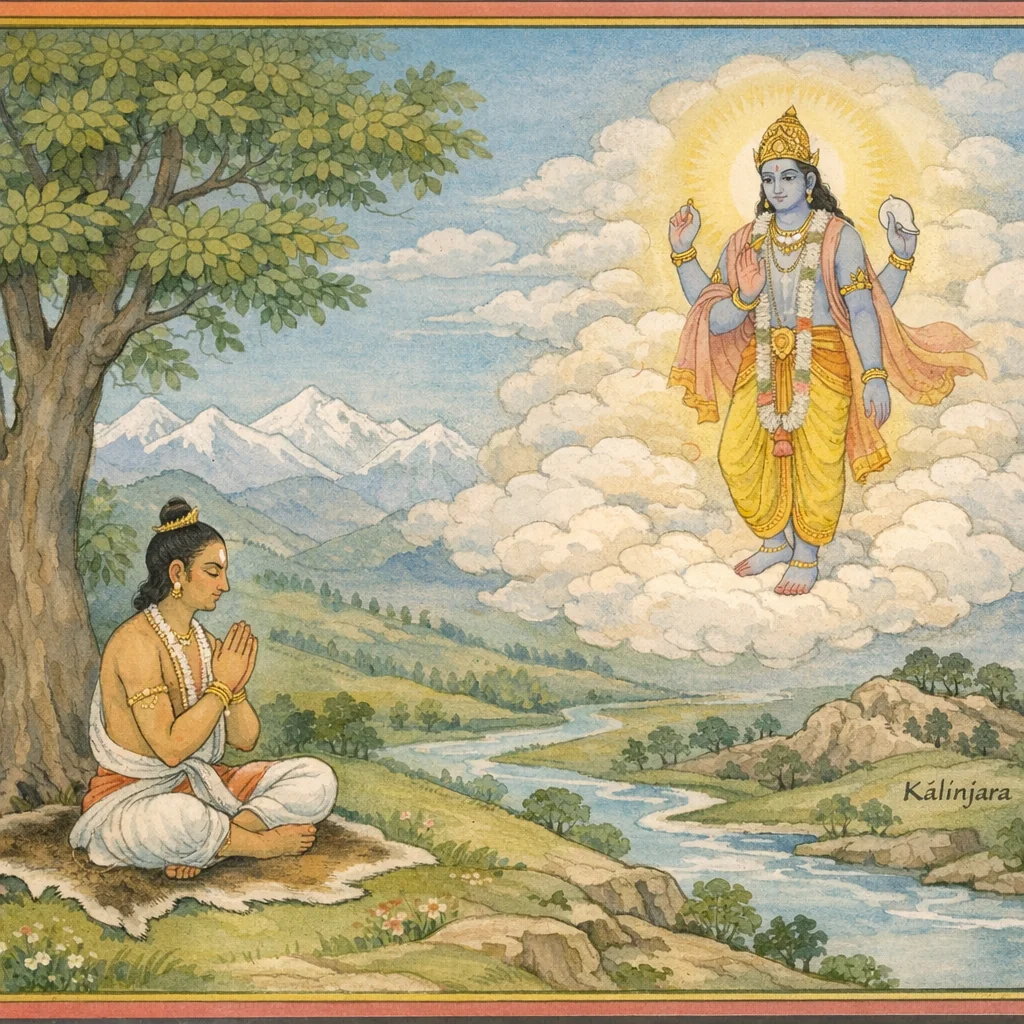
Adhyaya 50: Indra’s Penance at the Great River and Aditi’s Solar Vow for Vishnu’s Descent
इन्द्रप्रायश्चित्तं तथा अदितेः सूर्यव्रत-विष्णुप्रवेशः (Indra-prāyaścittaṃ tathā Aditēḥ Sūrya-vrata–Viṣṇu-praveśaḥ)
Solar Vow for Vishnu's Descent
Within the Pulastya–Nārada narrative frame, this adhyāya explains how Indra (Śakra), dispossessed by Bali, seeks expiation and restoration through disciplined devotion rather than mere martial power. In Brahmā’s assembly, Kaśyapa identifies Indra’s prior transgression as a form of bhrūṇahatyā connected to the violent cutting of Diti’s embryo, and Brahmā redirects him toward refuge in Mādhava (Viṣṇu) as the supreme remedial authority. Indra then undertakes austerities on the bank of a ‘Mahānadī’ at a sanctified landscape described through precise directional markers (Kāliñjara, Himālaya), integrating topographical sanctification with soteriology. Viṣṇu (Gadādhara) grants absolution and promises the return of sovereignty. The narrative then shifts to Aditi’s vow: she worships a solar manifestation (Bhāskara/ghṛtārciṣ) through iconographic and ritual acts, receiving the boon that Viṣṇu will enter her womb to neutralize daitya power and re-establish deva-rājya. The chapter’s syncretic theology is evident in the seamless movement between solar devotion, Vaiṣṇava refuge, and cosmic yogic embodiment.
Divine Beings
Sacred Geography
Mortal & Asura Figures
Key Content Points
- Pulastya recounts Indra’s loss of the three-world sovereignty to Bali and his appeal to Brahmā and Kaśyapa for diagnosis and prāyaścitta, grounding the crisis in karmic causality and bhrūṇahatyā.
- Brahmā and the sages prescribe śaraṇāgati to Viṣṇu (Śaṅkha-cakra-gadā-pāṇi), after which Indra performs year-long tapas on the bank of the Mahānadī and receives absolution and a promise of restored kingship from Gadādhara.
- Aditi performs a structured vow and pūjā to Bhāskara (solar form), culminating in the boon that Viṣṇu will incarnate by yogic power in her womb, rendering the daityas ‘nistejas’ and enabling the reconstitution of deva authority.
Shlokas in Adhyaya 50
Verse 2
तत्रापश्यत् स देवेशं ब्रह्माणं कमलोद्भवम् ऋषिभिः सार्धमासीनं पितरं स्वं च कश्यपम्
There he beheld the Lord of the gods, Brahmā, born from the lotus, seated together with the sages; and he also saw his own father Kaśyapa.
Verse 3
ततो ननाम शिरसा शक्रः सुरगणैः सह ब्रह्माणं कश्यपं चैव तांश्च सर्वास्तपोधनान्
Then Śakra (Indra), together with the hosts of gods, bowed with his head to Brahmā and to Kaśyapa, and also to all those sages who were rich in ascetic power.
Verse 4
प्रोवाचेन्द्रः सुरैः सार्ध देवनाथं पितामहम् पितामह हृतं राज्यं बलिना बलिना मम
Indra, together with the gods, addressed the Lord of the gods, the Grandfather (Brahmā): ‘O Grandfather, my kingdom has been taken away by Bali—the mighty one.’
Verse 5
ब्रह्मा प्रोवाच शक्रैतद् भुज्यते स्वकृतं फलम् शक्रः पप्रच्छ भो ब्रूहि किं मया दुष्कृतं कृतम्
Brahmā said: “O Śakra, one must indeed experience the fruit of one’s own actions.” Śakra asked: “Sir, tell me—what evil deed has been done by me?”
Verse 6
कश्यपो ऽप्याह देवेशं भ्रूणहत्या कृता त्वया दित्युदरात् त्वया गर्भः कृत्तो वै बहुधा बलात्
Kaśyapa too said to the Lord of the gods: “You have committed the sin of bhrūṇahatya. From Diti’s womb you forcibly cut the embryo into many parts.”
Verse 9
तच्छ्रुत्वा कश्यपवचः प्राह शक्रः पितामहम् विनाशं पाप्मनो ब्रूहि प्रायश्चित्तं विभो मम
Hearing Kaśyapa’s words, Śakra said to Pitāmaha: “Tell me, O venerable one, the expiation by which my sin may be destroyed.”
Verse 10
ब्रह्मा प्रोवाच देवेशं वशिष्ठः कश्यपस्तथा हितं सर्वस्य जगतः शक्रस्यापि विशेषतः
Brahmā spoke to the lord of the gods; and so too did Vasiṣṭha and Kaśyapa—(speaking) what is beneficial for the whole world, and especially for Śakra.
Verse 11
शङ्खचक्रगदापाणिर्माधवः पुरुषोत्तमः तं प्रपद्यस्व शरणं स ते श्रेयो विधास्यति
Mādhava, the Supreme Person (Puruṣottama), who bears the conch, discus, and mace in His hands—take refuge in Him. He will bring about your highest welfare.
Verse 13
इत्येवमुक्तः सुरराड् विरिञ्चिना मरीचिपुत्रेण च कश्यपेन तथैव मित्रावरुणात्मजेन वेगान्महीपृष्ठमवाप्य तस्थौ
Thus instructed, the king of the gods (Indra)—by Viriñci (Brahmā), by Kaśyapa the son of Marīci, and likewise by the son of Mitra and Varuṇa—swiftly reached the surface of the earth and stood there.
Verse 14
कालिञ्जरस्योत्तरतः सुपुण्यस्तथा हिमाद्रेरपि दक्षिणस्थः सुशस्थलात् पूर्वत एव विश्रुतो वसोः पुरात् पिश्चिमतो ऽवतस्थे
“(This sacred place) is exceedingly meritorious: it lies to the north of Kaliñjara and likewise to the south of the Himālaya. It is renowned as being to the east of Suśasthala, and it is situated to the west of Vasu’s city (Vasupura).”
Verse ["pañcama kali", "dvāparānta", "deva-asura saṃgrāma", "śakra", "bali", "yuga sandhi"]
पूर्वं गयेन नृवरेम यत्र यष्टो ऽश्वमेधः शतकृत्सदक्षिणः मनुष्येमेधः शतकृत्सहस्रकृन्नरेन्द्रसूयश्च सहस्रकृद् वै
“Formerly, O best of kings, in that place the Aśvamedha sacrifice was performed a hundred times, complVamana Purana,48,15,VamP 48.15,pañcamasya kalerādau dvāparānte sudāruṇaḥ devāsuro 'bhūt saṃgrāmo yatra śakro 'pyabhūd baliḥ,पञ्चमस्य कलेरादौ द्वापरान्ते सुदारुणः देवासुरो ऽभूत् संग्रामो यत्र शक्रो ऽप्यभूद् बलिः,Vamana–Bali Narrative,Itihasa / Deva–Asura Sangrama (Mythic History),Adhyaya 48 (Vamana–Bali-prasaṅga; Bali’s sovereignty and the Deva–Asura war),15,pañcamasya kalerādau dvāparānte sudāruṇaḥ devāsuro 'bhūt saṃgrāmo yatra śakro 'pyabhūd baliḥ,pañcamasya kaler ādau dvāparānte sudāruṇaḥ | devāsuro ’bhūt saṃgrāmo yatra śakro ’py abhūd baliḥ ||,At the close of the Dvāpara age
Verse 16
तथा पुरा दुर्यजनः सुरासुरैः ख्यातो महामेध इति प्रसिद्धः यत्रास्य चक्रे भगवान् मुरारिः वास्तव्यमव्यक्ततनुः खमूर्तिमत् ख्यातिं जगामाथ गदाधरेति महाघवृक्षस्य शितः कुठारः
“So too, in ancient times there was a wicked person, famed among gods and demons, renowned as ‘Mahāmedha’. There the Blessed Murāri (Viṣṇu) made his abode—his form unmanifest, having the sky as his body. Thereafter he became celebrated by the name ‘Gadādhara’. (He was) like a sharp axe (kuṭhāra) for the great sin-tree.”
Verse 18
महानदी यत्र सुरर्षिकन्या जलापदेशाद्धिमशैलमेत्य चक्रे जगत्पापविनष्टिमग्र्यां संदर्शनप्राशनमञ्जनेन
There is the Mahānadī, where the daughter of a divine seer, having come to the Himālaya under the pretext of seeking water, brought about an excellent destruction of the world’s sins—through (the river’s) mere sight, drinking, and bathing.
Verse 22
ततो गदाधरः प्रीतो वासवं प्राह नारद गच्छ प्रीतो ऽस्मि भवतो मुक्तपापो ऽसि साम्प्रतम्
Then Gadādhara, being pleased, spoke to Vāsava (Indra): ‘Nārada, go— I am pleased with you; now you are freed from sin.’
Verse 26
इत्येवमुक्त्वा सुरराट् पुलिन्दान् विमुक्तपापो ऽमरसिद्धयक्षैः संपूज्यमानो ऽनुजगाम चमं मातुस्तदा धर्मनिवासमीड्यम्
Having spoken thus to the Pulindas, the lord of the gods—freed from sin—then proceeded to his mother. He was being honored by the gods, Siddhas, and Yakṣas, and he went to that venerable abode of Dharma (his mother’s dwelling), worthy of praise.
Verse ["Legitimation of sovereignty (installation by right-hand gesture)", "Indra’s throne as symbol of cosmic kingship", "Bali’s elevation/placement within divine polity", "Ritualized political action"]
पप्रच्छ सा कारणमीश्वरं तम् आघ्राय चालिङ्ग्य सहाश्रुदृष्ट्या स चाचचक्षे बलिना रणे जयं तदात्मनो देवगणैश्च सार्धम्
She (Aditi) asked that lord (Indra) the reason (for his coming/condition). With tearful eyes she smelled his head (in maternal affection) and embraced him. And he then related the victory in battle over Bali—his own, together with the hosts of gods.
Verse 37
निवेद्य चैवाज्ययुतं महार्हमन्नं महेन्द्रस्य हिताय देवी स्तवेन पुण्येन च संस्तुवन्ती स्थिता निराहारमथोपवासम्
And having offered a most excellent food-oblation mixed with ghee, for the welfare of Mahendra, she praised the Goddess with a meritorious hymn; thereafter she remained without food, observing a fast.
Verse Devās’ Appeal / Śaraṇāgati (Seeking Refuge)
ततो द्वितीये ऽह्नि कृतप्रणामा स्नात्वा विधानेन च पूजयित्वा दत्त्वा द्विजेभ्यः कणकं तिलाज्यं ततो ऽग्रतः सा प्रयता बभूव
Then, on the second day, having made obeisance, she bathed and worshipped according to rule; having given to the twice-born (brāhmaṇas) gold, sesame, and ghee, she thereafter proceeded forward with due care and discipline.
Verse 40
व्रतेतानेन सुप्रीतस्तवाहं दक्षनन्दिनि प्राप्स्यसे दुर्लभं कामं मत्प्रसादान्न संशयः
“By this vow I am exceedingly pleased with you, O daughter of Dakṣa. Through my favor you shall obtain a desire that is difficult to attain—of this there is no doubt.”
Verse 46
विष्णुरुवाच सत्यमेतन्महाभागे दुर्धरो ऽस्मि सुरासुरैः तथापि संभविष्यामि अहं देव्युदरे तव
Vishnu said: “It is true, O noble lady: I am difficult to be borne (or sustained) by gods and Asuras alike. Even so, I shall come into being—indeed, I shall be born—in your womb, O goddess.”
Frequently Asked Questions
The chapter moves from Brahmā’s prescription of śaraṇāgati to Mādhava (Viṣṇu) as the decisive remedy for karmic fault, to Aditi’s vow addressed to Bhāskara (a solar manifestation) that grants the boon of Viṣṇu’s descent. Rather than competing cults, solar worship functions as a ritually valid gateway through which Viṣṇu’s salvific agency is disclosed, illustrating a layered, integrative devotional economy.
Indra’s austerities are anchored at the bank of a ‘Mahānadī’ (Great River), and the text situates the site through directional references to Kāliñjara and Himādri/Himaśaila, along with regional markers such as Vasoḥ-pura and the renowned sacrificial landscape of Gayā. The geography is not decorative: it authorizes the efficacy of tapas and frames the riverbank as a purificatory locus where sin is ritually exhausted and sovereignty is ritually reconstituted.
It supplies the theological and ritual preconditions for Bali’s eventual subjugation: Indra is purified and promised restoration, while Aditi receives the assurance that Viṣṇu will incarnate in her womb, causing the daityas to lose their tejas. The focus is preparatory—establishing expiation, divine commitment, and the mechanism of avatāra—rather than narrating the confrontation itself.