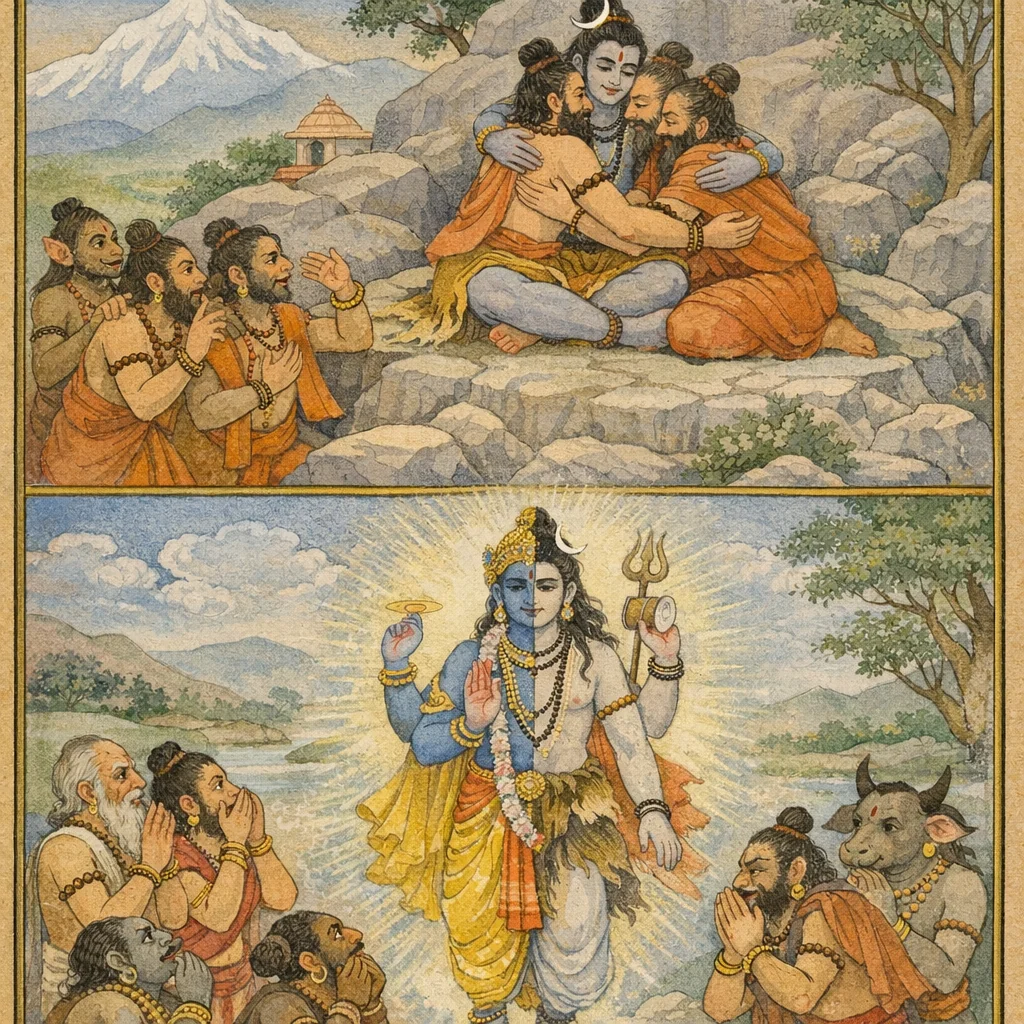
Adhyaya 41: Harihara Non-Duality and the Revelation of Sadasiva to the Ganas
हरिहरैक्य-प्रदर्शनं सदाशिवरूप-दर्शनं च (Harihara-aikya-pradarśanaṃ Sadāśivarūpa-darśanaṃ ca)
Revelation of Sadasiva to the Ganas
Within the Pulastya–Nārada narrative frame, this Adhyāya turns to a syncretic theological correction delivered by Rudra himself. After Śambara’s departure, Hara summons Nandin, who rapidly convenes innumerable gaṇas—Rudras, Skanda-kumāras, Pramathas, Pāśupatas, Kālamukhas, and other iconographically marked attendants—presented as a vast, sect-coded retinue. The gaṇas are astonished when Maheśvara embraces the Mahāpāśupatas, prompting an inquiry into the grounds of such honor. Rudra rebukes their ignorance and sectarian disparagement of the Vaiṣṇava station, declaring the non-difference of Śiva and Viṣṇu: one reality appearing in dual form. To seal this doctrine, he manifests a transcendent Sadāśiva/Harihara vision—thousand-faced, multi-armed, then half-Vaiṣṇava and half-Hara—cycling through colors and identities (Śaṅkara, Viṣṇu, Brahmā, etc.). The gaṇas’ ‘bhinnadṛṣṭi’ (divided vision) is purified, and they seek a boon: the destruction of sin born from doctrinal separation, establishing unity as the chapter’s soteriological core.
Divine Beings
Sacred Geography
Mortal & Asura Figures
Key Content Points
- Nandin’s mustering of Śiva’s hosts: catalog-like iconographic descriptions of Rudras, Skanda-kumāras, Pramathas, Pāśupatas, Kālamukhas, and other gaṇas assembled for assistance.
- Rudra’s doctrinal intervention: explicit assertion of Harihara non-duality—Śiva and Viṣṇu as one essence, ‘ekā mūrtiḥ dvidhā sthitā’—and critique of sectarian nindā (disparagement).
- Revelation theology through form: Sadāśiva’s cosmic and composite manifestations (sahasra-vaktra/bhuja; half-Vaiṣṇava/half-Hara; rapid chromatic and functional transformations), culminating in the gaṇas’ purification and request to remove sin arising from ‘bhinnadṛṣṭi’.
Shlokas in Adhyaya 41
Verse 11
तथा पाशुपताश्चान्ये भस्मप्रहारणा विभो एते गणास्त्वसंख्याताः सहायार्थं समागताः
“So too, other Pāśupatas—O Lord—whose mode of striking is with ash (bhasma), these innumerable gaṇas have assembled for the purpose of assisting (you).”
Verse 12
पिनाकधारिणो रौद्रा गणाः कालमुखापरे तव भक्ताः समायाता जटामण्डलिनोद्भुताः
“Fierce gaṇas bearing the Pināka (bow) have come; others are Kālamukhas. Your devotees have arrived—wondrous, with their matted locks arranged in circular coils.”
Verse 13
खट्वाङ्गयोधिनो वीरा रक्तचर्मसमावृताः इमे प्राप्ता गणा योद्धुं महाव्रतिन उत्तमाः
“Heroic gaṇas, fighting with khaṭvāṅgas (club-staves), clad in red hides—these excellent great-vow observers have arrived to do battle.”
Verse 14
दिग्वाससो मौनिनश्च घण्टाप्रहरणास्तथा निराश्रया नाम गणाः समायाता जगद्गुरो
“There arrived the gaṇas called ‘Nirāśrayas’—sky-clad, observing silence, and bearing bells as their weapons—(coming) to the World-Teacher.”
Verse 15
सार्धद्विनेत्राः पद्माक्षाः श्रीवत्साङ्कितवक्षसः समायाताः खगारूढा वृषभध्वजिनो ऽव्ययाः
“There also arrived (others): some bearing the mark of the three-eyed one, some lotus-eyed; some with the Śrīvatsa sign upon their chests; they came mounted on birds, and (others) bearing the bull-banner—imperishable (divine) beings.”
Verse 16
महापाशुपता नाम चक्रशूलधरास्तथा भैरवो विष्णुना सार्द्धमभेदेनार्चितो हि यै
“And (there came) those called the ‘Mahāpāśupatas’, bearing the discus and the trident. Bhairava, together with Viṣṇu, was indeed worshipped by them as non-different (from one another).”
Verse 17
इमे मृगोन्द्रवदनाः शूलबाणधनुर्धराः गणास्त्वद्रोमसंभूता वीरभद्रपुरोगमाः
“These (beings) with faces like lions, bearing tridents, arrows, and bows—these gaṇas, born from the hairs of your body, have arrived with Vīrabhadra at their head.”
Verse 18
एते चान्ये च बहवः शतशो ऽथ सहस्रशः सहायार्थं तवायाता यथाप्रीत्यादिशस्व तान्
“These and many others—by hundreds and by thousands—have come for your assistance. Command them according to your pleasure.”
Verse 19
ततो ऽभ्येत्य गणाः सर्वे प्रणेमुर्वृषभध्वजम् तान् करेणैव भगवान् समाश्वास्योपवेशयत्
“Then all the gaṇas approached and bowed to the Bull-bannered Lord. The Blessed One, with his hand alone, reassured them and bade them sit.”
Verse 20
महापाशुपतान् दृष्ट्वा समुत्थाय महेश्वरः संपरिष्वजताध्यक्षांस्ते प्रणेमुर्महेश्वरम्
Seeing the great Pāśupatas, Maheśvara rose up and embraced their leader; and they bowed down to Maheśvara.
Verse 21
ततस्तदद्भुततमं दृष्ट्वा सर्वे गणेश्वराः सुचिरं विस्मिताक्षाश्च वैलक्ष्यमगमत् परम्
Then, seeing that most wondrous event, all the lords of the gaṇas stood for a long time with astonished eyes, and they fell into the utmost perplexity/embarrassment.
Verse 24
तदेतेषां महादेव स्फुटं त्रैलोक्यविन्दकम् रूपं ज्ञानं विवेकं च वदस्व स्वेच्छया विभो
“Therefore, O Mahādeva—clearly explain to these (Gaṇas) the form, the knowledge, and the discernment that are ‘delighting/pleasing to the three worlds’, O all-powerful one, as you wish.”
Verse 25
प्रमथाधिपतेर्वाक्यं विदित्वा भूतभावनः बभाषे तान् गणान् सर्वान् भावाभावविचारिणः
“Having understood the words of the lord of the Pramathas, Bhūtabhāvana (Śiva) spoke to all those Gaṇas—(he who is) the examiner of being and non-being.”
Verse 26
रुद्र उवाच/ भव्द्भिर्भक्तिसंयुक्तैर्हरो भावेन पूजितः अहङ्कारविमूढैश्च निन्दद्भिर्वैष्णवं पदम्
Rudra said: “By you—endowed with devotion—Hara has been worshipped with a devoted disposition; but by those deluded by ego, who revile the Vaiṣṇava state (the station/path of Viṣṇu), [that worship is marred].”
Verse 28
नावयोर्वै विशेषो ऽस्ति एका मूर्तिर्द्विधा स्थिता तदमीभिर्नरव्याघ्रैर्भक्तिभावयुतैर्गणैः
“Indeed, there is no distinction between us. One form (one divine embodiment) stands in two ways. This is [to be understood] by these tiger-like men—these gaṇas endowed with the disposition of devotion.”
Verse 29
यथाहं वै परिज्ञातो न भवद्भिस्तथा ध्रुवम् येनाहं निन्दितो नित्यं भवद्भिर्मूढबुद्धिभिः
“Surely you have not truly understood me as I really am; for I am constantly reviled by you, whose understanding is deluded.”
Verse 30
तेन ज्ञानं हि वै नष्टं नातस्त्वालिङ्गिता मया इत्येवमुक्ते वचने गणाः प्रोचुर्महेश्वरम्
“By that (conduct), indeed, knowledge has been destroyed; therefore you were not embraced by me.” When these words were spoken, the gaṇas questioned Maheśvara.
Verse 31
कथं भवान् यथैक्येन संस्थितो ऽस्ति जनार्दनः भवान् हि निर्मलः सुद्धः शान्तः सुक्लो निरञ्जनः
“How is it that you, abiding in oneness, are (also) Janārdana? For you are indeed stainless, pure, tranquil, bright, and untainted.”
Verse 32
स चाप्यञ्जनसंकाशः कथं तेनेह युज्यते तेषां वचनमर्थाढ्यं श्रुत्वा जीमूतवाहनः
“And how could he—dark-hued like collyrium (añjana)—be connected with him here?” Hearing their statement, rich in import, Jīmūtavāhana (the Cloud-Vehicle) [prepared to respond].
Verse 33
विहस्य मेघगम्भीरं गणानिदमुवाच ह श्रूयतां सर्वमाख्यास्ये स्वयशोवर्द्धनं वचः
Smiling, in a voice deep as thunderclouds, he spoke this to the gaṇas: “Listen— I shall relate everything; [hear] the account that increases my own renown.”
Verse 34
न त्वेव योग्या यूयं हि महाज्ञानस्य कर्हिचित् अपवादभयाद् गुह्यं भवतां हि प्रकाशये
“Yet you are not, indeed, at any time fit for this great knowledge. Still, out of fear of reproach (apavāda), I disclose to you what is secret.”
Verse 35
प्रियध्वमपि चैतेन यन्मच्चित्तास्तु नित्यशः एकरूपात्मकं देहं कुरुध्यं यत्नमास्थिताः
“Even by this alone you may please (me): that you should be ever intent upon me in mind. With effort firmly undertaken, make your embodied state one-pointed and of a single form (i.e., unified in devotion).”
Verse pṛtanā: army, host; vadhyamānā: being slain, being killed; dānavī: belonging to the Dānavas (demonic clan); rudrasutaiḥ gaṇaiḥ: by Rudra’s gaṇas (Śiva’s attendant hosts; lit
पयसा हविषाद्यैश्च स्नापनेन प्रयत्नतः चन्दनादिभिरेकाग्रैर्न मे प्रीतिः प्रजायते
tairvadhyamānā pṛtanā maharṣe sādānavī rudrasutairgaṇaiśca viṣaṇṇārūpā bhayavihvalāṅgī jagāma sukraṃ śaraṇaṃ bhayārtā
Verse 39
व्रजन्ति नरकं घोरं इत्येवं परिवादिनः अतोर्ऽथं न क्षिपाम्यद्य भवतो नरके ऽद्भुते
“‘Thus do slanderers go to dreadful hell’—(people will say). Therefore, today I will not cast you into that wondrous (i.e., extraordinary) hell.”
Verse 40
यन्निन्दध्वं जगन्नाथं पुष्कराक्षं च मन्मयम् स चैव सदृशो लोके विद्यते सचराचरे श्वेतमूर्तिः स गवान् पीतो रक्तो ऽञ्जनप्रभः
“The Lord of the universe—lotus-eyed, pervading me (and all)—whom you revile: He indeed exists in the world in forms corresponding (to beings), in all that moves and does not move. He is of white form as a cow; yellow; red; and dark with the luster of collyrium.”
Verse 41
न तस्य सदृशो लोके विद्यते सचराचरे श्वेतमूर्तिः स भगवान् पीतो रक्तो ऽञ्जनप्रभः
In this world—whether of the moving or the unmoving—there exists none equal to him. That Blessed Lord appears with a white form; (he is) yellow, red, and of the splendor of collyrium (dark, lustrous) as well.
Verse 42
तस्मात् परतरं लोके नान्यद् धर्म हि विद्यते सात्त्विकं राजसं चैव तामसं मिश्रकं तथा स एव धत्ते भगवान् सर्वपूज्यः सदाशिवः
Therefore, in this world there is no dharma higher than him. The sāttvika, the rājasa, the tāmasa, and likewise the mixed (forms of dharma)—all these the Blessed One himself bears/ordains: Sadāśiva, ever worthy of all worship.
Verse 43
शङ्करस्य वचः श्रुत्वा शैवाद्या प्रमथोत्तमाः प्रत्यूचुर्भगवन् ब्रूहि सदाशिवविशेणम्
Having heard Śaṅkara’s words, the foremost among the Pramathas—beginning with the Śaivas—replied: “O Lord, speak (to us) the distinctive greatness/special characteristic of Sadāśiva.”
Verse 44
तेषां तद् भाषितं श्रुत्वा प्रमथानामथेश्वरः दर्शयामास तद्रूपं सदाशैवं निरञ्जनम्
Having heard what they (the Pramathas) had spoken, the Lord of the Pramathas then revealed to them His own form—ever-auspicious (Sadāśiva), stainless and untainted (nirañjana).
Verse 45
ततः पश्यन्ति हि गणाः तमीसं वै शहस्रशः सहस्रवक्त्रचरणं सहस्त्रभुजमीश्वरम्
Then the Gaṇas beheld that Lord in manifold ways: the Sovereign endowed with a thousand faces and feet, and with a thousand arms.
Verse 46
दण्डपाणिं सुदुर्दृश्यं लोकैर्व्याप्तं समन्ततः दण्डसंस्थास्य दृश्यन्ते देवप्रहरणास्तथा
They beheld the Lord holding a staff (daṇḍa) in His hand—an awe-inspiring vision—pervading the worlds on every side; and around that staff-like manifestation, the divine weapons also appeared.
Verse 47
तत एकमुखं भूयो ददृशुः शङ्करं गणाः रौद्रैश्च वैष्णवैश्चैव वृतं चिह्नैः सहस्रशः
Then the Gaṇas again beheld Śaṅkara as ‘Ekamukha’ (single-faced/one-aspected), surrounded by countless insignia—both Rudraic (Śaiva) and Vaiṣṇava—by the thousand.
Verse 48
अर्द्धेन वैष्णववपुर्द्धेन हरविग्रहः खगध्वजं वृषारूढं वृषध्वजम्
With one half of his body as Vaiṣṇava in form and the other half as Hara in embodiment, he bore the banner marked by the bird (Garuḍa) and was mounted upon the bull; (he was) the one whose banner is the bull.
Verse 49
यथा यथा त्रिनयनो रूपं धत्ते गुणाग्रणीः तथा तथा त्वजायन्त महापाशुपता गणाः
In whatever manner the three-eyed one—foremost among the guṇas—assumed a form, in that very manner there arose the great Pāśupata Gaṇas.
Verse 50
ततो ऽभवच्चैकरूपी शङ्करो बहुरूपवान् द्विरूपश्चाभवद् योगी एकरूपो ऽप्यरूपवान् क्षणाच्छ्वेतः क्षणाद् रक्तः पीतो नीलः क्षणादपि
Then Śaṅkara—though of a single essence—became possessed of many forms. The Yogin became two-formed; though one-formed, he also became formless. In an instant he became white; in an instant red; in an instant yellow; and in an instant again blue.
Verse 51
मिश्रको वर्णहीनश्च महापाशुपतस्तथा क्षणाद् भवति रुद्रेन्द्रः क्षणाच्छंभुः प्रभाकरः
He became of mixed coloration, and also colorless; likewise he became the great Pāśupata. In an instant he becomes Rudra, the lord of the Rudras; in an instant (he becomes) Śambhu, the maker of radiance.
Verse 52
क्षणार्द्धाच्छङ्करो विष्णुः क्षणाच्छर्वः पितामहः ततस्तदद्भुततमं दृष्ट्वा शैवादयो गणाः
In half an instant Śaṅkara became Viṣṇu; in an instant Śarva became Pitāmaha (Brahmā). Then, seeing that most wondrous (manifestation), the Śaiva and other gaṇas (hosts) …
Verse 53
अजानन्त तदैक्येन ब्रह्मविष्ण्वीशभास्करान् यदाभिन्नममन्यन्त देवेदेवं सदाशिवम्
Then, through that realization of oneness, they came to know (the truth): when they regarded Brahmā, Viṣṇu, Īśa (Śiva), and Bhāskara (the Sun) as non-different, they understood Sadāśiva—the God of gods—as the single divine reality.
Verse 54
तदा निर्धूतपापास्ते समजायन्त पार्षदाः तेष्वेवं धूतपापेषु अभिन्नेषु हरीश्वरः
Then, their sins having been shaken off, they became (fit to be) attendants (pārṣadas). And when they had thus become purified and established in non-difference, Hari-Īśvara (the unified Lord as Hari and Śiva) [manifested/was present among them].
Verse 55
प्रीतात्मा विबभो शंशुः प्रीतीयुक्तो ऽब्रवीद् वचः परितुष्टो ऽस्मि वः सर्वे ज्ञानेनानेन सुव्रताः
Then Śaṃśu (Śiva), his heart delighted, shone forth; filled with affection he spoke these words: ‘I am fully pleased with all of you, O well-vowed ones, because of this knowledge.’
Verse 56
वृणुध्वं वरमानन्त्यं दास्ये वो मनसेप्सितम् ऊचुस्ते देहि भगवन् वरमस्माकमीश्वर भिन्नदृष्ट्युद्भवं पापं यत्तद् भ्रंशं प्रयातु नः
“Choose a boon without end; I shall grant you what your minds desire.” They said: “Grant us a boon, O Blessed Lord, O Sovereign: may the sin that arises from divided viewpoints—whatever downfall it brings—depart from us.”
Verse 57
पुलस्त्य उवाच बाढमित्यब्रवीच्छर्वश्चक्रे निर्धूतकल्पषान् संपरिष्वजताव्यक्तस्तान् सर्वान् गणयूथपान्
Pulastya said: Śarva replied, “So be it,” and made them free from sin. The Unmanifest One embraced all those leaders of the Gaṇas.
Verse 58
इति विभुना प्रणतार्तिहरेण गणपतयो वृषमेघरथेन श्रुतिगदितानुगमेनेव मन्दरं गिरिमवतत्य समध्यवसन्तम्
Thus, by the all-powerful Lord—remover of the distress of those who bow—by him whose chariot is like a bull and a cloud, the chiefs of the Gaṇas, following as though in accordance with what the Veda proclaims, descended upon Mount Mandara and took up their station there.
Frequently Asked Questions
Rudra explicitly declares non-difference: Śiva and Viṣṇu are one essence appearing as two (‘ekā mūrtiḥ dvidhā sthitā’). He condemns the gaṇas’ disparagement of the Vaiṣṇava station as ignorance and demonstrates the doctrine through a theophany culminating in a Harihara (half-Vaiṣṇava, half-Hara) manifestation.
This Adhyāya is primarily doctrinal and iconographic rather than tīrtha-mahātmya. The setting is mountain-associated (Śailādi/Śailādri) with a concluding Mandara-giri simile, but no rivers, sarovaras, or pilgrimage rites are prescribed in the received passage.
The Bali–Vāmana cycle is not advanced here. The chapter functions as a theological interlude within the Pulastya–Nārada framework, emphasizing soteriology through the removal of ‘bhinnadṛṣṭi’ (divided vision) and establishing Harihara as the integrative principle.