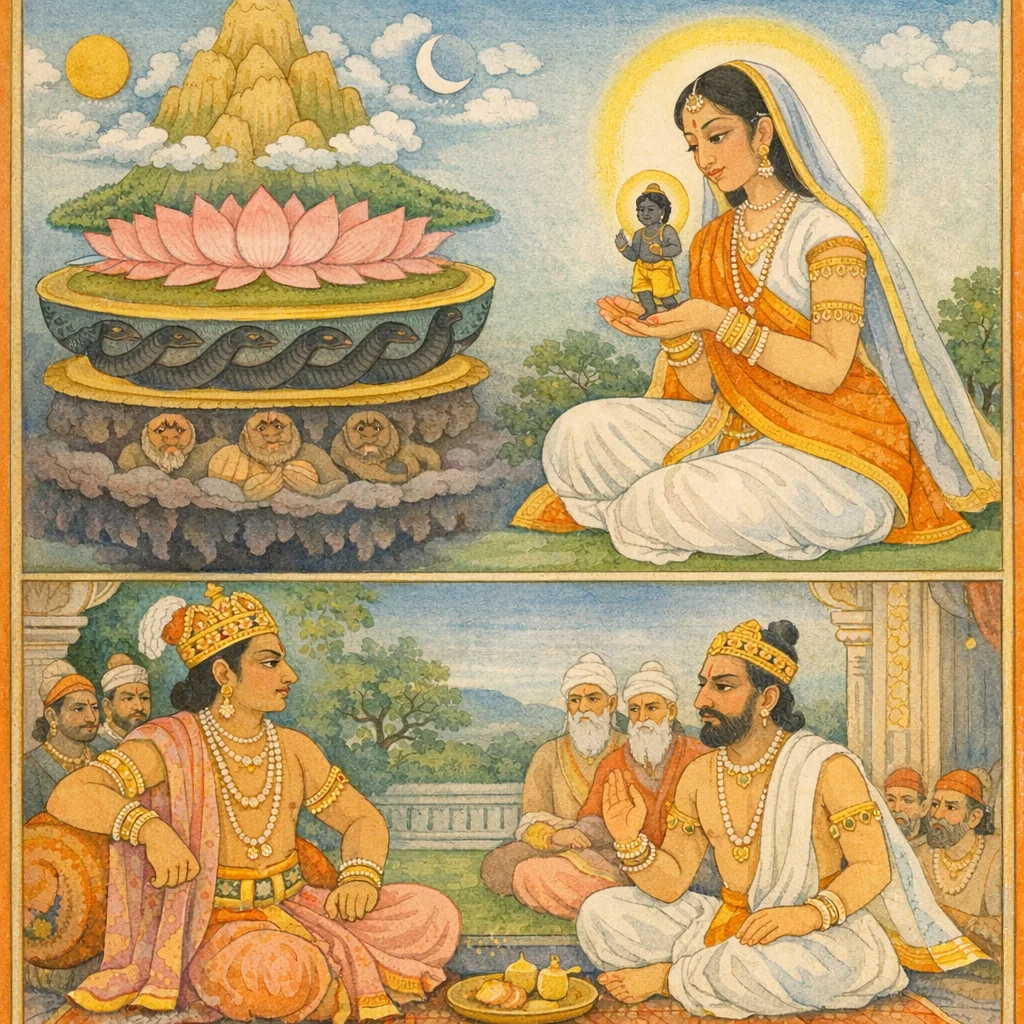
Adhyaya 51: Bali Learns of Vamana in Aditi’s Womb and Prahlada Teaches Refuge in Hari
अदितिगर्भस्थ-वामन-दर्शनं बलि-प्रह्लाद-संवादश्च (Aditigarbhastha-Vāmana-Darśanaṃ Bali-Prahlāda-Saṃvādaśca)
Prahlada Teaches Refuge in Hari
Within the Pulastya–Nārada narrative frame, this adhyāya explains the sudden loss of asuric tejas as a direct consequence of Hari’s descent as Vāmana within Aditi’s womb. Bali, observing the daityas’ diminished radiance, questions Prahlāda, who traces the cause to the devas’ surrender to Viṣṇu after their defeat. Pulastya’s yogic vision then surveys the cosmic lotus-like earth and Meru, culminating in the iconographic sight of Vāmana—Puṇḍarīkākṣa bearing śaṅkha, cakra, and gadā—whose presence drains daitya-splendor. Bali’s boastful denigration of Hari provokes Prahlāda’s sharp rebuke and curse of impending rājya-nāśa, followed by Bali’s repentance and request for forgiveness. The chapter closes with Prahlāda’s didactic counsel on equanimity amid gain and loss, and a clear prescription of śaraṇāgati to Puruṣottama. Prahlāda himself resolves to undertake tīrtha-yātrā for pāpa-upaśamana, signaling the Purāṇa’s guidebook impulse even where specific Kurukṣetra toponyms are not yet enumerated.
Divine Beings
Sacred Geography
Mortal & Asura Figures
Key Content Points
- Causal theology of tejas: the asuras’ loss of radiance is attributed to Hari’s avatāra as Vāmana in Aditi’s womb, establishing avatāra-presence as a cosmological force affecting asura-dharma.
- Iconographic and cosmographic sequence: Pulastya’s yogic reconnaissance of pātālas, the lotus-shaped earth, and Meru culminates in the vision of Vāmana (śaṅkha-cakra-gadādhara), explicitly described as daitya-tejo-hara.
- Ethical instruction and śaraṇāgati: Prahlāda condemns Hari-nindā, foretells Bali’s political downfall, then teaches dhairya (equanimity) and recommends taking refuge in Janārdana; he departs for tīrtha-yātrā as expiatory praxis.
Shlokas in Adhyaya 51
Verse 2
निस्तेजसो ऽसुरान् दृष्ट्वा प्रह्लादं दानवेश्वरम् बलिर्दानवशार्दूल इदं वचनमब्रवीत्
Seeing the Asuras bereft of splendor, Bali—the tiger among the Dānavas—addressed Prahlāda, the lord of the Dānavas, with these words.
Verse 4
पुलस्त्य उवाच तत्पौत्रवचनं श्रुत्वा मुहूर्तं ध्यानमास्तितः किमर्थं तेजसो हानिरिति कस्मादतीव च
Pulastya said: Having heard that grandson’s words, he remained in contemplation for a moment—(considering) for what reason there was a loss of splendor, and why it was so severe.
Verse 5
स ज्ञात्वा वासुदेवोत्थं भयं दैत्येष्वनुत्तमम् चिन्तयामास योगात्मा क्व विष्णुः सांप्रतं स्थितः
Having understood that an unsurpassed fear had arisen among the Daityas due to Vāsudeva, that yogic-souled one reflected: “Where is Viṣṇu presently stationed?”
Verse 8
तस्योपरि महापुर्यस्त्वष्टौ लोकपतीस्तथा तेषामातुः स ददृशे मृगपक्षिगणैर्वृतम्
Above that (region), he beheld great settlements and also the eight Lokapālas. There too he saw their Mother, surrounded by groups of deer and birds.
Verse 14
अथोवाच महाबुद्धिर्विरोजनसुतं बलिम् प्रह्लादो मधुरं वाक्यं प्रणम्य मधुसूदनम्
Then Prahlāda, the great-minded one, having bowed to Madhusūdana (Viṣṇu), spoke sweet words to Bali, the son of Virocana.
Verse 15
प्रह्लाद उवाच श्रूयतां सर्वमाख्यास्ये यतो वो भयमागतम् येन निस्तेजसो दैत्या जाता दैत्येन्द्र हेतुना
Prahlāda said: Listen— I shall tell everything: from what cause fear has come upon you, and by what reason, O lord of the Daityas, the Daityas have become bereft of splendor—due to a cause connected with you.
Verse 26
धिक्त्वां पापसमारारं दुषुटबुद्धिं सुबालिशम् हरिं निन्दयतो जिह्वा कथं न पतिता तव
“Fie upon you—an utterly sinful wretch, of perverse understanding and great folly! When you revile Hari, how is it that your tongue has not fallen off?”
Verse 27
शोच्यस्त्वमसि दुर्बुद्धे निन्दनीयश् च साधुभिः यत् त्रैलोक्यगुरुं विष्णुमभिनिन्दसि दुर्मते
“You are indeed pitiable, O evil-minded one, and worthy of censure by the virtuous—since you, of wicked intent, revile Viṣṇu, the teacher of the three worlds.”
Verse 28
शोच्यश्चास्मि न संदेहो येन जातः पिता तव यस्य त्वं कर्कशः पुत्रो जातो देवावमान्यकः
“And I too am pitiable—there is no doubt—since your father was born (from me / because of me); for you, a harsh son, have been born to him, one who shows contempt for the gods.”
Verse iti śrī-vāmana-purāṇe dvi-pañcāśo 'dhyāyaḥ | pulastya uvāca | kālindī-salile snātvā pūjayitvā trivikramam upoṣya rajanīm ekāṃ liṅga-bhedaṃ giriṃ yayau
शोचनीया दुराचारा दानवामी कृतास्त्वया येषां त्वं कर्कशो राजा वासुदेवस्य निन्दकः
1
Verse 36
यता न तस्मादपरं व्यतिरिक्तं हि विद्यते चतुर्दशसु लोकेषु रपाज्यभ्रष्टस्तथा पत
“Just as, apart from Him, nothing else distinct or superior exists in the fourteen worlds, so too—though deprived of kingship—may I remain (fixed in Him).”
Verse 37
सर्वेषामंपि भूतानां नान्यल्लोके परायणम् यथा तथानुपस्येयं भवन्तं राज्यविच्युतम्
“For all beings, there is no other refuge in the world. Therefore, in that very way, may I continue to behold (and rely upon) you, even when I am displaced from kingship.”
Verse 51
एवं विदित्वा दैत्येन्द्र न विषादं कथञ्चन कर्तुमर्हसि विद्वांस्त्वं पण्डितो नावसीदति
Knowing thus, O lord of the Daityas, you should not fall into dejection in any way; for you are learned—one who is wise does not sink into despair.
Verse while in front ran the eaters of funeral rice-balls (piṇḍas)
तथान्यच्च महाबाहो हितं शृणु महार्थकम् भवतो ऽथ तथान्येषां श्रुत्वा तच्च समाचर
And further, O mighty-armed one, listen to what is beneficial and of great import—both for you and likewise for others; having heard it, put that teaching into practice.
Verse 53
शरण्यं शरणं गच्छ तमेव पुरुषोत्त्मम् स ते त्राता भयादस्माद् दानवेन्द्र भविष्यति
“Go for refuge to the One who is the refuge of all—indeed to that Supreme Person (Puruṣottama). He will become your protector from this fear, O lord of the Dānavas.”
Verse 55
ये संश्रिता हरिमनन्तमनादिमध्यं विष्णुं चराचरगुरुं हरिमीशितारम् संसारगर्तपतितस्य करावलम्बं नूनं न ते भुवि नरा ज्वरिणो भवन्ति // वम्प्_51.54 तन्मना दानवश्रेष्ठ तद्भक्तश्च भवाधुना स एष भवतः श्रेयो विधास्यति जनार्धनः
“Those men on earth who have taken shelter in Hari—endless, without beginning or middle—Viṣṇu, the teacher of all moving and unmoving beings, Hari the sovereign; (who is) the supporting hand for one fallen into the pit of saṃsāra—surely such men do not become afflicted with fever (torment). Therefore, O best of Dānavas, fix your mind on him and become his devotee now; this Janārdana will bring about your welfare.”
Verse 56
अहं च पापोपशमार्थमीशमाराध्य यास्ये प्रतितीर्थयात्राम् विमुक्तपापश्च ततो गमिष्ये यत्राच्युतो लोकपतिर्नृसिंहः
“And I too, for the sake of the pacification of sin, having worshiped the Lord, will undertake a pilgrimage to each sacred ford (tīrtha). Freed from sin thereafter, I shall go to that place where Acyuta—the lord of the worlds—(is present as) Nṛsiṃha.”
Frequently Asked Questions
This chapter is predominantly Vaiṣṇava in its syncretic theology: Hari/Viṣṇu is presented as the supreme refuge (śaraṇya) whose avatāra-presence alters cosmic power (tejas). Śaiva–Vaiṣṇava reconciliation is implicit rather than explicit here: Rudra is named among the devas who seek Hari’s protection, indicating a hierarchical but integrative Purāṇic model where major deities participate within Viṣṇu-centered soteriology.
While specific Kurukṣetra or Sarasvatī-basin sites are not detailed in these verses, the chapter signals tīrtha praxis through Prahlāda’s vow of pratitīrtha-yātrā for pāpa-upaśamana (expiation). It also includes cosmographic mapping (seven pātālas; Meru) that frames later topographical sanctification typical of the Vāmana Purāṇa’s pilgrimage-oriented sections.
The adhyāya advances the Vāmana–Bali arc by identifying the immediate cause of asuric weakness as Vāmana’s descent in Aditi’s womb, then dramatizing Bali’s hubris (Hari-nindā), Prahlāda’s corrective curse of rājya-nāśa, and Bali’s repentance. The moral emphasis shifts to asura-dharma reformation: equanimity under karmic fluctuation and śaraṇāgati to Puruṣottama as the only stable protection.