Sarga 99
Mahāpārśva-vadhaḥ — The Slaying of Mahāpārśva (Angada’s Counterstrike)
युद्धकाण्ड
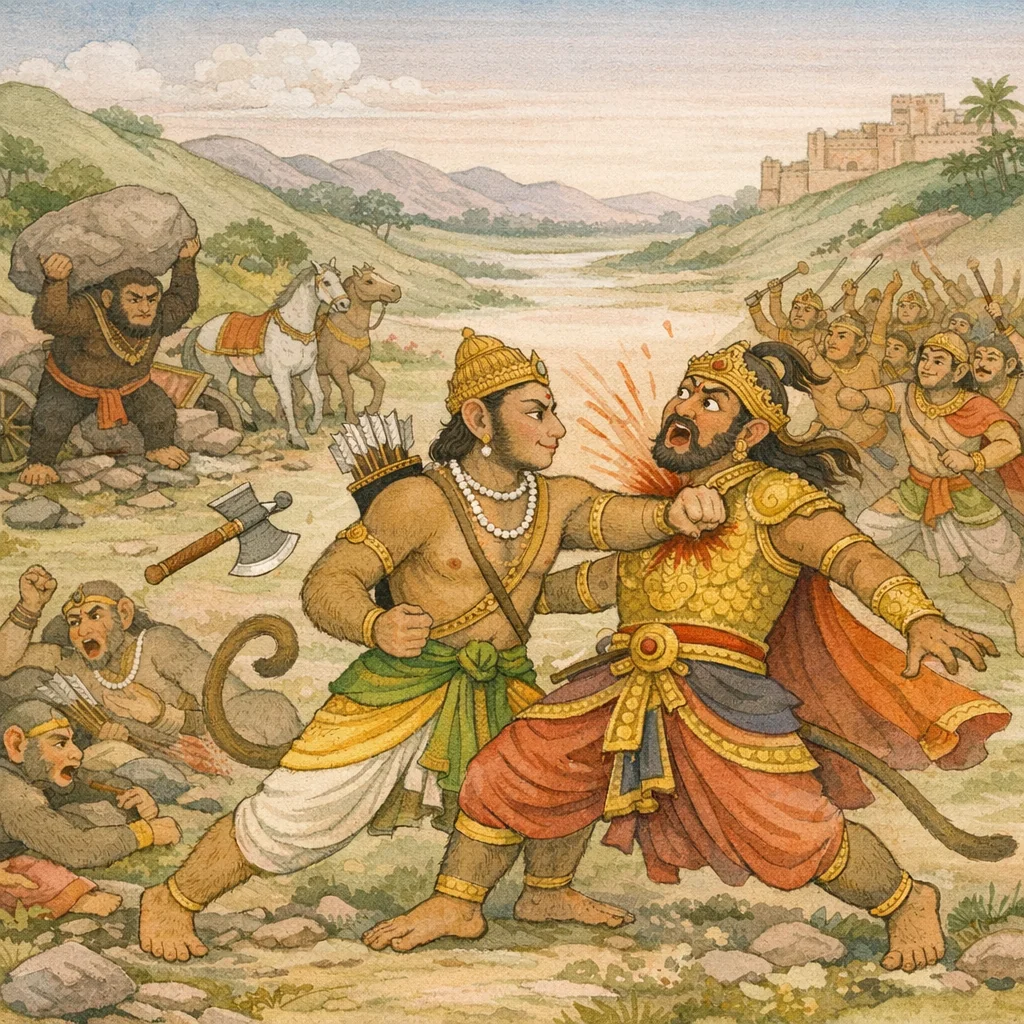
This sarga stages a concentrated battlefield reversal centered on Mahāpārśva, following the death of Mahodara at Sugrīva’s hands. Seeing Mahodara slain, Mahāpārśva’s anger intensifies and he disrupts Aṅgada’s forces with a punishing arrow-storm, severing and wounding vānaras and briefly depressing the front line. Aṅgada, observing the demoralization, surges forward and hurls an iron club/bar (parigha) at Mahāpārśva, knocking him from his chariot; Jāmbavān simultaneously assaults the rākṣasa chariot formation with a massive rock, striking horses and breaking the vehicle. Regaining consciousness, Mahāpārśva renews the attack—shooting Aṅgada and piercing Jāmbavān and Gavākṣa—prompting Aṅgada to seize a dreadful parigha, whirl it, and strike Mahāpārśva, then close in with a palm-strike. Mahāpārśva retaliates by throwing a battle-axe, which Aṅgada evades. Aṅgada then delivers a decisive, anatomically targeted fist-blow into the chest/heart region, shattering Mahāpārśva’s heart; the rākṣasa falls dead. The vānaras roar in triumph, Laṅkā’s structures vibrate, and Rāvaṇa—hearing the tumult—reorients toward renewed battle, marking a tactical and psychological escalation.
Shlokas
Verse 1
महोदरेतुनिहतेमहापार्श्वोमहाबलः ।सुग्रीवेणसमीक्ष्याथक्रोधात्सम्ररक्तलोचनः ।।।।अङ्गदस्यचमूंभीमांक्षोभयामाससायकैः ।
When Mahodara had been slain, the mighty Mahāpārśva, seeing it was done by Sugrīva, his eyes reddened with anger; and with his arrows he threw Angada’s formidable troops into turmoil.
Verse 2
सवानराणांमुख्यानामुत्तमाङ्गानिसर्वशः ।।।।पातयामानकायेभ्यःफलंवृन्तादिवानिलः ।
That leader (Mahāpārśva) struck down the heads of the foremost Vānara chiefs from their bodies on every side, like the wind knocking fruits from their stalks.
Verse 3
केषांचिदिषुभिर्बाहुन् स्कन्धांश्छिच्छेदराक्षसः च ।।।।वानराणांसुङ्कृद्ध: पार्श्वंकेषांव्यदारयत् ।
Then that rākṣasa, raging with fury, severed the arms and shoulders of some vānaras with his arrows, and tore open the sides of others.
Verse 4
तेऽर्दिताबाणवर्षेणमहापार्श्वेनवानराः ।।।।विषादविमुखाःसर्वेबभूवुर्गतचेतसः ।
Struck down by Mahāpārśva’s shower of arrows, those vānaras all turned despondent, their spirits shaken and their wits lost.
Verse 5
निरीक्ष्यबलमुद्विग्नमङ्गदोराक्षसार्दितम् ।।।।वेगंचक्रेमहावेगमहाबाहुस्समुद्रइवपर्वणि ।
Seeing the army distressed under the rākṣasa’s attack, mighty-armed Angada surged forth with great speed—like the ocean swelling on the day of the full moon.
Verse 6
आयसंपरिघंगृह्यसूर्यरमशिसमप्रभम् ।।।।समरेवानरश्रेष्ठोमहापार्श्वेन्यपातयत् ।
The foremost of the Vānaras, seizing an iron bar blazing like the sun’s rays, hurled it in the battle against Mahāpārśva.
Verse 7
स तुतेनप्रहारेणमहापार्श्वोविचेतनः ।।।।ससूतस्स्यन्दनात्तस्माद्विसंज्ञश्चापतद्भुवि ।
Struck by that blow, Mahāpārśva lost consciousness and—together with his charioteer—fell senseless from his chariot onto the ground.
Verse 8
स ऋक्षराजस्तेजस्वीनीलाञ्जनचयोपमः ।।।।निष्पत्यसुमहावीर्यस्स्वाद्व्यूहन्मेघसन्निभात् ।प्रगृह्यगिरिशृङ्गाभांक्रुद्धस्सविपुलांशिलाम् ।।।।अश्वाञ्जघानतरसाबभञ्जतम् स्यन्दनं च तम् ।
Then Jāmbavān, the radiant king of bears—like a heap of dark collyrium—sprang forth with great prowess from his own battle-formation that looked like a cloud.
Verse 9
स ऋक्षराजस्तेजस्वीनीलाञ्जनचयोपमः ।।6.99.8।।निष्पत्यसुमहावीर्यस्स्वाद्व्यूहन्मेघसन्निभात् ।प्रगृह्यगिरिशृङ्गाभांक्रुद्धस्सविपुलांशिलाम् ।।6.99.9।।अश्वाञ्जघानतरसाबभञ्जतम् स्यन्दनं च तम् ।
Enraged, he seized a massive rock like a mountain peak; with force he struck down the horses and smashed that chariot as well.
Verse 10
मुहूर्ताल्लब्धसंज्ञस्तुमहापार्श्वोमहाबलः ।।।।अङ्गदंबहुभिर्बाणैर्भूयस्तंप्रत्यविध्यत ।
After a short while, regaining consciousness, the mighty Mahāpārśva again struck Angada with many arrows.
Verse 11
जाम्बवन्तंत्रिभिर्बाणैराजघानस्तनान्तरे ।।।।ऋक्षराजंगवाक्षं च जघानबहुभिश्शरैः ।
He pierced Jāmbavān in the chest with three arrows, and he struck the bear-king and Gavākṣa as well with a shower of many shafts.
Verse 12
जाम्बवन्तंगवाक्षं च स दृष्टवाशरपीडितौ ।।।।जग्राहपरिघंघोरमङ्गदःक्रोधमूर्छितः ।
Seeing Jāmbavān and Gavākṣa tormented by arrows, Aṅgada—overwhelmed by anger—seized a dreadful iron club.
Verse 13
तस्याङ्गदःप्रकुपितोराक्षसस्यतमायसम् ।।।।दूरस्थितस्यपरिघंरविरश्मिसमप्रभम् ।द्वावाभ्यांभुजाभ्यांसङ्गृह्यभ्रामयित्वा च वेगवान् ।।।।महापार्श्वस्यचिक्षेपवधार्थंवालिनस्सुतः ।
Enraged at that Rākṣasa, Vālin’s son Aṅgada—standing at a distance—grasped the iron club radiant like the sun’s rays; whirling it with both arms, the swift one hurled it at Mahāpārśva with the intent to slay.
Verse 14
तस्याङ्गदःप्रकुपितोराक्षसस्यतमायसम् ।।6.99.13।।दूरस्थितस्यपरिघंरविरश्मिसमप्रभम् ।द्वावाभ्यांभुजाभ्यांसङ्गृह्यभ्रामयित्वा च वेगवान् ।।6.99.14।।महापार्श्वस्यचिक्षेपवधार्थंवालिनस्सुतः ।
Enraged at that Rākṣasa, Vālin’s son Aṅgada—standing at a distance—grasped the iron club radiant like the sun’s rays; whirling it with both arms, the swift one hurled it at Mahāpārśva with the intent to slay.
Verse 15
स तुक्षिप्तोबलवतापरिघन्तस्यरक्षसः ।।।।धनुश्चसशरंहस्ताछचिरस्त्रांचाप्यपातयत् ।
But that iron club, hurled with force, made the Rākṣasa drop his bow with arrows from his hand, and it also knocked down his head-gear.
Verse 16
तंसमासाद्यवेगेनवालिपुत्रःप्रतापवान् ।।।।तलेनाभ्यहनत्क्रुद्धः कर्णमूले सकुण्डले ।
Closing in swiftly, the valiant son of Vāli—angered—struck him with his palm at the base of the ear, where his earrings hung.
Verse 17
स तुक्रुद्धोमहावेगोमहापार्श्वोमहाद्युति ।।।।करेणैकेनजग्राहसुमहान्तंपरश्वथम् ।
Then Mahāpārśva—furious, swift, and brilliant—grasped with one hand a massive battle-axe.
Verse 18
तंम्तैलधौतंविमलंशैलसारमयंदृढम् ।।।।राक्षसःपरमक्रुद्धोवालिपुत्रेन्यपातयत् ।
That Rākṣasa, enraged beyond measure, hurled at Vālin’s son the firm battle-axe—oil-polished, spotless, and hard as mountain rock.
Verse 19
तेनवामांसफलकेभृशंप्रत्यवपादितम् ।।।।अङ्गदोमोक्ष्यामाससरोषस्सपरश्वधम् ।
Though the axe was driven hard toward his left shoulder, Aṅgada—still blazing with fury—evaded that blow.
Verse 20
सवीरोवज्रसङ्काशमङ्गदोमुष्टिमात्मनः ।।।।संवर्तयत्सुसङ्कृद्धःपितृतुल्यपराक्रमः ।
Then the heroic Angada—whose prowess matched his father’s—burning with fury, clenched his own fist, hard as a thunderbolt.
Verse 21
राक्षसस्यस्तनाभ्याशेमर्मज्ञोहृदयंप्रति ।।।।इन्द्राशनिमस्पर्शं स मुष्टिंविन्यपातयत् ।
Knowing the vital points, he drove his fist—like Indra’s thunderbolt—into the rākṣasa’s chest, straight toward the heart.
Verse 22
तेनतस्यनिपातेनराक्षसस्यमहामृधे ।।।।पफालहृदयंचास्य स पपातहतोभुवि ।
By that blow, in the midst of the great battle, the rākṣasa’s heart burst—and he fell, slain, upon the ground.
Verse 23
स्मिन्निपतितेभूमौतत्सैन्यंसम्प्रचुक्षुभे ।।।।अभवच्चमहान्क्रोधस्समरेरावणस्यतु ।
When he fell upon the ground, that host was thrown into turmoil; and in the battle, Rāvaṇa was seized by a great wrath.
Verse 24
वानराणांश्चहृष्टानांसिंहनादःसुपुष्कलः ।।।।स्पोटयन्निवशब्देनलङ्कांसाट्टालगोपुराम् ।महेन्द्रेणेवदेवानांनादस्समभवन्महान् ।।।।
The delighted vānaras raised a mighty lion-roar; with its crash it seemed to shake Laṅkā, with her lofty terraces and gateways. And among the gods too, as if with Mahendra (Indra) present, a great acclamation arose.
Verse 25
वानराणांश्चहृष्टानांसिंहनादःसुपुष्कलः ।।6.99.24।।स्पोटयन्निवशब्देनलङ्कांसाट्टालगोपुराम् ।महेन्द्रेणेवदेवानांनादस्समभवन्महान् ।।6.99.25।।
By that blow, in the midst of the great battle, the rākṣasa’s heart burst—and he fell, slain, upon the ground.
Verse 26
अथैन्द्रशत्रुस्त्रिदिवालयानांवनौकनांचैवम्हाप्रणादम् ।श्रुत्वासरोषंयुधिराक्षसेन्द्रः ।पुनश्चयुद्धाभिमुखोऽवतस्थे ।।।।
Then the rākṣasa-king—Indra’s foe—hearing the great tumult raised by the dwellers of heaven and by the forest-dwellers (the vānaras), flared up in rage and once again stood facing the battle.
Frequently Asked Questions
The pivotal action is Aṅgada’s escalation from defensive response to decisive neutralization of a commander who is inflicting indiscriminate casualties on allied troops; the episode frames leadership as the duty to restore battlefield stability while protecting the broader force.
Though largely non-dialogic, the sarga teaches that courage is inseparable from discernment: Aṅgada observes collective distress, acts to restore morale, and applies targeted force (marmaprahāra) to end a destructive threat—illustrating duty-driven action rather than impulsive violence.
Laṅkā is highlighted as a resonant war-space: the vānaras’ victory-roar is described as vibrating its attics and gateways (sāṭṭāla-gopura), underscoring the city’s architectural presence and the psychological reach of battlefield sound.