Sarga 96
युद्धाय रावणस्य निर्याणं तथा उत्पातदर्शनम् (Ravana’s Mobilization for War and the ظهور of Fatal Portents)
युद्धकाण्ड
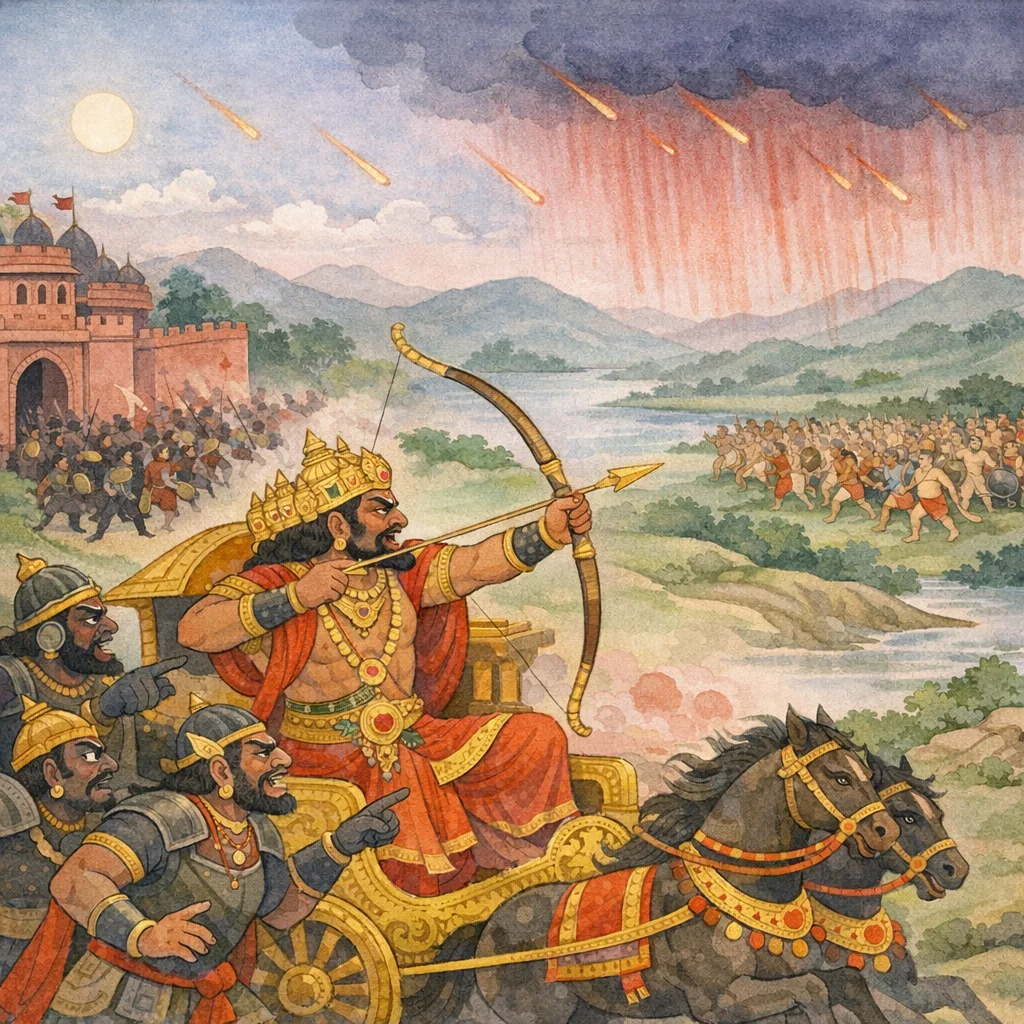
Sarga 96 opens with Rāvaṇa hearing lamentation throughout Laṅkā, indicating civic distress and the war’s domestic toll. He pauses, then assumes a terrifying, wrathful demeanor and issues rapid commands to Mahodara, Mahāpārśva, and Virūpākṣa to mobilize the remaining night-rangers. In a sequence of boastful martial vows, Rāvaṇa declares he will dispatch Rāghava and Lakṣmaṇa to Yama’s abode, avenge fallen champions (Khara, Kumbhakarṇa, Prahasta, Indrajit), and annihilate Vānara battalions with cloudlike volleys of arrows. The Rākṣasa forces arm themselves with a catalogue of weapons and sortie with chariots and roars. As Rāvaṇa advances—glowing, bow raised—cosmic and bodily omens erupt: the sun dims, directions darken, meteors fall, blood rains, animals cry inauspiciously, and his left eye and arm twitch. Despite these death-signs, he proceeds, and a tumultuous engagement begins in which his golden-feathered arrows inflict grievous injuries on the Vānara ranks.
Shlokas
Verse 1
आर्तानांराक्षसीनांतुलङ्कायांवैकुलेकुले ।रावणःकरुणंशब्दंशुश्रावपरिदेवितम् ।।6.96.1।।
In Laṅkā, from house to house, Rāvaṇa heard the afflicted rākṣasī women raising piteous, lamenting cries.
Verse 2
स तुदीर्घंविनिःश्वस्यमुहूर्तंध्यानमास्थितः ।बभूवपरमक्रुद्धोरावणोभीमदर्शनः ।।6.96.2।।
Rāvaṇa, after heaving a long sigh and pausing for a moment in thought, became exceedingly enraged—his appearance turning terrifying.
Verse 3
सन्दश्यदशनैरोष्ठंक्रोधसम्रक्तलोचनः ।राक्षसैरपिदुर्दर्शःकालाग्निरिवमूर्छितः ।।6.96.3।।
Clenching his lip between his teeth, his eyes reddened with rage, Rāvaṇa became a dreadful sight—even to the rākṣasas—like the fire of Time itself when it flares up.
Verse 4
उवाच च समीपस्थान्राक्षसान्राक्षसेश्वरः ।क्रोधाव्यक्तकथस्तत्रनिर्दहन्निवचक्षुषा ।।6.96.4।।महोदरंमहापार्श्वंविरूपाक्षं च राक्षसम् ।शीघ्रंवदतसैन्यानिनिर्यातेतिममाज्ञया ।।6.96.5।।
Then the lord of the rākṣasas addressed the rākṣasas standing near him—his words choked by anger, his eyes as though burning. He said to Mahodara, Mahāpārśva, and the rākṣasa Virūpākṣa: “Quickly, order the troops to march out—this is my command.”
Verse 5
उवाच च समीपस्थान्राक्षसान्राक्षसेश्वरः ।क्रोधाव्यक्तकथस्तत्रनिर्दहन्निवचक्षुषा ।।6.96.4।।महोदरंमहापार्श्वंविरूपाक्षं च राक्षसम् ।शीघ्रंवदतसैन्यानिनिर्यातेतिममाज्ञया ।।6.96.5।।
Then the lord of the rākṣasas addressed the rākṣasas standing near him—his words choked by anger, his eyes as though burning. He said to Mahodara, Mahāpārśva, and the rākṣasa Virūpākṣa: “Quickly, order the troops to march out—this is my command.”
Verse 6
तस्यतद्वचनंश्रुत्वाराक्षसास्तेभयार्दिताः ।चोदयामासुरव्यग्रान्राक्षसांस्तान्नृपाज्ञया ।।6.96.6।।
Hearing those words of their king, the rākṣasas—stricken with fear—nevertheless, by the royal command, urged on the others who remained steady.
Verse 7
तेतुसर्वेतथेत्युक्त्वाराक्षसाभीमदर्शनाः ।कृतस्वस्त्वयनाःसर्वेतेरणाभिमुखाययुः ।।6.96.7।।
Then all those fearsome-looking rākṣasas, saying “So be it,” and having made their auspicious preparations, went forth facing the battlefield.
Verse 8
प्रतिपूज्ययथान्यायंरावणंतेमहारथाः ।तस्थुःप्राञ्जलयःसर्वेभर्तुर्विजयकाङ्क्षिणः ।।6.96.8।।
Having duly paid respect to Rāvaṇa, those great chariot-warriors all stood with folded hands, wishing for their lord’s victory.
Verse 9
अथोवाचप्रहस्यैतान्रावणःक्रोधमूर्छितः ।महोदरमहापार्श्वौविरूपाक्षं च राक्षसम् ।।6.96.9।।
Then Rāvaṇa—beside himself with anger—laughed and spoke to these rākṣasas: Mahodara, Mahāpārśva, and Virūpākṣa.
Verse 10
अद्यबाणैर्धनुर्मुक्स्सैर्युगान्तादित्यसन्निभैः ।राघवंलक्ष्मणंचैवनेष्यामियमसादनम् ।।6.96.10।।
“Today, with arrows loosed from my bow—blazing like the sun at the world’s end—I shall send Rāghava and Lakṣmaṇa to Yama’s abode,” (declared Rāvaṇa).
Verse 11
खरस्यकुम्भकर्णस्यप्रहसेन्द्रजितोस्तथा ।करिष्यामिप्रतीकारमद्यशत्रुवधादहम् ।।6.96.11।।
“Today, by slaying the enemy, I will exact vengeance—for Khara, for Kumbhakarṇa, and likewise for Prahasta and Indrajit,” (said Rāvaṇa).
Verse 12
नैवान्तरिक्षं न दिशो न नद्यौर्नापिसागराः ।प्रकाशत्वंगमिष्यन्तिमद्बाणजलदावृताः ।।6.96.12।।
“Covered by the cloud-mass of my arrows, neither the sky, nor the directions, nor the rivers, nor even the oceans will retain their brightness,” (boasted Rāvaṇa).
Verse 13
अद्यवानरमुख्यानांतानियूथानिभागशः ।धनुषाशरजालेनवधिष्यामिपतत्रिणा ।।6.96.13।।
“Today, with a net of feathered arrows from my bow, I will slaughter those troops of the foremost vānaras—piece by piece,” (said Rāvaṇa).
Verse 14
अद्यवानरसैन्यानिरथेनपवनौजसा ।धनुस्समुद्रादुद्भूतैर्मथिष्यामिशरोर्मिभिः ।।6.96.14।।
“Today, mounted on my chariot and swift as the wind, I will churn and shatter the vānara forces with wave-like torrents of arrows rising from the ocean of my bow,” (declared Rāvaṇa).
Verse 15
व्याकोशपद्मवक्त्राणिपद्मकेसरवर्चसाम् ।अद्ययूथतटाकानिगजवत्प्रमथाम्यहम् ।।6.96.15।।
“Today I will ravage the battalion-ponds of those vānaras—whose faces are like fully opened lotuses and whose splendor is like lotus-filaments—just as an elephant tramples ponds,” (boasted Rāvaṇa).
Verse 16
सशरैरद्यवदनैस्सङ्ख्येवानरयूथपाः ।मण्डयिष्यन्तिवसुधांसनालैरिवपङ्कजैः ।।6.96.16।।
“Today, in battle, the vānara troop-leaders—faces transfixed with arrows—will adorn the earth like lotuses still attached to their stalks,” (said Rāvaṇa).
Verse 17
अद्ययूथप्रचण्डानांहरीणांद्रुमयोधिनाम् ।मुक्तेनैकेषुणायुद्धेभेत्स्यामि च शतंशतम् ।।6.96.17।।
“Today, in battle, with each single arrow I release, I will pierce a hundred upon a hundred of those fierce monkey-warriors who fight with trees,” (declared Rāvaṇa).
Verse 18
हतोभर्ताहतोभ्रातायासां च चतनयोहतः ।वधेनाद्यरिपोस्तासांकरोम्यश्रुप्रमार्जनम् ।।6.96.18।।
“By killing the enemy today, I will wipe away the tears of those women whose husband is slain, whose brother is slain, and whose son too is slain,” (said Rāvaṇa).
Verse 19
अद्यमद्भाणनिर्भिन्नैःप्रकीर्णैर्गतचेतनैः ।करोमिवानरैर्युद्धेयत्नावेक्ष्यतलांमहीम् ।।6.96.19।।
Today, in battle, I shall make the earth strewn with Vānaras—split by my arrows and bereft of life—so that the ground itself will be seen only with effort.
Verse 20
अद्यगोमयवोगृध्राश्चये च मांसाशिनोऽपरे ।सर्वांस्तांस्तर्पयिष्यामिशत्रुमांसैश्शरार्दितैः ।।6.96.20।।
Today I shall sate the jackals, the vultures, and other flesh-eaters—all of them—with the enemies’ flesh, torn by my arrows.
Verse 21
कल्प्यतांमेरथंशीघ्रंक्षिप्रमानीयतांधनुः ।अनुप्रयान्तुमांयुद्धेयेऽत्रशिष्टानिशाचराः ।।6.96.21।।
Let my chariot be made ready at once; let my bow be brought quickly. Let those Night-rangers who remain here follow me into battle.
Verse 22
तस्यतद्वचनंश्रुत्वामहापार्श्वोऽब्रवीद्वचः ।बलाध्यक्षान् स्थिथांस्तत्रबलंसंत्वर्यतामिति ।।6.96.22।।
Hearing his words, Mahāpārśva spoke to the army chiefs who stood there, urging: “Let the forces be hastened (made ready)!”
Verse 23
बलाध्यक्षास्तुसम्रब्दाराक्षसांस्तान् गृहेगृहे ।चोदयन्तःपरिययुर्लङ्कांलघुपराक्रमाः ।।6.96.23।।
Then the army commanders, acting swiftly, went about Laṅkā from house to house, rousing those Rākṣasas (to assemble).
Verse 24
ततोमुहूर्तान्निष्पेतूराक्षसाभीमदर्शनाः ।नदन्तोभीमवदनानानाप्रहरणैर्भुजैः ।।6.96.24।।असिभिःपट्टसै: शूलैर्गदाभिर्मुसलैर्हलैः ।शक्तिभिस्तीक्ष्णधाराभिर्महद्भि: कूटमुद्गरैः ।।6.96.25।।यष्टिभिर्विमलैश्चक्रैर्निशितैश्चपरश्वथै: ।भिन्दिपालैःशतघ्नीभिरन्यैश्चापिवरायुधैः ।।6.96.26।।
Soon after, the fearsome Rākṣasas rushed out, roaring—grim-faced and bearing many kinds of weapons on their arms: swords, spears, tridents, maces, clubs, ploughshares; sharp javelins and massive spiked hammers; staffs, shining discus-weapons, keen axes, bhindipālas, śataghnīs, and other excellent arms.
Verse 25
ततोमुहूर्तान्निष्पेतूराक्षसाभीमदर्शनाः ।नदन्तोभीमवदनानानाप्रहरणैर्भुजैः ।।6.96.24।।असिभिःपट्टसै: शूलैर्गदाभिर्मुसलैर्हलैः ।शक्तिभिस्तीक्ष्णधाराभिर्महद्भि: कूटमुद्गरैः ।।6.96.25।।यष्टिभिर्विमलैश्चक्रैर्निशितैश्चपरश्वथै: ।भिन्दिपालैःशतघ्नीभिरन्यैश्चापिवरायुधैः ।।6.96.26।।
Then, by Rāvaṇa’s command, the army chief swiftly brought a chariot—quick, with its charioteer in place, yoked to eight horses. At that time the dreadful Rāvaṇa, blazing with his own splendor, mounted it.
Verse 26
ततोमुहूर्तान्निष्पेतूराक्षसाभीमदर्शनाः ।नदन्तोभीमवदनानानाप्रहरणैर्भुजैः ।।6.96.24।।असिभिःपट्टसै: शूलैर्गदाभिर्मुसलैर्हलैः ।शक्तिभिस्तीक्ष्णधाराभिर्महद्भि: कूटमुद्गरैः ।।6.96.25।।यष्टिभिर्विमलैश्चक्रैर्निशितैश्चपरश्वथै: ।भिन्दिपालैःशतघ्नीभिरन्यैश्चापिवरायुधैः ।।6.96.26।।
They went forth bearing staffs, bright discus-weapons, and sharp axes—along with bhindipālas, śataghnīs, and other excellent arms.
Verse 27
अथानयद्बलाध्यक्षस्सत्वरोरावणाज्ञया ।द्रुतंसूतसमायुक्तंयुक्ताष्टतुरगंरथम् ।आरुरोहतदाभीमोदीप्यमानंस्वतेजसा ।।6.96.27।।
Then, by Rāvaṇa’s command, the army chief swiftly brought a chariot—quick, with its charioteer in place, yoked to eight horses. At that time the dreadful Rāvaṇa, blazing with his own splendor, mounted it.
Verse 28
ततःप्रयातस्सहसाराक्षसैर्भहुभिर्वृतः ।।6.96.28।।रावणःसत्त्वगाम्भीर्याद्दारयन्निवमेदिनीम् ।
Then Rāvaṇa set out at once, surrounded by many rākṣasas, seeming—by the sheer weight of his proud might and grim resolve—to tear open the earth itself.
Verse 29
रावणेनाभ्यनुज्ञातौमहापार्श्वमहोदरौ ।विरूपाक्षश्चदुर्धर्षोरथानारुरुहुस्तदा ।।6.96.29।।
With Rāvaṇa’s permission, Mahāpārśva and Mahodara—and the hard-to-overcome Virūpākṣa as well—then mounted their chariots.
Verse 30
तेतुहृष्टाविवर्धन्तोभिन्दन्तइवमेदिनीम् ।नादंघोरंविमुञ्चन्तोनिर्ययुर्जयकाङ्क्षिणः ।।6.96.30।।
They, elated and swelling with pride, went forth as though splitting the earth, releasing terrifying roars, hungry for victory.
Verse 31
ततोयुद्धायतेजस्वीरक्षोगणबलैर्वृतः ।निर्ययावुद्यतधनुःकालान्तकयमोपमः ।।6.96.31।।
Then the radiant Rāvaṇa, ringed by the strength of rākṣasa hosts, went out for battle with bow raised—like Yama, the End-Time destroyer.
Verse 32
ततःप्रजविताश्वेनरथेन स महारथः ।द्वारेणनिर्ययौतेनयत्रतौरामलक्ष्मणौ ।।6.96.32।।
Then that great chariot-warrior went out through the gate in his chariot yoked with exceedingly swift horses, toward the place where Rāma and Lakṣmaṇa stood.
Verse 33
ततोनष्टप्रभःसूर्योदिशश्चतिमिरावृताः ।द्विजाश्चनेदुर्घोराश्चसञ्चचाल च मेदिनी ।।6.96.33।।
Then the sun’s radiance seemed to fail; the directions were wrapped in darkness; birds cried out ominously, and the earth itself began to tremble.
Verse 34
ववर्षरुधिरंदेवश्चस्खलुश्चतुरङ्गमाः ।ध्वजाग्रेन्यपतद्गृध्रोविनेदुश्चाशिवाःशिवाः ।।6.96.34।।
The heavens seemed to rain blood; the horses stumbled; a vulture alighted upon the banner-top; and inauspicious jackals howled.
Verse 35
नयनंचास्फुरद्वामंवामोबाहुरकम्पत ।विवर्णवदनश्साकतिंचिदभ्रश्यतस्वनः ।।6.96.35।।
His left eye twitched; his left arm quivered; his face grew pale, and his voice faltered into a hoarse, broken tone.
Verse 36
ततोनिष्पततोयुद्धेदशग्रीवस्यरक्षसः ।रणेनिधनशंसीनिरूपाण्येतानिजज्ञिरे ।।6.96.36।।
Then, as the rākṣasa Daśagrīva rushed out into battle, these very forms—omens foretelling death in war—manifested.
Verse 37
अन्तरिक्षात्पपातोल्कानिराघतसमनिर्घास्वना ।विनेदुरशिवागृध्रावायसैरभिमिश्रिताः ।।6.96.37।।
A meteor fell from the sky with a roar like thunder; and inauspicious cries rang out—vultures and crows calling together.
Verse 38
एतानचिन्तयन्घोरानुत्पातान्समवस्थितान् ।निर्ययौरावणोमोहाद्वधार्थंकालचोदितः ।।6.96.38।।
Not reflecting on these dreadful portents that had arisen, Rāvaṇa—deluded and driven by Time—marched out toward the destruction that awaited him.
Verse 39
तेषांतुरथघोषेणराक्षसानांमहात्मनाम् ।वानराणामपिचमूर्युद्धायैवाभ्यवर्तत ।।6.96.39।।
At the thunder of the rākṣasas’ chariots, the vānaras’ host also moved forward—arraying itself for battle.
Verse 40
तेषांतुतुमुलंयुद्धंबभूवकपिरक्षसाम् ।अन्योन्यमाह्वयानानांक्रुद्धानांजयमिच्छताम् ।।6.96.40।।
Then a fierce battle erupted between the vānaras and the rākṣasas—each side angrily challenging the other, each longing for victory.
Verse 41
ततःक्रुद्धोदशग्रीवश्शरैःकाञ्चनभूषणैः ।वानराणामनीकेषुचकारकदनंमहत् ।।6.96.41।।
Then Daśagrīva, enraged, with arrows adorned in gold, wrought great carnage among the vānaras’ battle-formations.
Verse 42
विकृत्तशिरसःकेचिद्रावणेनवलीमुखाः ।केचिद्विच्छिन्नहृदयाःकेचिच्छ्रोत्रविवर्जिताः ।।6.96.42।।
Some vānaras had their heads mangled by Rāvaṇa; some had their hearts pierced; and some were left without ears.
Verse 43
निरुच्छवासाहताःकेचित्केचित्पार्श्वेषुदारिताः ।केचिद्विभिन्नशिरसःकेचिच्चक्षुर्विनाकृताः ।।6.96.43।।
Some were slain and left without breath; some had their flanks torn open; some had their heads shattered; and some were deprived of their eyes.
Verse 44
Wherever Daśānana advanced in his chariot—his eyes widened and overturned by rage—there and there the monkey-leaders could not endure the onrush of his arrows.
Frequently Asked Questions
The pivotal action is Rāvaṇa’s decision to escalate personally into battle despite civic grief and repeated death-portents. Ethically, the chapter frames a leadership failure: policy driven by revenge and rage overrides prudence, counsel, and the interpretive warnings of nimittas (omens).
The sarga emphasizes that krodha and moha distort perception: even clear indicators of impending ruin are dismissed when ego and retaliation dominate. It also illustrates epic causality—adharma intensifies violence yet simultaneously accelerates self-destruction.
Laṅkā is presented as a city in collective distress, heard “house after house,” underscoring war’s social footprint. The battlefield threshold is marked by chariot sounds and mass sortie, while the wider cosmos (sun, directions, meteors) functions as a cultural omen-field validating the epic’s moral universe.