Sarga 94
रावणस्य सभाप्रवेशः — रामस्य शरवृष्ट्या राक्षससेनाविनाशः (Ravana Enters Council; Rama’s Arrow-Storm Destroys the Rakshasa Host)
युद्धकाण्ड
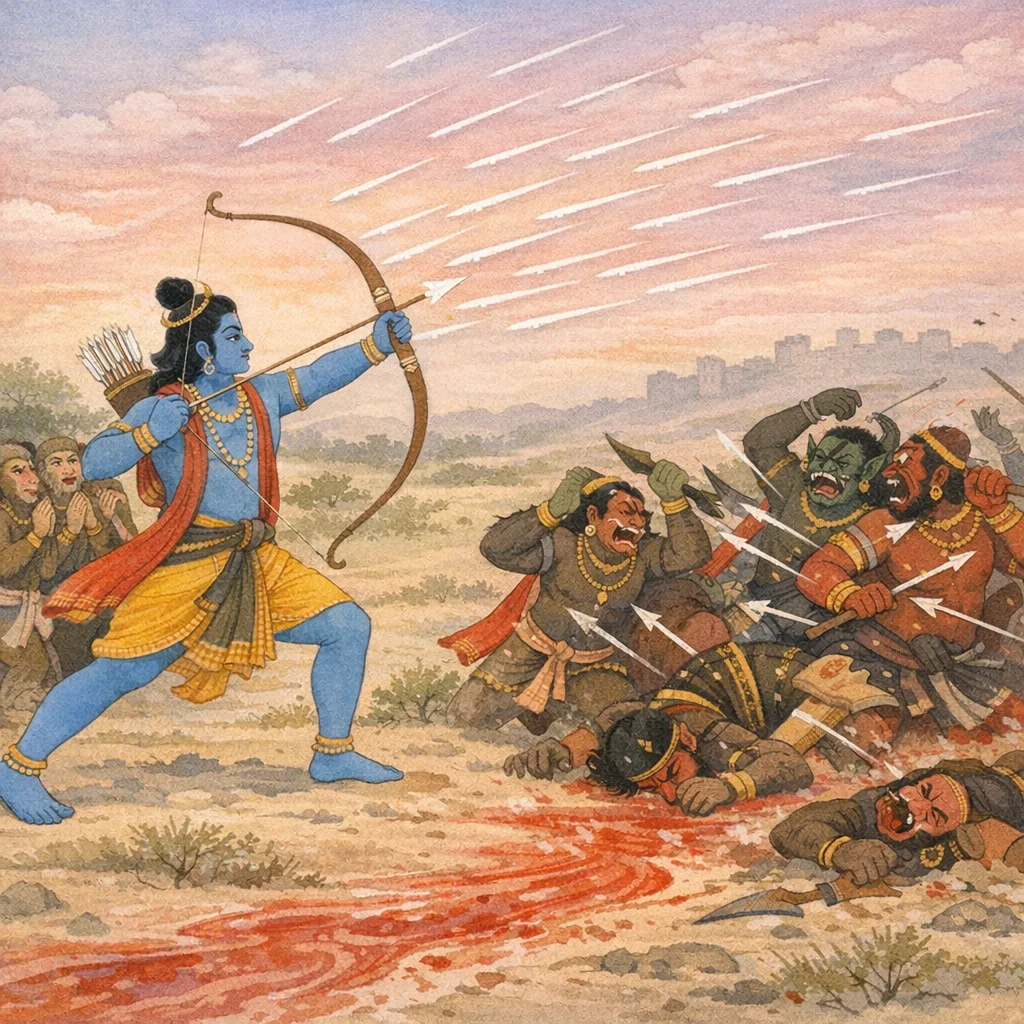
Sarga 94 opens with Rāvaṇa entering the council in visible grief and anger, then addressing his military chiefs with folded hands, urging a concentrated assault focused on a single target—Rāma. Orders are issued for a combined deployment of elephants, horses, chariots, and infantry. At sunrise a terrifying, tumultuous battle erupts; missiles, maces, swords, axes, trees, and rocks are exchanged. The field becomes a landscape of dust and blood: rivers of gore, bodies as driftwood, and war-engines as banks and trees. As vānaras are struck, they seek refuge in Rāma. Rāma then enters the rākṣasa army and unleashes an overwhelming rain of arrows; his speed and the Gandharva-associated supreme missile create visual confusion—rākṣasas perceive multiple Rāmas, cannot directly perceive him, and in mistaken fury strike one another. The chapter culminates in a quantitative devastation of the rākṣasa host within a brief fraction of the day, survivors retreating to Laṅkā. Celestial beings praise Rāma, and he remarks to Sugrīva, Vibhīṣaṇa, Hanūmān, Jāmbavān, Mainda, and Dvivida that such divine astric power belongs to him and Tryambaka (Śiva) alone.
Shlokas
Verse 1
स प्रविश्यसभांराजादीनःपरमदुःखितः ।निषपादासनेमुख्येसिंहःक्रुद्धइवश्वसन् ।।।।
Rāvaṇa entered the council-hall, pitiable and overwhelmed with grief; sighing like an enraged lion, he sat down on the chief seat.
Verse 2
अब्रवीच्च स तान्सर्वान् बलमुख्यान् महाबलः ।रावणःप्राञ्जलिर्वाक्यंपुत्रव्यसनकर्शितः ।।।।
Then Rāvaṇa—mighty in power yet worn down by grief over his son—addressed all the chiefs of his forces, speaking with folded hands.
Verse 3
सर्वेभवन्तस्सर्वेणहस्त्यश्वेनसमावृताः ।निर्यान्तुरथसङ्घैश्चपादातैश्चोपशोभिताः ।।6.94.3।।
“All of you—fully equipped with elephants and horses, adorned with companies of chariots and with foot-soldiers—march out!”
Verse 4
एकंरामंपरिक्षिप्यसमरेहन्तुमर्हथ ।वर्षन्तश्शरवर्षाणिप्रावृट् कालइवाम्बुदाः ।।6.94.4।।
“Surround Rama alone in battle and you should strike him down—pouring showers of arrows like clouds in the monsoon season.”
Verse 5
अथवाहंशरैस्तीक्ष्णैर्भिन्नगात्रंमहाहवे ।भवद्भिःश्वोनिहन्तास्मिरामंलोकस्यपश्यतः ।।।।
“Or else, once you have pierced his limbs with sharp arrows in this great battle, tomorrow—before the world’s very eyes—I will kill Rama.”
Verse 6
इत्येतद्वाक्यमादायरक्षसेन्द्रस्यराक्षसाः ।निर्ययुस्तेरथैःशीघ्रैर्नानानीकैश्चसंयुताः ।।।।
Having taken in those words of the lord of rākṣasas, the rākṣasas marched out swiftly in their chariots, joined with many different battalions.
Verse 7
परिघान् पट्टसांश्चैवशरखङ्गपरश्वधान् ।शरीरान्तकरान् सर्वेचिक्षिपुर्वानरान् प्रति ।।।।वानराश्चद्रुमान्शैलान्राक्षसान्प्रतिचिक्षिपुः ।
All of them hurled iron bars, heavy clubs, arrows, swords, and axes—deadly enough to end life—toward the vānaras; and the vānaras, in turn, hurled trees and rocks at the rākṣasas.
Verse 8
स सङ्ग्रामोमहाभीमस्सूर्यस्यदयनंप्रति ।।।।रक्षसांवानराणां च तुमुलस्समपद्यत ।
At sunrise, that battle between rākṣasas and vānaras became exceedingly dreadful and tumultuous.
Verse 9
तेगदाभिश्चचित्राभिःप्रासैःखडगैःपरश्वधैः ।।।।अन्योन्यंसमरेजघ्नुस्तदावानरराक्षसाः ।
Then the vānaras and rākṣasas struck one another in battle with wondrous maces, spears, swords, and axes.
Verse 10
एवंप्रवृत्तेसङ्ग्रामेह्यद्भुतंसुमहद्रजः ।।।।रक्षसांवानराणां च शान्तंशोणितविस्रवैः ।
As the battle raged on, a vast and astonishing cloud of dust rose up; it was then laid low by the streaming flow of blood from both rākṣasas and vānaras.
Verse 11
मातङ्गरथकूलाश्चवाजिमत्सास्यध्वजद्रुमाः ।।।।शरीरसङ्घाटवहाःप्रसस्रुःशोणितापगाः ।
Rivers of blood flowed forth—having elephants and chariots for their banks, horses as their fish, banners as their trees, and heaps of bodies borne along like logs.
Verse 12
ततस्तेवानराःसर्वेशोणितौघपरिप्लुताः ।।।।ध्वजवर्मरथानश्वान्नानाप्रहरणानि च ।आप्लुत्याप्लुत्यसमरेवानरेन्द्राबभञ्चिरे ।।।।
Then all the vānaras, drenched in streams of blood, leapt again and again in the fight; the leaders of the vānaras smashed banners, armour, chariots, horses, and weapons of many kinds.
Verse 13
ततस्तेवानराःसर्वेशोणितौघपरिप्लुताः ।।6.94.12।।ध्वजवर्मरथानश्वान्नानाप्रहरणानि च ।आप्लुत्याप्लुत्यसमरेवानरेन्द्राबभञ्चिरे ।।6.94.13।।
This verse is a duplicated transmission in the provided input (matching 6.94.12 in full). In sense: the blood-drenched vānaras, leaping repeatedly, shattered banners, armour, chariots, horses, and diverse weapons in the battle.
Verse 14
केशान् कर्णललाटं च नासिकाश्चप्लवङ्गमाः ।रक्षसांदशनैस्तीक्ष्णैर्नखैश्चापिव्यकर्तयन् ।।।।
The monkeys, using their sharp teeth and claws, tore away the rākṣasas’ hair, ears, foreheads, and noses.
Verse 15
एकैकंराक्षसंसङ्ख्येशतंवानरपुङ्गवाः ।अभ्यधावन्तफलिनंवृक्षंशकुनयोयथा ।।।।
In the thick of battle, hundreds of mighty vānaras rushed at each single rākṣasa—just as birds swoop upon a fruit-laden tree.
Verse 16
तदागदाभिर्गुर्वीभिःप्रासैःखडगैःपरश्वधैः ।निर्जघ्नुर्वानरान्घोरान्राक्षसाःपर्वतोपमाः ।।।।
Then the rākṣasas, huge as mountains, struck down the fearsome vānaras with heavy maces, spears, swords, and axes.
Verse 17
राक्षसैर्वध्यमानानांवानराणांमहाचमूः ।शरण्यंशरणंयातारामंदशरथात्मजम् ।।।।
As the vānaras were being cut down by the rākṣasas, their great host went for refuge to Rāma—Dasharatha’s son—who is the true protector of those seeking shelter.
Verse 18
ततोरामोमहातेजाधनुरादायवीर्यवान् ।प्रविश्यराक्षसंसैन्यंशरवर्षंववर्ष ह ।।।।
Then Rāma, radiant with great power and mighty in valor, took up his bow and entered the rākṣasa ranks, showering them with a rain of arrows.
Verse 19
प्रविष्टंतुतदारामंमेघास्सूर्यमिवाम्बरे ।नाथिजग्मुर्महाघोरानिर्दहन्तंशराग्निना ।।।।
When Rāma entered (the enemy host) then, the most dreadful rākṣasas could not close in on him—just as clouds in the sky cannot draw near the sun—while he burned them with the fire of his arrows.
Verse 20
कृतान्येवसुघोराणिरामेणरजनीचराः ।ददृशुस्ते न वैरामंकर्माण्यसुकराणिते ।।।।
Those night-rangers saw only the terrible deeds once they were already done by Rāma; they could not truly see Rāma himself, whose acts were impossible for others to match.
Verse 21
चालयन्तंमहासैन्यंविधमन्तंमहारथान् ।ददृशुस्ते न वैरामंवातंवनगतंयथा ।।।।
Though he was shaking the vast army and smashing great charioteers, they still could not see Rāma—like wind moving through a forest, felt by its force yet not grasped by sight.
Verse 22
छिन्नंभिन्नंशरैर्दग्धंप्रभन्नंशस्त्रपीडितम् ।बलंरामेणददृशुर्नरामंशीघ्रकारिणम् ।।।।
They saw the host cut down, split apart, scorched by arrows, torn open and tormented by weapons—yet they could not make out Rāma himself, so swift was his action.
Verse 23
प्रहरन्तंशरीरेषु न तेपश्यन्तिराघवम् ।इन्द्रियार्थेषुतिष्ठन्तंभूतात्मानमिवप्रजाः ।।।।
Though their bodies were being struck, they could not perceive Rāghava—just as people, absorbed in the objects of the senses, do not perceive the inner self that abides within beings.
Verse 24
एषहन्तिगजानीकमेषहन्तिमहारथान् ।एषहन्तिशरैस्तीक्ष्णैःपदातीस्वाजिभिःसह ।।।।इतितेराक्षसास्सर्वेरामस्यसदृशान्रणे ।अन्योन्यंकुपिताजघ्नुस्सादृश्याद्राघवस्यते ।।।।
‘This one is killing the elephant-corps! This one is slaying the great chariot-warriors! This one is striking down foot-soldiers and horses with sharp arrows!’—thus they cried out (in confusion).
Verse 25
एषहन्तिगजानीकमेषहन्तिमहारथान् ।एषहन्तिशरैस्तीक्ष्णैःपदातीस्वाजिभिःसह ।।6.94.24।।इतितेराक्षसास्सर्वेरामस्यसदृशान्रणे ।अन्योन्यंकुपिताजघ्नुस्सादृश्याद्राघवस्यते ।।6.94.25।।
So, all those rākṣasas—angered in the battle—struck one another, mistaking their own comrades for Rāma, because of the bewildering semblance created around Rāghava.
Verse 26
न तेददृशिरेरामंदहन्तमपिवाहिनीम् ।मोहिताःपरमास्त्रणगान्धर्वेणमहात्मना ।।।।
Though Rāma was burning their host, they still could not see him—bewildered as they were by that supreme Gandharva-weapon released by the great-souled one.
Verse 27
तेतुरामसहस्राणिरणेपश्यन्तिराक्षसाः ।पुनःपश्यन्तिकाकुत्स्थमेकमेवमहाहवे ।।।।
In that great battle, the rākṣasas at one moment saw a thousand Rāmas in the field; and then again they saw only one Kakutstha.
Verse 28
भ्रमन्तीकाञ्चनींकोटिंकार्मुकस्यमहात्मनः ।अलातचक्रप्रतिमांददृशुस्ते न राघवम् ।।।।
As the great-souled Rāghava moved in rapid circles with his bow, they saw only the bow’s golden tip—like a whirling firebrand—and could not make out Rāma himself.
Verse 29
शरीरनाभिसत्त्वार्चिश्शरारंनेमिकार्मुकम् ।ज्याघोषतलनिर्घोषंतेजोबुधदिगुणप्रभम् ।।।।दिव्यास्त्रगुणपर्यन्तंनिघ्नन्तंयुधिराक्षसान् ।ददृशूरामचक्रंतत्कालचक्रमिवप्रजाः ।।।।
The people beheld that ‘Wheel of Rāma’ cutting down the Rākṣasas in battle: his body as the hub, his inner strength as its radiance, arrows as spokes, the bow as the rim, the twang of the bowstring as its roar, and his splendor, intelligence, and virtues as the force driving his divine weapons—like the very Wheel of Time.
Verse 30
शरीरनाभिसत्त्वार्चिश्शरारंनेमिकार्मुकम् ।ज्याघोषतलनिर्घोषंतेजोबुधदिगुणप्रभम् ।।6.94.29।।दिव्यास्त्रगुणपर्यन्तंनिघ्नन्तंयुधिराक्षसान् ।ददृशूरामचक्रंतत्कालचक्रमिवप्रजाः ।।6.94.30।।
Within an eighth part of a day, Rāma alone cut down the shape-shifting Rākṣasas with arrows like tongues of fire—ten thousand swift chariots, eighteen thousand powerful elephants, fourteen thousand horses with riders, and a full two hundred thousand infantry.
Verse 31
अनीकंदशसाहस्रंरथानांवातरम्हसाम् ।अष्टादशसहस्राणिकुञ्जराणांतरस्विनाम् ।।।।चतुर्दशसहस्राणिसारोहाणां च वाजिनाम् ।पूर्णेशतसहस्रेद्वेराक्षसानांपदातिनाम् ।।।।दिवसस्याष्टभागेनशरैरग्निशिखोपमैः ।हतात्यान्येकेनरामेणरक्षसांकामरूपिणाम् ।।।।
Within an eighth part of a day, Rāma alone cut down the shape-shifting Rākṣasas with arrows like tongues of fire—ten thousand swift chariots, eighteen thousand powerful elephants, fourteen thousand horses with riders, and a full two hundred thousand infantry.
Verse 32
अनीकंदशसाहस्रंरथानांवातरम्हसाम् ।अष्टादशसहस्राणिकुञ्जराणांतरस्विनाम् ।।6.94.31।।चतुर्दशसहस्राणिसारोहाणां च वाजिनाम् ।पूर्णेशतसहस्रेद्वेराक्षसानांपदातिनाम् ।।6.94.32।।दिवसस्याष्टभागेनशरैरग्निशिखोपमैः ।हतात्यान्येकेनरामेणरक्षसांकामरूपिणाम् ।।6.94.33।।
With elephants, infantry, and horses lying slain, that battlefield looked like the play-ground of the great Rudra when wrathful.
Verse 33
अनीकंदशसाहस्रंरथानांवातरम्हसाम् ।अष्टादशसहस्राणिकुञ्जराणांतरस्विनाम् ।।6.94.31।।चतुर्दशसहस्राणिसारोहाणां च वाजिनाम् ।पूर्णेशतसहस्रेद्वेराक्षसानांपदातिनाम् ।।6.94.32।।दिवसस्याष्टभागेनशरैरग्निशिखोपमैः ।हतात्यान्येकेनरामेणरक्षसांकामरूपिणाम् ।।6.94.33।।
Then the Devas, along with Gandharvas, Siddhas, and great seers, honored that deed of Rāma, acclaiming, “Well done! Well done!”
Verse 34
तेहताश्वाहतरथाश्शान्ताविमथितध्वजाः ।अभिपेतुःपुरींलङ्कांहतशेषानिशाचराः ।।।।
Those night-roamers—left only as remnants, their horses slain, chariots ruined, and standards shattered—fell back and fled into the city of Laṅkā.
Verse 35
हतैर्गजपदात्यश्वैस्तद्बभूवरणाजिरम् ।अक्रीडभूमिःक्रुद्धस्यरुद्रस्येवमहात्मनः ।।।।
With elephants, infantry, and horses lying slain, that battlefield looked like the play-ground of the great Rudra when wrathful.
Verse 36
ततोदेवास्कसगन्धर्वास्सिद्धाश्चपरमर्षयः ।साधुसावधितिरामस्यतत्कर्मसमपूजयन् ।।।।
Then the Devas, along with Gandharvas, Siddhas, and great seers, honored that deed of Rāma, acclaiming, “Well done! Well done!”
Verse 37
अब्रवीच्छतदारामःसुग्रीवंप्रत्यनन्तरम् ।विभीषणं च धर्मात्माहनूमन्तं च वानरम् ।।।।जाम्बवन्तंहरिश्रेष्ठंमैन्दंद्विविदमेव च ।एतदस्त्रबलंदिव्यंममवात्ऱ्यम्बकस्यवा ।।।।
Then righteous Rama spoke at once to Sugrīva—also to Vibhīṣaṇa, Hanūmān the vānara, Jāmbavān the foremost of the haris, and to Mainda and Dvivida: “This divine power of the weapon belongs to me—or to Tryambaka (Śiva) alone.”
Verse 38
अब्रवीच्छतदारामःसुग्रीवंप्रत्यनन्तरम् ।विभीषणं च धर्मात्माहनूमन्तं च वानरम् ।।6.94.37।।जाम्बवन्तंहरिश्रेष्ठंमैन्दंद्विविदमेव च ।एतदस्त्रबलंदिव्यंममवात्ऱ्यम्बकस्यवा ।।6.94.38।।
“Or else, once you have pierced his limbs with sharp arrows in this great battle, tomorrow—before the world’s very eyes—I will kill Rama.”
Verse 39
निहत्यतांराक्षसराजवाहिनींरामस्तदाशक्रसमोमहात्मा ।अस्त्रषुशस्त्रषुजितक्लमश्चसंस्तूयतेदेवगणैःप्रहृष्टैः ।।।।
Having destroyed that army of the rākṣasa-king, great-souled Rama—Indra’s equal—unwearied in the use of weapons and missiles, was praised by the jubilant hosts of devas.
Frequently Asked Questions
The pivotal action is Rāvaṇa’s directive to concentrate force on a single opponent (Rāma) versus Rāma’s response: protecting allies who seek refuge and applying overwhelming yet targeted astric force to halt a collapsing frontline.
The chapter frames dhārmic power as disciplined and purposive: when refuge is sought, the protector must act decisively; yet true agency can remain ‘unseen’—effects are evident even when the actor is beyond ordinary perception, emphasizing the limits of sense-based cognition.
Key landmarks are Laṅkā (as the defensive city to which survivors retreat) and the sabhā (council hall) as the institutional space of rākṣasa statecraft; culturally, the text foregrounds astra-traditions (e.g., Gandharva missile) and the Rudra/Tryambaka theological horizon invoked in Rāma’s statement.