Sarga 90
इन्द्रजित्-लक्ष्मणयुद्धम् तथा वानरप्रोत्साहनम् (Indrajit–Lakshmana Battle and the Rallying of the Vanaras)
युद्धकाण्ड
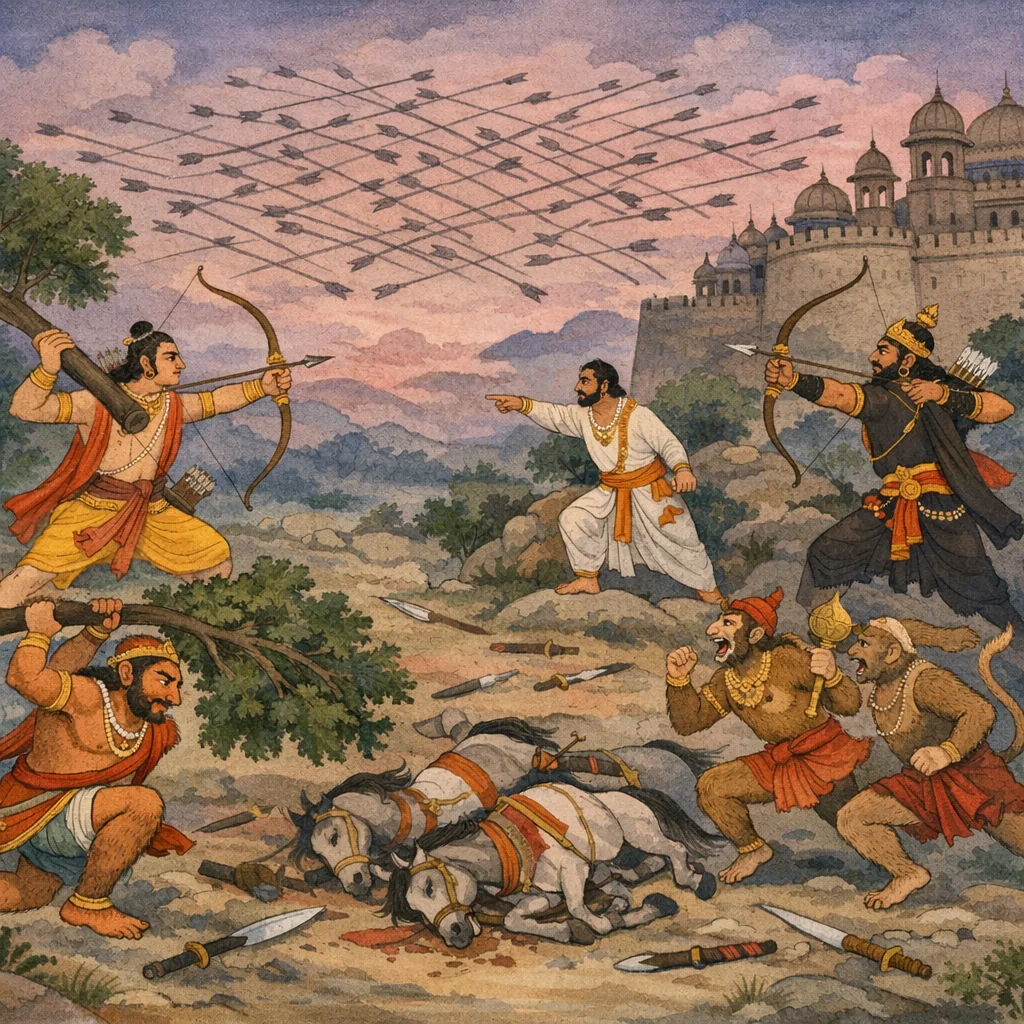
Sarga 90 frames a decisive phase of the Laṅkā war around two interlocking movements: (1) Vibhīṣaṇa’s strategic encouragement of the Vānara leadership and (2) the intensification of the duel between Lakṣmaṇa and Indrajit (Rāvaṇi). The chapter opens by situating Lakṣmaṇa and Indrajit as mutually intent on victory, likened to battling elephants, while Vibhīṣaṇa positions himself at the battle-front to witness and direct. Vibhīṣaṇa then enumerates prominent Rākṣasa commanders already slain, reclassifying the remaining contest as a narrowed objective: Indrajit is portrayed as the principal remaining pillar of Rākṣasa resistance (with Rāvaṇa as the final exception). He articulates a personal dharma-conflict—striking his brother’s son for Rāma’s cause—marking the moral cost of alliance and kin-slaying in wartime. The Vānara chiefs respond with martial exhilaration. Combat imagery escalates: Jāmbavān and troops clash with weapon-bearing Rākṣasas; Hanumān dismounts Lakṣmaṇa and devastates Rākṣasa ranks with an uprooted sāla tree. The Lakṣmaṇa–Indrajit engagement becomes so rapid that bow-hand motions are imperceptible; the sky is netted with arrows, darkness and omens intensify, and battlefield sound resembles mythic Deva–Asura war. Tactical turning points follow: Saumitri pierces Indrajit’s four horses; the charioteer is beheaded by a bhalla shot; Indrajit briefly assumes charioteer duties himself; Vānara leaders leap upon and kill the horses, forcing Indrajit to fight on foot. Lakṣmaṇa checks him with concentrated volleys, while Vānara morale rises at Indrajit’s visible despondency. The sarga closes with Indrajit advancing on foot and Lakṣmaṇa obstructing his renewed arrow-rain, consolidating momentum toward Indrajit’s eventual downfall.
Shlokas
Verse 1
युध्यमानौतुतौदृष्टवाप्रसक्तौनरराक्षसौ ।प्रभिन्नाविवमातङ्गौपरस्परवधैषिणौ ।।।।तौद्रष्टुकामस्सङ्ग्रामेपरस्परगतौबली ।शूरस्सरावणभ्रातातस्थौसङ्ग्राममूर्धनि ।।।।
Seeing those two—the man and the rākṣasa—locked in combat, each eager for the other’s death, like two maddened elephants smashing against one another, the valiant hero, Rāvaṇa’s brother (Vibhīṣaṇa), stood at the front of the battlefield, intent on watching their fight.
Verse 2
युध्यमानौतुतौदृष्टवाप्रसक्तौनरराक्षसौ ।प्रभिन्नाविवमातङ्गौपरस्परवधैषिणौ ।।6.90.1।।तौद्रष्टुकामस्सङ्ग्रामेपरस्परगतौबली ।शूरस्सरावणभ्रातातस्थौसङ्ग्राममूर्धनि ।।6.90.2।।
Desiring to witness those two mighty warriors locked against one another in battle, the heroic brother of Rāvaṇa stood at the very forefront of the battlefield.
Verse 3
ततोविष्फारयामासमहद्धनुरवस्थितः ।उत्ससर्ज च तीक्ष्णाग्रान् राक्षसेषुमहाशरान् ।।।।
Then, taking his stance, he drew his great bow to the full and released sharp-pointed mighty arrows upon the rākṣasas.
Verse 4
तेशराःशिखिसम्पर्शानिपतन्तस्समाहिताः ।राक्षसान् दारयामासुर्वज्राणीवमहागिरीन् ।।।।
Those well-aimed arrows, blazing as if touched by fire, fell and tore through the rākṣasas—like thunderbolts splitting great mountains.
Verse 5
विभीषणस्यानुचरास्तेपिशूलासिपट्टसै: ।चिच्छिदुःसमरेवीरान्राक्षसान्राक्षसोत्तमाः ।।।।
In that battle, even the foremost rākṣasas who followed Vibhīṣaṇa cut down rākṣasa warriors with pikes, swords, and axes.
Verse 6
राक्षसैस्स्सैःपरिवृतस्सतदातुविभीषणः ।बभौमध्येप्रहृष्टानामाकलभानामिवद्विपः ।।।।
Then Vibhīṣaṇa, surrounded by those rākṣasas, shone among them like a great elephant in the midst of delighted young elephants.
Verse 7
ततस्स्संञ्चोदयानोवैहरीन्रक्षोरणप्रियान् ।उवाचवचनंकालेकालज्ञोरक्षसांवरः ।।।।
Then Vibhīṣaṇa—best among rākṣasas and wise in judging the right moment—spoke timely words to rouse the Vānaras who were eager to fight the rākṣasas.
Verse 8
एकोऽयंराक्षसेन्द्रस्यपरायणमवस्थितः ।एतच्छेषंबलंतस्यकिंतिष्ठतहरीश्वराः ।।।।
“This one man stands here as the rākṣasa-king’s last refuge; this is all that remains of his force. Why do you stand still, O lords of the Vānaras?”
Verse 9
अस्मिंन्विनिहतेपापेराक्षसेरणमूर्थनि ।रावणंवर्जयित्वातुशेषमस्यबलंहतम् ।।।।
“If this wicked rākṣasa is slain at the very front of battle, then—leaving aside Rāvaṇa—what remains of his army is as good as destroyed.”
Verse 10
प्रहस्तोनिहतोवीरोनिकुम्भश्चमहाबल. ।कुम्भकर्णश्चकुम्भश्चधूम्राक्षश्चनिशाचरः ।।।।जम्बुमालीमहामालीतीक्ष्णवेगोऽशनिप्रभः ।सुप्तघ्नोयज्ञकोपश्चवज्रदंष्ट्रश्चराक्षसः ।।।।सम्ह्रादीविकटोऽरिघ्नस्तपनोदमएव च ।प्रघासःप्रघसश्चैवप्रजङ्घोजङ्घएव च ।।।।अग्निकेतुश्चदुर्धर्षोरश्मिकेतुश्चवीर्यवान् ।विद्युज्जिह्वाद्विजिह्वश्चसूर्यशत्रुश्चराक्षसः ।।।।अकम्पनःसुपार्श्वश्चचक्रमाली च राक्षसः ।कम्पनस्सत्त्ववन्तौतौदेवान्तकनरान्तकौ ।।।।
(Addressing Rāvaṇa:) “The hero Prahasta has been slain; so too Nikumbha the mighty; Kumbhakarṇa, Kumbha, and Dhūmrākṣa the night-ranger. Jambumālī, Mahāmālī, Tīkṣṇavega, Aśaniprabha, Suptaghna, Yajñakopa, and Vajradaṃṣṭra; Samhrādī, Vikaṭa, Arighna, Tapana, and Dama; Praghāsa, Praghasa, Prajaṅgha, and Jaṅgha; Agniketu the unassailable, Raśmiketu the valiant, Vidyujjihvā, Dvijihva, and Sūryaśatru; Akampana, Supārśva, and Cakramālī; and also Kampana—along with the powerful Devāntaka and Narāntaka.”
Verse 11
प्रहस्तोनिहतोवीरोनिकुम्भश्चमहाबल. ।कुम्भकर्णश्चकुम्भश्चधूम्राक्षश्चनिशाचरः ।।6.90.10।।जम्बुमालीमहामालीतीक्ष्णवेगोऽशनिप्रभः ।सुप्तघ्नोयज्ञकोपश्चवज्रदंष्ट्रश्चराक्षसः ।।6.90.11।।सम्ह्रादीविकटोऽरिघ्नस्तपनोदमएव च ।प्रघासःप्रघसश्चैवप्रजङ्घोजङ्घएव च ।।6.90.12।।अग्निकेतुश्चदुर्धर्षोरश्मिकेतुश्चवीर्यवान् ।विद्युज्जिह्वाद्विजिह्वश्चसूर्यशत्रुश्चराक्षसः ।।6.90.13।।अकम्पनःसुपार्श्वश्चचक्रमाली च राक्षसः ।कम्पनस्सत्त्ववन्तौतौदेवान्तकनरान्तकौ ।।6.90.14।।
(Addressing Rāvaṇa:) “The hero Prahasta has been slain; so too Nikumbha the mighty; Kumbhakarṇa, Kumbha, and Dhūmrākṣa the night-ranger. Jambumālī, Mahāmālī, Tīkṣṇavega, Aśaniprabha, Suptaghna, Yajñakopa, and Vajradaṃṣṭra; Samhrādī, Vikaṭa, Arighna, Tapana, and Dama; Praghāsa, Praghasa, Prajaṅgha, and Jaṅgha; Agniketu the unassailable, Raśmiketu the valiant, Vidyujjihvā, Dvijihva, and Sūryaśatru; Akampana, Supārśva, and Cakramālī; and also Kampana—along with the powerful Devāntaka and Narāntaka.”
Verse 12
प्रहस्तोनिहतोवीरोनिकुम्भश्चमहाबल. ।कुम्भकर्णश्चकुम्भश्चधूम्राक्षश्चनिशाचरः ।।6.90.10।।जम्बुमालीमहामालीतीक्ष्णवेगोऽशनिप्रभः ।सुप्तघ्नोयज्ञकोपश्चवज्रदंष्ट्रश्चराक्षसः ।।6.90.11।।सम्ह्रादीविकटोऽरिघ्नस्तपनोदमएव च ।प्रघासःप्रघसश्चैवप्रजङ्घोजङ्घएव च ।।6.90.12।।अग्निकेतुश्चदुर्धर्षोरश्मिकेतुश्चवीर्यवान् ।विद्युज्जिह्वाद्विजिह्वश्चसूर्यशत्रुश्चराक्षसः ।।6.90.13।।अकम्पनःसुपार्श्वश्चचक्रमाली च राक्षसः ।कम्पनस्सत्त्ववन्तौतौदेवान्तकनरान्तकौ ।।6.90.14।।
(Addressing Rāvaṇa:) “The hero Prahasta has been slain; so too Nikumbha the mighty; Kumbhakarṇa, Kumbha, and Dhūmrākṣa the night-ranger. Jambumālī, Mahāmālī, Tīkṣṇavega, Aśaniprabha, Suptaghna, Yajñakopa, and Vajradaṃṣṭra; Samhrādī, Vikaṭa, Arighna, Tapana, and Dama; Praghāsa, Praghasa, Prajaṅgha, and Jaṅgha; Agniketu the unassailable, Raśmiketu the valiant, Vidyujjihvā, Dvijihva, and Sūryaśatru; Akampana, Supārśva, and Cakramālī; and also Kampana—along with the powerful Devāntaka and Narāntaka.”
Verse 13
प्रहस्तोनिहतोवीरोनिकुम्भश्चमहाबल. ।कुम्भकर्णश्चकुम्भश्चधूम्राक्षश्चनिशाचरः ।।6.90.10।।जम्बुमालीमहामालीतीक्ष्णवेगोऽशनिप्रभः ।सुप्तघ्नोयज्ञकोपश्चवज्रदंष्ट्रश्चराक्षसः ।।6.90.11।।सम्ह्रादीविकटोऽरिघ्नस्तपनोदमएव च ।प्रघासःप्रघसश्चैवप्रजङ्घोजङ्घएव च ।।6.90.12।।अग्निकेतुश्चदुर्धर्षोरश्मिकेतुश्चवीर्यवान् ।विद्युज्जिह्वाद्विजिह्वश्चसूर्यशत्रुश्चराक्षसः ।।6.90.13।।अकम्पनःसुपार्श्वश्चचक्रमाली च राक्षसः ।कम्पनस्सत्त्ववन्तौतौदेवान्तकनरान्तकौ ।।6.90.14।।
(Addressing Rāvaṇa:) “The hero Prahasta has been slain; so too Nikumbha the mighty; Kumbhakarṇa, Kumbha, and Dhūmrākṣa the night-ranger. Jambumālī, Mahāmālī, Tīkṣṇavega, Aśaniprabha, Suptaghna, Yajñakopa, and Vajradaṃṣṭra; Samhrādī, Vikaṭa, Arighna, Tapana, and Dama; Praghāsa, Praghasa, Prajaṅgha, and Jaṅgha; Agniketu the unassailable, Raśmiketu the valiant, Vidyujjihvā, Dvijihva, and Sūryaśatru; Akampana, Supārśva, and Cakramālī; and also Kampana—along with the powerful Devāntaka and Narāntaka.”
Verse 14
प्रहस्तोनिहतोवीरोनिकुम्भश्चमहाबल. ।कुम्भकर्णश्चकुम्भश्चधूम्राक्षश्चनिशाचरः ।।6.90.10।।जम्बुमालीमहामालीतीक्ष्णवेगोऽशनिप्रभः ।सुप्तघ्नोयज्ञकोपश्चवज्रदंष्ट्रश्चराक्षसः ।।6.90.11।।सम्ह्रादीविकटोऽरिघ्नस्तपनोदमएव च ।प्रघासःप्रघसश्चैवप्रजङ्घोजङ्घएव च ।।6.90.12।।अग्निकेतुश्चदुर्धर्षोरश्मिकेतुश्चवीर्यवान् ।विद्युज्जिह्वाद्विजिह्वश्चसूर्यशत्रुश्चराक्षसः ।।6.90.13।।अकम्पनःसुपार्श्वश्चचक्रमाली च राक्षसः ।कम्पनस्सत्त्ववन्तौतौदेवान्तकनरान्तकौ ।।6.90.14।।
(Addressing Rāvaṇa:) “The hero Prahasta has been slain; so too Nikumbha the mighty; Kumbhakarṇa, Kumbha, and Dhūmrākṣa the night-ranger. Jambumālī, Mahāmālī, Tīkṣṇavega, Aśaniprabha, Suptaghna, Yajñakopa, and Vajradaṃṣṭra; Samhrādī, Vikaṭa, Arighna, Tapana, and Dama; Praghāsa, Praghasa, Prajaṅgha, and Jaṅgha; Agniketu the unassailable, Raśmiketu the valiant, Vidyujjihvā, Dvijihva, and Sūryaśatru; Akampana, Supārśva, and Cakramālī; and also Kampana—along with the powerful Devāntaka and Narāntaka.”
Verse 15
एतान्निहत्यातिबलान्बहून्राक्षससत्तमान् ।बाहुभ्यांसागरंतीर्त्वालङ्घ्यतांगोष्पदं लघु ।।।
“Having slain many exceedingly mighty chiefs among the rākṣasas and even crossed the ocean by your own arms, now cross this small ‘cow-hoofprint’ (i.e., this minor obstacle) without delay.”
Verse 16
एतावदेवशेषंवोजेतव्यमिहवानराः ।हतास्सर्वेसमागम्यराक्षसाबलदर्पिताः ।।।।
“O Vānaras, only this much remains now—to win here. All the rākṣasas who were intoxicated with the pride of strength have been slain when they came into close encounter with you.”
Verse 17
अयुक्तंनिधनंकर्तुंपुत्रस्यजनितुर्मम ।घृणामपास्यरामार्थेनिहन्यांभ्रातुरात्मजम् ।।।।
“For me, a father, it is not fitting to bring about the death of one who is like a son. Yet, casting aside compassion for Rama’s purpose, I would kill my brother’s son.”
Verse 18
हन्तुकामस्यमेबाष्पंचक्षुश्चैवनिरुध्यति ।तमेवैषमहाबाहुर्लक्ष्मणश्शमयिष्यति ।।।।वानराघ्नतसम्भूयभृत्यानस्यसमीपगान् ।
“Though I desire to strike him down, tears cloud and restrain my eyes. This mighty-armed Lakṣmaṇa will himself bring him to an end. You vānaras—gather together and destroy his attendants who are drawing near.”
Verse 19
इतितेनातियशसाराक्षसेनाभिचोदिताः ।।।।वानरेन्द्राजहृषिरेलाङ्गूलानि च विव्यधुः ।
Thus urged on by that highly renowned rākṣasa, the leaders of the vānaras rejoiced and briskly shook their tails in exhilaration.
Verse 20
ततस्तुकपिशार्दूलाःश्रवेन्तःश्चपुनःपुनः ।।।।मुमुचुर्विविधान्नादान्मेघान् दृष्टवेवबर्हिणः ।
Then the tiger-like monkeys, roaring again and again, let out many kinds of cries—like peacocks upon seeing rain-clouds.
Verse 21
जाम्बवानपितैःसर्वैःसयूथ्यैरभिसम्वृतः ।।।।तेऽश्मभिस्ताडयामासुर्नखैर्धन्स्सैश्चराक्षसान् ।
Jāmbavān too, surrounded by all those allied troops, struck the rākṣasas—while they battered them with stones, claws, and teeth.
Verse 22
निघ्नन्तमृक्षाधिपतिंराक्षसास्तेमहाबलाः ।।।।परिवव्रुर्भयंत्यक्त्वातमनेकविधायुथाः ।
Those mighty rākṣasas, casting off fear and bearing many kinds of weapons, surrounded the lord of bears as he struck them down.
Verse 23
शरैःपरशुभिस्तीक्ष्णैःपट्टिशैर्यष्टितोमरैः ।।।।जाम्बवन्तंमृधेजघ्नुर्निघ्नन्तंराक्षसींचमूम् ।
With arrows, sharp axes, iron clubs, and spear-like javelins, they assailed Jāmbavān in the fight—him who was felling the rākṣasa host.
Verse 24
स सम्प्रहारस्तुमुलःसञ्जज्ञेकपिरक्षसाम् ।।।।देवासुराणांक्रुद्धानांयथाभीमोमहास्वनः ।
A tumultuous clash then arose between the vānaras and the rākṣasas—fearsome, thunderous, like the ancient battle of enraged devas and asuras.
Verse 25
हनुमानपिसङ्क्रुद्धःसानुमुत्पाट्यपर्वतात् ।।।।स लक्ष्मणंस्वयंपृष्ठादवरोप्यमहामनाः ।रक्षसांकदनंचक्रेसमासाद्यसहस्रशः ।।।।
Hanumān too, inflamed with fury, uprooted a sāla tree from the mountainside; then, that great-souled one set Lakṣmaṇa down from his back and, closing in upon them, began to cut down the rākṣasas by the thousand.
Verse 26
हनुमानपिसङ्क्रुद्धःसानुमुत्पाट्यपर्वतात् ।।6.90.25।।स लक्ष्मणंस्वयंपृष्ठादवरोप्यमहामनाः ।रक्षसांकदनंचक्रेसमासाद्यसहस्रशः ।।6.90.26।।
Hanumān too, enraged, tore up a sāla tree from the mountain; then the great-souled one himself set Lakṣmaṇa down from his back and, pressing into the enemy ranks, wrought destruction among the rākṣasas in their thousands.
Verse 27
स दत्त्वातुमुलंयुद्धंपितृव्यस्येन्द्रजत् बली ।लक्ष्मणंपरवीरघ्नःपुनरेवाभ्यधावत ।।।।
After waging a fierce battle against his uncle, the mighty Indrajit—slayer of enemy heroes—once again rushed straight toward Lakṣmaṇa.
Verse 28
तौप्रयुद्दौतदावीरौमृधेलक्ष्मणराक्षसौ ।शरौघानभिवर्षन्तौजघ्नतुस्तौपरस्परम् ।।।।
Then, in the thick of battle, those two heroes—Lakṣmaṇa and the rākṣasa (Indrajit)—poured down torrents of arrows and struck each other without pause.
Verse 29
अभीक्षणमन्तर्धदतुश्शरजालैर्महाबलौ ।चन्द्रादित्याविवोष्णान्तेयथामेघैस्तरस्विनौ ।।।।
Again and again, those two mighty, vigorous fighters obscured one another behind nets of arrows—like the sun and moon after summer, repeatedly veiled by swift-moving clouds.
Verse 30
न ह्यादानं न सन्धानंधनुषोवापरिग्रहः ।न विप्रमोक्षोबाणानां न विकर्षो न विग्रहः ।।।।न मुष्टिप्रतिसन्धानं न लक्ष्यप्रतिपादनम् ।अदृश्यततयोस्तत्रयुध्यतोःपाणिलाघवात् ।।।।
So swift were their hands as they fought there that one could not make out the steps of archery at all—neither taking up arrows, nor setting them to the bow, nor drawing and releasing, nor even the fixing of the grip or the striking of the mark—everything vanished into sheer speed.
Verse 31
न ह्यादानं न सन्धानंधनुषोवापरिग्रहः ।न विप्रमोक्षोबाणानां न विकर्षो न विग्रहः ।।6.90.30।।न मुष्टिप्रतिसन्धानं न लक्ष्यप्रतिपादनम् ।अदृश्यततयोस्तत्रयुध्यतोःपाणिलाघवात् ।।6.90.31।।
As they fought there, the light-swift motion of their hands made the very process of archery impossible to discern—taking, setting, drawing, releasing, gripping, and striking the target all blurred into one continuous speed.
Verse 32
चापवेगप्रयुक्स्सैश्चबाणजालैःसमन्ततः ।अन्तरिकेऽभिसम्पन्ने न रूपाणिचकाशिरे ।।।।
With nets of arrows driven by the force of the bow on every side, the sky became completely filled, and no forms could be seen clearly at all.
Verse 33
लक्ष्मणोरावणिंप्राप्यरावणिश्चापिलक्ष्मणम् ।अव्यवस्थाभवत्युग्राताभ्यामन्योन्यविग्रहे ।।।।
When Lakṣmaṇa met Rāvaṇi (Indrajit) and Rāvaṇi in turn met Lakṣmaṇa, a fierce confusion arose in their mutual assault—who was overpowering whom was no longer clear.
Verse 34
ताभामुभाभ्यांतरसाप्रसृष्टैर्विशिखैःशितैः ।निरन्तरमिवाकाशंबभूवतमसावृतम् ।।।।
As both warriors hurled sharp arrows at great speed, volley upon volley without pause, the sky seemed continuously covered—shrouded as though by darkness.
Verse 35
तैःपतभदिश्चबहुभिस्तयोःशरशतैःशितैः ।दिशश्चप्रदिशश्चैवबभूवुःशरसङ्कुलाः ।।।।
With the many hundreds of sharp arrows shot by those two and raining down, the quarters and the intermediate directions alike became thickly filled with arrows.
Verse 36
तमसापिहितंसर्वमासीत्प्रतिभयंमहत् ।अस्तंगतेसहस्रांशेसम्वृतेतमसा च वै ।।।।रुधिरौघामहानद्यःप्रावर्तन्तसहस्रशः ।
When the thousand-rayed sun had set and darkness spread, everything appeared veiled and terrifying; and in thousands, great rivers of blood began to flow.
Verse 37
क्रव्यादादारुणावाग्भिश्चिक्षिपुर्भीमनिःस्वनान् ।।।।न तदानींवनौवायुर्न च जज्वालपावकः ।
Carnivorous creatures uttered dreadful cries, casting fearsome sounds; at that time the wind did not blow through the forest, and even fire did not blaze.
Verse 38
स्व्स्त्वस्तुलोकेभ्यइतिजजल्पुस्तेमहर्षयः ।।।।सम्पेतुश्चात्रसन्तप्तागन्धर्वाःसहचारणैः ।
The great sages murmured, “Let there be well-being for the worlds”; and the Gandharvas, together with the Cāraṇas who were present, departed distressed.
Verse 39
अथराक्षससिंहस्यकृष्णान् कनकभूषणान् ।।।।शरैश्चतुर्भिःसौमित्रिद्विव्याधचतुरोहयान् ।
Then Saumitri struck with four arrows the four black horses of that lion among Rākṣasas, adorned with gold.
Verse 40
ततोऽपरेणभल्लेनपीतेननिशितेन च ।।।।सम्पूर्णायतमुक्तेनसुपत्रेणसुवर्चसा ।महेन्द्राशनिकल्पेनसूतस्यविचरिष्यतः ।।।।स तेनबाणाशनिनातलशब्दानुवादिना ।लाघवाद्राघवःश्रीमान् शिरःकायादपाहरत् ।।।।
Then glorious Rāghava, with a bright and razor-sharp bhalla arrow—fully drawn and released, feathered and radiant, like Indra’s thunderbolt—struck the charioteer as he drove about; and with that arrow, sounding like a thunderclap, he swiftly severed the head from the body.
Verse 41
ततोऽपरेणभल्लेनपीतेननिशितेन च ।।6.90.40।।सम्पूर्णायतमुक्तेनसुपत्रेणसुवर्चसा ।महेन्द्राशनिकल्पेनसूतस्यविचरिष्यतः ।।6.90.41।।स तेनबाणाशनिनातलशब्दानुवादिना ।लाघवाद्राघवःश्रीमान् शिरःकायादपाहरत् ।।6.90.42।।
This verse is a duplicated pāṭha in the provided snippet, repeating the description of Rāma’s radiant bhalla arrow and the swift beheading of the charioteer.
Verse 42
ततोऽपरेणभल्लेनपीतेननिशितेन च ।।6.90.40।।सम्पूर्णायतमुक्तेनसुपत्रेणसुवर्चसा ।महेन्द्राशनिकल्पेनसूतस्यविचरिष्यतः ।।6.90.41।।स तेनबाणाशनिनातलशब्दानुवादिना ।लाघवाद्राघवःश्रीमान् शिरःकायादपाहरत् ।।6.90.42।।
This verse, as presented, repeats the same unit as 6.90.40–41 in the snippet; it again states that Rāma’s thunderbolt-like arrow swiftly severed the charioteer’s head.
Verse 43
स यन्तरिमहातेजाहतेमन्दोदरीसुतः ।स्वयंसारथ्यमकरोत्सुनश्चधनुरस्प ृशत् ।।।।
When his charioteer had been slain, the radiant son of Mandodarī (Indrajit) himself took up the task of driving the chariot, and once again grasped his bow.
Verse 44
तदद्भुतमभूत्तत्रसामर्थ्यंपश्यतांयुधि ।हयेषुव्यग्रहस्तं त विव्याधनिशितैःशरैः ।।।।धनुष्यथपुनर्व्यग्रेहयेषुमुमुचेशरान् ।
There in the battle, his prowess became a marvel to those who watched: even while his hand was occupied with managing the horses, he was struck with sharp arrows. Then, once more, as he busied himself with the bow and the horses, arrows were released.
Verse 45
छिद्रेषुतेषुबाणौघैर्विचरन्तमभीतवत् ।।।।अर्धयामाससमरेसौमित्रिःशीघ्रकृत्तमः ।
As he moved about fearlessly amid those openings made by volleys of arrows, Saumitri—swiftest in action—pressed him hard in the battle, wounding him further.
Verse 46
निहतंसारथिंदृष्टवासमरेरावणात्मजः ।।।।प्रजहौसमरोद्धर्षंविषण्णः स बभूव ह ।
Seeing his charioteer slain in the battle, Rāvaṇa’s son became downcast and let go of his fighting ardor.
Verse 47
विषण्णवदनंदृष्टवाराक्षसंहरियूथपाः ।।।।ततःपरमसम्हृष्टालक्ष्मणंचाभ्यपूजयन् ।
Seeing the rākṣasa’s face fallen with dejection, the leaders of the monkey-host became greatly delighted and acclaimed Lakṣmaṇa.
Verse 48
ततःप्रमाथीरभसःशरभोगन्धमादनः ।।।।अमृष्यमाणाश्चत्वारश्चक्रुर्वेगंहरीश्वराः ।
Then the four lords among the monkeys—Pramāthī, Rabhasa, Śarabha, and Gandhamādana—unable to bear it any longer, surged forward with speed.
Verse 49
तेचास्यहयमुख्येषुतूर्णमुत्पत्यवानराः ।।।।चतुर्षुसुमहावीर्यानिपेतुर्भीमविक्रमाः ।
Leaping up at once, those vanaras—mighty in valor and terrible in prowess—fell upon the four foremost horses of his chariot.
Verse 50
तेषामधिष्ठितानांतैर्वानरैःपर्वतोपमैः ।।।।मुखेभ्योरुधिरंरक्तंहयानांसमवर्तत ।
As those mountain-like vanaras climbed upon them, red blood began to stream from the mouths of the horses.
Verse 51
तेहयामथिताभग्नाव्यसवोधरणींगताः ।।।।तेनिहत्यहयांस्तस्यप्रमथ्य च महारथम् ।पुनरुत्पत्यवेगेनतस्थुर्लक्ष्मणपार्श्वतः ।।।।
Those horses, battered and broken, fell lifeless to the ground. Having killed his horses and battered the great chariot as well, they leapt back swiftly and stood at Lakṣmaṇa’s side.
Verse 52
तेहयामथिताभग्नाव्यसवोधरणींगताः ।।6.90.51।।तेनिहत्यहयांस्तस्यप्रमथ्य च महारथम् ।पुनरुत्पत्यवेगेनतस्थुर्लक्ष्मणपार्श्वतः ।।6.90.52।।
After killing his horses and smashing that great chariot, they sprang back at speed and took their stand beside Lakṣmaṇa.
Verse 53
स हताश्वादवप्लुत्यरथान्मथितसारथिः ।शरवर्षेणसौमित्रिमभ्यधावतरावणिः ।।।।
With his horses slain and his charioteer struck down, Rāvaṇa’s son leapt from the chariot and rushed at Saumitrī (Lakṣmaṇa), showering him with arrows.
Verse 54
ततोमहेन्द्रप्रतिमः स लक्ष्मणःपदातिनंतंनिहतैर्हयोत्तमैः ।सृजन्तमाजौनिशितान्शरोत्तमान् भृशंतदाबाणगणैर्न्यवारयत् ।।।।
Then Lakṣmaṇa—like mighty Mahendra—powerfully checked him with volleys of arrows, as that warrior, now fighting on foot after his finest horses had been slain, kept releasing sharp and excellent shafts in the battle.
Frequently Asked Questions
Vibhīṣaṇa confronts a dharma-tension: for Rāma’s cause he must consent to, and even desire, the death of Indrajit—his brother’s son—despite paternal compassion and the impropriety he feels in harming one regarded as a son.
The sarga teaches that righteous outcomes in war require both moral clarity and practical leadership: compassion is acknowledged, yet action is governed by a higher commitment to restoring order; morale and coordinated effort become instruments of dharma rather than mere aggression.
The scene is anchored at the saṅgrāma-mūrdhan (forefront of the battlefield) near Laṅkā’s war theatre; culturally, the text highlights epic-war conventions—omens, celestial spectators (Gandharvas/Cāraṇas), and mythic comparisons to Deva–Asura conflict—to frame the battle’s cosmic significance.