Sarga 89
इन्द्रजित्–लक्ष्मणयोर् घोरः शरयुद्धः (Indrajit and Lakshmana’s Fierce Exchange of Arrows)
युद्धकाण्ड
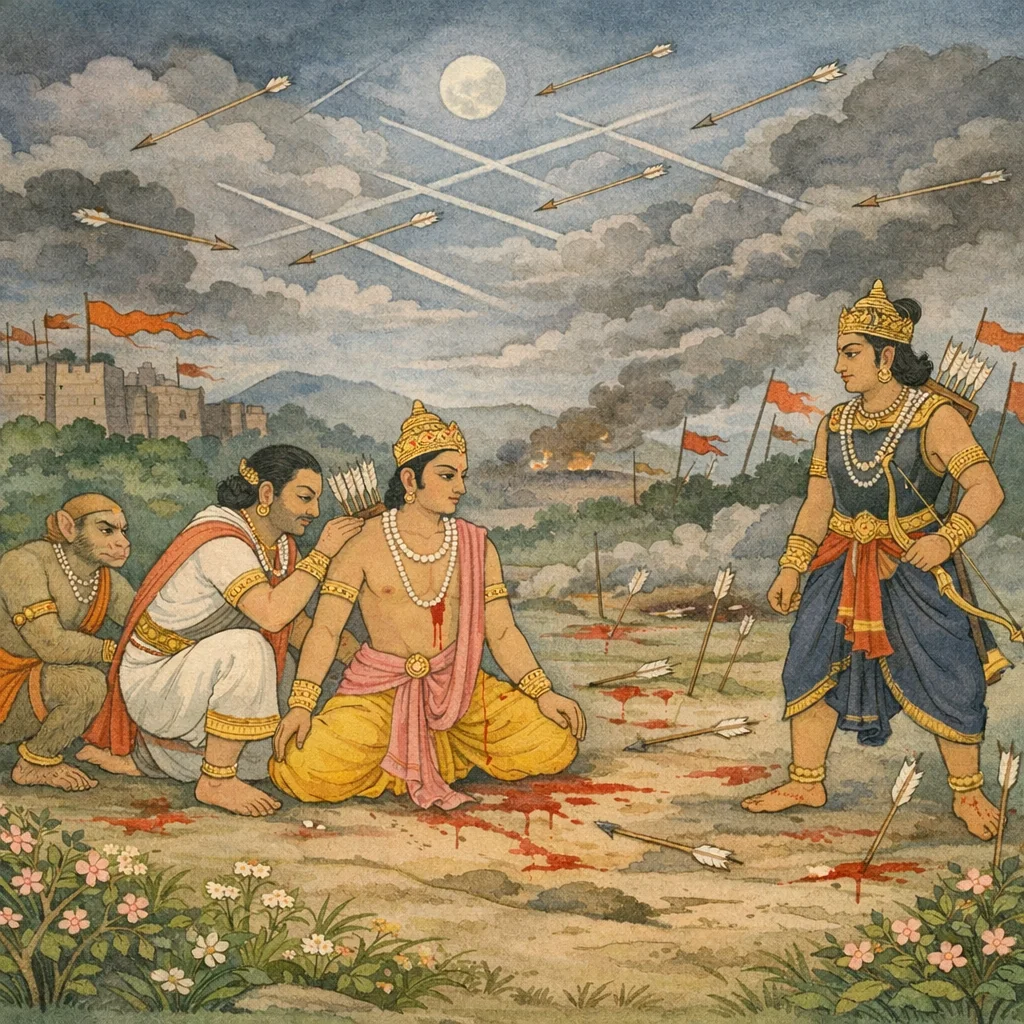
Sarga 89 intensifies the Lakṣmaṇa–Indrajit duel through alternating phases of taunt (vāk-yuddha) and projectile combat (śara-yuddha). Lakṣmaṇa initiates with anger-controlled precision, his bowstring’s report unsettling the rākṣasa leader, while Vibhīṣaṇa interprets Indrajit’s pallor as a psychological breach. Indrajit responds with provocative recollections of earlier battlefield incapacitation, challenging Lakṣmaṇa’s memory and daring him toward “Yama’s abode.” The encounter escalates into reciprocal barrages: Lakṣmaṇa rains arrows; Indrajit pierces Lakṣmaṇa, Hanumān, and Vibhīṣaṇa; both shields and standards are shattered. The narration emphasizes endurance—neither warrior withdraws nor shows fatigue—while the sky becomes a lattice of arrows, compared to dissolution-time clouds. Graphic yet stylized imagery (blood like waterfalls, bodies shining like blossoming trees) frames a technical lesson in martial steadiness: composure, accuracy, and refusal to concede psychological advantage. The sarga closes with Vibhīṣaṇa stepping in to support the invincible Lakṣmaṇa, signaling allied duty and battlefield care.
Shlokas
Verse 1
ततश्शरान् दाशरथिस्सन्धायामित्रकर्शणः ।ससर्जराक्षसेन्द्रायकृद्धस्सर्पइवश्वसन् ।।6.89.1।।
Thereupon Lakṣmaṇa, Daśaratha’s son and a scourge of enemies, set his arrows and discharged them at the lord of the Rākṣasas—seething like a serpent as he hissed with wrath.
Verse 2
तस्यज्यातलनिर्घोषं स श्रुत्वाराक्षसाधिपः ।विवर्णवदनोभूत्वालक्ष्मणंसमुदैक्षत ।।6.89.2।।
Hearing the sharp twang of Lakṣmaṇa’s bowstring, the lord of the rākṣasas turned pale and fixed his gaze upon Lakṣmaṇa.
Verse 3
विषण्णवदनंदृष्टवाराक्षसंरावणात्मजे ।सौमित्रिंयुद्धसंयुक्तंप्रत्युवाचविभीषणः ।।6.89.3।।
Seeing Rāvaṇa’s son among the rākṣasas, his face fallen and dispirited, Vibhīṣaṇa addressed Saumitrī (Lakṣmaṇa), who stood fully engaged and ready for battle.
Verse 4
निमित्तान्युपपश्यामियान्यस्मिन् रावणात्मजे ।त्वरतेनमहाबाहोभग्नएष न संशयः ।।6.89.4।।
I observe ominous signs in this son of Rāvaṇa; he is faltering. O mighty-armed one, he is broken in spirit—there is no doubt.
Verse 5
ततस्सन्धायसौमित्रिश्शरानग्निशिखोपमान् ।मुमोचनिशितांस्तस्मिन् सर्पानिवमहाविषान् ।।6.89.5।।
Then Saumitri (Lakṣmaṇa), setting arrows like tongues of fire upon his bow, released them at him—keen and deadly, like great-venomed serpents.
Verse 6
शक्राशनिसमस्पर्शैर्लक्ष्मणेनाहतश्शरैः ।मुहूर्तमभवन्मूक्षःसर्वसंक्षुभितेन्द्रियः ।।6.89.6।।
Struck by Lakṣmaṇa’s arrows—touching like Indra’s thunderbolt—he was stunned for a moment, all his senses thrown into turmoil.
Verse 7
उपलभ्यमुहूर्तेनसंज्ञांप्रत्यागतेन्द्रियः ।ददर्शावस्थितंवीरंवीरोदशरथात्मजम् ।।6.89.7।।
Regaining consciousness in a short while, his senses restored, that hero beheld the steadfast hero—Daśaratha’s son—standing firm.
Verse 8
सोऽभिचक्रामसौमित्रिंरोषात्संरक्तलोचनः ।अब्रवीच्चैनमासाद्यपुनस्सपरुषंवचः ।।6.89.8।।
With eyes reddened in anger, he advanced toward Saumitri; approaching him again, he spoke harsh words.
Verse 9
किं न स्मरसितद्युद्धेप्रथमेमत्पराक्रमम् ।निबद्धस्त्वंसहभ्रात्रायदाभुविविचेष्टसे ।।6.89.9।।
Do you not recall my prowess in the first battle—when you and your brother, bound by me, lay writhing upon the ground?
Verse 10
युवांखलुमहायुद्धेशक्रानिसमैश्शरैः ।शायितौप्रथमंभूमौविसंज्ञौसपुरस्सरौ ।।6.89.10।।
“Indeed, in that great battle earlier, you two were the first to be laid upon the ground, senseless, struck by my arrows—like Indra’s thunderbolt.”
Verse 11
स्मृतिर्वानास्तितेमन्येव्यक्तंवायमसादनम् ।गन्तुमिच्छसियस्मात्त्वमंधर्षयितुमिच्छसि ।।6.89.11।।
I think you have either lost your sense and memory—or else you clearly wish to go to Yama’s abode—since you desire to challenge me.
Verse 12
यदितेप्रथमेयुद्धे न दृष्टोमत्पराक्रमः ।अद्यतेदर्शयिष्यामितिष्ठेदानींव्यवस्थितः ।।6.89.12।।
If in our first encounter you did not witness my prowess, today I shall show it to you—stand firm now, ready for battle.
Verse 13
इत्युक्त्वासप्तभिर्भाणैरभिविव्याथलक्ष्मणम् ।दशभिस्तुहनूमन्तंतीक्ष्णधाश्शरोत्तमैः ।।6.89.13।।
Having spoken thus, he struck Lakṣmaṇa with seven arrows, and Hanūmān with ten—keen-edged shafts of the finest kind.
Verse 14
ततःशरशतेनैवसुप्रयुक्तेनवीर्यवान् ।क्रोथाव्दिगुणसम्रब्धोनिर्बिभेदविभीषणम् ।।6.89.14।।
Then the mighty one, his fury doubled, struck Vibhīṣaṇa with a full hundred arrows, well-aimed and forcefully loosed.
Verse 15
तद्दष्टवेन्द्रजिताकर्मकृतंरामानुजस्तदा ।अचिन्तयित्वाप्रहसन्नैतत्किञ्चिदितिब्रुवन् ।।6.89.15।।मुमोच च शरान् घोरान् सम्गृह्यनरपुङ्गवः ।अभीतवदनःक्रुद्धोरावणिंलक्ष्मणोयुधि ।।6.89.16।।
Seeing the deed done by Indrajit, Rāma’s younger brother paid it no heed; smiling, he said, “This is nothing.” Then Lakṣmaṇa—the best of men—his face unafraid and his anger kindled in battle, took up dreadful arrows and released them at Rāvaṇa’s son.
Verse 16
तद्दष्टवेन्द्रजिताकर्मकृतंरामानुजस्तदा ।अचिन्तयित्वाप्रहसन्नैतत्किञ्चिदितिब्रुवन् ।।6.89.15।।मुमोच च शरान् घोरान् सम्गृह्यनरपुङ्गवः ।अभीतवदनःक्रुद्धोरावणिंलक्ष्मणोयुधि ।।6.89.16।।
Seeing the deed done by Indrajit, Rāma’s younger brother paid it no heed; smiling, he said, “This is nothing.” Then Lakṣmaṇa—the best of men—his face unafraid and his anger kindled in battle, took up dreadful arrows and released them at Rāvaṇa’s son.
Verse 17
नैवंरणगताःशूराःप्रहरन्तिनिशाचर ।लघवश्चाल्पवीर्याश्चशरासुखास्तवहीमे ।।6.89.17।।
O night-roamer, true heroes engaged in war do not strike in such a manner. These arrows of yours are light and of little force—indeed, they feel almost pleasant.
Verse 18
नैवंशूरास्तुयुध्यन्तेसमरेजयकाङ्क्षिणः ।इत्येवंतंब्रुवाणस्तुधन्वीशरैरभिववर्ष ह ।।6.89.18।।
“Heroes who seek victory do not fight like this in battle.” Saying so, the bowman showered him with a rain of arrows.
Verse 19
स्यबाणैस्सुविध्वस्तंकवचंकाञ्चनंमहत् ।व्यशीर्यतरथोपस्थेताराजालमिव्बारात् ।।6.89.19।।
Shattered by his arrows, the great golden armor fell apart and dropped onto the chariot-floor, like a cluster of stars falling from the sky.
Verse 20
विधूतवर्मानाराचैर्भभूव स कृतव्रणः ।इन्द्रजित्समरेवीरःप्रत्यूषेभानुमानिव ।।6.89.20।।
With his armour and shield shattered by iron arrows, Indrajit—wounded in battle—stood forth like the sun at dawn, blazing amid the blood and dust of combat.
Verse 21
ततःशरसहस्रेणसङ्क्रुद्धोरावणात्मजः ।बिभेदसमरेवीरोलक्ष्मणंभीमविक्रमः ।।6.89.21।।
Then Ravana’s son, enraged and terrible in prowess, struck Lakṣmaṇa in the battle with a thousand arrows, piercing him again and again.
Verse 22
व्यशीर्यतमहद्धिव्यंकवचंलक्ष्मणस्य च ।कृतप्रतिकृतान्योन्यंबभूवतुरभिद्रुतौ ।।6.89.22।।
Lakṣmaṇa’s great and splendid armour too was shattered; and the two, rushing at one another, traded blow for blow—offense answered immediately by counter-offense.
Verse 23
अभीक्ष्णंनिश्श्वसन्तौतौयुध्येतांतुमुलंयुधि ।शरसङ्कृत्तसर्वाङ्गौसर्वतोरुधिरोक्षितौ ।।6.89.23।।
Breathing hard again and again, the two fought fiercely in the war—limbs cut by arrows, their bodies drenched with blood on every side.
Verse 24
सुदीर्घकालंतौवीरावन्योन्यनिशितैःशरैः ।ततक्षतुर्महात्मानौरणकर्मविहारदौ ।।6.89.24।।
For a very long time those two heroes—great-souled and skilled in the arts of war—tore at one another with sharp arrows.
Verse 25
बभूवतुश्चात्मजयेयत्तौभीमपराक्रमौ ।तौशरौघैस्तदाकीर्णौनिकृत्तकवचध्वजौ ।।6.89.25।।सृजन्तौरुधिरंचोष्णंजलंप्रस्रवणाविव ।
Both, of dreadful prowess and intent on victory, pressed on; covered then with torrents of arrows, their armour and standards cut down, they poured forth hot blood like streams of water rushing from mountain springs.
Verse 26
शरवर्षंततोघोरंमुञ्चतोर्भीमनिःस्वनम् ।।6.89.26।।सासारयोरिवाकाशेनीलयोःकालमेघयोः ।तयोरथमहान्कालोव्यत्ययाद्युध्यमानयोः ।।6.89.27।।न च तौयुद्धवैमुख्यंश्रमंवाप्युपजग्मतुः ।
Then from the bows of the two came a dreadful rain of arrows with a terrifying roar—like dark storm-clouds in the sky pouring down at the world’s end.
Verse 27
शरवर्षंततोघोरंमुञ्चतोर्भीमनिःस्वनम् ।।6.89.26।।सासारयोरिवाकाशेनीलयोःकालमेघयोः ।तयोरथमहान्कालोव्यत्ययाद्युध्यमानयोः ।।6.89.27।।न च तौयुद्धवैमुख्यंश्रमंवाप्युपजग्मतुः ।
As they fought on, a long time passed; yet neither of the two turned away from the battle, nor did either succumb to fatigue.
Verse 28
अस्त्राण्यस्त्रविदांश्रेष्ठौदर्शयन्तौपुनःपुनः ।।6.89.28।।शरानुच्छावचाकारानन्तरिक्षेबबन्धतुः ।
Those two best of weapon-knowers repeatedly displayed their missile-skills, weaving in the open sky a net of arrows of many kinds and forms.
Verse 29
न्यपेतदोषमस्यन्तौलघुचित्रं च सुष्ठु च ।।6.89.29।।उभौतुतुमुलंघोरंचक्रतुर्नरराक्षसौ ।
The man and the rākṣasa both shot without a single misfire—swiftly, brilliantly, and with great precision—making the battle tumultuous and dreadful.
Verse 30
तयोःपृथक् पृथभगीमश्शुश्रुवेतलनिस्स्वनः ।।6.89.30।।प्रकम्पयन्जनंघोरोनिर्घातइवदारुणः ।
From the two combatants, separately and distinctly, there was heard a fearsome sound like the clap/impact of palms—grim and crushing, like a violent thunderclap, shaking the gathered host.
Verse 31
सतयोःभ्राजतेशब्दस्तदासमरयत्तयोः ।।6.89.31।।सुघोरयोर्निष्टनतोर्गगनेमेघयोरिव ।
As the two fought on, that resounding roar blazed forth—like the deep rumbling of two ominous clouds reverberating across the sky.
Verse 32
सुवर्णपुङ्खैर्नाराचैर्बलवन्तौकृतव्रणौ ।।6.89.32।।प्रसुस्रुवातेरुधिरंकीर्तिमन्तौजयेधृतौ ।
Wounded by nārāca arrows with golden fletching, the two mighty, fame-bearing heroes—fixed on victory—began to bleed profusely.
Verse 33
तेगात्रयोर्निपतितारुक्मपुङ्खाःशरायुधि ।।6.89.33।।असृदगिग्धाविनिष्पेतुर्विविशुर्धरणीतलम् ।
In the battle, those gold-fletched arrows fell upon their limbs; smeared with blood, they slipped out again and bored into the surface of the earth.
Verse 34
अन्येसुनिशितैश्शस्त्रैराकाशेसञ्जघट्टिरे ।।6.89.34।।बभञ्जुश्चिच्छिदुश्चैवतयोर्बाणाःसहस्रशः ।
Meanwhile, thousands of other arrows from the two met and collided in the sky with razor-sharp weapons—shattering and splitting apart.
Verse 35
सबभूवरणेघोरस्तयोर्बाणमयश्चयः ।।6.89.35।।अग्निभ्यामिवदीप्ताभ्यांसत्रेकुशमयश्चयः ।
In that battle there arose a dreadful heap and spread of arrows between the two—appearing to the eyes like a mass of kuśa grass lit up by twin blazing fires in a sacrificial ground.
Verse 36
तयोःकृतव्रणौदेहौशुशुभातेमहात्मनोः ।।6.89.36।।सुपुष्पाविवनिष्पत्रौवनेशाल्मलिकिंशुकौ ।
The wounded bodies of those two great warriors shone—like the śālmali and kiṃśuka trees in a forest, heavy with blossoms yet stripped of leaves.
Verse 37
चक्रतुस्तुमुलंघोरंसन्निपातंमुहुर्मुहुः ।।6.89.37।।इन्द्रजिल्लक्ष्मणश्चैवपरस्परवधैषिणौ ।
Again and again, Indrajit and Lakṣmaṇa—each intent on the other’s downfall—brought about a tumultuous and dreadful clash in battle.
Verse 38
लक्ष्मणोरावणिंयुद्धेरावणिश्चापिलक्ष्मणम् ।।6.89.38।।अन्योन्यंतावभिघ्नन्तौ न श्रमंप्रतिपद्यताम् ।
In the battle Lakṣmaṇa struck at Rāvaṇi, and Rāvaṇi likewise struck at Lakṣmaṇa; as they assailed each other, neither of the two gave way to fatigue.
Verse 39
बाणजालैश्शरीरस्थैरवगाढैस्तरस्विनौ ।।6.89.39।।शुशुभातेमहावीर्यौप्ररूढाविवपर्वतौ ।
Those two swift, mighty heroes—pierced deep by a net of arrows lodged in their bodies—still shone, like mountains thickly overgrown with trees.
Verse 40
तयोरुधिरसिक्तानिसम्वृतान्तिशरैर्भृशम् ।।6.89.40।।बभ्राजुःसर्वगात्राणिज्वलन्तइवपावकाः ।
Both their bodies, drenched in blood and thickly covered with arrows, blazed with a terrible brilliance—like flames of fire.
Verse 41
तयोरथमहान् कालोव्यतीयाद्युध्यमानयोः ।।6.89.41।।न च तौयुद्धवैमुख्यंश्रमंवाप्युपजग्मतुः ।
A long time passed as those two fought; yet neither turned away from the battle, nor did they succumb to fatigue.
Verse 42
Then the great-souled Vibhīṣaṇa, seeking the welfare of Lakṣmaṇa—invincible at the forefront of battle—came to the battlefield to relieve him of combat-weariness, and stood there.
Frequently Asked Questions
The pivotal action is psychological warfare within dharmic combat: Indrajit attempts to destabilize Lakṣmaṇa through memory-taunts and threats of death, while Lakṣmaṇa rejects fear, critiques improper striking, and responds with disciplined, targeted force rather than reckless rage.
The sarga teaches that true vīrya includes mental sovereignty: endurance under pain, refusal to concede moral or psychological ground, and sustained effort without fatigue or retreat—supported by loyal allies who act for one’s welfare in crisis.
No specific terrestrial landmark is foregrounded; instead, the ‘sky’ (antarikṣa/gagana) becomes the primary arena through networks of arrows and cloud similes, while ‘Yama’s abode’ functions as a cultural-religious reference point for mortality and warrior challenge.