Sarga 87
न्यग्रोध-प्रवेश-निवारणम् (Preventing Indrajit’s Banyan-Tree Rite) / Indrajit Confronts Vibhishana
युद्धकाण्ड
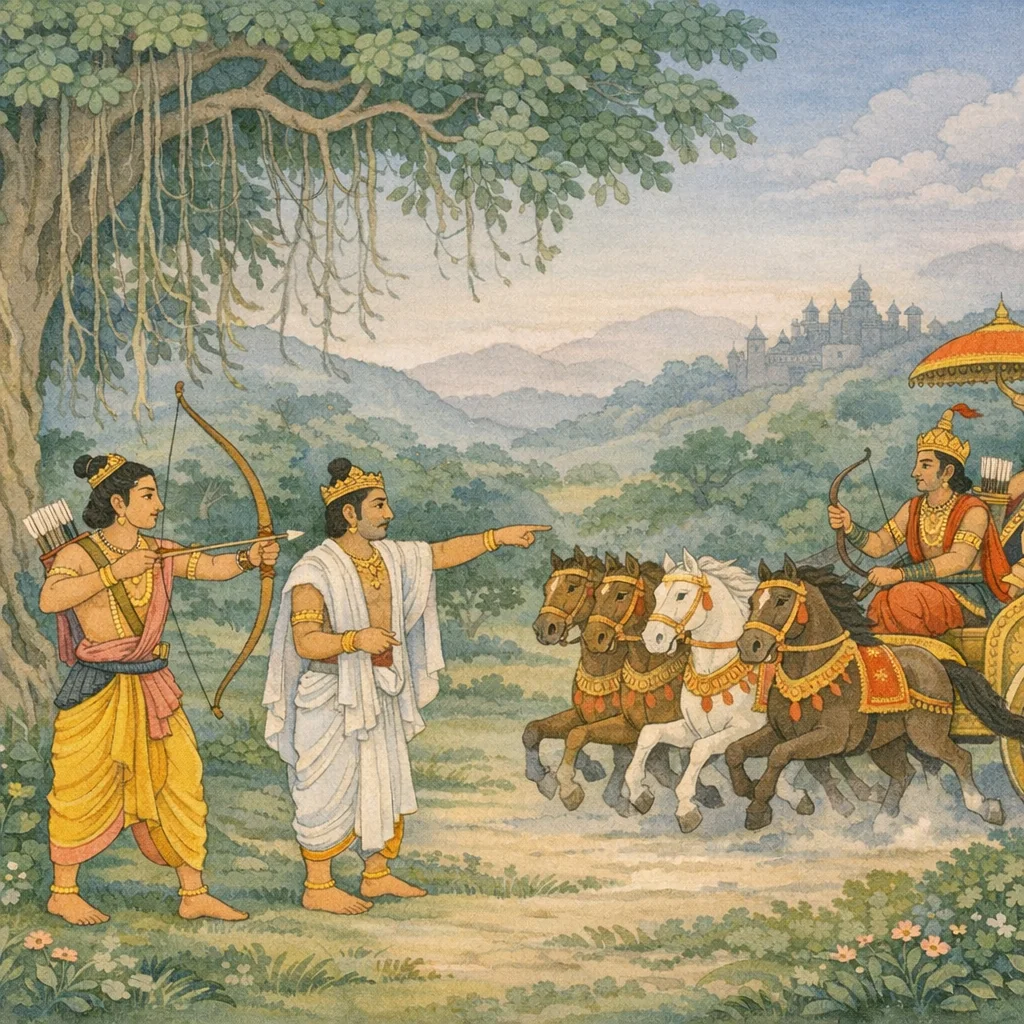
This sarga stages a tactical briefing, a moral dispute, and a doctrinal rebuttal within the war narrative. Vibhīṣaṇa, satisfied after instructing Lakṣmaṇa, leads him into a forested area and identifies a भयङ्कर (frightening) nyagrodha (banyan tree) resembling dark clouds. He explains that Indrajit, after making offerings, becomes invisible and gains lethal advantage; therefore Lakṣmaṇa must strike before Indrajit enters the nyagrodha, destroying his chariot, horses, and charioteer with flaming arrows. Lakṣmaṇa accepts and waits, bow twanged, as Indrajit appears in a radiant chariot and is challenged to direct combat. The scene then pivots to a harsh exchange: Indrajit rebukes Vibhīṣaṇa for abandoning kin and seeking refuge with ‘strangers,’ arguing loyalty to one’s own side even if flawed. Vibhīṣaṇa replies with a dharma-centered self-definition: though born among rākṣasas, he renounced cruel deeds and rejects adharmic association (likened to shaking off a venomous serpent or fleeing a burning house). He enumerates destructive faults—stealing, violating others’ spouses, distrust of friends, killing sages, hostility to deities, pride, anger, animosity—asserting these obscured Rāvaṇa’s prospects like rainclouds veiling mountains, and prophesies Laṅkā’s impending ruin. The chapter closes with Vibhīṣaṇa’s warning that Indrajit, bound by death’s noose, will not return alive after facing Lakṣmaṇa’s arrows.
Shlokas
Verse 1
एवमुक्त्वातुसौमित्रिंजातहर्षोविभीषणः ।धनुष्पाणिंनमादायत्वरमाणोजगामसः ।।6.87.1।।
Having spoken thus to Saumitrī, Vibhīṣaṇa—filled with glad resolve—quickly set out, taking him along, as Lakṣmaṇa stood ready with bow in hand.
Verse 2
अविदूरंततोगत्वाप्रविश्यतुमहद्वनम् ।दर्शमामासतत्कर्मलक्ष्मणातविभीषणः ।।6.87.2।।
Then, going a short distance and entering the great forest, Vibhīṣaṇa showed Lakṣmaṇa what action was to be done.
Verse 3
नीलजीमूतसङ्काशंन्यग्रोधंभीमदर्शनम् ।तेजस्वीरावणभ्रातालक्ष्मणायन्यवेदयत् ।।6.87.3।।
Vibhīṣaṇa—the radiant brother of Rāvaṇa—pointed out to Lakṣmaṇa a dreadful banyan tree, dark as a mass of rain-clouds.
Verse 4
इहोपहारंभूतानांबलवान्रावणात्मजः ।उपहृत्यततःपश्चात्सङ्ग्राममभिवर्तते ।।6.87.4।।
Here, the mighty son of Rāvaṇa, after presenting offerings to the spirits/beings, comes thereafter to the battlefield.
Verse 5
अदृश्टस्सर्वभूतानांततोभवतिराक्षसः ।निहन्तिसमरेशत्रून् बध्नाति च शरोत्तमैः ।।6.87.5।।
Thereafter that rākṣasa becomes invisible to all beings; in battle he slays enemies and also binds them fast with excellent arrows.
Verse 6
तमप्रविष्टंन्यग्रोधंबलिनंरावणात्मजम् ।विध्वंसयशरैर्दीप्टै: सरथंसाश्वसारथिम् ।।6.87.6।।
Before he can enter the banyan, destroy that powerful son of Rāvaṇa with blazing arrows—along with his chariot, horses, and charioteer.
Verse 7
तथेत्युक्त्वामहातेजास्सौमित्रिर्मित्रनन्दनः ।बभूवावस्थितस्तत्रचित्रंविस्फारयन्? धनुः ।।6.87.7।।
Saying, “So be it,” the mighty and radiant Saumitrī—delight of his allies—stood firm there, twanging his splendid bow.
Verse 8
स रथेनाग्निवर्णेनबलवान्रावणात्मजः ।इन्द्रजित्कवचीखङ्गीसध्वजःप्रत्यदृश्यत ।।6.87.8।।
Rāvaṇa’s son Indrajit—mighty in strength—came into view, standing in a chariot glowing like fire, armed with armor and sword, and bearing a bannered standard.
Verse 9
तमुवाचमहातेजाःपौलस्त्यमपराजितम् ।समह्वयेत्वांसमरेसम्यग्युद्धंप्रयच्छमे ।।6.87.9।।
Then Lakṣmaṇa, radiant with great energy, addressed that undefeated scion of the Paulastya line: “I challenge you in battle—grant me a fair, face-to-face fight.”
Verse 10
एवमुक्तोमहातेजामनस्वीरावणात्मजः ।अब्रवीत्परुषंवाक्यंतत्रदृष्टवाविभीषणम् ।।6.87.10।।
Thus addressed, the high-splendored and resolute son of Rāvaṇa, seeing Vibhīṣaṇa there, spoke harsh words to him.
Verse 11
इहत्वंजातसम्वृद्धःसाक्षाद्भ्रातापितुर्मम ।कथंद्रुह्यसिपुत्रस्यपितृव्योममराक्षस ।।6.87.11।।
“Here you were born and raised; you are in truth my father’s own brother. How, then, O rākṣasa, can you bear hostility toward your nephew—toward me, his son?”
Verse 12
न ज्ञातित्वं न सौहार्धं न जातिस्तवदुर्मते ।प्रमाणं न च सौदर्यं न धर्मोधर्मदूषण ।।6.87.12।।
“You wicked-minded one—corrupter of dharma—there is in you no regard for kinship, no affection, no loyalty to your lineage; you recognize no proper measure, no brotherly bond, no righteousness at all.”
Verse 13
शोच्यस्त्वमसिदुर्बुद्धेनिन्दनीयश्चसाधुभिः ।यस्त्वंस्वजनमुत्सृज्यपरभृत्यत्वमागतः ।।6.87.13।।
“You are to be pitied, O foolish-minded one—and condemned by the good—for you have cast off your own people and come to serve another.”
Verse 14
नैतछचिथिलयाबुद्ध्यात्वंवेसतिमहदन्तरम् ।क्व च स्वजनसम्वासःक्व च नीचपराश्रयः ।।6.87.14।।
“With your slackened judgment you do not grasp the great difference: what is life among one’s own, and what is taking shelter with outsiders of low repute.”
Verse 15
गुणवान्वापरजनःस्वजनोनिर्गुणोऽपिवा ।निर्गुणःस्वजनःश्रेयान् यःपरःपरएवसः ।।6.87.15।।
“Even if outsiders are virtuous and one’s own are without merit, one’s own—though flawed—are preferable; for whoever is ‘other’ remains other still.”
Verse 16
यसस्स्वपक्षंपरित्यज्यपरपक्षंनिषेवते ।स स्वपक्षेक्ष्यंप्राप्तेपश्चास्त्तैरेवहन्यते ।।6.87.16।।
“Whoever abandons his own side and attaches himself to the other side—when ruin comes upon his former party, he is afterward destroyed by those very people whose side he sought.”
Verse 17
निरनुक्रोशताचेयंयादृशीतेनिशाचर ।स्वजनेनत्वयाशक्यंपौरुषंरावणानुज ।।6.87.17।।
O night-roamer, Ravana’s brother! This is the sort of ruthlessness you display; such ‘heroism’ is possible only when turned against one’s own people.
Verse 18
इत्युक्तोभ्रातृपुत्रेणप्रत्युवाचविभीषणः ।अजानन्निवमछचीलंकिंराक्षसविकत्थसे ।।6.87.18।।
Thus addressed by his brother’s son, Vibhīṣaṇa replied: “O Rākṣasa, why do you boast as though you did not know my true nature?”
Verse 19
राक्षसेन्द्रसुतासाधोपारुष्यंत्यजगौरवात् ।कुलेयद्यप्यहंजातोरक्षसांक्रूरकर्मणाम् ।।6.87.19।।गुणोयःप्रथमोनृणंतन्मेशीलमराक्षसम् ।
O wicked son of the rākṣasa-king, abandon this harshness out of regard for what is honorable. Though I was born in a clan of rākṣasas known for cruel deeds, I have taken as my foremost human virtue what is right; therefore my character is not rākṣasa-like.
Verse 20
न रमेदारुणेनाहं न चाधर्मेणवैरमे ।।6.87.20।।भ्रात्राविषशीलोऽपिकथंभ्रातानिरस्यते ।
I do not take pleasure in cruelty, nor do I delight in unrighteousness. Even if a brother is of hostile nature, how can one brother cast out another?
Verse 21
धर्मात्प्रच्युतशीलंहिपुरुषंपापनिश्चयम् ।।6.87.21।।त्यक्त्वासुखमवाप्नोतिहस्तादाशीविषंयथा ।
Indeed, by abandoning a man whose character has fallen away from dharma and who is resolved upon sin, one attains well-being—like shaking a venomous serpent off one’s hand.
Verse 22
परस्वहरणेयुक्तंपरदाराभिमर्शकम् ।।6.87.22।।त्याज्यमाहुर्दुरात्मानंवेश्मप्रज्वलितंयथा ।
One engaged in stealing others’ property and violating others’ wives—such an evil-minded person, they say, must be abandoned, like a house engulfed in flames.
Verse 23
परस्वानां च हरणंपरदाराभिमर्शनम् ।।6.87.23।।सुहृदामतिशङ्का च त्रयोदोषाःक्षयावहाः ।
Stealing others’ wealth, violating others’ wives, and excessive suspicion toward one’s friends—these three faults bring ruin.
Verse 24
महर्षीणांवधोघोरस्सर्वदेवैश्चविग्रहः ।।6.87.24।।अभिमानश्चदोषश्चवैरित्वंप्रतिकूलता ।एतेदोषाममभ्रातुर्जीवितैश्वर्यनाशनाः ।।6.87.25।।गुणान्प्रच्छादयामासुःपर्वतानिवतोयदाः ।
The dreadful killing of great sages, hostility even toward all the gods, arrogance and fault-finding, enmity and perversity—these vices have destroyed my brother’s life and sovereignty. They have covered over his good qualities, as rain-clouds conceal mountains.
Verse 25
महर्षीणांवधोघोरस्सर्वदेवैश्चविग्रहः ।।6.87.24।।अभिमानश्चदोषश्चवैरित्वंप्रतिकूलता ।एतेदोषाममभ्रातुर्जीवितैश्वर्यनाशनाः ।।6.87.25।।गुणान्प्रच्छादयामासुःपर्वतानिवतोयदाः ।
Pride, wrongdoing, enmity, and contrariness—these very faults are ruinous to my brother’s life and sovereignty.
Verse 26
दोषैरेतैःपरित्यक्तोमयाभ्रातापितातव ।।6.87.26।।नेयमस्तिपुरीलङ्का न च त्वं न च तेपिता ।
Because of these very faults, your father—who is my brother—has been renounced by me. Neither will this city of Laṅkā stand, nor will you, nor your father.
Verse 27
अतिमाननी च बालश्चदुर्विनीतश्चराक्षस ।बद्धस्त्वंकालपाशेनब्रूहिमांयद्यदिच्छसि ।।6.87.27।।
O rākṣasa—arrogant, childish, and ill-disciplined—you are bound by the noose of Death. Say to me whatever you wish.
Verse 28
अद्यतेव्यसनंप्राप्तंकिंमांत्वामिहवक्ष्यसि ।प्रवेष्टुं न त्वयाशक्यंन्यग्रोधंराक्षसाधम ।।6.87.28।।
Today calamity has come upon you—what will you say to me here? You will not be able to enter the banyan, O worst of rākṣasas.
Verse 29
धर्षयित्वा च काकुत्स्थं न शक्यंजीवितुंत्वया ।युध्यस्वनरदेवेनलक्ष्मणेनरणेसह ।।6.87.29।।हतस्त्वंदेवताकार्यंकरिष्यसियमक्षये ।
Having assailed a scion of the Kakutsthas, you cannot live. Fight in battle with Lakṣmaṇa, that godlike prince; once slain, you will serve the purposes of the gods in Yama’s abode.
Verse 30
Display your mustered strength and expend every weapon and missile you have; yet once you come within the range of Lakṣmaṇa’s arrows, you will not depart alive today—nor with your forces.
Frequently Asked Questions
The dilemma is whether allegiance to one’s clan overrides moral law: Indrajit condemns Vibhīṣaṇa for leaving his kin, while Vibhīṣaṇa frames departure as a necessary rejection of adharmic leadership and cruel conduct.
Vibhīṣaṇa teaches that righteousness is prior to birth-group identity: association with the unrighteous should be abandoned (like casting off a venomous serpent or escaping a burning house), and destructive vices inevitably eclipse merit and bring ruin.
The nyagrodha (banyan tree) in a great forest functions as a tactical landmark tied to Indrajit’s ritualized advantage (offerings leading to invisibility), and Laṅkā is invoked as the threatened political center whose fate is linked to Rāvaṇa’s faults.