Sarga 86
इन्द्रजितः कर्माननुष्ठानात् उत्थाय हनूमन्तं प्रति प्रस्थानम् / Indrajit Abandons the Unfinished Rite and Moves Against Hanuman
युद्धकाण्ड
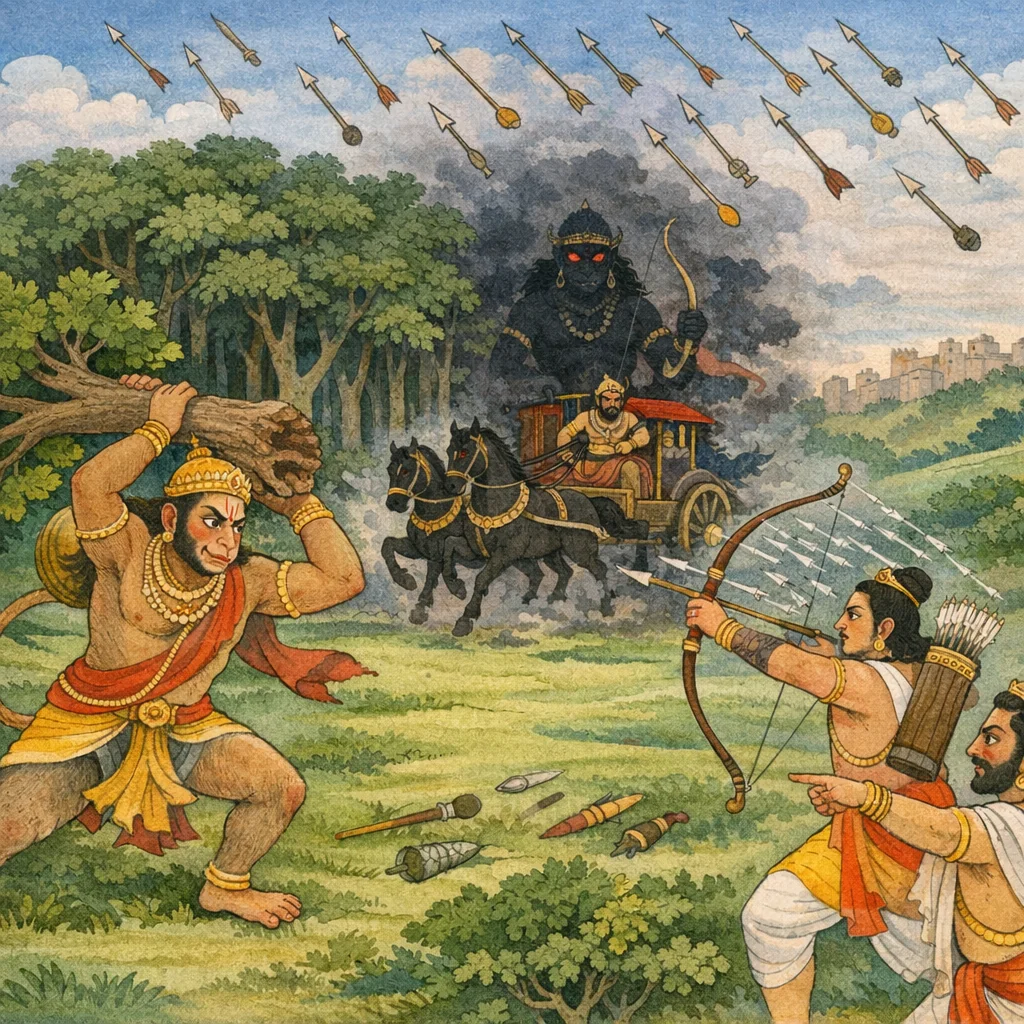
Sarga 86 pivots from counsel to kinetic battle. Vibhīṣaṇa (Rāvaṇa’s brother) issues task-oriented advice to Lakṣmaṇa: rapidly break the cloud-dark rākṣasa host so that Rāvaṇa’s son (Indrajit) becomes visible and can be struck before completing his ritual act. A fierce mêlée follows, with the sky metaphorically “covered” by thrown weapons—arrows, trees, and even mountain-peaks—while bears and vanaras press the assault using natural weapons. Hearing the distress of his forces, Indrajit—described as difficult to overpower—rises without finishing the rite, emerges from wooded darkness, mounts his prepared chariot, and appears deathlike with storm-cloud radiance and red eyes. As rākṣasas surround Lakṣmaṇa, Hanūmān escalates the battle by wielding massive trees, burning through enemy ranks like dissolution-fire. Thousands of rākṣasas converge on Hanūmān with an exhaustive arsenal (tridents, swords, javelins, iron bars, axes, hammers, bhindipālas), prompting Indrajit to order his charioteer toward the vanara champion, whereupon missiles are rained down. Hanūmān receives the assault and issues a direct challenge, while Vibhīṣaṇa alerts Lakṣmaṇa to Indrajit’s intent and urges immediate lethal counteraction; Lakṣmaṇa, recognizing Indrajit on the chariot, begins an answering shower of arrows.
Shlokas
Verse 1
अथतस्यामवस्थायांलक्ष्मणंरावणानुजः ।परेषामहितंवाक्यमर्थसाधकमब्रवीत् ।।।।
Then, in that situation, Rāvaṇa’s younger brother addressed Lakṣmaṇa with words that would accomplish the purpose—words harmful to the enemy.
Verse 2
यदेतद्राक्षसानीकंमेघश्यामंविलोक्यते ।एतदायोध्यतांशीघ्रंकपिभिपादपायुधैः ।।।।
Seeing that rākṣasa host, dark like a cloud, let it be attacked at once—by the monkeys, wielding trees as their weapons.
Verse 3
अस्यानीकस्यमहतोभेदनेयतलक्ष्मण ।राक्षसेन्द्रसुतोऽप्यत्रभिन्नेदृश्योभविष्यति ।।।।
“Lakṣmaṇa, once this vast host is shattered, even the rākṣasa-king’s son here will be seen clearly when the formation breaks.”
Verse 4
सत्वमिन्द्राशनिप्रख्यैःशरैरवकिरन्परान् ।अभिद्रवाशुयावद्वैनैतत्कर्मसमाप्यते ।।।।
Hurry and assail him at once, showering the foe with arrows like Indra’s thunderbolt, before he can complete this stratagem.
Verse 5
ज हिवीरदुरात्मानंमायापरमधार्मिकम् ।रावणिंक्रूरकर्माणंसर्वलोकभयावहम् ।।।।
O hero, slay Rāvaṇi—evil-minded, devoted to deceit, unrighteous, cruel in deed, and a terror to all the worlds.
Verse 6
विभीषणवच्श्रुत्वालक्ष्मणश्शुभलक्षणः ।ववर्षशरवर्षाणिराक्षसेन्द्रसुतंप्रति ।।।।
Hearing Vibhīṣaṇa’s words, Lakṣmaṇa—marked with auspicious signs—poured down a rain of arrows against the son of the lord of Rākṣasas.
Verse 7
ऋक्षाःशाखामृगाश्चैवद्रुमद्रिनखयोधिनः ।अभ्यधावन्तसहितास्तदनीकमवस्थितम् ।।।।
Bears and monkeys together rushed upon that arrayed host, fighting with trees, rocks, and their claws as weapons.
Verse 8
राक्षसाश्चशितैर्भाणैरसिभिश्शक्तितोमरैः ।उद्यदैससम् वर्तन्तसमरेकपिसैन्यजिघांसवः ।।।।
The rākṣasas, intent on slaughtering the monkey-army, surged forward in battle—hurling sharp arrows and striking with swords, javelins, and lances.
Verse 9
स सम्प्रहारस्तुमुलःसञ्जज्ञेकपिरक्षसाम् ।शब्देनमहतालङ्कांनादयन्वैसमन्ततः ।।।।
Then a tumultuous clash erupted between monkeys and rākṣasas, and with its mighty roar Laṅkā resounded on every side.
Verse 10
शस्त्रश्चविविधाकारैश्शितैर्बाणैश्चपादपैः ।उद्यतैर्गिरिशृङ्गैश्चघोरैराकाशमावृतम् ।।।।
The sky was veiled by dreadful missiles—weapons of many kinds, sharp arrows, uprooted trees, and even lifted mountain-peaks hurled aloft.
Verse 11
तेराक्षसावानरेषुविकृताननबाहवः ।निवेशयन्तःशस्त्राणिचक्रुस्तेसुमहद्भयम् ।।।।
Those rākṣasas—hideous in face and limb—drove their weapons into the vānaras, and by that assault they caused immense fear among them.
Verse 12
तथैवसकलैर्वृक्षैर्गिरिशृङ्गैश्चवानराः ।अभिजघ्नुजघ्नुश्चसमरेराक्षसर्षभान् ।।।।
So too the vānara warriors, with whole trees and even mountain-peaks, struck down and battered the bull-like champions among the rākṣasas in the battle.
Verse 13
ऋक्षवानरमुख्यैश्चमहाकायैर्महाबलैः ।रक्षसांयुध्यमानानांमहद्भयमजायत ।।।।
As the great leaders among bears and vānara warriors—huge-bodied and immensely strong—fought on, a great fear arose among the battling rākṣasas.
Verse 14
स्वमनीकंविषण्णंतुश्रुत्वाशत्रुभिरर्दितम् ।उदतिष्ठतदुर्दर्षः स कर्मण्यननुष्ठिते ।।।।
Hearing that his own troops were in distress, harried by the enemy, the hard-to-overpower one rose—though the rite he had begun was still unfinished.
Verse 15
वृक्षान्धकारान्निर्गम्यजातक्रोधः स रावणिः ।आरुरोहरथंसज्जंपूर्वयुक्तंसुसंयतम् ।।।।
Rāvaṇi, anger newly kindled, emerged from the tree-darkness and mounted his ready chariot—already yoked and firmly secured.
Verse 16
स भीमकार्मुकधरःकालमेघसमप्रभ: ।रक्तास्यनयनोकृद्धोमभौमृत्युरिवान्तकः ।।।।
Bearing a dreadful bow, dark-glowing like a storm-cloud, with reddened eyes and face in fury, he shone forth like Death itself—the Ender.
Verse 17
दृष्टवैवतुरथस्थंतंपर्यवर्तततद्बलम् ।रक्षसांभीमवेगानांलक्ष्मणेनयुयुत्सताम् ।।।।
Seeing him stationed on his chariot, that rākṣasa force—terrible in speed—wheeled about and closed in around Lakṣmaṇa, who was eager to fight.
Verse 18
तस्मिन् कालेतुहनूमानुद्यम्यसुदुरासदम् ।धरणीधरसङ्काशोमहावृक्षमरिन्दमः ।।।।स राक्षसानांतत्सैन्यंकालाग्निरिवनिर्दहन् ।चकारबहुभिर्वक्षैर्निःसंज्ञंयुधिवानरः ।।।।
Just then Hanūmān—mountain-like, tamer of foes—hoisted a massive tree, hard to withstand; and in the fight he scorched that rākṣasa host like the fire of dissolution, striking many with trees until they fell senseless.
Verse 19
तस्मिन् कालेतुहनूमानुद्यम्यसुदुरासदम् ।धरणीधरसङ्काशोमहावृक्षमरिन्दमः ।।6.86.18।।स राक्षसानांतत्सैन्यंकालाग्निरिवनिर्दहन् ।चकारबहुभिर्वक्षैर्निःसंज्ञंयुधिवानरः ।।6.86.19।।
Just then Hanūmān—mountain-like, tamer of foes—hoisted a massive tree, hard to withstand; and in the fight he scorched that rākṣasa host like the fire of dissolution, striking many with trees until they fell senseless.
Verse 20
विध्वंसन्तंतरसादृष्टवैवपवनात्मजम् ।राक्षसानांसहस्राणिहनूमन्तमवाकिरन् ।।।।
Seeing the Wind-god’s son wreaking destruction with great speed, thousands of rākṣasas swarmed and surrounded Hanūmān.
Verse 21
शितशूलधराश्शूलैरसिभिश्चासिपाणयः ।शक्तिहस्ताश्चभिश्शक्तिपट्टसै: पट्टसायुधाः ।।।।परिघैश्चगदाभिश्चकुन्तैश्चशुभदर्शनैः ।शतशश्चशतघ्नीभिरायसैरपिमुद्गरैः ।।।।घोरैःपरशुभिश्चैवभिदनिपालैश्चराक्षसाः ।मुष्टिभिर्वज्रकल्पैश्चतलैरशनिसन्निभैः ।।।।अभिजघ्नुःसमासाद्यसमन्तात्पर्वतोपमम् ।तेषामपि च सङ्ग्रुद्धश्चकारकदनंमहत् ।।।।
The rākṣasas, bearing razor-edged tridents, with swords in their hands, and with javelins and spears as their weapons, closed in for combat.
Verse 22
शितशूलधराश्शूलैरसिभिश्चासिपाणयः ।शक्तिहस्ताश्चभिश्शक्तिपट्टसै: पट्टसायुधाः ।।6.86.21।।परिघैश्चगदाभिश्चकुन्तैश्चशुभदर्शनैः ।शतशश्चशतघ्नीभिरायसैरपिमुद्गरैः ।।6.86.22।।घोरैःपरशुभिश्चैवभिदनिपालैश्चराक्षसाः ।मुष्टिभिर्वज्रकल्पैश्चतलैरशनिसन्निभैः ।।6.86.23।।अभिजघ्नुःसमासाद्यसमन्तात्पर्वतोपमम् ।तेषामपि च सङ्ग्रुद्धश्चकारकदनंमहत् ।।6.86.24।।
They also fought with iron clubs and maces, with fine-looking spears, and by the hundreds with śataghnīs, iron weapons, and heavy mallets.
Verse 23
शितशूलधराश्शूलैरसिभिश्चासिपाणयः ।शक्तिहस्ताश्चभिश्शक्तिपट्टसै: पट्टसायुधाः ।।6.86.21।।परिघैश्चगदाभिश्चकुन्तैश्चशुभदर्शनैः ।शतशश्चशतघ्नीभिरायसैरपिमुद्गरैः ।।6.86.22।।घोरैःपरशुभिश्चैवभिदनिपालैश्चराक्षसाः ।मुष्टिभिर्वज्रकल्पैश्चतलैरशनिसन्निभैः ।।6.86.23।।अभिजघ्नुःसमासाद्यसमन्तात्पर्वतोपमम् ।तेषामपि च सङ्ग्रुद्धश्चकारकदनंमहत् ।।6.86.24।।
The rākṣasas struck with dreadful axes and bhindipālas, and even with fists like thunderbolts and with slaps that fell like lightning.
Verse 24
शितशूलधराश्शूलैरसिभिश्चासिपाणयः ।शक्तिहस्ताश्चभिश्शक्तिपट्टसै: पट्टसायुधाः ।।6.86.21।।परिघैश्चगदाभिश्चकुन्तैश्चशुभदर्शनैः ।शतशश्चशतघ्नीभिरायसैरपिमुद्गरैः ।।6.86.22।।घोरैःपरशुभिश्चैवभिदनिपालैश्चराक्षसाः ।मुष्टिभिर्वज्रकल्पैश्चतलैरशनिसन्निभैः ।।6.86.23।।अभिजघ्नुःसमासाद्यसमन्तात्पर्वतोपमम् ।तेषामपि च सङ्ग्रुद्धश्चकारकदनंमहत् ।।6.86.24।।
Closing in from every side, they struck the mountain-like hero; but he too, enraged, wrought great destruction among them.
Verse 25
स ददर्शकपिश्रेष्ठमचलोपममिन्द्रजित् ।सूदमानमसन्त्रस्तममित्रान् पवनात्मजम् ।।।।
Indrajit saw the best of monkeys—Hanumān, like an immovable mountain—slaying his foes without fear.
Verse 26
स सारथिमुवाचेदंयाहियत्रैषवानरः ।क्षयमेवहिनःकुर्याद्राक्षसामुपेक्षितः ।।।।
He said to his charioteer: “Drive to where that vānara is. If left unchecked, he will surely bring our rākṣasas to ruin.”
Verse 27
इत्युक्तस्सारथिस्तेनययौयत्र न मारुतिः ।वहन् परमदुर्धर्षंस्थितमिन्द्रजितंरथे ।।।।
Thus instructed, the charioteer drove the chariot to where Hanumān was, carrying Indrajit—most formidable—standing upon the car.
Verse 28
सोऽभ्युपेत्यशरान्खङ्गान्पट्टसासिपरश्वधान् ।अभ्यवर्षतदुर्धर्षःकपिमूर्थनिराक्षसः ।।।।
Drawing near, the rākṣasa—hard to withstand—poured down arrows, swords, spears, and axes upon the head of the monkey-warrior.
Verse 29
तानिशस्त्राणिघोराणिप्रतिगृह्य स मारुतिः ।रोषेणमहताविष्टोवाक्यंचेदमुवाच ह ।।।।
Hanumān bore those terrible weapons; then, seized by great wrath, he spoke these words.
Verse 30
युध्यस्वयदिशूरोऽसिरावणात्मजदुर्मते ।वायुपुत्रंसमासाद्य न जीवन् प्रतियास्यसि ।।।।
Fight—if you are truly a warrior, O evil-minded son of Rāvaṇa; once you have faced the Wind-god’s son, you will not return alive.
Verse 31
बाहुभ्यांसम्प्रतियुध्यस्वयदिमेद्वन्द्वमाहवे ।वेगंसहस्वदुर्बुद्धेततस्त्वंरक्षसांवरः ।।।।
If you desire a duel in battle, then fight me hand to hand. Endure my onrush, O wicked-minded one—then you may call yourself the foremost among the Rākṣasas.
Verse 32
हनूमन्तंजिघांसन्तंसमुद्यतशरासनम् ।रावणात्मजमाचष्टे लक्ष्मणाय विभीषण: ।।।।
Vibhīṣaṇa informed Lakṣmaṇa that the son of Rāvaṇa, bow raised and ready, was bent on killing Hanumān.
Verse 33
यस्सवासवनिर्जेतारावणस्यात्मसम्भवः ।स एषरथमास्थायहनूमन्तंजिघांसति ।।।।
He who conquered Vāsava (Indra), born of Rāvaṇa himself—he is now mounted on his chariot, seeking to slay Hanumān.
Verse 34
तमप्रतिमसंस्थानैश्शरैश्शत्रुनिवारणैः ।जीवितान्तकरैर्घोरैःसौमित्रेरावणिंजहि ।।।।
O Saumitri, strike down Rāvaṇi with dreadful arrows of unmatched make—enemy-stopping shafts that bring life to its end.
Verse 35
इत्येवमुक्तस्तुतदामहात्माविभीषणेनारिविभीषणेन ।ददर्शतंपर्वतसन्निकाशंरथस्थितंभीमबलंदुरासदम् ।।।।
Thus addressed then by Vibhīṣaṇa—terror to his foes—the great-souled Lakṣmaṇa beheld him: Indrajit, mountain-like, standing on his chariot, terrible in strength and hard to approach.
Frequently Asked Questions
The pivotal action is the injunction to strike Indrajit before his ritual task is completed, raising the wartime dharma question of timing: when decisive intervention is justified to prevent a greater threat and protect allied forces.
Counsel (upadeśa) must translate into prompt, proportionate action: discern the enemy’s enabling conditions (concealment, ritual power, morale) and remove them, while sustaining collective duty toward allies under crisis.
Lanka is the primary setting, with emphasis on battlefield atmosphere (sky filled with missiles) and wooded cover (“darkness of trees”) as a tactical landmark from which Indrajit emerges—signaling terrain’s role in epic warfare.